
Apple's 95% Vision Pro ad-spend cut preceded the layoffs
Apple's digital ad spending for Vision Pro fell more than 95% year over year in the US and UK, reported in January 2026 — months before the August Siri and Vision Pro layoffs that closed out the wind-down. This sourced case record shows media buyers how to read a named advertiser's spend-cut velocity as the early signal of a product exit, and why layoff headlines are late confirmation, not a new event.
- Platform
- Apple
- Change category
- Budget
- Effective date
- 0-01-02
- Change type
- Spend cut
- Impact level
- Low
More than 95%: that was the year-over-year reduction in Apple’s US and UK digital advertising for Vision Pro, based on Sensor Tower data in a paywalled Financial Times report accessed through MacRumors on January 2, 2026.[1]
The number appeared more than seven months before Apple cut jobs in the Vision Pro gaming and immersive-video teams on August 21. That order matters when assessing the impact of Apple’s Siri and AI layoffs on paid advertising. The observable advertising event was the budget contraction reported in January. The layoffs came later, alongside a broader reorganization, and did not create the spend decline.
This is also a third-party estimate, not a line from Apple’s accounts. Apple stopped separately disclosing its advertising expense after FY2016; its last reported figure was approximately $1.8 billion for 2015, as detailed in the site’s Apple budget-disclosure record. Sensor Tower’s geographically bounded estimate is therefore unusually useful, but it is not a substitute for Apple’s books or proof of what executives formally decided.
Last reviewed: August 27, 2026.
The dated sequence
| Date | Observed event | What the evidence supports |
|---|---|---|
| January 2, 2026 | Sensor Tower data reported via the FT showed Vision Pro digital advertising down more than 95% year over year in the US and UK.[1] | A severe, named contraction in Apple’s product-level advertising activity—not a companywide advertising total. |
| April 29, 2026 | The Vision Products Group was redistributed, according to a dated organizational timeline published by staffing firm KORE1.[2] | Organizational dispersal consistent with a wind-down. KORE1 is a commercially interested staffing source, not an Apple filing. |
| August 21, 2026 | Apple cut more than 200 roles across Vision Pro, Siri, and Intelligent Systems Experience, including Vision Pro gaming and immersive-video teams.[3][4] | Later employment-side confirmation that specific work was being reduced; not evidence that the layoffs caused January’s measured ad contraction. |
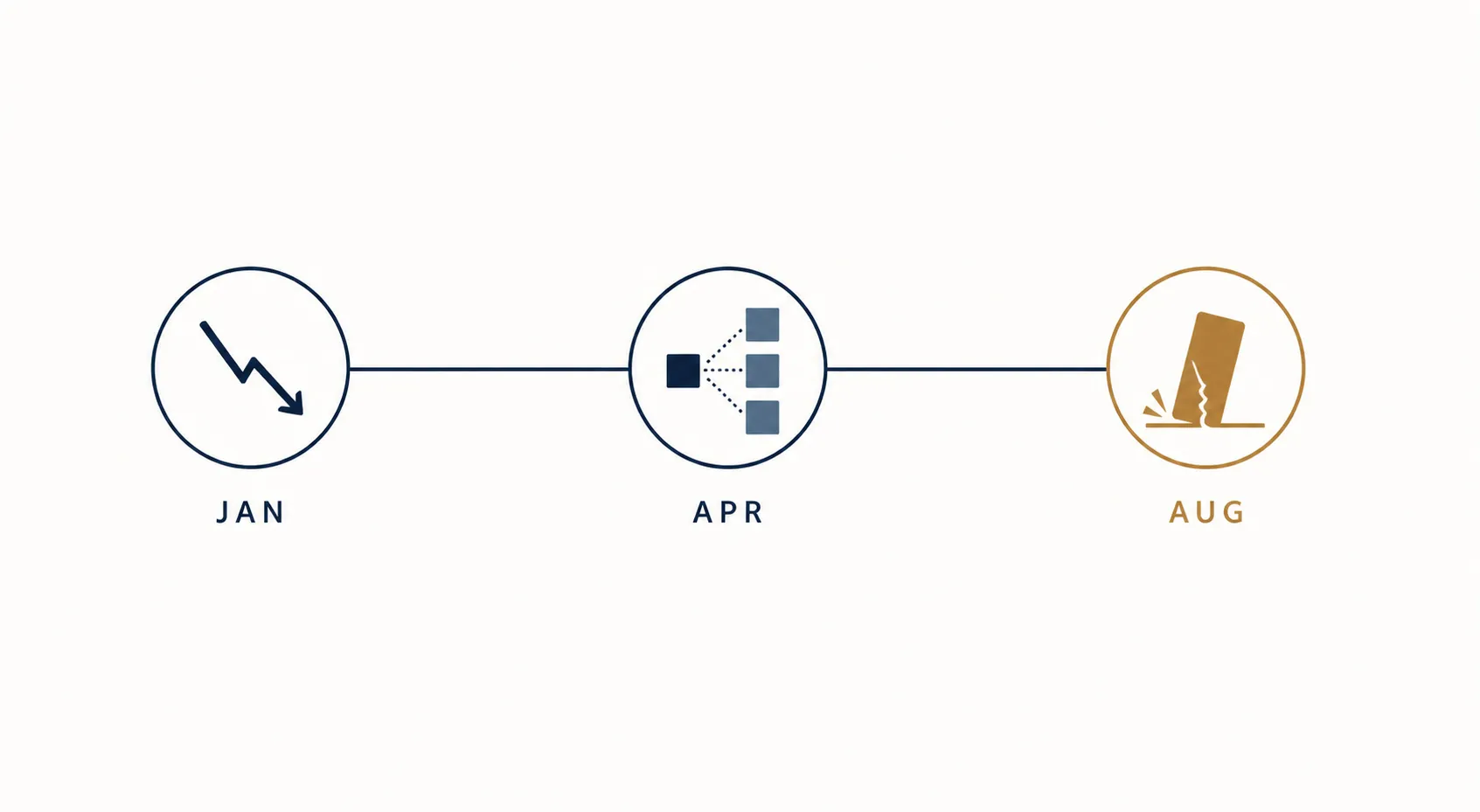
The timeline separates three records that can easily blur together in a breaking-news cycle. Sensor Tower observed media activity. The April entry describes organizational redistribution. The August reporting concerns employment. They point in the same direction, but none establishes that one event caused the next.
Why the contraction was visible first
A media budget can be reduced quickly. Teams, contracts, reporting lines, and product commitments usually take longer to unwind. Buyers therefore had an external sign of the Vision Pro pullback before Apple’s staffing decisions became public—not because advertising data predicts every layoff, but because a decline of this size is difficult to dismiss as routine pacing.
The velocity is more informative than the direction alone. A modest year-over-year decline can reflect seasonality, creative delays, channel substitution, inventory constraints, or a more efficient campaign. A reduction exceeding 95% across two named markets leaves a much narrower set of plausible operating explanations. It suggests that paid digital acquisition was no longer being funded at anything close to its previous level.
That still does not prove a complete product exit. Apple could retain support, sell existing hardware, redirect marketing to retail or owned channels, or prepare a different version while sharply reducing current-product promotion. The defensible conclusion is narrower: the measured US and UK digital campaign had entered a severe wind-down.
Demand made the spend decision less surprising
The advertising contraction sat beside a weak demand record. IDC data cited in the FT indicated that Apple shipped roughly 390,000 Vision Pro units during 2024 and was expected to ship about 45,000 in the fourth quarter of 2025. Luxshare, the assembler, reportedly halted production at the beginning of 2025.[1]
Those shipment figures cover different periods—one full year and one quarter—so they should not be converted into a direct percentage decline. Their value is contextual. They show why a major reduction in product advertising fits a wider pattern of limited demand and reduced operating activity.
Morgan Stanley analysts cited cost, form factor, and a shortage of native visionOS applications as barriers to broad adoption. Apple said approximately 3,000 native apps were available.[1] That is an adoption diagnosis, not an independent experiment proving which factor caused sales to miss expectations. It does, however, make a continued launch-scale media budget harder to justify.
The category offered little relief. Counterpoint Research recorded a 14% year-over-year decline in global VR headset shipments, while Meta held approximately 80% of VR sales and reportedly reduced its own VR marketing spend.[1] This wider slowdown cannot explain Apple’s precise budget decision, but it makes the Vision Pro pullback less likely to be an isolated media-planning anomaly.
How to read the same signal in an account
A buyer defending a Q4 reforecast needs more than a layoff headline. The useful task is to reconstruct the account’s own dated sequence before leadership treats the headline as a fresh market event.
- Compare like with like. Keep geography, channel, campaign objective, product, and seasonal window consistent. A blended company total can hide a product-level withdrawal.
- Measure the rate of contraction, not merely whether spend is down. Record when the decline began, how rapidly it deepened, and whether it persists after expected pacing or launch effects are removed.
- Check where the reduction appears. Brand video, search, app acquisition, retargeting, and retail support answer different operating questions. A cut concentrated in one channel does not establish a total marketing exit.
- Look for operational alignment. Shipment weakness, paused production, fewer launches, disappearing creative, reduced localization, and team redistribution can strengthen an interpretation when they occur in sequence.
- Treat subsequent restructuring as confirmation only when it matches the budget pattern already observed. Do not rewrite the account history as though the headline caused earlier auction behavior.
For example, if a product campaign contracts abruptly while the rest of an advertiser’s portfolio remains stable, the right response is to isolate that product and investigate the operating record. It is not to assume that all company spending, all competitors, or the auction itself will move in parallel.
The method is most useful as an escalation system rather than a universal forecasting rule. A severe decline should trigger review; it should not be automatically labeled an exit. Budgets can return, channels can change, and third-party tracking can miss activity. Confidence rises when several independent observations line up over time.
Apple as an advertiser is separate from Apple as an auction operator
Nothing in the Vision Pro spend record establishes a layoff-driven change to Apple Search Ads placements, pricing, defaults, reporting, or revenue. It also provides no measured effect on Google Ads inventory. Those are platform and inventory questions; the greater-than-95% figure measures Apple’s behavior as a product advertiser in the US and UK.
The separate Siri and Vision Pro layoffs tracker records the inventory-side finding: the reported cuts were placed in Siri, Vision Pro, and software teams rather than Apple’s advertising organization, while App Store and Apple Maps auction developments followed their own product timetable. Combining the records would turn coincidence into an unsupported causal claim.
September’s expected iOS 27 and Siri behavior remains a watch-item. TechCrunch reported that Gemini-powered Siri would answer some queries inline instead of sending users to the web.[5] That could matter for search referrals and intent capture, but as of August 27 it had not produced a measured advertising impact. The appropriate monitoring questions concern query behavior, referral volume, attribution, and auction demand after release; they are not conclusions that can be filled in before the data arrives. Related scenarios are tracked in the site’s iOS 27 attribution analysis and Safari tracking record.
For Vision Pro, the dated evidence ends more cleanly: budget withdrawal was visible first, organizational redistribution followed, and workforce cuts arrived later. The layoffs closed the sequence; they did not start it.
References
- Report: Apple Vision Pro Is Still Failing to Catch On — MacRumors, January 2, 2026
- Apple Layoffs 2026: Vision Pro Wind-Down & Hiring Impact — KORE1
- Apple Cuts Jobs in Siri, Vision Pro Immersive Video and Gaming Teams — Bloomberg, August 21, 2026
- Apple is reportedly cutting hundreds of jobs from Siri, Vision Pro teams — TechCrunch, August 21, 2026
- Apple finally fixed Siri, so why does it feel anticlimactic? — TechCrunch, August 3, 2026
Primary source: https://www.macrumors.com/2026/01/02/report-apple-vision-pro-is-still-failing-to-catch-on/