
Why Amazon's custom AI chips won't cut your ad costs
Amazon's custom AI chips cut its own compute costs, not advertiser CPCs: the savings flow into free AI tools, new AI placements, and more auction competition while third-party CPC benchmarks keep rising. The takeaway for advertisers is to verify AI performance claims independently instead of expecting an infrastructure discount.
- Platform
- Amazon Ads
- Change category
- creative
- Effective date
- 0-02
- Change type
- opt-in feature
- Impact level
- Medium
If you are asking what Amazon custom AI chips mean for advertisers, the direct Q3 2026 answer is uncomfortable but simple: Amazon’s chips can lower Amazon’s own AI compute cost, but there is no advertiser-facing evidence that those savings are flowing through as lower CPCs. In the same Q2 2026 window, Amazon’s advertising revenue was reported at $19.8 billion, up 26% year over year, while third-party Amazon Ads benchmarks put average CPC around $1.12 in 2025, up 15.5% year over year, with 2026 projections in the $1.18–$1.25 range.[1][2]
That CPC benchmark is not official Amazon data, and it is not a substitute for your own account history. It is still useful because it points in the opposite direction from the easy infrastructure story. The visible advertiser market is not behaving as if Amazon’s silicon savings have become an auction discount.
| What changed | What did not change | Advertiser consequence |
|---|---|---|
| Amazon has more custom silicon underneath AI workloads: Trainium, Inferentia, and Graviton. | Sponsored Products, sponsored prompts, and other placements still clear through competitive ad auctions. | Do not lower CPC assumptions just because Amazon’s compute stack is cheaper to run. |
| Amazon is offering more AI creative and workflow tools at no additional cost. | Free tooling does not make clicks free, nor does it guarantee incremental sales. | Expect easier creative production and more competitors able to enter more auctions. |
| Amazon is expanding AI-assisted shopping surfaces such as Rufus and Alexa for Shopping. | Early placement evidence is uneven and sometimes small at the account level. | Test new placements against CPC, CPA, ROAS, and incrementality rather than accepting platform lift claims. |
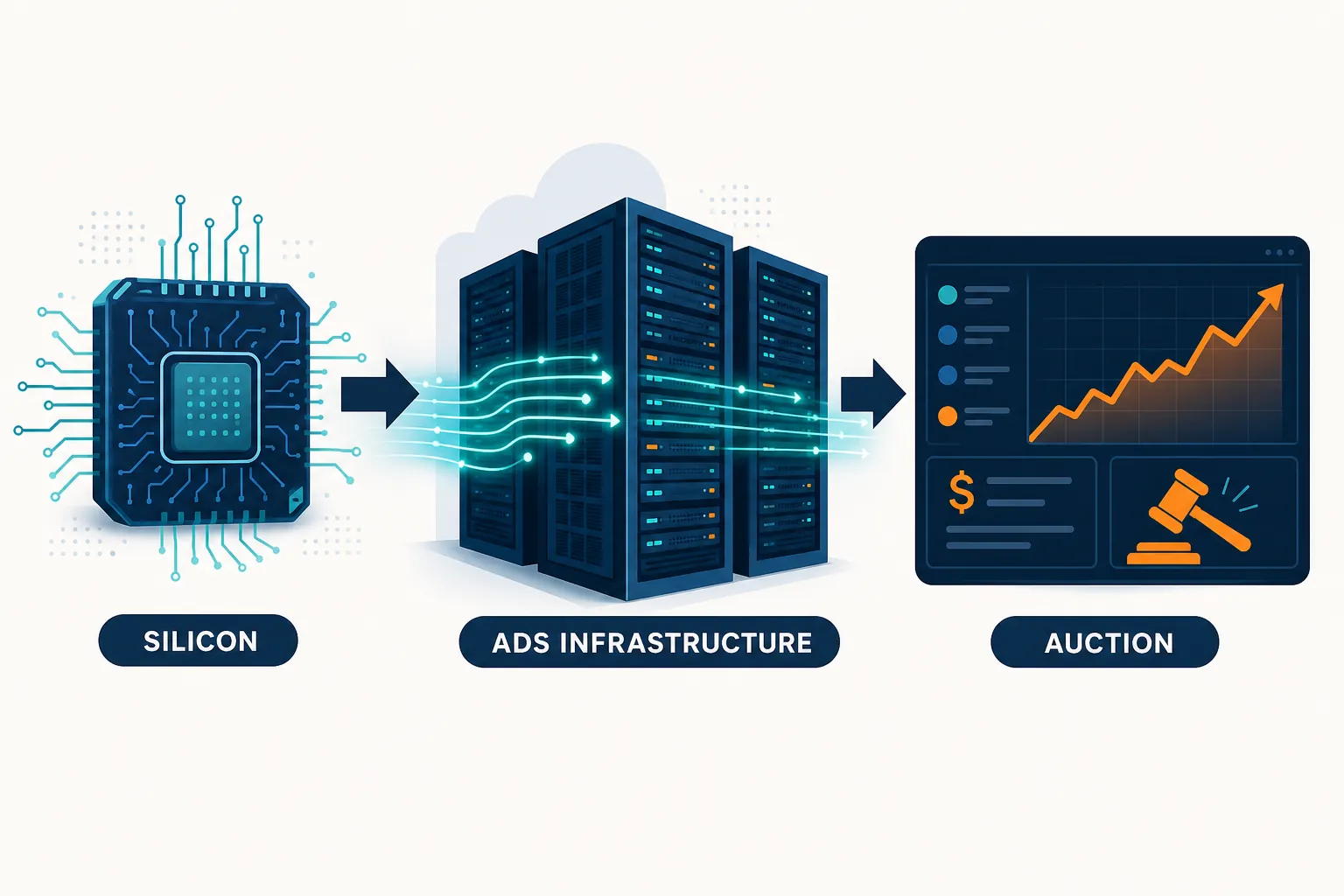
The chips matter, but they sit upstream of your bid
Amazon’s three chip names are not interchangeable. Trainium is for training and running large AI models, Inferentia is for lower-cost inference, and Graviton is Amazon’s Arm-based server processor family used across general cloud workloads.[3] The business relevance for advertisers is not the naming. It is where each chip can remove cost or latency before an ad request ever reaches an auction.
A clean example is Amazon’s own ad-verification work. AWS described Amazon Ads compiling BERT-based ad-verification models to AWS Inferentia, with latency down 30% and cost down 71% versus GPU endpoints.[4] That is a real operating-cost improvement inside the ad system. It helps Amazon run AI-heavy review and safety workflows more efficiently. It does not, by itself, change the second-price dynamics, advertiser density, keyword competition, retail-media budgets, or campaign goals that determine what a buyer pays for traffic.
Sponsored Products relevance is another place where infrastructure scale matters. AWS says Amazon Ads serves hundreds of millions of deep-learning requests per second for Sponsored Products relevance across 20 marketplaces.[5] If you have ever watched CPCs move during a crowded retail week, this is the part worth respecting: Amazon does need cheaper, faster machine learning just to keep the ad marketplace responsive. But a cheaper relevance engine is still Amazon’s cost advantage unless Amazon changes auction pricing, fee structure, or advertiser credits in a way buyers can actually see.
This is the same pattern tracked in Does ARM Infrastructure Savings Reduce Ad Tech Costs for Buyers?: infrastructure savings are real, but they are often absorbed before they become line-item savings for media buyers.
Amazon is building a cost and capacity moat, not an advertiser rebate program
Trainium3 makes the upstream point clearer. At re:Invent in December 2025, Amazon announced Trainium3 with claims of 4x the speed and roughly half the cost of Trainium2; the reported general-availability timing was March 2026.[6] Those are exactly the kinds of figures that should make Amazon’s AI roadmap cheaper to execute if the claims hold in production.
The Bedrock shift points the same way. GuruFocus, via Yahoo Finance, reported in October 2025 that AWS executive Julia White said more than half of Amazon Bedrock was running on Trainium.[7] That matters because Bedrock is one of the layers through which generative-AI tools and model access can be packaged for customers. It does not mean Bedrock users, Amazon Ads buyers, or sponsored-placement buyers automatically receive a pass-through discount.
External commitments are useful as seriousness checks, not as CPC evidence. Amazon said Meta expanded its AWS partnership using Graviton chips for AI in April 2026, and Tech Insider reported Uber commitments involving Trainium3 and Graviton4 that same month.[8][9] Those deals show Amazon has a market reason to keep pushing custom silicon. They do not prove anything about the price of a click on “protein powder,” “running shoes,” or “wireless earbuds.”
The Nvidia rivalry and the possible size of Amazon’s standalone chip business are adjacent context, not the spine of an advertiser forecast. Digital Applied has separately treated some chip-business and Trainium-commitment figures as reported or press-aggregated, not company-published numbers.[10] That distinction matters. A reported chip revenue opportunity can explain Amazon’s incentive to invest; it cannot be booked into a client’s media plan as lower CPC.
Where the savings actually show up: free tools, more surfaces, more participation
The advertiser-facing benefit is not nothing. It is just arriving in a different form. In February 2026, Amazon Ads launched Creative Agent, described as an agentic AI tool for producing professional-quality ads and positioned at no additional cost to advertisers.[11] Amazon’s broader AI creative suite has also been framed around no-additional-cost access for advertisers, including generative image and video capabilities.[12]

That is the practical bridge from custom silicon to the ad account. Cheaper inference and model serving can let Amazon bundle more AI into the workflow without charging a separate software fee. A small brand that could not justify a production cycle for every Sponsored Brands video may now generate more variations. A lean agency can produce more product-image tests without waiting on a design queue. That is useful.
It also changes the competitive environment. If more sellers can generate acceptable creative faster, more sellers can enter more placements with more assets. The cost saving has changed form: from Amazon compute efficiency, to advertiser tooling, to auction participation. By the time it reaches the bid, the effect may be more pressure, not less.
That is why the AI creative claims need their own verification lane. Amazon has stated internal performance figures around its creative tools, including a 10.3% ROAS lift, a 10% sales lift, 5x more products, and a 48% Sponsored Prompt conversion lift in defined U.S. windows, but those are vendor-stated “Amazon Internal” figures without an audited methodology in the materials available here.[12] They are claims to test, not budget instructions. The working standard should be closer to Amazon AI Marketing Tools: What the Data Actually Shows than to a product-launch deck.
Sponsored prompts are the cleanest warning label
Rufus and Alexa for Shopping show the same economics from another angle. AI shopping assistants create new conversational surfaces where Amazon can insert sponsored opportunities. For advertisers, that means more inventory to evaluate, not a guaranteed improvement in acquisition cost. The placement may be valuable. The existence of the placement does not settle the incrementality question.
The early Rufus reporting is a useful brake on the broader AI-placement story. eMarketer reported that Rufus ads opened a window into Amazon’s AI while still missing some shoppers, and WinBuzzer separately reported that a named advertiser in the coverage had seen only about 88 Rufus sponsored-prompt clicks versus 500,000 total clicks since January 2026.[13][14] That is not a verdict on the entire format. It is enough to reject the habit of turning Amazon’s internal lift claims into assumed account performance.
For teams already planning around assistant-driven shopping, the more useful question is not whether Rufus is “the future.” It is whether each AI surface clears the same standard as a normal placement: traffic quality, CPC, conversion rate, assisted sales, new-to-brand behavior where available, and incrementality against a holdout or at least a credible baseline. The Alexa-specific planning issues sit in How Amazon Advertisers Should Adapt to the Alexa for Shopping Era, but the measurement burden is the same: do not let a new AI surface inherit the credibility of the chip stack underneath it.

What a media plan should do with this information
The safest planning assumption for the rest of 2026 is not “Amazon’s chips will reduce my ad costs.” It is “Amazon’s chips will let Amazon run more AI inside the ad and shopping system.” Those are different operating assumptions.
- Do not revise CPC forecasts downward because of Trainium, Inferentia, or Graviton announcements. Use your own trailing CPCs by campaign type, category, match type, and event period.
- Treat no-additional-cost AI creative as a production-efficiency gain first. Measure whether it improves conversion rate, ROAS, and incremental sales before scaling spend behind it.
- Separate placement testing from creative testing. If a Rufus or Alexa placement performs, isolate whether the gain came from the surface, the audience, the creative, or budget cannibalization from existing placements.
- Keep vendor-stated lift claims in a claims log with source, date, metric definition, test window, and whether the result was independently reproduced in your own account.
- When platform infrastructure news is used to justify a strategy change, ask where the saving appears in the ledger: software fee, media cost, workflow time, conversion rate, or margin.
That last question is the same discipline used in How AI Capex Drives Digital Ad Spend — and What You Can Verify. AI infrastructure spending can be real and strategically important without being a buyer discount. The account-level question is always narrower: did this change reduce the cost of acquiring an incremental order, or did it simply add another way to spend?
The verification record to keep current
Two items need re-checking whenever this analysis is used in a live plan: Trainium3 general-availability timing and the latest Amazon advertising revenue figure. The materials here place Trainium3 GA in March 2026 and Q2 2026 ad revenue at $19.8 billion, reported July 30, 2026.[1][6] If Amazon updates either figure in a primary release, use the primary release.
Everything else should be verified inside the advertiser’s own measurement stack. Test AI creative against human-made controls. Test Rufus, Alexa for Shopping, and other new AI placements against existing Sponsored Products, Sponsored Brands, and Sponsored Display baselines. Track CPC, CPA, ROAS, conversion rate, new-to-brand where available, and incrementality. Amazon’s custom AI chips may make the machine cheaper for Amazon to run; they do not remove the buyer’s obligation to prove that the next click is worth the bid.
References
- Amazon Q2 2026 Earnings: Ads, AWS, Anthropic Gain, Digital Applied, July 30, 2026
- Amazon Advertising Statistics, Sequence Commerce
- 10 AI chip terms to know, About Amazon
- Scaling Ad Verification with Machine Learning and AWS Inferentia, AWS News Blog
- Delivering Ultralow Latency Machine Learning for Amazon Ads, AWS
- Amazon Rolls Out Updated Trainium Chip, New AI Models at Re:Invent Conference, Sherwood News
- Amazon Says Bedrock Now Mostly Runs On Trainium, GuruFocus via Yahoo Finance, October 2025
- Meta expands Amazon partnership with AWS Graviton chips for AI, About Amazon, April 2026
- Uber AWS Trainium3 Amazon AI Chip Deal 2026, Tech Insider, April 2026
- Amazon Custom AI Chips Nvidia Challenge 2026 Analysis, Digital Applied
- Amazon Ads launches Creative Agent for professional-quality ads, ChannelX, February 2026
- Amazon Ads generative AI video generator advertisers, About Amazon
- Rufus Ads Open Window into Amazon’s AI, While Missing Some Shoppers, eMarketer
- Amazon’s Rufus AI Chatbot Ads Yield Data But Few Sales, WinBuzzer, April 2, 2026
Primary source: https://www.aboutamazon.com/news/retail/amazon-ads-generative-ai-video-generator-advertisers