
Does ARM Infrastructure Savings Reduce Ad Tech Costs for Buyers?
ARM-based server migrations are cutting ad platform infrastructure costs by 20-40%, but that doesn't mean lower CPMs. This article traces the pipeline from silicon to advertiser pricing and explains why savings get absorbed before reaching buyers.
- Platform
- Google Ads
- Campaign type
- Performance Max
- Spend range
- Enterprise
- Timeframe
- 0 Q1
- ROAS
- 0%
- Verdict
- mixed
- Industry vertical
- ecommerce
- Last reviewed
- 0-07-30
ARM infrastructure savings are real. The uncomfortable part for buyers is that real savings do not create an automatic CPM discount. Between a cheaper server hour and an advertiser’s invoice sit cloud pricing, bidder architecture, platform operating margin, auction competition, data transfer, AI inference demand, and commercial leverage. Any one of those can absorb the benefit before it reaches media pricing.
That is the practical answer for ad tech buyers watching ARM migration and AI demand reshape infrastructure costs: ARM can lower the unit cost of running bidders, exchanges, device intelligence, and inference-heavy decisioning systems, but advertiser cost falls only if the platform has a reason to pass those economics through. Most do not price like regulated utilities. They price against demand, competition, take-rate tolerance, contract terms, and the perceived value of their automation.
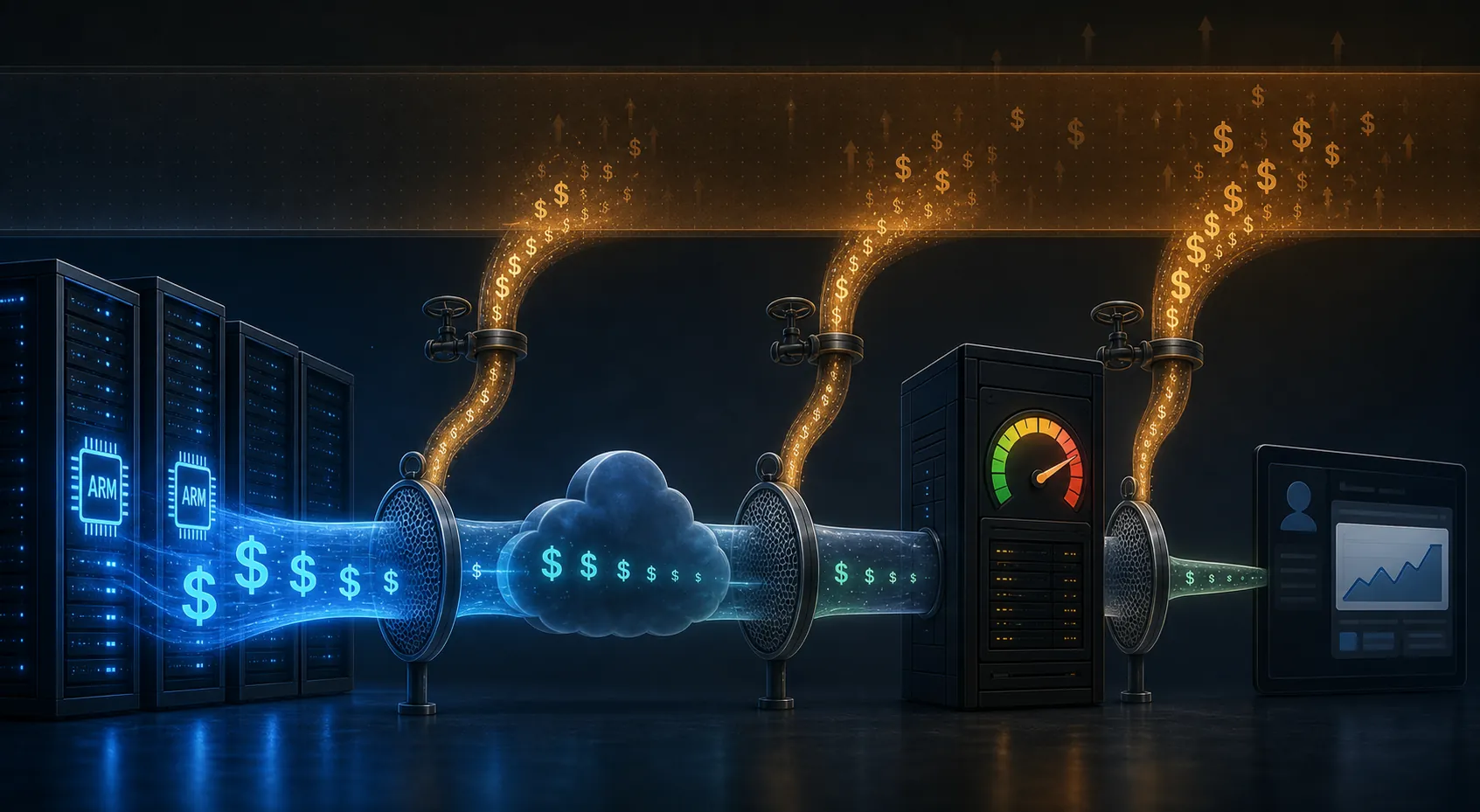
The Pipeline Buyers Actually Need To Follow
The clean way to look at this is not “ARM saves 30%, so my CPM should fall 30%.” The pipe has more joints than that:
- ARM silicon improves cloud economics or workload performance.
- Cloud providers expose some of that improvement through instance pricing, price-performance, or specialized infrastructure.
- Ad tech platforms reduce part of their infrastructure bill if their workloads migrate cleanly.
- The saving either expands platform margin, funds more compute, offsets other costs, or supports lower commercial pricing.
- Advertisers see a benefit only if it shows up as fee compression, better auction economics, lower effective media cost, or measurable performance improvement.
Most buyer confusion starts by skipping from step one to step five. The platform rep is usually talking about step three. The finance team is asking about step five. Those are related, but they are not the same account.
This Is No Longer A Niche Server Story
The reason this belongs in an ad bidding conversation is scale. IDC reported that ARM accelerated server spending reached $53 billion in Q1 2026, overtaking x86 accelerated server spending at $34.6 billion, with the crossover beginning in Q4 2025. IDC also put total AI infrastructure spending at $89.7 billion in Q1 2026, up 33% year over year, and raised its full-year 2026 forecast to $497 billion.[1]
That changes the premise. A few years ago, an ARM migration might have sounded like a procurement footnote buried inside cloud engineering. In 2026, it is part of the cost base for the systems deciding which impression to bid on, which model to invoke, which user or device signal to pay for, and which auction path to route through.
The buyer-facing consequence is not that marketers need to become chip specialists. It is that the infrastructure beneath programmatic buying is being repriced at market scale while platforms are simultaneously asking advertisers to pay for more automation, more signals, and more AI decisioning. That combination deserves a sharper pass-through question than “are your servers cheaper now?”
The Savings Are Concrete, Even With The Vendor Asterisk
The strongest evidence comes from ad tech workloads that already look like the systems buyers pay to access. Yahoo DSP, TripleLift, and DeviceAtlas are not generic benchmark demos. They sit in or near bidding, exchange, and real-time device detection workflows.
Yahoo DSP’s AWS customer story says the company projected $1.8 million in monthly savings across its PTS and DSP platforms after moving Intel-based workloads to AWS Graviton3. The same case cites a 40% PTS cost reduction and 20% bid-server savings, which is roughly $21.6 million on an annualized basis if the projected monthly figure holds.[2]
TripleLift’s AWS customer story says the company saved more than $2 million per year on its Ad Exchange, which handles 7 trillion monthly ad transactions. The reported monthly cost reduction ranged from 23% to 40% through a mix of Graviton, Spot, and custom load balancing, while instance counts fell 30% to 40% in APAC and European regions.[3]
DeviceAtlas’s AWS customer story says its device detection workload achieved 200% better price-performance at 55% lower cost on Graviton3, while processing an estimated 5 trillion ads monthly across the RTB supply chain.[4]
These figures need the obvious label: they are vendor-published AWS customer stories, not independent audits of each company’s full cost structure. Still, they are too specific to wave away. They show that ARM migration can remove meaningful waste from real ad tech infrastructure. A 30% regional instance-count reduction is not a press-release abstraction if you are the team carrying the cloud bill.
| Ad Tech Layer | Published Claim | What It Measures | What It Does Not Prove |
|---|---|---|---|
| DSP and platform systems | Yahoo DSP projected $1.8M/month in savings | Infrastructure savings across specified Yahoo platforms | That advertisers received lower CPMs or lower platform fees |
| Ad exchange | TripleLift saved $2M+/year | Exchange infrastructure cost reduction | That exchange economics passed through to buyers one-for-one |
| Device intelligence | DeviceAtlas reported 55% lower cost | Price-performance for device detection workloads | That every RTB participant using device signals paid less |
Unit Cost Can Fall While The Total Bill Rises
The cleanest mistake in this debate is treating lower cost per compute unit as lower total compute spend. Ad tech rarely behaves that politely. If a bidder can score more impressions, call more models, evaluate more supply paths, and enrich more requests, the platform may use the saving to do more work rather than return the saving to the buyer.

ARK Invest’s March 2026 analysis captures the broader AI version of this tension: inference costs have fallen by about 95% annually by its median benchmark improvement, while token demand has grown 28x since December 2024 based on OpenRouter data.[5] That is the accounting problem in one sentence. A cheaper unit does not guarantee a smaller invoice when usage expands fast enough.
IDC’s own infrastructure numbers point in the same direction. ARM accelerated server spending nearly doubled from $29.8 billion to $53 billion in two quarters, even as ARM economics were improving the case for migration.[1] More efficient infrastructure did not shrink the market. It helped support a larger one.
That matters for AI bidding. Each incremental scoring layer, creative selection model, quality filter, supply-path decision, or fraud check can consume part of the savings. The same platform can truthfully say its cost per inference is lower and still carry a larger total AI infrastructure bill.
The Absorption Points Are Where The Money Disappears
Once the platform’s infrastructure bill falls, the saving has several places to go before it ever reaches a buyer. Some are ordinary business behavior. Some are real technical offsets. None require bad faith.
- Margin retention: If the DSP, exchange, or data provider can hold pricing steady, the infrastructure saving becomes margin.
- Competitive discounting: If rival platforms compete aggressively on take rate, managed-service fees, or outcome guarantees, some saving may be pushed into commercial terms.
- AI expansion: Lower inference cost can encourage more model calls per auction or campaign decision.
- Bid-volume growth: More evaluated bid requests can raise total infrastructure consumption even when cost per bid improves.
- Network and data costs: Compute savings can be offset by data movement, NAT, egress, logging, and replication costs.
Servers.com’s July 2026 cost-per-bid analysis is useful because it does not stop at the CPU. It argues that a 20% increase in bid volume can drive infrastructure costs up 40%, with data movement compounding faster than compute; the same piece calls out NAT Gateway pricing at $0.045 per GB and egress fees as part of the cost stack.[6]
That is why the finance answer cannot be “we moved bidders to ARM.” The next question is whether the platform also reduced duplicated traffic, unnecessary model calls, inefficient supply paths, avoidable cross-zone traffic, and expensive data movement. ARM improves the engine. It does not automatically fix the route.
Benchmarks Show Direction, Not Your Actual Invoice
The benchmark claims are directionally consistent. Graviton instances are commonly described as costing about 20% less per hour than equivalent x86 instances on AWS. Arm’s cloud AI materials cite Google Axion benchmarks showing up to 2.5x higher AI inference performance with 64% cost savings versus x86, and Microsoft Cobalt 100 claims up to 1.9x better LLM inference with 2.8x better price-performance versus x86.[7]
AWS’s RTB Fabric guidance also recommends Graviton for bidder nodes, citing 40% better price-performance versus x86 and up to 80% networking cost reduction in that solution context.[8]
Those numbers matter, but they are not production averages for every bidder workload. Controlled benchmarks and solution guidance do not tell a buyer how much of a DSP’s spend sits in eligible compute, how cleanly the software migrated, how much traffic growth offset the gain, or whether the platform changed its commercial terms afterward.
A bidder with high CPU utilization, stable traffic patterns, and well-tuned networking may see the migration cleanly. A platform carrying messy data movement, over-broad bidstream ingestion, expensive logging, or rising inference volume may report great unit economics and still have little room to lower buyer-facing prices.
Where A Buyer Might Actually See Pass-Through
The most credible pass-through usually appears indirectly. A platform may not announce “our ARM savings reduced your CPM.” Instead, buyers might see lower platform fees, sharper minimums, improved bid shading economics, more generous data processing terms, better outcome pricing, or a willingness to compete harder in an RFP.
This is also where public automation claims should be treated differently from infrastructure claims. When Meta says a product produces a lower average cost per result, or Google says Performance Max produces more conversion value, that is a buyer-facing performance claim. It can be tested in campaign data. It is not the same as proving that cheaper ARM infrastructure flowed through to advertiser pricing.
For DSP selection, the useful questions are commercial and operational, not theological. How exposed is the platform to RTB compute cost? How much of its stack has moved to ARM or other custom silicon? Are savings being used to improve margins, increase model depth, reduce fees, or bid more broadly? Does the platform compete on transparent take rate, outcome performance, service layer, or black-box optimization?
A small independent DSP under fee pressure may have a stronger reason to pass infrastructure savings into pricing than a large platform with scarce inventory access, locked-in workflows, or proprietary signal advantages. A supply-side platform may use the saving to process more bid requests. A data provider may use it to improve latency or coverage. The same ARM migration can create very different buyer consequences depending on where market pressure sits.
What To Ask Instead Of “Did ARM Lower My CPM?”
The better question is whether the platform’s unit-cost improvement changed the economics of your contract or auction access. That moves the conversation from engineering pride to buyer evidence.
- Ask whether infrastructure savings have affected platform fees, take rates, minimums, or managed-service pricing.
- Separate cost-per-bid improvements from total infrastructure spend, especially if bid volume or AI inference usage is rising.
- Ask which costs grew at the same time: model inference, data transfer, egress, NAT, logging, storage, or regional redundancy.
- Compare platforms under competitive pressure rather than assuming every vendor has the same incentive to pass through savings.
- Treat vendor-published migration numbers as evidence of possible margin expansion until buyer-facing pricing changes are visible.
There is nothing wrong with appreciating the engineering. Yahoo DSP taking projected monthly savings of $1.8 million out of a platform stack is impressive. TripleLift cutting regional instance counts by 30% to 40% is real operational work. DeviceAtlas improving price-performance in a workload that touches trillions of ad decisions is relevant to the market. The mistake is pretending those achievements answer the buyer’s invoice question by themselves.
Until a platform shows pricing behavior, fee compression, or competitive DSP pressure that moves the benefit downstream, assume ARM improves platform economics first. Buyers should track the margin and fee behavior around the migration, not treat infrastructure savings as a guaranteed media-cost discount.
References
- AI Infrastructure Spending Holds Near $90 Billion in Q1 2026 as ARM Overtakes x86 in Accelerated Servers, 2026 Forecast Raised to $497 Billion, IDC, July 2026.
- How Yahoo DSP Supercharged Their Advertising Tech with AWS Graviton Processors, AWS.
- How TripleLift Optimized Real-Time Bidding with Custom Load Balancing, Spot, and Graviton, AWS.
- How DeviceAtlas Optimized Real-Time Advertising Price Performance on AWS Graviton3, AWS.
- The State of AI Infrastructure: Demand, Costs, and Custom Silicon, ARK Invest, March 2026.
- Questions Around AdTech Cost Per Bid, Servers.com, July 2026.
- Datacenter AI, Arm.
- Building a Real-Time Bidder for Advertising on AWS, AWS.
Built on this evidence
No Bidding tactic or Creative record currently cites this case file. Compare it against other results in Benchmarks.
Related benchmark reading
Report a corroborating or contradicting result
Seeing something different in your own account? Feed the data-integrity loop instead of leaving an open comment.