

Why AI SEO Tools Optimize for the Wrong Thing
If your content optimizer gives high scores but your pages still don't rank or earn AI citations, you're optimizing for the wrong signals. This article explains which metrics actually predict AI search visibility in 2026 and which tools measure them.
The trap is easy to recognize if you have ever had to defend an SEO budget in a room that does not care about optimizer scores. A page clears the brief. Surfer, Clearscope, or Frase says the content is well optimized. The draft includes the related phrases, covers the expected subtopics, and mirrors competitor pages closely enough to earn a green score. Then the page stalls. It does not rank meaningfully. It does not show up as a cited source in AI search. No one can point to what, exactly, the score predicted.
That is the central problem with many AI SEO tools in 2026: they are often better at measuring resemblance to already-ranking pages than at predicting whether a page deserves to be selected by Google or cited by an AI answer engine.
A practitioner test published by Behind Rankings in April 2026 put a clean edge on that failure. After Google’s January 2026 update dropped previously successful content from top rankings, the tested content optimization tools still scored that content highly. The useful takeaway is not that every optimizer is useless. It is narrower and more damaging: a high score can remain high after the market signal it is supposed to approximate has already failed.[1]
That makes the score a workflow convenience, not a quality proof. It can help a junior writer avoid missing obvious semantic territory. It can make a brief less vague. It can surface language patterns competitors use. But if the content team treats the score as a proxy for ranking durability or AI citation value, the measurement system is already misaligned.
The Score Fails Because It Rewards Commodity Completion
The reported distinction that matters now is between commodity and non-commodity content. Behind Rankings’ attendee notes from Google’s April 2026 Search Central event describe Google’s framing as a split between generic, repeatable content and pages grounded in real experience, original data, or genuine depth. That wording should be treated as one attendee’s interpretation rather than a verbatim Google transcript, but it matches the pressure many SEO teams are seeing in the field: pages that are complete in the old on-page sense can still be interchangeable.[1]
Most conventional content optimizers were not built to detect interchangeability. They compare a draft against patterns in a result set: term usage, headings, entity coverage, approximate length, competitor topics, and sometimes readability or structure. Those are legitimate inputs. They are also easy to satisfy without adding a reason for the page to exist.
A commodity page can mention every expected phrase. It can include every recommended heading. It can answer the same surface questions as the current SERP. What it cannot do is give Google, ChatGPT, Perplexity, or another AI system a defensible reason to choose it over a dozen similar pages. The page has coverage, but not evidence. It has breadth, but not selection value.
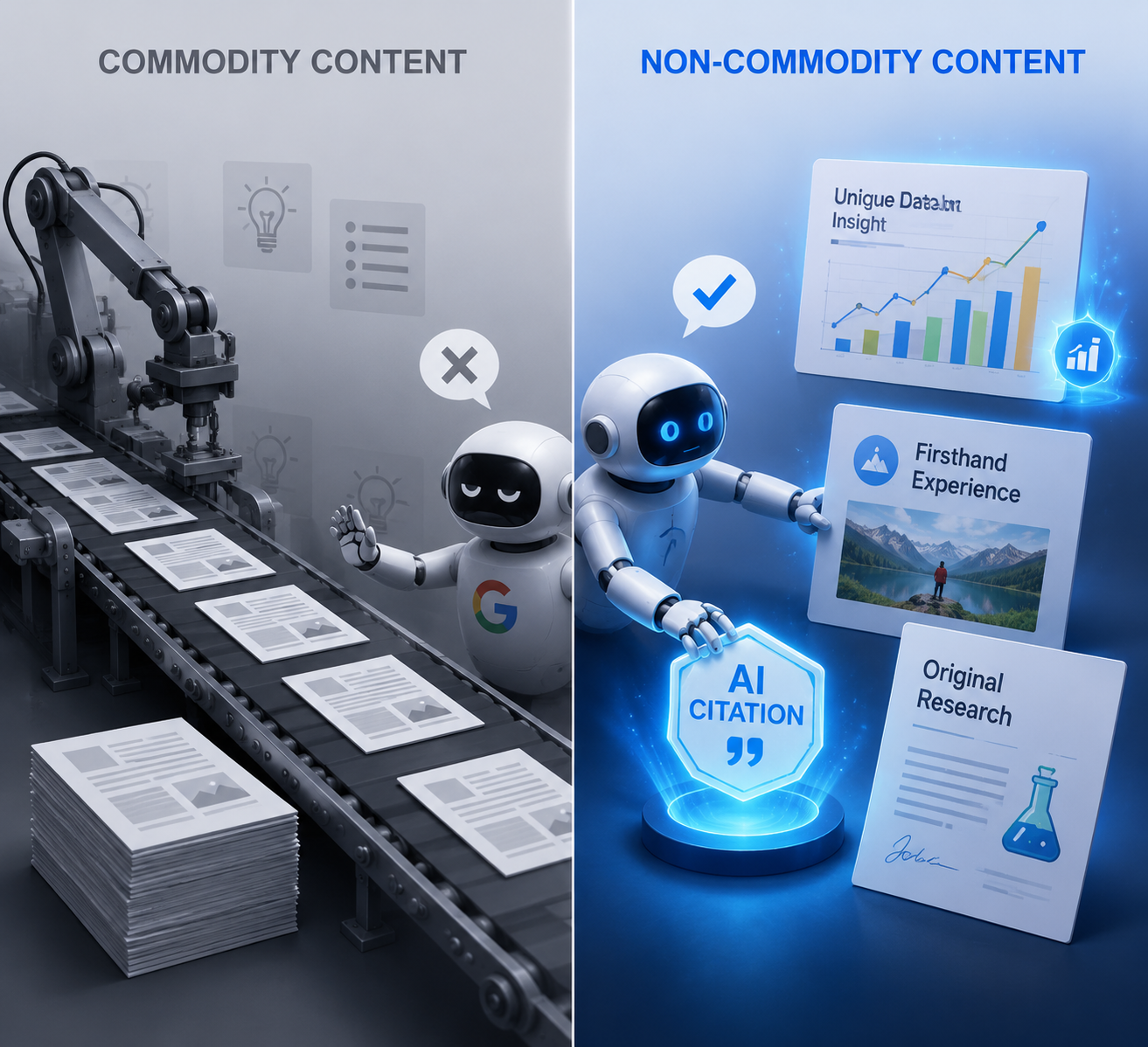
This is where the tool category gets mislabeled. A platform that helps a team cover the expected semantic field is not necessarily an AI visibility tool. It is a content completeness tool. That job still has value, especially for teams with inconsistent briefs or thin drafts. The mistake is promoting completeness into evidence of authority.
The SEO-GEO Gap Is Not Theoretical
Search Engine Land’s 2026 study is the heavier evidence because it measured the gap directly. The study looked at 10 websites and 150,000 indexed pages, so it should not be treated as a universal sample of the web. Within that sample, though, the pattern is hard to wave away: educational how-to content had a 12% LLM citation rate, while data-driven analysis reached 78% and year-in-review content reached 61%.[2]
| Content type in SEL study | LLM citation rate |
|---|---|
| Educational how-to content | 12% |
| Data-driven analysis | 78% |
| Year-in-review content | 61% |
That spread matters because educational how-to content is exactly the format many optimizer-driven workflows produce at scale. It is also the format most likely to look healthy inside a traditional content score: clear intent, familiar headings, predictable entities, and lots of opportunities to include recommended terms.
The same Search Engine Land study found that adding recommended keywords from content optimizers produced no ranking improvement. It also found that, among the top 100 organic pages studied, 49 had zero LLM traffic.[2] Those two findings should sit next to each other in any tool evaluation. Keyword recommendations did not improve ranking outcomes in the study, and organic success did not reliably translate into AI visibility.
That does not mean keyword research is dead, and it does not mean rankings no longer matter. It means one familiar operating assumption has cracked: if a page is optimized enough to rank, it will naturally be visible in AI-generated answers. The evidence available here supports a narrower conclusion. In this sample, organic performance and LLM citation behavior diverged enough that they need separate measurement.
This is also where content type becomes more than an editorial preference. A standard how-to article usually explains a known process. A data-driven analysis contributes something extractable: a finding, comparison, benchmark, or observation that can support an answer. A year-in-review page can consolidate a time-bound view that did not exist in the same form elsewhere. AI systems need answer material; they also need source material worth attributing.
The Answer Capsule Is a Structural Signal Teams Can Actually Change
The most operational finding in the Search Engine Land research is not a content type label. It is the answer capsule. In prior research across 15 domains and nearly 2 million sessions, Search Engine Land identified the answer capsule as the strongest structural predictor of ChatGPT citations: a concise, early-page answer to the page’s core question, without distracting internal links.[2]

This is not the same as writing a fluffy introduction with a definition paragraph. The answer capsule has a job: resolve the core query quickly enough that a machine can identify the page’s main answer before the page branches into nuance, proof, examples, and caveats.
A practical answer capsule usually does four things. It names the issue in the user’s language. It gives the direct answer without forcing the reader through background. It states the condition or limitation that prevents overclaiming. It avoids stuffing the opening with internal links that interrupt extraction. Internal links still belong in the article; they just should not compete with the answer in the first decisive block.
For a page targeting this topic, the capsule would be blunt: many AI SEO tools fail because they optimize for keyword coverage and competitor resemblance, while AI citation systems appear to reward extractable answers, original evidence, and source distinctiveness. That answer can then be supported by studies, examples, and tool evaluation. The capsule is not a replacement for depth. It is the handle that lets the depth be found.
This is a better revision target than “raise the score from 78 to 92.” An editor can audit the first screen of a page and ask: if an AI system needed one clean answer from this URL, have we made it obvious what to extract? If the answer is buried under positioning copy, table-of-contents links, throat-clearing, and internal promotions, the page may be well optimized and still structurally hard to cite.
Ranking Position Is Not the Same as Citation Eligibility
Semrush’s AI search study widens the problem. It found that ChatGPT cites pages ranking in positions 21 or lower almost 90% of the time.[3] That finding does not prove rankings are irrelevant, and it should not be twisted into advice to ignore organic search. It does show that AI citation is not simply top-10 ranking under a new label.
For teams used to SERP-first planning, this changes the audit question. A page outside the top 20 may still be citation-eligible if it offers a cleaner answer, a more useful passage, a distinctive data point, or a better source fit for a generated response. A page in the top 10 may fail to earn citations if it is navigationally cluttered, generic, or too dependent on restating known advice.
That is why AI visibility reporting has to include cited-source presence, not just rank tracking. It also needs to separate surfaces. AI Overviews, AI Mode, ChatGPT, Perplexity, and other answer systems do not behave identically. A team working through those distinctions may need a separate operating model for different AI search surfaces, which is why a guide such as AI Mode vs. AI Overviews belongs closer to the measurement conversation than another generic keyword checklist.
What to Measure Instead of a Green Optimization Score
The replacement for one bad proxy is not one new magic metric. The better move is to split the workflow into signals that answer different business questions.
| Question | Useful signal | What it helps decide |
|---|---|---|
| Is the page saying something competitors do not? | Original data, firsthand experience, distinctive analysis, or time-bound synthesis | Whether to create, consolidate, or stop funding the page |
| Can an AI system extract the core answer quickly? | Early answer capsule with limited distraction | Whether the introduction and page structure need revision |
| Does the page cover the semantic field without becoming generic? | Entity and topic gap analysis used as an editorial input | Whether the draft has missed necessary context |
| Is the page actually being cited? | Cited-source presence, placement, sentiment, and query-level visibility | Whether visibility exists beyond organic rankings |
| Can AI crawlers access and interpret the page? | Crawler access, indexability, renderability, and technical eligibility | Whether the issue is content quality or discoverability |
The first signal is the hardest because it cannot be fully automated. “Non-commodity” is not a style setting. It usually comes from material the average competitor does not have: customer data, expert judgment, product usage patterns, original interviews, field observations, proprietary benchmarks, or a synthesis that required real editorial work. For teams using AI-generated drafts, this is also where human authority matters; the related E-E-A-T problem is better handled as an editorial gate than as a detector score, as discussed in Why AI Content Needs Human Authority to Pass Google’s E-E-A-T Gate.
The second signal is highly editable. If the answer capsule is weak, the team can fix it without rewriting the entire asset. That makes it a useful audit item for existing libraries: start with pages that already have impressions, rankings, or business value, then test whether their openings contain a clear extractable answer.
The third signal is where conventional optimizers still belong. Semantic coverage can prevent embarrassing gaps. A page about AI search measurement that never discusses citations, crawler access, query variation, or source placement is probably underdeveloped. But semantic coverage should be a diagnostic, not a finish line.
The fourth and fifth signals require tools built for AI visibility rather than content scoring. If a vendor cannot show whether your brand, page, or domain appears in AI-generated answers, where it appears, and under which queries, it is not measuring the outcome that started the conversation.
Reclassify the Tools by the Job, Not the Category Label
The phrase “AI SEO tools” now covers too many products to be useful on its own. A content optimizer, a clustering platform, an AI visibility monitor, and a technical crawler may all claim a place in the stack, but they do not solve the same problem.
| Tool or tool type | Better job description | Main caution |
|---|---|---|
| Surfer, Clearscope, Frase | Improve semantic completeness and brief consistency | Do not treat the content score as proof of ranking or citation value |
| MarketMuse | Identify topical depth gaps and content inventory opportunities | Depth analysis still needs original material to become non-commodity |
| Keyword Insights | Cluster intent and reduce duplicate or overlapping content plans | Intent clustering does not prove a page deserves citation |
| KIME | Measure AI visibility signals such as sentiment and placement | Useful only if queries and reporting match real business questions |
| Profound | Monitor AI visibility and crawler access issues | Technical eligibility is not the same as editorial distinctiveness |
| Semrush AI Visibility | Analyze cited-source presence and AI search exposure | Should be read alongside organic, conversion, and content-quality data |
This classification is more useful than asking which single platform is “best.” If the bottleneck is duplicate intent across 40 articles, a clustering tool may create more value than another optimizer. If the bottleneck is a library of generic posts with no original evidence, no scoring tool will rescue the investment. If the bottleneck is that executives keep asking whether the brand appears in AI answers, a citation and visibility tool belongs in the budget conversation earlier.
There is a cost reason to be this strict. Business Research Insights values the AI SEO software market at $2.43 billion in 2026 and reports a 10.5% CAGR, while also noting that 46% of SMBs report subscription costs as a barrier. The market-size methodology is not fully transparent publicly, so those figures should be treated as directional context rather than a precise operating benchmark.[4]
Still, the budget implication is real. A team can easily pay for multiple subscriptions that all make content look more complete while none of them answer whether the content is being cited, whether crawlers can access it, or whether the page contains anything competitors cannot cheaply reproduce. That is not a tooling strategy. It is a stack of dashboards around the same blind spot.
A Practical Audit for Existing Content
For an existing library, start where the mismatch is most expensive: pages that already consumed meaningful budget, have acceptable optimizer scores, and still underperform in rankings, AI citations, or assisted conversions. Do not begin by rewriting everything. Sort the pages by the type of failure.
- High score, weak rankings: check whether the page is a commodity version of a topic where competitors have stronger authority, data, or experience.
- High rankings, zero AI visibility: inspect the opening answer, extractable passages, source distinctiveness, and whether the page is cluttered with links before it gives a direct answer.
- AI citations with poor business value: review query relevance, sentiment, placement, and whether the cited page leads to a useful next action.
- No citations and no rankings: decide whether the topic deserves original investment or should be consolidated, redirected, or removed from the roadmap.
The answer will not always be “make it longer.” In many cases, the fix is to add a proprietary comparison, replace generic advice with expert review, restructure the first screen, or move internal links below the answer capsule. In other cases, the honest decision is to stop funding a page that has no realistic path out of commodity status.
This also changes how new briefs should be approved. A brief that only lists target keywords, recommended terms, competitor headings, and word count has not answered the source-selection question. Before assignment, it should state what the page will contribute that is not already abundant: data, experience, comparison, testing, expert judgment, or a cleaner synthesis of a messy topic.
If the page is intended to hedge against declining search clicks, the measurement plan should include AI citation and owned-audience effects rather than only organic sessions. That connects directly to broader content allocation decisions, including when a newsletter or other owned channel becomes a safer demand-capture asset than another generic search page, a problem explored in How to Rethink Newsletter Strategy as an AI Search Traffic Hedge.
Where Conventional Optimizers Still Earn Their Seat
It would be too convenient to throw every old optimizer into the same bin. Surfer, Clearscope, and Frase can still help teams avoid thin topical coverage, especially when writers are new to a subject or editors need a repeatable baseline. They can expose missing entities, competitor language, and sections that a draft has ignored.
The discipline is to keep them in that lane. Use them before publication to catch omissions. Use them during refreshes to see whether the topic has shifted. Use them to make briefs more concrete. But do not use a green score to tell leadership that the page is high quality, differentiated, or likely to be cited by AI systems. The available evidence does not support that promotion.
The better investment pattern is mixed. Keep conventional optimizers where they reduce avoidable editorial gaps. Add tools that measure cited-source presence, sentiment, placement, and crawler access. Put more of the human budget into material that makes a page non-commodity: original analysis, firsthand experience, expert review, and answer structures that can be extracted without guesswork.
That is the workflow decision. The old scoreboard is not useless, but it is no longer allowed to be the scoreboard. It is one input in a larger system whose real tests are whether the page has a defensible reason to exist, whether it answers the core question cleanly, and whether AI search systems actually select it as a source.
References
- Best AI SEO Tools 2026 & the Ones to Avoid (I Tested 20+), Behind Rankings
- The SEO-GEO gap: How AI search traffic differs from organic traffic, Search Engine Land
- We Studied the Impact of AI Search on SEO Traffic. Here's What We Learned, Semrush
- AI SEO Software Market Report, Business Research Insights

Comments
Join the discussion with an anonymous comment.