

How to Rethink Newsletter Strategy as an AI Search Traffic Hedge
With AI search driving 60% of queries to zero clicks, content teams can no longer rely on organic traffic alone. This article outlines a staged newsletter migration strategy that replaces declining search visibility with owned audience growth, backed by current publisher data and real outcomes.
The uncomfortable part of building a newsletter strategy for AI search traffic is that the newsletter is not really the starting point. The starting point is admitting that the old content model treated the visit as the asset, while AI search increasingly treats the visit as optional.
Bain has reported that 60% of searches now end without a click, and Chartbeat data cited by The Current showed publisher traffic falling by a third in 2025.[1] Pew found that users click links only 8% of the time when an AI Overview is present, a reminder that the problem is not just ranking position; it is the shrinking surface area for referral behavior.[2] Gartner’s widely discussed forecast that search volume could fall 25% by 2026 should be read directionally, because verticals vary and algorithm updates muddy the picture, but it points to the same operating reality: content teams are budgeting against a channel whose dependable click-through behavior is weakening.[3]
That does not make SEO irrelevant. It makes the old handoff incomplete. A content page can still earn visibility, citations, and high-intent visits. What it can no longer guarantee is that the person who needed the answer will arrive, return, or remember who provided it. For more background on why AI citation now matters even when clicks are compressed, see Signal & Convert’s guide to AI Overview citation advantage.
The Search Visit Is Becoming a Worse Unit of Planning
Organic sessions used to be a flawed but serviceable proxy. If rankings improved, sessions usually followed. If sessions followed, some percentage of visitors moved into trials, demos, ad impressions, affiliate clicks, subscriptions, or retargeting pools. The model was never clean, but it was legible enough for planning.
AI search breaks that legibility in two ways. First, it can satisfy the user before the click. Second, when the user does eventually convert, the trail may not come back labeled as AI search at all. A person might see a brand cited in an AI answer, search the brand later, and arrive through branded search or direct traffic. The content team did the work, but the dashboard gives credit to the last visible doorway.
That is why responding with only another technical SEO cleanup feels underpowered. Schema, crawlability, page speed, internal links, and BOFU content quality still matter. But they do not answer the ownership question: once the user reaches you, what mechanism lets you reach them again without asking Google, ChatGPT, Perplexity, LinkedIn, or an ad auction for permission?
The newsletter is useful because it changes that unit of planning. It turns a successful visit into a retained relationship, then gives editorial, marketing, and revenue teams a recurring surface they control. It does not eliminate the need for acquisition. It gives acquisition somewhere sturdier to land.
Keep the Search Work That Still Has Leverage
The first move is not to abandon search. It is to stop treating every organic visit as equally recoverable. The search work worth protecting is the work that still attracts high-intent people, earns citations in AI systems, or strengthens the topical authority that makes a newsletter worth subscribing to.
Semrush has reported that AI search visitors are 4.4 times more valuable than traditional organic visitors, while Adobe found AI referral visits had 27% lower bounce rates and 38% longer sessions.[4][2] Those figures should not be inflated into a universal law that “AI traffic is better.” They are platform and practitioner signals, not a guarantee for every category. But they do suggest a practical priority: when AI-influenced visitors do reach the site, they are often worth capturing with more care than a generic top-of-funnel browser.
Bottom-of-funnel content deserves special protection. Grow & Convert’s analysis of more than 400 keywords found that pages ranking in positions 1–3 for BOFU keywords had an 82% chance of being cited by Perplexity.[5] That does not mean every BOFU page will send a flood of AI referral traffic. It means the page may keep influencing decisions even when the click is reduced, delayed, or misattributed.
So the better question is not, “Which SEO pages can we squeeze for more traffic?” It is, “Which pages still put us in front of the right buyer or reader at the moment of intent, and how do we keep that relationship when they arrive?”
| Search Asset | What to Do With It | Newsletter Role |
|---|---|---|
| BOFU comparison, alternative, and problem-aware pages | Keep improving accuracy, usefulness, and citation-worthiness | Offer a specific subscription promise tied to the decision the visitor is making |
| Authority-building explainers | Maintain when they support topical credibility or AI citation visibility | Use them to invite readers into a continuing editorial thread |
| Thin TOFU posts built mostly for volume | Audit hard before refreshing | Do not force newsletter acquisition from low-intent traffic |
| Pages that already convert or assist revenue | Protect and instrument carefully | Make subscription a secondary conversion when the primary conversion is not ready |
Use AI and Search Visibility as the Front Door, Not the House
A staged newsletter strategy starts with a less sentimental view of the website. The site is still a publishing surface, but for many teams it now has to work harder as a conversion layer between rented discovery and owned audience.
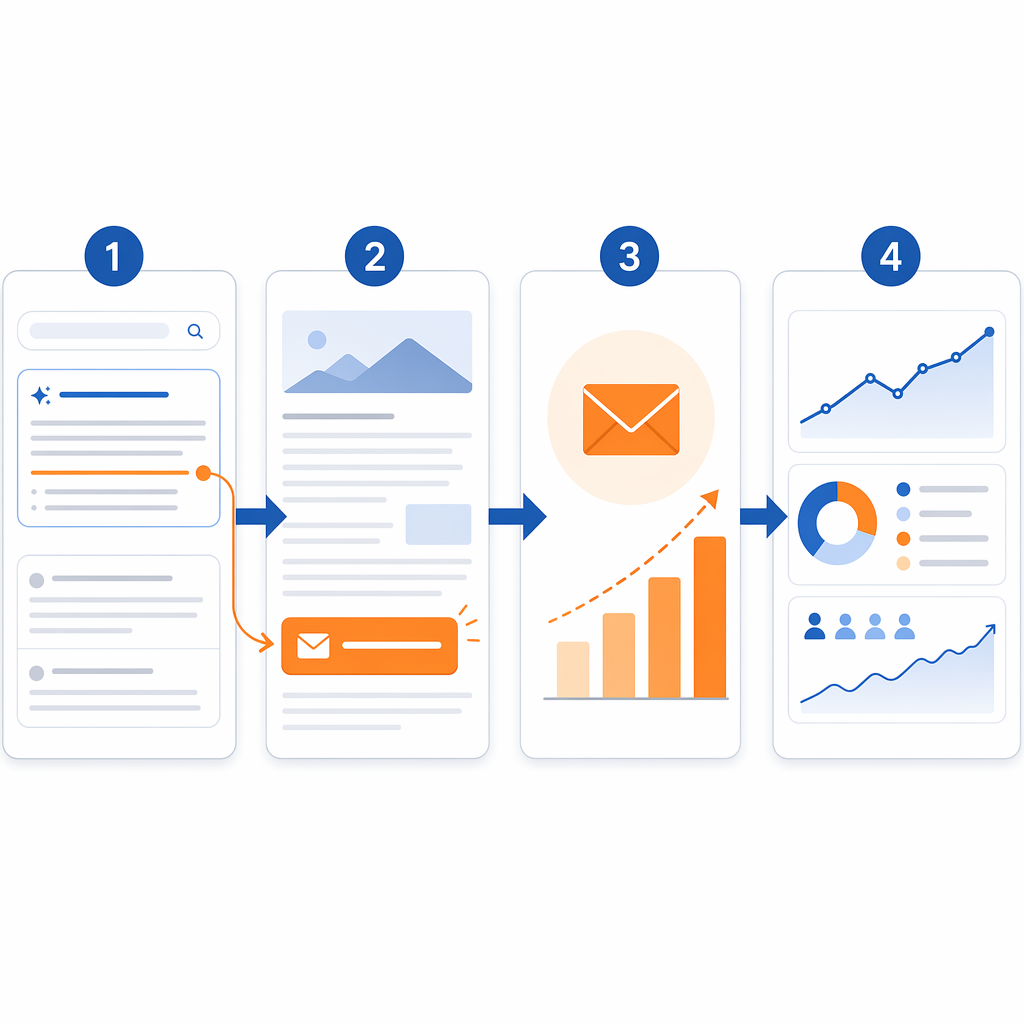
The migration usually looks like this:
- Preserve the pages that can still earn AI citations, branded recall, or high-intent visits.
- Replace generic newsletter CTAs with offers that match the page’s intent.
- Route subscribers into a consistent editorial product, not a sporadic promotional list.
- Measure subscriber growth, activation, and downstream revenue alongside search visibility.
- Use newsletter engagement data to decide which topics deserve more search and editorial investment.
The second step is where many teams underperform. “Subscribe for updates” is too weak for a visitor who arrived with a specific job to do. A comparison page should not offer the same newsletter promise as a trend essay. A pricing or alternatives page can offer a buyer’s briefing, teardown series, benchmark digest, or decision guide. An authority article can offer a recurring analysis of the same market, not a vague announcement list.
This is not about trapping visitors with pop-ups. It is about making the next exchange obvious. The visitor came because a search engine or AI system exposed a need. The newsletter should tell them why that need will keep changing and why hearing from you again will save them time.
A SaaS content team, for example, might keep investing in “best tools,” “alternatives,” and “how to choose” pages because those pages can still shape AI answers and attract people near a purchase decision. The newsletter CTA on those pages should not be a broad company newsletter. It should be a practical continuation of the buying process: new vendor changes, implementation mistakes, budget benchmarks, or operator notes. The content page earns the first moment of trust. The newsletter asks for the second.
The Newsletter Becomes the Audience Metric Search Can No Longer Be
Raw organic sessions were always a noisy scorecard. In the AI search era, they become noisier because influence and attribution separate. Grow & Convert has argued that AI-influenced conversions often show up in GA4 as direct or branded search traffic, which means traditional analytics can undercount AI’s contribution.[6] That is not a reason to ignore analytics. It is a reason to stop asking one report to explain the whole journey.
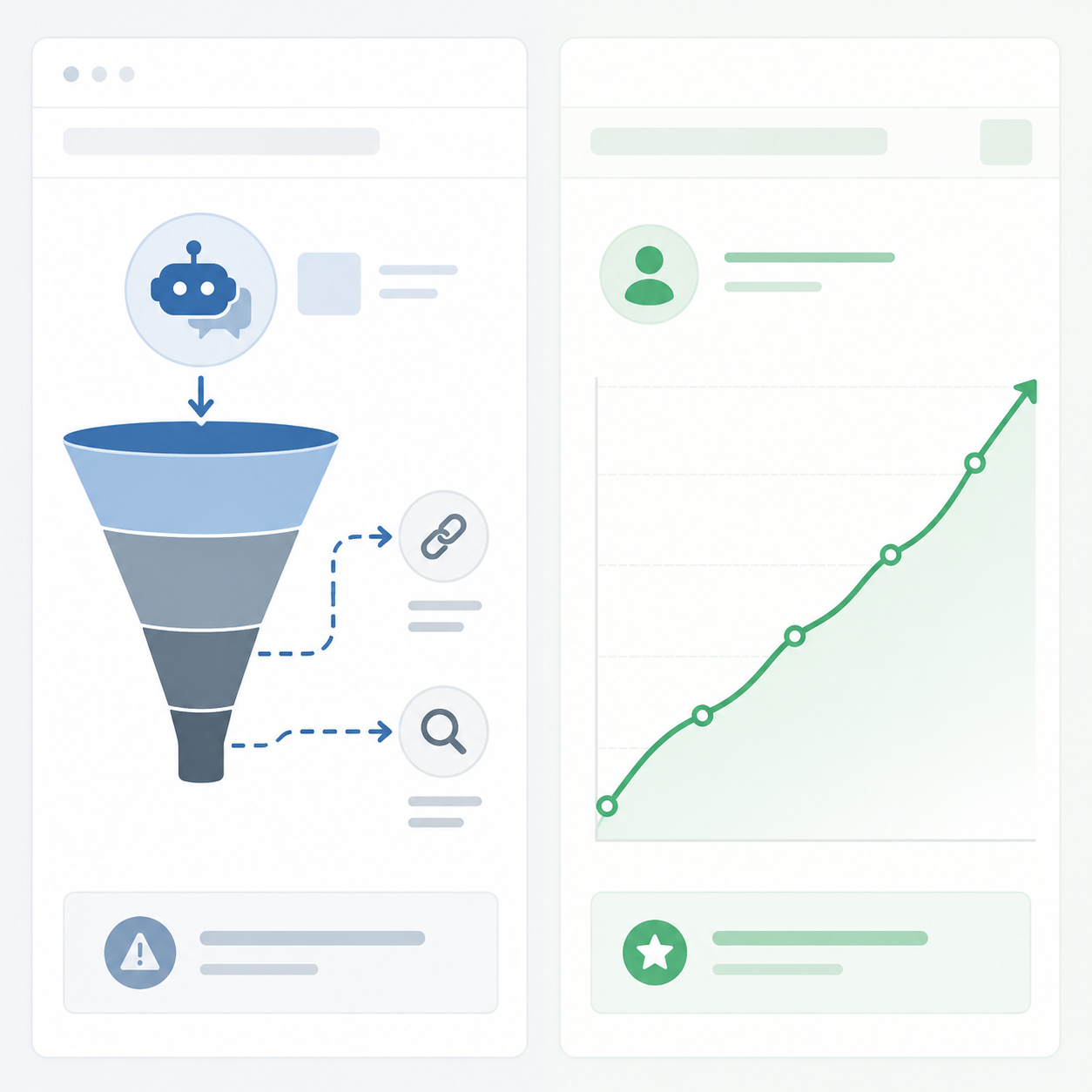
Subscriber growth is not perfect either. A subscriber can be unqualified, inactive, or impossible to monetize. But as a north star for an AI search hedge, it answers a cleaner question than sessions do: are more of the right people giving us permission to reach them again?
The measurement loop should separate acquisition, activation, and business value:
| Layer | What to Watch | Why It Matters |
|---|---|---|
| AI and search visibility | Citations, rankings, branded search lift, AI referral sessions where visible | Shows whether discovery surfaces still expose the brand |
| On-site conversion | Newsletter CTA impressions, signup rate by page type, signup source | Shows whether remaining visits are being captured |
| Subscriber activation | Open behavior, click behavior, replies, preference selection, return visits | Shows whether the list is becoming an audience rather than a database |
| Commercial contribution | Assisted conversions, demo requests, subscriptions, ad yield, sponsorship revenue, retargeting quality | Shows whether owned attention is producing business outcomes |
This matters politically inside a company. A content lead explaining falling organic sessions needs a replacement measurement story before the quarterly review turns into a blame exercise. “Traffic is down, but subscribers from high-intent pages are up, activated readers are returning, and newsletter-assisted pipeline is growing” is a more durable argument than “we cleaned up metadata and hope the next update is kinder.”
The Current’s reporting on Paved gives one useful market signal: newsletter revenue on the platform grew 30% in 2025, and unique users grew 84%, as publishers looked for more owned audience models.[1] That is not a universal forecast for every brand newsletter. Sponsorship marketplaces have their own mix of publishers, categories, and buyers. Still, it shows that the migration away from pure SEO dependence is already happening in the open web economy, not just in strategy decks.
Two Revenue Paths Sit Behind the Same Signup
Once the newsletter becomes more than a traffic recovery tactic, the business model matters. The Credland framework cited in The Current points to two broad paths: a subscription model and a first-party data model.[1] They can overlap, but they ask different things of the reader relationship.
The subscription path monetizes the relationship directly. It works when the editorial product is specific enough, trusted enough, and frequent enough that readers will pay for continued access. This is harder than adding a paywall to a list. It requires a clear promise: insight, utility, access, or analysis that is meaningfully better than what the reader can collect from feeds and AI summaries.
The first-party data path uses the newsletter to strengthen advertising, sponsorships, segmentation, retargeting, and audience intelligence. In that model, the reader may not pay directly, but their declared interests and engagement behavior help the publisher or brand sell better, target better, and learn faster. This is often the more realistic path for B2B brands that already monetize through pipeline rather than paid editorial access.
HubSpot’s 2025 State of Newsletters Report, based on a survey of more than 400 professionals through HubSpot’s own channels, adds useful texture about how marketers are thinking about newsletters, though its sample may overrepresent HubSpot-aware creators and teams.[7] Selling Signals’ newsletter growth trends also point to continued operator interest in segmentation, creator-led trust, and monetization experiments going into 2026.[8] These are helpful signals, but they should not distract from the core decision: what does your organization need the owned audience to do?
Where This Strategy Works Best
A newsletter-first hedge works best when the brand already has some topical authority, demand capture, or distribution base. If nobody recognizes the brand, if the site has no credible pages, and if there is no clear editorial promise, a newsletter will not magically create attention. It will simply move the distribution problem into the inbox.
Teams starting from a weaker position may need a parallel track. Keep building search assets where intent is clear. Publish authority content that can earn citations and trust. Use partnerships, paid acquisition, events, webinars, creator collaborations, or communities to feed the list while search visibility compounds. The mistake is not investing in SEO. The mistake is investing in SEO as though the click is still guaranteed to carry the relationship.
The strategy is also weaker when the newsletter has no distinct cadence or editorial judgment. A digest of recent blog posts is usually not enough. The inbox is crowded, and permission has to be re-earned with every send. If the content team would not defend the newsletter in a revenue meeting as a product with a defined audience and purpose, the audience probably will not defend it with attention.
The practical standard is simple: if an AI or search visitor arrives tomorrow, does the page give them a reason to become reachable next week? If the answer is no, the team is still renting attention, just with better dashboards.
The Hedge Is Ownership, Not Abandonment
AI-driven search traffic decline does not require a dramatic funeral for SEO. It requires a cleaner division of labor. SEO and AI visibility should bring the right people into contact with the brand. BOFU pages should still answer real buying questions. Technical SEO should still prevent avoidable waste. Authority content should still make the brand citable.
But incremental SEO improvements no longer solve the ownership problem by themselves. A higher ranking, a better snippet, or an AI citation can create exposure without creating access. The newsletter closes that gap when it turns a shrinking pool of search and AI visitors into an audience the team can reach, learn from, and monetize without waiting for the next platform change to decide whether the click survives.
References
- How newsletters became publishers' answer to the AI-induced traffic collapse — The Current
- The AI Search Reckoning Is Dismantling Open Web Traffic — AdExchanger
- Will traffic from search engines fall 25% by 2026? — Search Engine Land
- 26 AI SEO Statistics for 2026 + Insights They Reveal — Semrush
- Does Google SEO Affect LLM Optimization? We Analyzed 400+ Keywords to Find Out — Grow & Convert
- How to Build an AI SEO Strategy That Drives Visibility in LLMs — Grow & Convert
- HubSpot's 2025 State of Newsletters Report — HubSpot
- 5 Newsletter Growth Trends We're Taking Into 2026 — Selling Signals

Comments
Join the discussion with an anonymous comment.