
How to Choose the Best AI SEO Tools for Your 2026 Stack
A framework to help SEO practitioners choose the right 2–4 AI tools for their team without overlapping features, based on team size, publishing volume, and budget. Includes cost benchmarks, ROI timelines, and stacking logic grounded in real data.
The hard part in choosing the best AI SEO tools in 2026 is no longer discovery. Most SEO teams already know the names: Semrush, Ahrefs, Surfer, Frase, ChatGPT, Clearscope, Jasper, and a newer set of AI visibility or GEO trackers. The harder question is whether those tools belong in the same stack, or whether the team is paying three times for keyword suggestions, two times for content scoring, and once more for a dashboard nobody uses.
That is not a theoretical annoyance. In small-business tool-buying research cited in 2026 AI SEO stack analysis, 73% of businesses with fewer than 20 employees bought tools with significant feature overlap, wasting an estimated $400 to $800 per year. The same research found that 47% of small businesses using three or more SEO tools saw conflicting recommendations weekly, and 31% said those conflicts delayed content publication.[1]
Those numbers explain why another alphabetical list of tools is not enough. The useful buying question is narrower: what combination fits your team size, publishing volume, budget, and search channel without duplicating core functions?
Start With Jobs, Not Tool Names
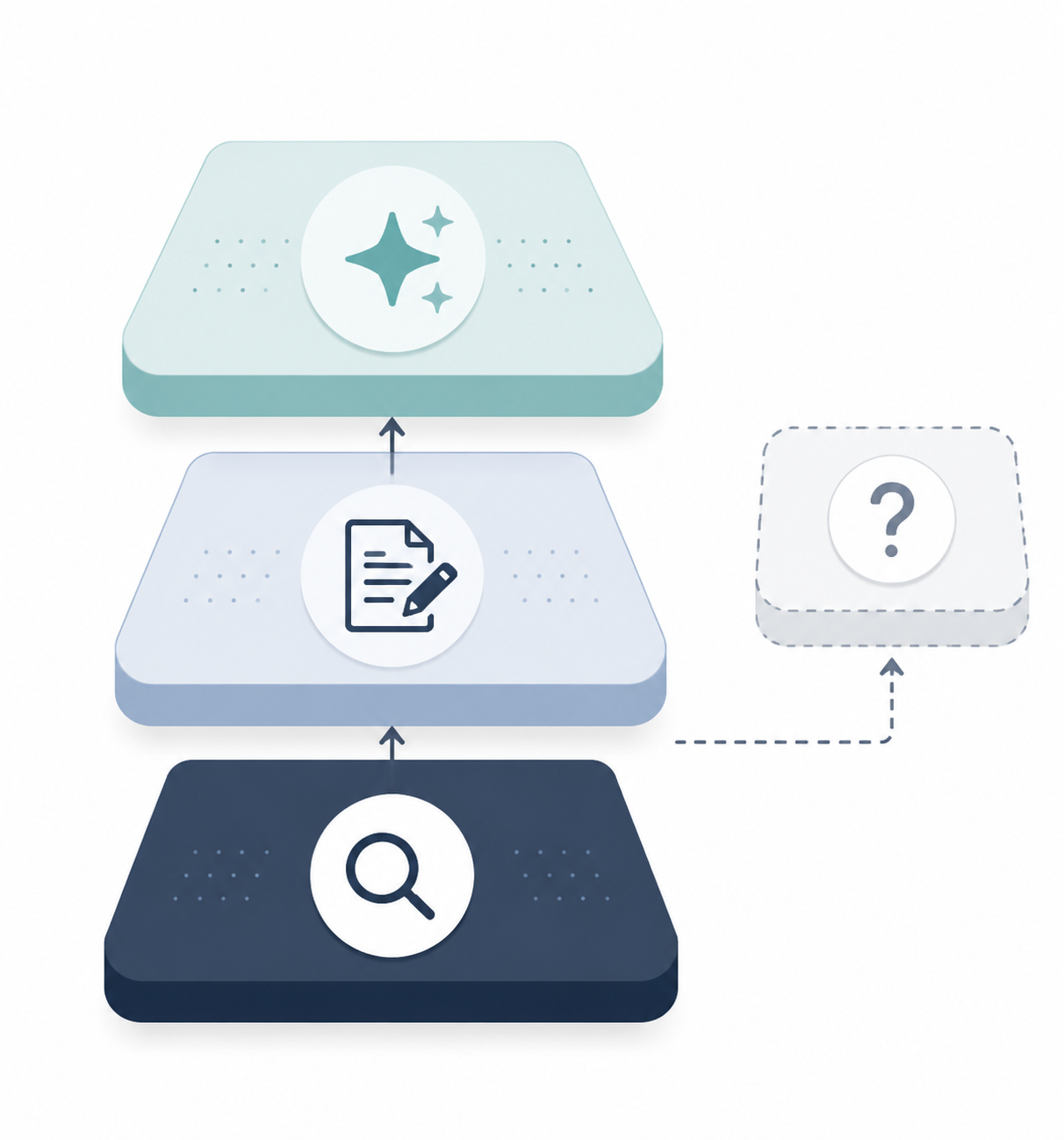
For most teams, an AI SEO stack only needs three core jobs covered. The first layer is research and tracking: keyword discovery, rankings, competitor visibility, backlinks, SERP analysis, and reporting. The second is content optimization: briefs, topical coverage, on-page recommendations, content scoring, and refresh guidance. The third is an AI assistant: drafting, rewriting, clustering, summarizing, schema help, spreadsheet cleanup, and the dozens of small tasks that slow down production.
A fourth slot can make sense, but it should not be automatic. AI visibility or GEO tracking belongs in the stack when visibility in AI-generated answers is a primary business concern, not when someone saw a new dashboard and wanted to “monitor ChatGPT.” The measurement category is real, but still young.
| Stack job | What it should decide | Common overlap |
|---|---|---|
| Research and tracking | Which queries, pages, competitors, and rankings deserve attention | Keyword databases, SERP reports, rank tracking, backlink snapshots |
| Content optimization | What a page or brief needs before publishing or refreshing | Content scores, NLP terms, outlines, internal linking suggestions |
| AI assistant | How to speed up drafting, editing, analysis, and formatting | Blog drafts, meta descriptions, clustering, summaries, code snippets |
| AI visibility or GEO tracking | Whether the brand appears in AI-generated search answers | AI Overview tracking, LLM citation monitoring, answer-engine reports |
The mistake is buying tools by feature excitement instead of decision ownership. If a tool does not remove a decision, shorten a handoff, improve prioritization, or create a report someone will actually use, it is probably not earning its seat.
The Minimum Viable Stack: $55–$99 Per Month
Pricing in this category moved enough from late 2025 through mid-2026 that every dollar figure should be treated as a July 2026 planning range, not a permanent quote. Before purchase, check current pricing pages, seat limits, usage caps, and whether AI credits are included.
For a solo marketer, freelancer, or very small team publishing a handful of pages per month, the minimum viable AI SEO stack usually sits around $55 to $99 per month. That range is enough to cover lightweight research or tracking, a content optimization workflow, and a general AI assistant if the team chooses carefully.[1][2]
- Choose one research layer, not two. If Ubersuggest, Semrush, Ahrefs, or a similar platform owns keyword discovery and tracking, do not add another keyword tool unless it answers a clearly different question.
- Add one content optimization tool only if it changes publishing behavior. A score is not valuable by itself; a better brief, faster refresh, or cleaner editor handoff is.
- Use one AI assistant as the flexible layer. ChatGPT, Claude, Gemini, Jasper, Copy.ai, or another assistant can support drafting and editing, but it should not become a second content strategy system unless that is intentional.
This is also where teams should be ruthless about what they do not need. A business publishing two optimized articles and one refreshed landing page per month probably does not need enterprise technical automation, AI Overview monitoring, a separate brief generator, and three writing assistants. It needs a way to pick the right topics, improve the page before publication, and move drafts through review without waiting a week for someone to reconcile five recommendation panels.
If the stack already feels crowded at this size, the issue is rarely tool quality. It is usually that the same workflow is being split across too many interfaces. That is the same pattern covered in the content automation stack consolidation guide: once every platform wants to be the source of truth, production slows down instead of speeding up.
The Serious Stack: $185–$240 Per Month
A serious stack is not just a more expensive version of the lean stack. It is what a team needs when publishing volume, stakeholder reporting, or competitive pressure makes manual coordination too slow. Planning benchmarks place this range around $185 to $240 per month for many small and mid-size setups, though seat counts and add-ons can move it quickly.[1][2]
The research and tracking layer should become more durable here. This is where a platform such as Semrush or Ahrefs often earns its place: not because every feature is used every week, but because rankings, competitor analysis, keyword expansion, backlink context, and reporting sit in one place. When an agency strategist has to explain the month’s movement, or an in-house SEO lead needs to prioritize across product pages, blog posts, and decaying content, the reporting layer needs to survive more than one campaign.
The content optimization layer also becomes more important, not less. Once the team publishes enough that briefs, outlines, edits, and refreshes are recurring work, the cost of inconsistent recommendations rises. Surfer, Frase, Clearscope, MarketMuse, or comparable platforms can be useful when they create a shared editorial standard. They are much less useful when every writer treats the score as a game and every editor has to explain why a term recommendation does not fit the page.
Independent practitioner testing from Behind Rankings and Freddie Chatt is useful here because it treats these tools as workflow objects, not magic ranking buttons. Their assessments repeatedly flag feature overlap, shallow recommendations, and the need to match tools to the actual production process rather than to a vendor’s positioning page.[3][4]
| Team situation | Likely stack | What to avoid |
|---|---|---|
| Solo marketer or freelancer | Light research tool + content optimizer + AI assistant | Two keyword databases, separate brief tools, advanced technical automation |
| Small content team | Durable research platform + content optimizer + AI assistant | Letting writers receive conflicting content scores from multiple editors |
| Agency or multi-brand team | Research/reporting platform + content optimization workflow + AI assistant, with optional GEO tracking for relevant clients | Buying one-off tools per client until reporting becomes unmanageable |
| SEO-led growth team with heavy publishing | Full research platform + mature optimization layer + assistant integrated into briefs, refreshes, and analysis | Treating AI drafting volume as a substitute for prioritization |
Prioritize the Tool That Pays Back First
If budget forces a sequence, content optimization usually deserves the earlier slot. In an analysis of more than 2,300 G2 reviews and implementation data across 340 SMB implementations, content optimization tools reached positive ROI in 2.4 months on average, compared with 5.1 months for technical SEO tools.[1]
That does not mean technical SEO is less important. It means the payback path is different. A content optimization tool can affect the next brief, the next refresh, and the next editorial review. A technical SEO automation tool may need more setup, more engineering coordination, and more time before fixes are deployed. If developers are already backlogged, buying another technical platform can simply create a more expensive queue.
A practical ordering looks like this: first stabilize research and tracking, then add content optimization if publishing volume justifies it, then formalize the AI assistant workflow, and only then add specialized technical automation or AI visibility monitoring when a real bottleneck appears.
There is also a content quality timing issue to watch. Search Engine Journal data cited by Semrush reported that AI-generated content took 5.2 days to index on average, compared with 2.1 days for human-written content.[5] That number should not be stretched into a universal ranking claim, but it is a useful reminder: the assistant is not the strategy layer. Teams still need human review, source checking, editorial judgment, and a briefing workflow that prevents generic drafts from entering the queue.
For teams rebuilding that part of the process, the tool choice matters less than the gates around it. A structured brief, a clear search intent decision, and a review step often do more to protect output than adding another writing platform. The same logic applies in an AI content stack or in a dedicated AI briefing workflow: the assistant helps, but the workflow decides whether the help becomes publishable.
Where Overlap Actually Happens
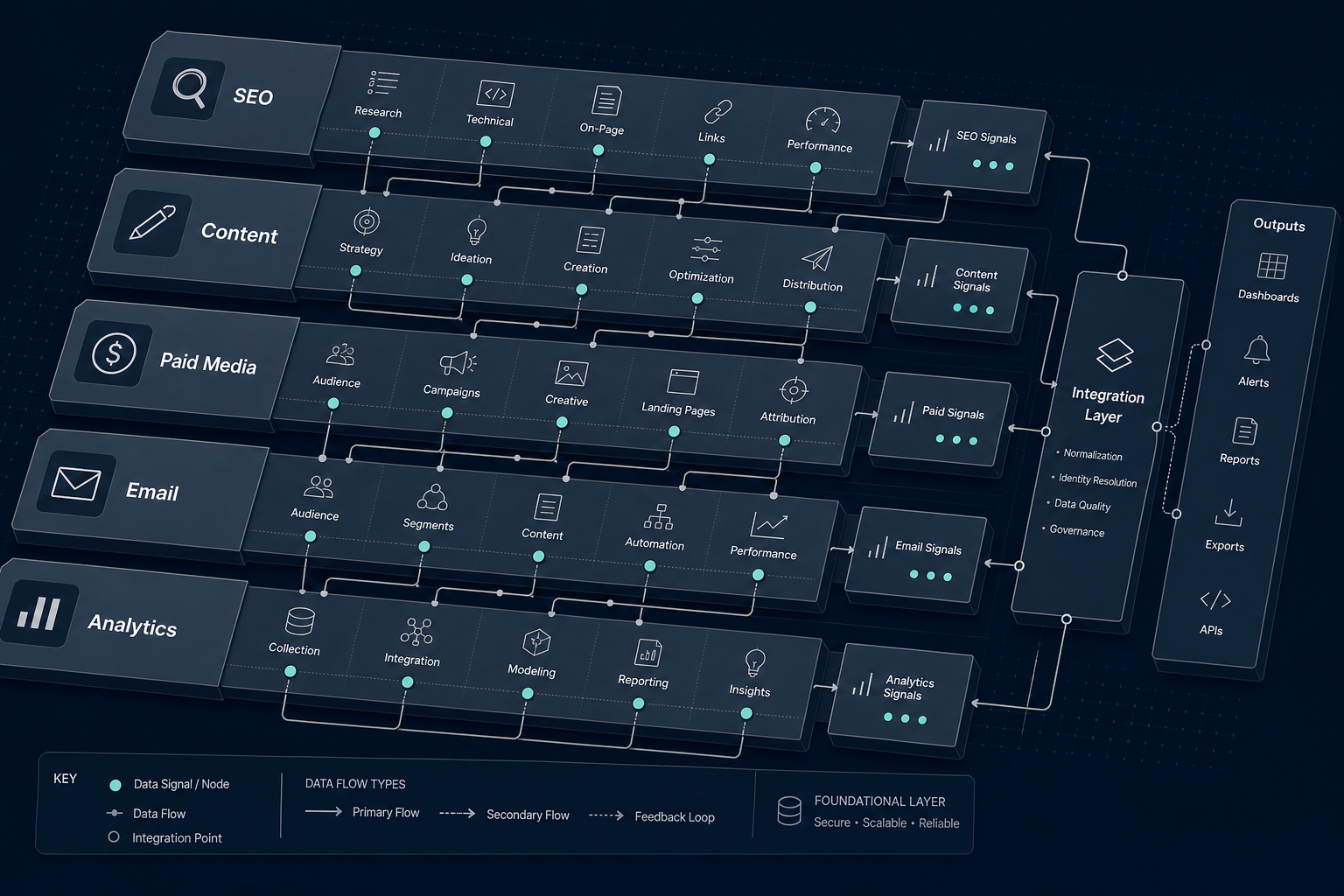
Overlap usually hides behind different labels. A research platform adds AI content briefs. A content optimizer adds keyword research. A writing assistant adds SEO scoring. A GEO tracker adds topic recommendations. Each feature can be legitimate on its own; the problem starts when the team treats all of them as separate authorities.
Before renewing, map each tool to the decision it owns. If two tools both decide target keywords, one should become secondary or disappear. If two tools both score drafts, pick one standard for writers. If three tools generate outlines, decide which one enters the brief and which ones are only used for optional research.
- Keyword ownership: one platform should be the source for target query, search volume, difficulty, ranking movement, and competitor comparison.
- Brief ownership: one workflow should decide intent, page type, required sections, internal links, and editorial angle.
- Optimization ownership: one tool should guide on-page coverage before publication or refresh.
- Drafting ownership: one assistant workflow should handle generation and revision tasks, with human review before publication.
- Reporting ownership: one dashboard should be trusted for leadership or client-facing performance conversations.
This is the point where buying discipline saves more time than negotiation. A discounted second platform is still expensive if it creates conflicting instructions every week.
Treat GEO Tracking as a Conditional Fourth Slot
AI search visibility is too important to ignore and too unsettled to treat as a default line item for every team. Semrush’s AI Overview volatility study, based on 3,000 keywords in October 2024, found 0% URL consistency and 91% URL churn in Google AI Overviews.[6] The study comes from a vendor, but the methodology is specific enough to be useful context: the measurement surface is unstable.
That has two consequences for stack planning. First, if AI-generated search answers are already affecting your category, a dedicated visibility tracker may be worth testing. This is especially true for software, finance, health, travel, and other research-heavy markets where buyers may encounter summarized answers before clicking a traditional result. Second, early dashboards should be treated as directional monitoring, not settled attribution systems.
Newer entrants such as OtterlyAI, KIME, AIclicks, and similar tools may develop quickly, but many launched in the 2024–2026 window and do not yet have the same long-term independent reliability record as established SEO platforms. That does not make them bad purchases. It means they should be bought with a test plan: which prompts, engines, markets, and competitors will be monitored; who will review the data; and what decision the report can actually change.
If the answer is “we want to know what is happening,” keep the test small. If the answer is “our leadership team needs to understand why brand mentions in AI answers are changing,” the fourth slot has a clearer job. For a deeper workflow view, see what GEO changes in SEO work.
A Simple Selection Rule for 2026
The best AI SEO tools for a given team are the smallest set that covers the workflow without duplicating authority. That usually means one research and tracking layer, one content optimization layer, and one AI assistant. Add a fourth AI visibility tool only when AI-generated search answers are a meaningful channel or stakeholder concern.
For a lean team, aim for the $55–$99 per month range and protect the workflow from unnecessary dashboards. For a serious content or agency operation, plan closer to $185–$240 per month and make sure each platform owns a different decision. If budget is tight, prioritize the content optimization layer before specialized technical automation because the average ROI timeline is shorter. Then verify pricing, seat limits, and AI usage caps before purchase.
A stack that ships clean briefs, consistent recommendations, and usable reports will beat a larger stack that makes the team argue with its own software.
References
- Best AI SEO Tools for Small Business (2026), Cited.so
- 16 Best AI SEO Tools to Supercharge Your Rankings in 2026, Veza Digital
- Best AI SEO Tools 2026 & the Ones to Avoid (I Tested 20+), Behind Rankings
- I Tried 18 AI SEO Tools. Here Are The Ones That Really Work, Freddie Chatt
- 26 AI SEO Statistics for 2026 + Insights They Reveal, Semrush
- Exploring URL Volatility in Google's AI Overviews, Semrush

Comments
Join the discussion with an anonymous comment.