

How to Prepare Your Marketing Tech Stack for Product Recalls
A product recall can destroy months of ad ROI in hours if your marketing tech stack isn't prepared. This guide walks through the eight systems you need to configure before a crisis hits — so you can pause affected SKUs automatically, comply with regulations, and protect brand trust.
The most expensive marketing mistake in a product recall can look painfully ordinary: a dynamic product ad keeps serving the recalled SKU because the feed still says it is available, the campaign is still optimizing, and nobody remembered that the retargeting audience refreshes on its own.
By the time someone catches it, the damage is not just wasted media spend. Customers who already bought the product may see a promotion instead of a safety notice. Prospects may click into a product detail page that legal is rewriting. Support teams may get screenshots before they get the approved talking points. The public mistake appears in the ad account, but the first mistake happened earlier: the marketing stack had no recall state that every system was required to obey.
That is the practical center of crisis marketing for product recall strategy in 2026. The plan cannot start with a war room calendar invite. It has to start with pre-configured controls across the systems that keep sending, bidding, ranking, answering, and reporting after the humans are distracted.
The urgency is no longer theoretical. U.S. recalled units surged 27% in Q1 2026 to 492.31 million units, a four-year high, even as individual event counts declined, which means a single recall can now cover much more customer, channel, and catalog surface area than many teams are built to handle.[1] In Europe, recall notifications rose 34% between 2023 and 2025, with the General Product Safety Regulation adding pressure through 48-hour authority notification and direct consumer outreach requirements; Sedgwick separately reported 7,729 European product safety and recall events in H1 2025, an 11-year high.[2][3]
Large recalls expose every automation shortcut. Catalog feeds push product availability into ad platforms. CRM segments continue to qualify buyers for replenishment offers. Chatbots serve the last approved answer. SEO pages keep ranking. Creative folders keep old claims within reach. A recall-ready stack gives those systems a shared stop condition before the announcement lands.
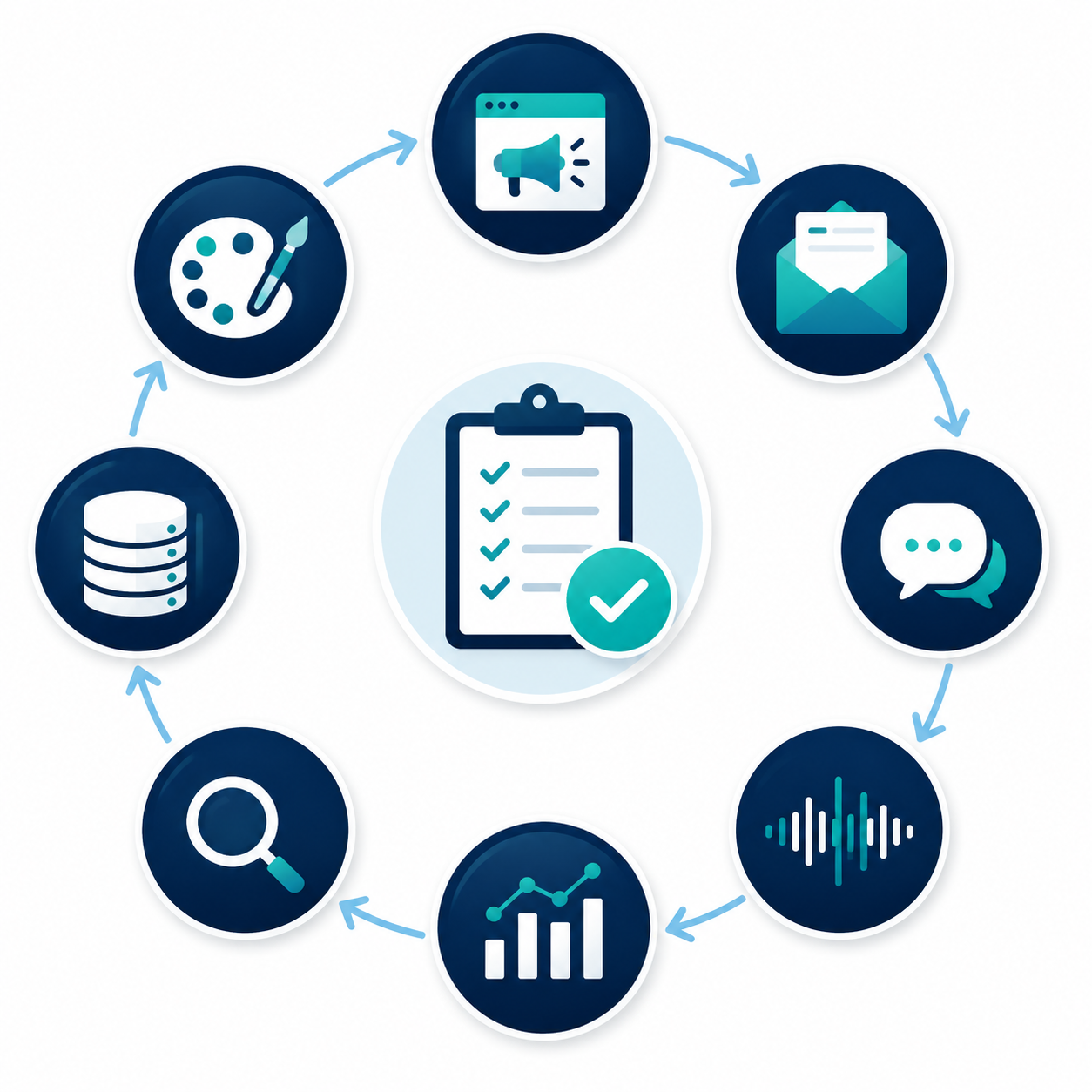
The Eight Systems That Need Recall Logic Before Anything Goes Wrong
A useful audit does not ask whether the team “has a recall plan.” It asks whether each system can recognize an affected product, suppress the wrong action, and route the right message without waiting for someone to manually search every campaign.
| System | Pre-crisis configuration standard | Failure it prevents |
|---|---|---|
| Ad platforms and product feeds | A recall status field, SKU exclusion rules, and campaign naming that lets affected products be paused or blocked without shutting down the whole account | Live ads, retargeting, shopping placements, and catalog ads promoting recalled products |
| CRM and ESP | Recall suppression flags, affected-customer segments, and approved safety-message routing across email, SMS, push, and direct mail exports | Promotions sent to affected customers while recall notices are still pending |
| Customer service chatbots | Recall intents, escalation rules, approved answers, and fallback language that can be activated quickly | Automated answers contradicting legal, support, or safety guidance |
| Social listening and routing | Keyword, SKU, symptom, retailer, and region monitoring tied to named owners and severity rules | High-risk signals seen by dashboards but not acted on |
| Analytics and reporting | Recall annotations, excluded conversion windows, and dashboards that separate safety traffic from commercial performance | Teams optimizing against contaminated data during and after the recall |
| SEO and owned web | Dedicated recall page templates, internal linking rules, and page-status decisions for affected product pages | Customers finding sales content before safety instructions |
| Data infrastructure | A governed recall-state table connected to product, order, customer, and campaign data | Every platform maintaining its own partial version of recall truth |
| Creative templates and asset libraries | Pre-approved recall modules, locked safety language, expiration rules, and claim review status | Old product claims resurfacing in ads, email, landing pages, or social posts |
The flow matters because these systems do not fail at the same speed. Ads and lifecycle messages can cause public damage within hours. Chatbots and social routing affect customer clarity as volume rises. Analytics, SEO, data infrastructure, and creative governance determine whether the same confusion keeps reappearing after the first fix.
Ad Platforms: Build SKU Exclusions as a Safety Control, Not a Panic Button
Ad platforms deserve the deepest audit because they are where the preventable mistake becomes visible fastest. A paid media manager can pause one campaign. The problem is that a modern product can appear in shopping ads, dynamic remarketing, catalog sales campaigns, affiliate feeds, creator whitelisting, localized campaigns, abandoned-cart sequences, and retailer media exports. If the only recall control is “tell the media buyer,” the system is already too fragile.
The pre-crisis requirement is a product-level recall status that ad systems can read. That field can live in a product information management system, commerce platform, feed management tool, or governed data table, but it needs a small, consistent vocabulary: active, under review, recalled, discontinued, replacement available. The exact labels matter less than the contract: when a SKU changes to recalled, every paid media destination receives a value that can trigger exclusion.
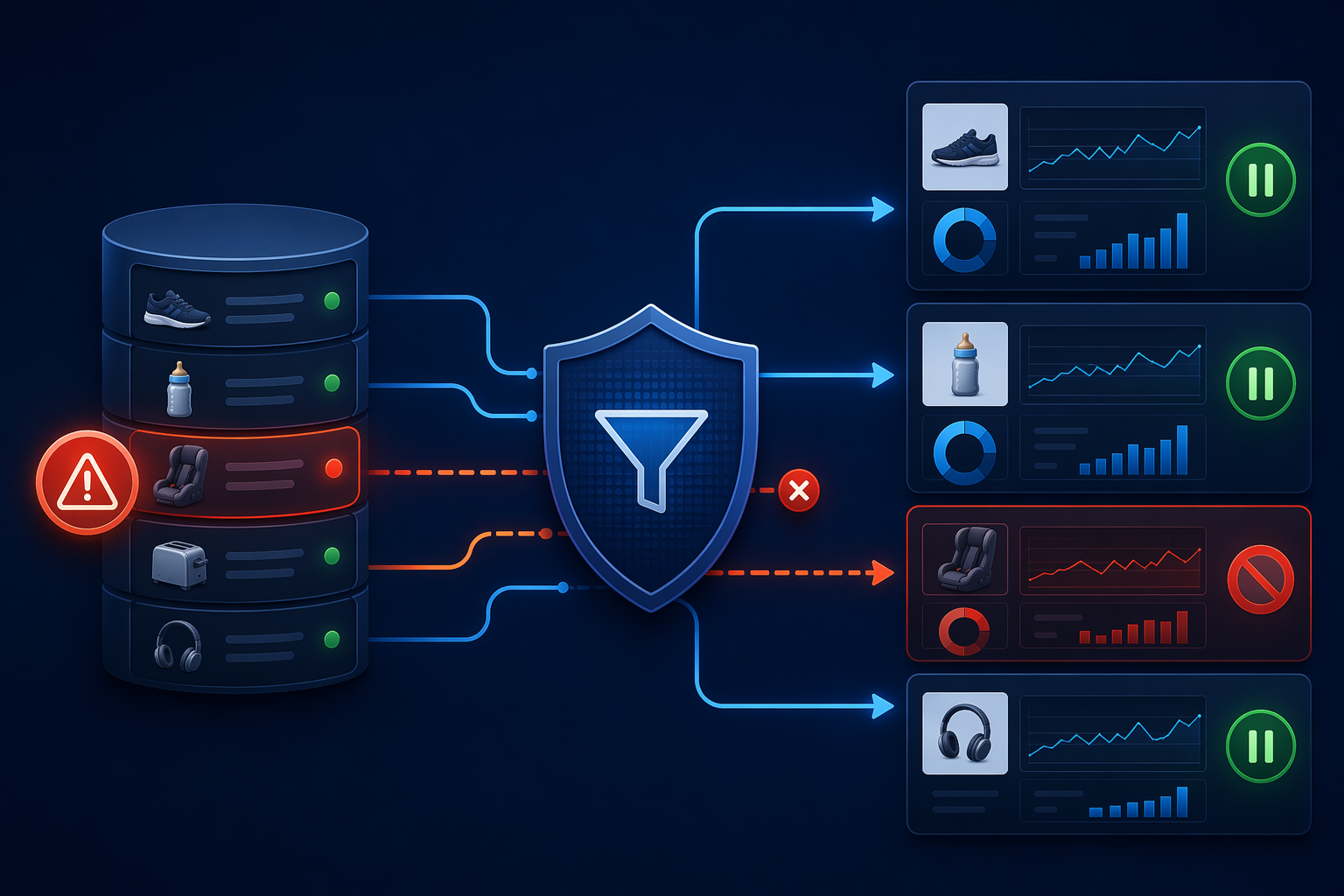
For Meta, Google, TikTok, retailer media networks, and feed syndication partners, the audit should verify capabilities rather than assume current feature names. Platform documentation and feed schemas change. In Q3 2026, the safe standard is not “we use a specific feature called X”; it is “we can exclude products from delivery using a feed attribute, product set, label, rule, or campaign filter without deleting the product record or pausing unrelated SKUs.”
That distinction is operationally important. Deleting a product from a feed may break historical reporting, replacement-product logic, or downstream catalog dependencies. Pausing an entire campaign may stop compliant products during a revenue-sensitive period. A recall exclusion rule should be precise enough to block affected SKUs while leaving unaffected products available for controlled communication and sales.
What the Ad Audit Should Prove
- Every product feed contains a recall-status or safety-status attribute that can be updated outside the ad platform.
- Catalog campaigns, shopping campaigns, dynamic retargeting, and product sets can exclude recalled SKUs using that attribute or a mapped label.
- Campaign naming and account structure make it possible to identify all campaigns that can serve product-level creative.
- Retargeting audiences built from product views, carts, purchases, or replenishment windows can be suppressed for affected SKUs.
- A dry-run test confirms that a dummy recalled SKU disappears from eligible ad delivery paths without affecting unrelated products.
- The rule owner, backup owner, and legal approver are documented in the same place as the feed logic.
The dry run is where optimistic diagrams become useful or embarrassing. Pick a harmless test SKU, mark it with the recall-status value, and trace it through every ad destination. Does it leave the catalog? Does it remain visible but ineligible? Does a local market feed override the central field? Does a manual product set still include it? Does a retailer media partner refresh hourly, daily, or only after a ticket? Those answers belong in the audit, not in the first recall call.
The same logic applies to pre-approved creative folders. If a campaign can run product-specific copy without pulling from a live feed, the SKU exclusion will not catch it. Static ads, influencer briefs, automated display variants, and old seasonal folders need a claim-review status and an expiration date. A practical creative workflow looks less like a brand library and more like a production control system; teams already rebuilding for auditable AI and automation can treat this as part of a broader martech stack governance problem.
CRM and ESP: Suppress Promotions Before You Write the Apology
The second high-risk system is CRM. Paid media can embarrass the brand in public; lifecycle automation can confuse the exact customers who most need clear safety information.
A recall-ready CRM does three things before copywriting begins. It identifies affected customers, suppresses commercial messages that would be inappropriate, and routes recall communications through approved templates. If those jobs are bundled into one manual spreadsheet, the team will lose time precisely when customer lists are being revised by SKU, batch, retailer, purchase window, geography, and regulatory scope.
The affected-customer segment should not rely only on a single purchase event. It may need order history, warranty registration, loyalty-card purchase data, product registration, subscription records, replacement-part orders, marketplace exports, and retailer-provided files. Some of those sources will be incomplete. That is why the CRM audit needs confidence levels and list provenance, not just a segment name that says “recall audience.”
Minimum Recall Fields for CRM Segmentation
| Field | Why it matters |
|---|---|
| Affected SKU or product family | Connects the customer record to the product scope legal and operations are reviewing |
| Purchase or registration date | Separates affected purchase windows from unaffected ownership |
| Batch, lot, serial, or model number when available | Narrows messaging when the recall does not cover every unit |
| Jurisdiction or shipping region | Supports region-specific regulatory language and contact routes |
| Notification status | Shows whether the customer has been sent, delivered, opened, clicked, or escalated |
| Commercial suppression status | Stops promotions, replenishment nudges, cross-sell, winback, and loyalty offers that conflict with the recall |
| Source confidence | Distinguishes registered owners, inferred buyers, retailer uploads, and uncertain matches |
The suppression layer should be channel-specific. A customer may need to receive a recall notice by email and SMS while being excluded from a coupon, back-in-stock alert, replenishment reminder, product-review request, winback offer, and lookalike seed export. Suppression is not silence. It is the routing rule that keeps safety communication open while commercial automation steps aside.
Template preparation also needs more discipline than most teams give it. The CPSC tells recalling companies to use the words “recall” and “safety” in social media messaging about recalls and to link directly to a dedicated recall webpage; it also provides platform-by-platform guidance for social outreach where the brand has a presence.[4] Even when a recall falls outside CPSC jurisdiction or outside the U.S., that kind of specificity is a useful configuration lesson: templates should reserve locked fields for required words, direct recall-page links, product identifiers, remedy instructions, and approved contact paths.
For email, SMS, push, and in-app messaging, the pre-crisis work is to separate variable content from locked language. Product name, batch range, retailer, and remedy steps may change. Safety framing, legal footer, support links, and escalation instructions should not be rewritten in a hurry by every regional marketer. Teams building more adaptive lifecycle programs can still keep recall templates constrained; the best personalization is useless if it personalizes the wrong promotion into a safety event. For a broader operating model, see this guide to AI in email marketing automation and personalization.
Chatbots: Prepare the Intent Before the Volume Spike
Chatbots can help during a recall, but only if they are treated as controlled routing systems rather than free-form answer machines. Market IA reports that conversational chatbots can absorb up to 80% of incoming customer requests during a recall crisis peak; that is a capacity claim from a vendor-side source, so it should be read as a directional indicator, not a guarantee for every brand or recall type.[2]
The safer goal is not “deflect 80% of tickets.” It is to make sure common recall questions receive current, approved answers and that high-risk cases escalate quickly. The bot needs recall-specific intents before the recall: “Is my product affected?”, “Where is the lot number?”, “Can I keep using it?”, “How do I get a refund or replacement?”, “I was injured,” “My child used this,” “I bought this from a retailer,” and “I cannot find my serial number.”
Each intent needs an owner-approved answer, a last-reviewed timestamp, and an escalation condition. Injury, medical symptoms, fire, contamination, child safety, media inquiries, regulator mentions, and legal threats should not be handled like shipping-status questions. If the bot cannot confirm the customer’s SKU, lot, or geography, it should route to the recall page or a human support path rather than improvising.
This is also where AI tool selection should stay grounded. A model that can summarize messy customer messages is useful only if the signal is routed somewhere. A model that generates fluent answers is risky if approved language expires without the bot knowing. Choose tooling around the bottleneck: intent recognition, queue triage, multilingual routing, knowledge-base control, or agent assist. The same principle applies outside recalls; tool choice should follow the real operational constraint, not the broadest AI feature list.
Social Listening Must Route, Not Merely Observe
Social listening is often oversold as sentiment monitoring. Sentiment alone is too blunt for recall readiness. The useful pre-crisis configuration monitors concrete signals: product names, SKU nicknames, model numbers, retailer names, batch codes, symptom language, failure modes, “refund,” “replacement,” “unsafe,” “recall,” and common misspellings.
The routing rule is the point. A TikTok comment about smoke from a consumer electronics product should not sit in the same dashboard queue as a sarcastic complaint about shipping. A Facebook post from a parent describing child exposure should not wait for the weekly brand-health readout. Severity categories should map to named owners in customer care, legal, quality, regulatory, and communications.
The CPSC’s social media guidance matters here because it turns messaging discipline into a platform configuration requirement. If the brand maintains a presence on a platform, recall communication may need to reach that platform’s audience with required terminology and a direct recall-page link.[4] That means the social team needs pre-approved post structures, boosted-post criteria, comment moderation rules, and escalation scripts before the legal review cycle compresses.
Analytics: Mark the Recall So the Team Stops Optimizing Against Noise
A recall contaminates performance data. Conversion rates drop for reasons that have nothing to do with creative quality. Support-page traffic spikes. Branded search changes shape. Refund and replacement flows may look like high-intent commerce activity unless analytics labels them correctly.
The audit standard is simple: every analytics workspace should have a recall annotation process and a way to separate safety journeys from commercial journeys. That includes web analytics, product analytics, attribution tools, BI dashboards, call-center reporting, ad platform exports, and experimentation tools. If an A/B test is running on an affected product page, someone needs authority to pause it or mark the window as invalid for normal commercial interpretation.
This is where the widely cited efficiency claims should be used carefully. Market IA cites McKinsey for AI-powered recall management reducing total recall cost by 28% on average and resolution time by 41%, but the article is a second-hand reference and the original study was not independently verified in the available source chain.[2] The practical conclusion is narrower: better automation and cleaner routing can plausibly reduce manual work and response lag, but no team should present those numbers as a guaranteed business case.
SEO and Owned Web: Make the Recall Page Easier to Find Than the Sales Page
During a recall, the owned web problem is not only publishing a page. It is making sure customers can find the safety page before they find old product claims, old reviews, cached buying guides, or a product detail page that still looks commercially normal.
The recall-page template should exist before it is needed. It needs locked areas for the product identifier, affected date or lot range, risk description, remedy, customer action, support contacts, regulator links when applicable, update timestamp, and accessibility-friendly instructions. It also needs a direct URL that social, email, SMS, support, QR labels, and paid media can all use without waiting for a landing-page build.
Product pages need a decision tree. Some pages should remain live with prominent safety notices and blocked purchase paths. Some should redirect to a recall page. Some should stay indexable because customers search the model number and need the official answer. The wrong default is leaving a normal product page live because “SEO traffic is valuable.” In a recall, clarity is the valuable traffic.
SmartLabel shows why owned product information infrastructure matters. The Consumer Brands Association says SmartLabel is used by more than 100,000 products and described a Salmonella recall in which a QR-code recall alert was activated in minutes and reached hundreds of thousands of consumers within days.[5] That is not proof that every brand can reach every buyer through a label system, but it is a useful example of what happens when the product information layer is already connected to customer-facing surfaces.
Data Infrastructure: One Recall State, Many Destinations
The weakest recall stacks usually have many partial truths. Legal has a PDF. Quality has a spreadsheet. Ecommerce has a product flag. Paid media has a manual exclusion list. CRM has a segment. Support has a knowledge-base article. None of them update at the same time.
The audit should identify the system of record for recall state and the destinations that consume it. For many companies, the right answer is not a brand-new platform. It may be a governed table connected to the PIM, commerce system, CRM, feed manager, warehouse data, and BI layer. What matters is that the recall state has version history, owner approval, field definitions, and a distribution path.
| Recall-state requirement | Audit question |
|---|---|
| Governed owner | Who can change a SKU from active to under review or recalled? |
| Approval trail | Can legal, quality, regulatory, and marketing see who approved the current status? |
| Destination map | Which ad, CRM, support, web, analytics, and partner systems consume the field? |
| Refresh cadence | How quickly does each destination receive a status change? |
| Rollback control | What happens if a product is incorrectly flagged or the recall scope changes? |
| Exception handling | How are regional, batch-level, retailer-specific, or replacement-product exceptions represented? |
Versioning matters because recall scope changes. A product can move from investigation to voluntary recall. A batch range can expand. A replacement remedy can change. A country can require different language. If the data model cannot represent that movement, marketers will invent local workarounds, and local workarounds are where stale campaigns survive.
Creative Templates: Lock the Parts Nobody Should Rewrite Under Pressure
Recall creative is not where a team should discover how much of its messaging depends on informal judgment. Pre-approved templates should exist for social posts, paid media notices, email, SMS, landing-page modules, app banners, retail partner copy, support macros, and executive statements. They do not need final recall details filled in. They do need the structure that keeps required information from being omitted.
The template library should distinguish between locked language and editable fields. A marketer can update a model number. They should not casually rewrite the safety description, remedy promise, regulator reference, or support escalation instruction. If generative AI is used to draft variants, the workflow needs retrieval from approved source language, human review, and a visible approval state before anything enters a campaign folder. The same production-system discipline applies to non-crisis content; a strong AI marketing workflow audit is useful precisely because it forces teams to define what machines may draft and what humans must approve.
This is not only a compliance concern. Customers trying to understand whether a product is safe do not benefit from five slightly different explanations because every channel “optimized” the message. Consistency is part of safety.
What Good Recall Infrastructure Makes Possible
The Tylenol precedent is still cited because it pairs visible action with infrastructure. Johnson & Johnson’s market share reportedly fell from 35% to 8% after the poisoning crisis and recovered within 12 months through nationwide recall action, transparent communication, and tamper-proof packaging innovation.[6] The lesson for a modern marketing stack is not to imitate a 1980s playbook. It is that communication works better when the company can actually change what customers see, buy, open, scan, and trust.
Market IA also reports that 62% of customers rebuy from a brand that communicates well during a recall, another vendor-side figure that should be treated as directional rather than universal.[2] Even with that caution, the operating implication is sound: recall communication is not a single announcement. It is a sequence of controlled experiences across media, email, search, support, packaging, and product pages.
The Recall-Ready Martech Scorecard
A pre-crisis audit should end with evidence, not confidence. The following scorecard is deliberately operational. A “yes” should mean the control has been tested or documented well enough that a backup owner could run it.
- Every product has a recall-status field or equivalent safety-state attribute connected to product, commerce, feed, CRM, and reporting systems.
- Ad platforms and feed destinations can exclude recalled SKUs from delivery without pausing unrelated products or deleting historical product records.
- Retargeting, replenishment, cross-sell, winback, review-request, and lookalike workflows can suppress affected customers or affected SKUs.
- CRM segments can identify affected customers by SKU, purchase window, batch or serial data when available, geography, and source confidence.
- Recall templates exist for email, SMS, push, social, paid media, web, support macros, and partner communications, with locked safety language and editable product fields.
- Chatbots have recall intents, approved answers, last-reviewed timestamps, and escalation rules for injury, child safety, medical, legal, and regulator-related messages.
- Social listening monitors product identifiers, symptom language, retailer mentions, and recall terms, and routes severe signals to named owners.
- Analytics systems can annotate recall windows, separate safety journeys from commercial journeys, and pause or label affected experiments.
- Owned web has a dedicated recall-page template, product-page decision rules, and direct links usable across social, email, SMS, QR labels, search, and support.
- The recall-state data model has owners, approval history, refresh cadence, destination mapping, rollback rules, and exception handling for regional or batch-level scope changes.
The useful question is not whether the team would care in a crisis. Of course it would. The question is whether the stack can stop doing the wrong thing while the team is still figuring out the right words. Crisis marketing for product recall strategy is partly about what the brand says under pressure. More often than teams admit, it is about making sure the systems cannot keep saying the wrong thing after a product has been pulled.
References
- Product Recall Data and CPSC/FDA Recall Trends, BCM Public Relations, https://bcmpublicrelations.com
- Product Recall: Complete Guide for Marketers 2026, Market IA, https://market-ia.fr/en/blog/product-recall-complete-guide-marketers-2026-4
- Product Recalls Hit 11-Year High, GlobalVision, https://globalvision.co/blog/product-recalls-hit-11-year-high
- Social Media Guide for Recalling Companies, U.S. Consumer Product Safety Commission, https://www.cpsc.gov/Business--Manufacturing/Recall-Guidance/Social-Media-Guide-for-Recalling-Companies
- Modernizing Recall Communications, Consumer Brands Association, 2025, https://consumerbrandsassociation.org/blog/modernizing-recall-communications
- Reputation, Recalls and Recovery, Harte Hanks, https://distribution.hartehanks.com/blog/reputation-recalls-and-recovery/
Comments
Join the discussion with an anonymous comment.