
Jasper vs Competitors: How to Choose the Right AI Writing Tool for Your Team
Compare Jasper AI with ChatGPT, Writesonic, Copy.ai, and other writing tools to find the best fit for your team's budget, brand voice needs, and content volume. This guide provides a total cost of ownership framework that accounts for editing time to reveal the true cost of each tool.
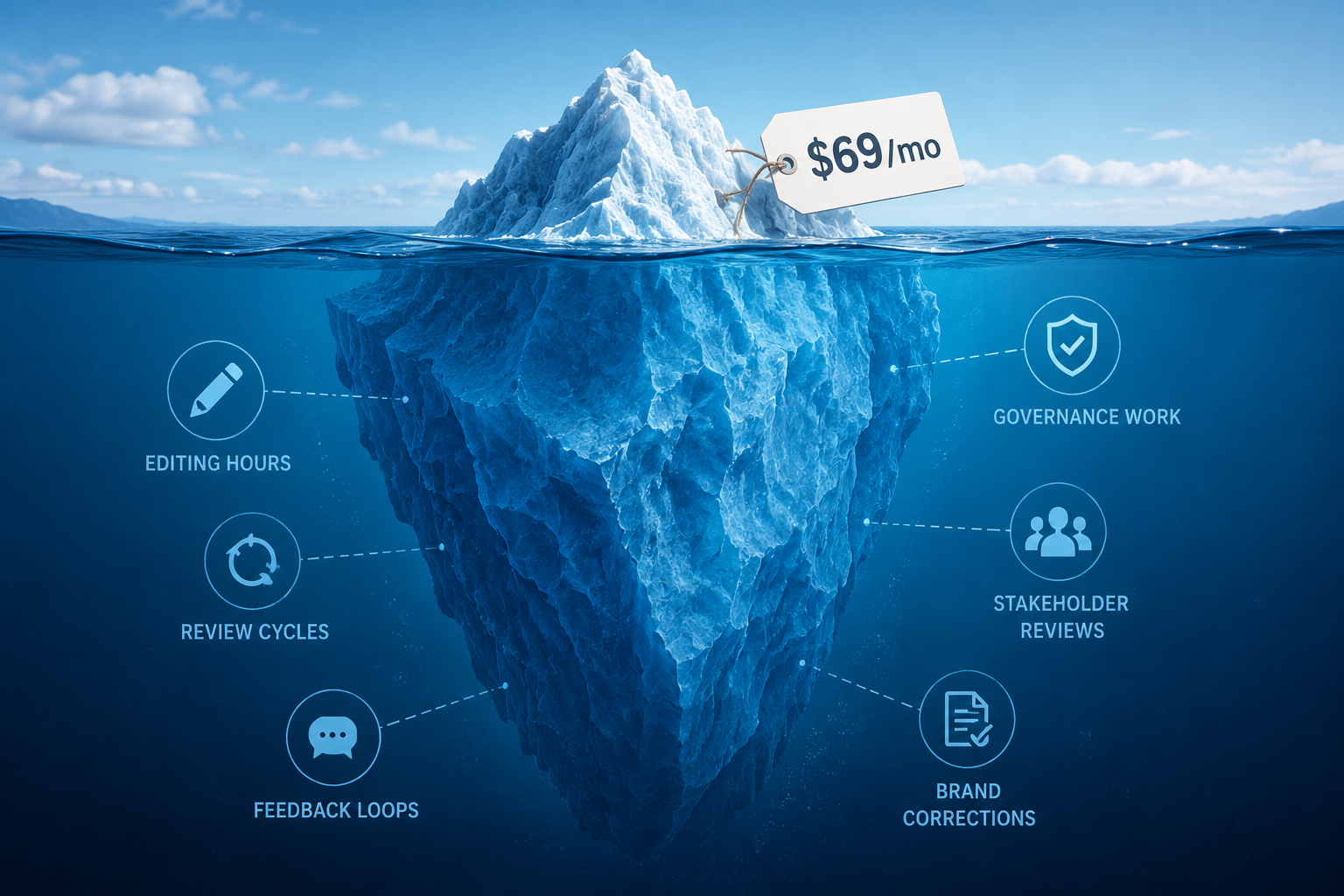
The expensive part of an AI writing tool usually starts after the draft appears. Someone still has to notice the claim that sounds too absolute, the intro that ignores the campaign angle, the product language that does not match the sales deck, and the five writers who all used the same tool into five different versions of the brand. That is why a jasper marketing ai comparison in 2026 should not begin with which tool can produce the cleanest paragraph in a demo. Most of them can. The better question is which one leaves the least work for the people who have to publish, approve, and defend the content.
The subscription price is the part procurement can see. Jasper Creator is listed at $49 per month, or $39 per month when billed annually; Jasper Pro is $69 per month, or $59 annually; Business is custom priced, with a 7-day trial and no free tier listed. Competing entry prices often look lighter: ChatGPT Plus and Writesonic are commonly compared at $20 per month, Copy.ai and Anyword at $49 per month, and Rytr at $9 per month in third-party reviews available in the reviewed sources.[1][2]
That price spread matters, but it is not the full budget. If a cheaper tool moves work into editing, brand correction, SEO cleanup, and review, the invoice only changed departments.
The Real Comparison Starts With Editing Time
A useful buying model has to include both seat cost and the editing tax. Reviewed comparisons used an illustrative workload of 20 articles per month and an editing rate of $80 per hour. In that model, Jasper Pro is not the cheapest subscription, but it is not the most expensive operating choice once editing hours are included.[2][3]
| Tool | Monthly tool cost used in model | Editing time used in model | Editing cost at $80/hour | Estimated monthly TCO |
|---|---|---|---|---|
| Jasper Pro | $69 | 10 hours | $800 | $869 |
| Writesonic | $20 | 9 hours | $720 | $740 |
| ChatGPT Plus | $20 | 12 hours | $960 | $980 |
The point is not that these numbers will match every team. They will not. A product-led SaaS team writing technical explainers will have a different review burden than a consumer brand creating promotional landing pages. The point is that a $20 monthly plan can become more expensive than a $69 plan if it adds only a few more hours of review.
This is also where broad claims about AI saving time become too blunt. If a tool gives a content manager a usable first draft but forces two rounds of brand correction, the calendar still pays. If another tool produces a less flashy draft but reliably remembers approved positioning, the team may publish faster.
For a deeper version of this three-tool cost model, see Jasper vs Copy.ai vs ChatGPT: Which Actually Costs Your Team Less?. The shorter version is simple: do not compare writing tools without assigning a cost to the editing hours they create.
Why Jasper Can Be Worth Paying More For
Jasper’s strongest argument is not that it writes a magical first draft. It is that it tries to make brand consistency operational before the draft reaches an editor. Tested reviews found Jasper’s Brand Voice training, using 5 to 30 samples, produced on-brand output 80% to 90% of the time in reviewed tests.[3]
That matters most when multiple people are generating content. One skilled solo marketer can often coax ChatGPT into a consistent voice with careful instructions, saved instructions, and manual examples. A team is different. Writers forget to paste the latest positioning. Freelancers use old boilerplate. A campaign manager asks for urgency while a product marketer asks for caution. By the time everything lands in the content lead’s queue, the problem is no longer raw writing quality; it is reconciliation.
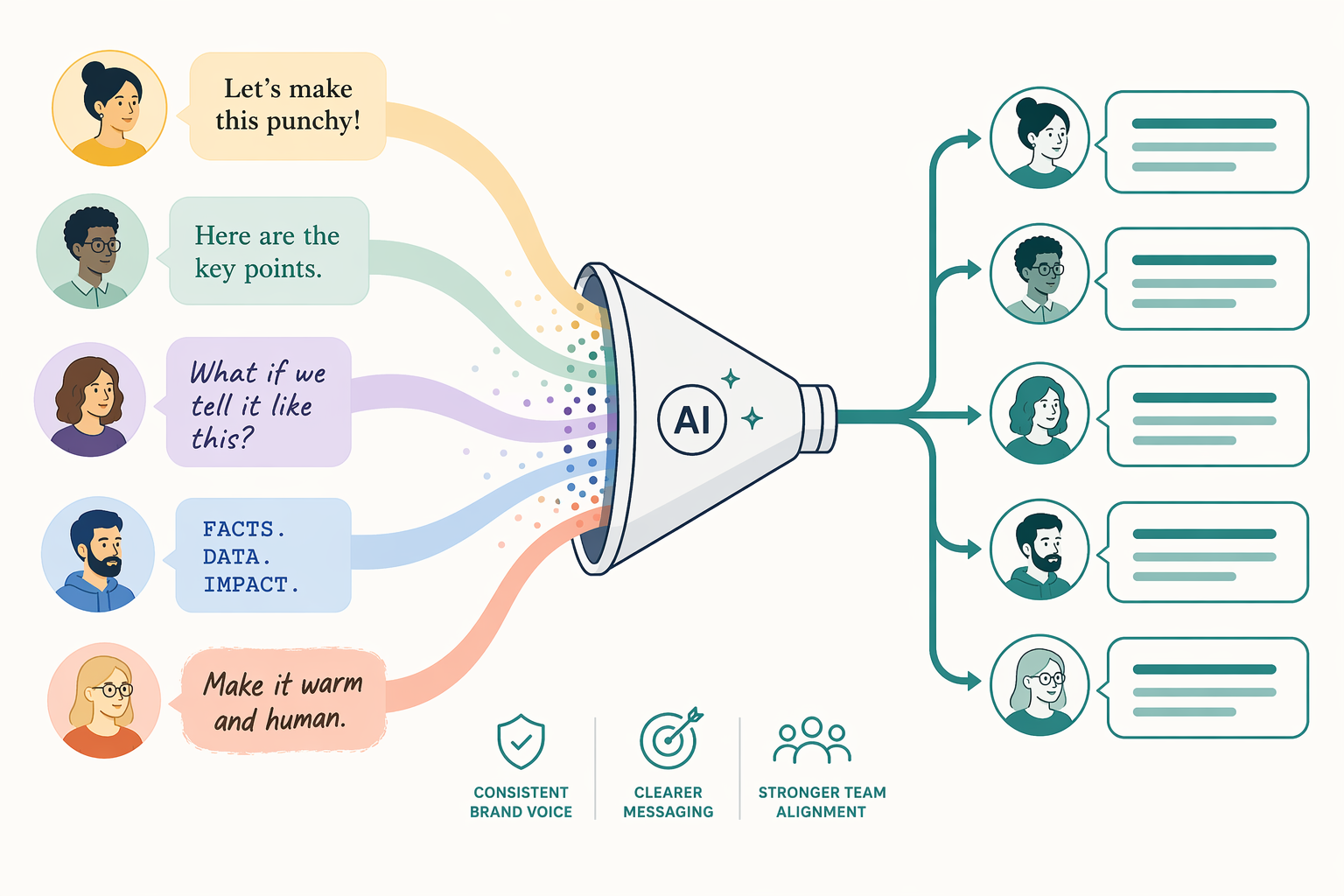
Jasper’s 2026 product direction leans into that coordination problem. Its platform messaging has shifted from a writing assistant toward a marketing agents platform with more than 100 agents, Content Pipelines, and Brand IQ. Jasper IQ includes governance elements such as Brand Voice, Visual Guidelines, Style Guide, and Knowledge Base, which are meant to shape generation rather than sit as a checklist after the fact.[4]
The distinction is practical. If the system can bring brand voice, product knowledge, and style rules into the generation step, the editor spends less time saying the same thing for the tenth time. That is the business case for Jasper Pro or Business: not prettier copy, but fewer avoidable corrections across a recurring content operation.
This is also why Jasper’s value tends to show up later than the demo. The first week may feel like templates, instructions, and setup. The payoff comes when the fifth person on the team generates a draft that sounds like it came from the same company as the first four.
Where the Premium Has to Prove Itself
A higher subscription can be justified only if the system is maintained. Brand Voice samples have to be selected well. Knowledge Base material has to be current. Style rules have to reflect how the company actually wants to sound, not a vague list of adjectives. If no one owns that maintenance, Jasper becomes an expensive writing workspace with a nicer interface.
That ownership usually sits somewhere between content operations, product marketing, and brand. It is unglamorous work, but it is the work that decides whether the platform reduces review time or simply gives the team another place to store instructions nobody follows.
Where Jasper Does Not Automatically Win
Jasper is a strong fit for brand-controlled, multi-user marketing content. That does not make it the best answer for every team. The competing tools matter because they solve different operational bottlenecks.
| Tool | Best fit | Operational caveat |
|---|---|---|
| Jasper | Multi-person marketing teams that need brand voice consistency, workflow infrastructure, and governance at generation time | Higher seat price; setup and knowledge maintenance determine whether the premium pays back |
| Writesonic | Teams where SEO production is central and built-in optimization or fact-checking reduces tool switching | May be less compelling if brand voice governance is the main bottleneck |
| ChatGPT Plus | Solo creators and low-volume teams that can tolerate manual setup and review | Low subscription cost can hide extra editing and governance work |
| Copy.ai | Go-to-market teams focused on short-form campaign, sales, and ad copy | Not the obvious choice for long-form editorial governance |
| Anyword | Ad-copy-focused teams that care about performance-oriented short-form variations | Less central for broad content operations |
| Rytr | Very low-budget or low-volume users | Savings matter most when review complexity is low |
| Writer.com | Enterprises with strict terminology, compliance, and governance needs | Adjacent to Jasper rather than a simple one-to-one replacement |
| Relato | Small teams that want structured content workflow support | Adjacent workflow fit; not necessarily a full Jasper substitute |
Writesonic deserves attention because it addresses a common integration gap: SEO. Reviewed comparisons note that Writesonic includes built-in SEO optimization and fact-checking, while Jasper may require a Surfer SEO add-on to match that workflow.[3][5] If the team’s weekly bottleneck is not brand voice but search production, briefs, optimization, and verification, Writesonic can be the more efficient choice even if Jasper has the stronger brand system.
Writer.com belongs in a different kind of comparison. It is not simply “another AI writer” in the same way a lightweight copy tool is. Relato’s comparison positions Writer.com as stronger on terminology controls and SOC 2/HIPAA readiness, while Jasper has the broader marketing feature set and newer AI search presence capabilities.[5] For regulated enterprises, terminology control and compliance posture may outweigh template breadth.
Copy.ai and Anyword are better judged through short-form go-to-market work. If a team mainly needs variations for ads, landing page sections, outbound campaigns, or sales enablement snippets, long-form editorial governance may be less important than fast campaign iteration. That is a different buying problem from managing a 20-article monthly content program.
ChatGPT Plus remains the uncomfortable benchmark because it is inexpensive and flexible. For a capable solo operator, that flexibility is often enough. The problem appears when leadership sees the $20 subscription and assumes the operating cost is also $20. It is not, unless someone has confirmed that review time, brand consistency work, and workflow handoffs stay low.
Fit the Tool to Team Maturity, Not Feature Count
Feature-count comparisons can make every tool look close. The better filter is team maturity: content volume, number of contributors, review complexity, SEO dependence, and governance risk. Those factors decide whether structure is helpful or just overhead.
Solo Creators and Very Low-Volume Teams
If one person is producing fewer than 10 articles per month, ChatGPT Plus or Writesonic is usually the more defensible starting point. The solo user can keep brand rules in their head, manually adjust instructions, and accept some inconsistency because no one else is waiting on a formal content pipeline.
This is where a structured platform can be more system than the team needs. Paying for governance makes sense only when there is enough repeated work for governance to replace human correction.
Small Teams With Brand Consistency Problems
Once three or more people are creating content and the team is publishing more than 10 articles per month, Jasper becomes easier to justify. The buying case is not “our writers need AI.” It is “our editors need fewer mismatched drafts.”
This is the point where Brand Voice, Style Guide, Knowledge Base, and Content Pipelines begin to matter. They create shared constraints around the work. For teams that have already felt the cost of cleaning up inconsistent AI output, that structure is not bureaucracy; it is damage control moved upstream.
Readers who want a broader constraint-based selection process can use How to Choose an AI Content Creation Tool in 2026 after narrowing the vendor list.
Teams Where SEO Production Is the Center of Gravity
If the main workflow is keyword research, brief creation, optimization, fact-checking, and refreshes, Writesonic may remove more friction than Jasper. Jasper can still fit, especially if brand governance is important, but a team should price the SEO stack around it. If matching Writesonic’s SEO-native workflow requires an add-on and another handoff, that cost belongs in the comparison.
This is where the practical question changes from “Which AI writes better?” to “Which one eliminates a tab, a review step, or a recurring manual check?” The answer may be different for an SEO production team than for a brand-led campaign team.
Ad-Copy and GTM Teams
For teams producing short-form campaign copy, Copy.ai or Anyword may be better aligned than Jasper. The work is usually variation-heavy: headlines, value propositions, outbound sequences, landing page sections, and paid social options. Governance still matters, but the review loop is often about message testing and channel fit rather than long-form editorial consistency.
A team like that should compare tools by how quickly they generate useful variations, how easily those variations map to campaign stages, and how much rewriting a demand generation manager has to do before anything can be tested.
Enterprises Comparing Jasper and Writer.com
Enterprise teams should not reduce this decision to writing quality either. The meaningful comparison is between Jasper’s broader marketing platform and Writer.com’s governance orientation. Writer.com’s terminology controls and compliance readiness make it a serious option where legal, medical, financial, or regulated language must be tightly managed.[5]
Jasper’s counterargument is breadth across marketing execution: agents, content workflows, brand systems, and now AI search presence monitoring. A team with strict compliance review may prefer Writer.com. A marketing organization trying to coordinate campaigns, content, and AI visibility from one workspace may find Jasper’s platform direction more useful.
Jasper’s 2026 AI Search Bet
Jasper’s GEO Agent is the part of the 2026 story that deserves attention beyond ordinary writing-tool comparison. Jasper announced a June 2026 launch focused on autonomous brand presence monitoring across ChatGPT, Gemini, and Claude, with five scores: Overall, Brand Presence, Citation Rate, Sentiment, and Share of Voice.[6]
For teams responsible for how the brand appears in AI search and answer engines, that is not a cosmetic add-on. Traditional SEO reporting does not fully answer whether AI systems mention the brand, cite it, describe it accurately, or position competitors more favorably. A marketing operations lead will care less about the dashboard itself and more about whether it creates a repeatable monitoring process someone can own.
The budgeting caveat is real. Jasper’s GEO Hub uses credits on top of seat pricing, which can make monthly spend less predictable than a flat writing-tool subscription. That does not make it a bad fit, but it does mean finance needs to see usage assumptions, not only seat counts.
For a Jasper-specific review of whether the broader marketing hub is worth the premium, see Jasper AI in 2026: Is the Marketing Hub Worth the Premium?.
A Practical Buying Test
Before choosing a tool, run the evaluation where the cost actually appears: after generation. Give each tool the same real assignment, using a content type the team publishes often. Do not judge the best single paragraph. Track what happens next.
- How many minutes does the editor spend before the draft is ready for stakeholder review?
- How many brand, product, tone, or compliance corrections appear repeatedly?
- Can different users produce drafts that feel like they came from the same company?
- Does the tool reduce SEO, fact-checking, or approval handoffs, or does it add another system?
- Who owns the knowledge base, brand rules, and workflow setup after the trial ends?
- Can the team forecast monthly cost from real usage, including add-ons and credits?
A clean test should include at least one strong writer, one average user, and one person who will use the tool only occasionally. The occasional user is important. Many AI pilots look good when run by the internal champion and fall apart when normal users inherit them.
If Jasper produces the most consistent drafts across users, its premium has a defensible operational basis. If Writesonic removes more SEO and fact-checking work, choose Writesonic. If ChatGPT Plus performs well enough and the team publishes lightly, do not buy structure you will not maintain. If governance and terminology are the risk, put Writer.com in the final round.
The same logic applies beyond the writing tool itself. For teams mapping these choices into a larger marketing stack, AI Marketing Stacks Compared 2026 is the more relevant next comparison. For teams that already chose a tool but still have messy handoffs, Beyond the First Draft: A Full Workflow Guide for AI Content Creation is the better problem to solve.
The Decision Rule
Choose Jasper when multiple marketers or writers need to produce recurring content in one brand voice, and when Content Pipelines, Brand IQ, Knowledge Base, and governance controls will reduce downstream correction. The business case is strongest when the team can show that higher seat cost is offset by fewer editing hours and fewer approval problems.
Choose Writesonic when SEO-native production and built-in optimization reduce more work than brand infrastructure would. Choose ChatGPT Plus or Rytr when volume is low, users are skilled, and manual setup is acceptable. Choose Copy.ai or Anyword when short-form GTM copy is the center of the job. Compare Writer.com when terminology, compliance, and governance risk outweigh broad marketing workflow breadth.
The best AI writing tool is the one that reduces your team’s review burden and governance risk. The most impressive demo draft is only useful if it survives the calendar.
References
- Jasper official pricing page, Jasper
- Fritz.ai Jasper AI review, Fritz.ai
- Tested Media Jasper AI competitor comparison and testing, Tested Media
- Jasper January 2026 product update, Jasper, January 2026
- Relato comparison page, Relato
- Jasper GEO Agent launch blog, Jasper, June 2026

Comments
Join the discussion with an anonymous comment.