
Beyond the First Draft: A Full Workflow Guide for AI Content Creation
A step-by-step guide to moving AI content creation beyond first drafts into research, outlining, brand voice enforcement, editing, repurposing, and distribution. Learn how to systematize a full lifecycle workflow that can double output without sacrificing quality.
Most teams have already had the same experience: AI produces a draft in minutes, and then the real work still takes hours because the angle is weak, the claims are thin, the phrasing sounds generic, and the distribution assets do not exist yet. The usage data matches that frustration. In Presenc AI's 2026 research across 1,860 marketers, 72% of top-100 publishers used AI tools, but only 31% used them for full drafting while 41% used them for research and outlining [1]. Siege Media and Wynter found a similar pattern: 74% used AI for ideation, 61% for outlining, and 44% for drafting [2].
That is the point where a lot of content creation AI programs quietly stall. They speed up the easiest visible step, then leave the editor to clean up the same mess the team had before. If AI only shortens the first pass, it has changed the shape of the work, not the amount of rework.
Where AI belongs in the content lifecycle
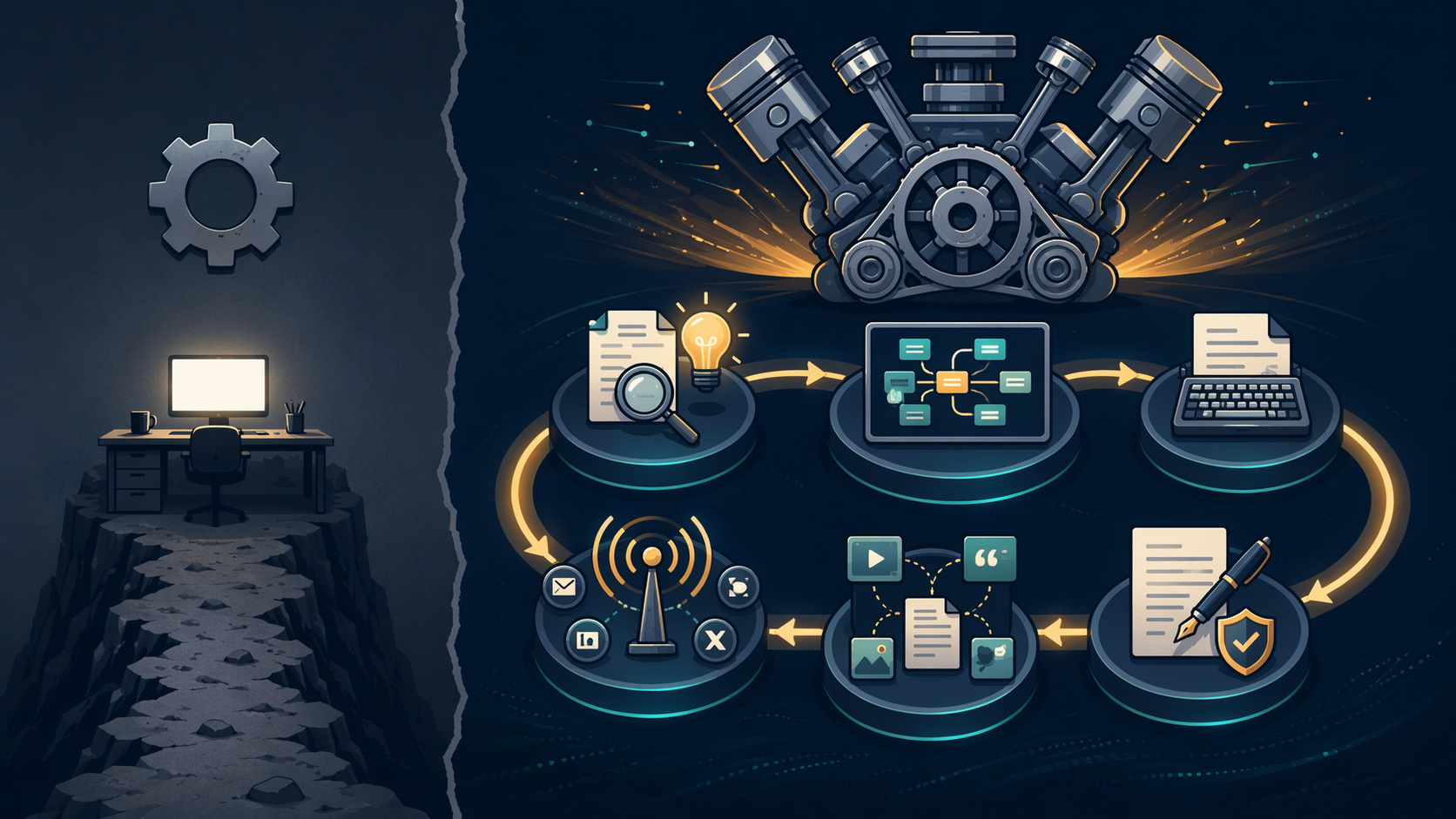
The useful way to think about content creation AI in 2026 is as a set of jobs across the workflow, not a single writing event. Some teams compress these phases, and some skip a pass entirely, but the questions are still the same: what should AI handle, what should a human decide, and where does the handoff prevent rework instead of creating it?
| Phase | What AI does well | What a human still has to decide |
|---|---|---|
| Research | Summarizes source material, clusters questions, surfaces competing angles | Which sources matter, which angle is worth pursuing, what should be excluded |
| Outlining | Suggests structures, section order, and alternate argument paths | Which structure best serves the audience and business goal |
| Drafting | Produces section scaffolds, transitions, and first-pass copy | Where the piece needs specifics, proof, and original judgment |
| Editing and brand voice | Flags repetition, generic phrasing, and tonal drift | Fact-checking, hallucination review, texture, and final voice alignment |
| Repurposing | Creates summaries, social variants, subject lines, and metadata | Which variants fit each channel and which message should stay primary |
| Distribution | Prepares CMS fields, drafts snippets, and preformats assets | Timing, approval, prioritization, and channel fit |
That workflow does not have to appear as six separate meetings. A solo marketer may collapse research and outlining into one pass. An in-house team with legal review may stretch editing and approvals. An agency may care more about repurposing and channel handoff than about the first draft itself. The point is not to copy the diagram; it is to keep every stage from becoming a hidden rewrite.
Research and outlining deserve more of the AI budget
The adoption numbers already hint at where the leverage is. If 74% of marketers are using AI for ideation and 61% for outlining, then those phases are not fringe experiments; they are the places where teams are most willing to let the model help [2]. That makes them the obvious place to improve workflow maturity, because a stronger brief reduces everything that has to be fixed later.
In practice, research and outlining are where AI can turn source notes, customer questions, competitor pages, and a rough assignment into a clearer plan before anyone writes prose. A better version of that process is mapped in the AI content brief playbook, and the important part is not the wording trick but the judgment call: which question is this piece actually answering, and which evidence belongs in the article before drafting starts?
A good AI-assisted outline should already know the likely objections, the proof points that deserve space, and the examples that are too weak to keep. If the draft has to discover the angle later, the team has already spent the time savings.
Drafting should be fast, not precious
Once the outline is stable, the draft should become a scaffold, not a finished object. AI can fill in section starts, transition copy, and rough expansions, but it should not be treated as the final authority in the process. A practitioner following a structured five-phase workflow reported that first-draft completion for a 2,000-word article dropped from 4–6 hours to 1–2 hours [3]. That is a useful benchmark, not a universal promise, but it does show what happens when the earlier phases stop leaking work into the draft.
That kind of time saving matters because the goal is not to squeeze more sentences out of exhausted people. Marketing Agent Blog's research briefing says 62% of digital creators report burnout [3], which is another way of saying that the best use of AI is often to remove the mechanical work that burns people out first.
Editing is where workflow maturity shows up
This is the part teams are tempted to underfund because the draft already exists. That is usually a mistake. Editing in an AI workflow is where claims get checked, hallucinations get removed, tone gets aligned, and the piece gets texture — the concrete specifics that make it sound like it came from a real team, not a generic template. If your editing pass does not change substance, voice, or evidence, the workflow is still draft-centric. For a deeper look at the failure patterns, see Why Your AI Content Sounds Generic: A 5-Failure Diagnostic Framework.
Presenc AI's 2026 research across 2,400+ brands found that AI-assisted content edited by humans earned 12% more citations in AI search results, while fully AI-generated unedited content performed 34% worse [1]. That is correlation, not proof that editing alone caused the difference, but it is enough to justify treating editing as a performance function rather than a sentimental preference.
The practical payoff is simple: a good voice and fact pass prevents the same article from being sent through SEO, brand, and legal review as a series of separate emergencies. One careful edit at the right time saves more time than three reactive edits late in the process.
If hallucinations are a recurring issue in your workflow, pair the edit with AI Hallucination Detection and Prevention for Marketing Teams, then use the same pass to remove the flat phrases that make a piece feel interchangeable.
A practical tool map by phase
- Research and synthesis: use a model that can summarize source notes, compare angles, and cluster audience questions. If the brief itself is weak, start with the AI content brief playbook.
- Outlining: use AI to generate two or three structures, then choose the one that best fits the audience and the decision the article needs to support.
- Drafting: keep the model on a short leash. Ask for section scaffolds, transitions, and placeholder expansions, not a publish-ready article.
- Editing and voice: run tone, repetition, and claim checks here, and pair that pass with the guidance in Why Unedited Generative AI Content Is Hurting Your Organic Rankings if your team still treats unedited output as close enough.
- Repurposing and distribution: generate summaries, social variants, and metadata after the article is approved, then hand those assets off to scheduling or CMS automation.
- Measurement: review what gets opened, cited, reused, or ignored so the workflow gets sharper instead of just faster.
If you still need help choosing platforms, use the decision framework in How to Choose an AI Content Creation Tool in 2026: A Decision Framework Based on Team Size, Workflow, and Actual Pricing, or compare a specific vendor pair in Jasper AI vs. Copy.ai for Agencies.
When the system actually saves time
The economics have changed quickly enough that a draft-only habit no longer looks efficient by default. Typeface reports that non-AI blog creation fell from 65% to 5% in two years, and the average cost of a 2,000-word article dropped 44%, from $480 to $268 [4]. Those numbers do not prove that every team should automate more, but they do show how much room there is to redesign the process once AI is no longer just a drafting toy.
The workflow pays off only when AI removes friction before and after the draft. Cleaner research means fewer rewrites. Sharper outlines mean less wandering. Stricter editing means fewer rescue passes. Faster repurposing means the article can support more channels without turning into a second project. If the editor still has to repair positioning, invented claims, off-brand phrasing, and missing assets after the draft, AI has only moved the mess downstream.
References
- AI Content Creation Statistics 2026 — Presenc AI, 2026
- 51 AI Writing Statistics To Know in 2026 — Siege Media + Wynter, 2026
- AI Content Creation Tools 2026: The Complete Practitioner's Guide — Marketing Agent Blog, 2026
- 50+ Content Marketing Statistics to Watch [2026] — Typeface, 2026

Comments
Join the discussion with an anonymous comment.