

The Data Prerequisites That Make or Break AI-Driven Ad Performance
Platform-native AI ad features often underperform because conversion tracking, data latency, and conversion volume thresholds are not met. This article details the three infrastructure prerequisites that separate campaigns improving CPA from those optimizing toward false signals.
AI-driven advertising is easy to switch on and surprisingly easy to misread. Performance Max, Advantage+ campaigns, LinkedIn automated bidding, and similar platform systems can all take repetitive bid, budget, and audience decisions out of a media manager's hands. That does not mean they can invent clean conversion data after launch.
The same native AI features are available to competitors with very different outcomes. One account sees CPA stabilize after learning. Another burns spend into a lead form event that sales never accepts. A third looks efficient inside the platform until CRM imports reveal duplicate credit from paid search, paid social, and retargeting. In the postmortem, “the algorithm” gets blamed before anyone checks whether the platform received the right event, fast enough, in enough volume.
The readiness test is more operational than philosophical. Before scaling an AI-optimized campaign, the account needs one trusted conversion definition, low-latency delivery of that signal, enough recent conversions for the platform to learn from, and first-party data clean enough to activate. First-party data quality matters, but it comes after the campaign is no longer learning from stale or contradictory events.
| Platform feature | Documented conversion-volume floor | Why it matters |
|---|---|---|
| Google Performance Max | 30 conversions in 30 days | Below this, the campaign has limited outcome signal for automated bidding and learning. |
| Meta Advantage+ | 50 conversions per week per ad set | The system needs enough weekly signal to move beyond unstable early learning. |
| LinkedIn automated bidding | 15 conversions in 7 days | Low-volume B2B campaigns may struggle to give the bidder enough recent feedback. |
Those thresholds are the hard floor that many AI campaign discussions skip. They do not guarantee better creative, stronger offers, or a sensible budget. They only answer a narrower question: is the system receiving enough confirmed outcomes to optimize against something real?
The First Failure Is Usually the Conversion Event
An AI bidding system can only optimize toward the goal it is given. That sounds obvious until the goal is assembled from a platform pixel, a server-side event, an offline conversion import, a CRM lifecycle stage, and a finance team that calculates CPA from closed-won revenue rather than form fills.
The operational question is not “are conversions tracked?” It is “which conversion is allowed to train the campaign?” A demo request, a qualified opportunity, a purchase, and a sales-accepted lead are not interchangeable signals. If the campaign optimizes toward the earliest or easiest event because it has more volume, the platform may learn to find people who complete a form rather than people who become useful pipeline.
This is where unified conversion tracking becomes more than analytics housekeeping. The media platform, CRM, attribution layer, and reporting stack need to agree on the event definition, deduplication logic, and timestamp that decide whether a conversion counts. Otherwise, automated bidding may get a different reality from the one used in the weekly performance readout.
For broader data-readiness work outside paid media, the same principle applies across customer identity, event collection, and governance. The advertising-specific problem is sharper: the platform is not just reporting on bad data; it is actively using that data to decide what to buy next. That is why a broader framework like data infrastructure for AI targeted marketing needs to be translated into campaign-level checks before budget moves.
The minimum viable version is not elegant, but it is enforceable:
- Name the primary optimization event and separate it from secondary reporting events.
- Confirm whether the event is browser-side, server-side, offline-imported, or stitched from multiple systems.
- Deduplicate conversions before they are used for optimization, not only after they appear in a dashboard.
- Keep the event timestamp tied to the customer action, not the later batch upload.
- Reconcile platform conversions against CRM or transaction data often enough to catch drift before a learning cycle resets.
A campaign can be technically “tracking conversions” and still fail this test. If Meta optimizes on a lead event, Google receives an imported qualified-lead event two days later, LinkedIn counts a form submit, and finance judges performance on opportunities, the platforms are not competing on the same outcome. They are training on different definitions of success.
Latency Turns Good Data Into Old Data
Attribution delay is the quiet failure mode. It does not look as dramatic as a broken pixel. The dashboard still fills in. Conversions eventually appear. The problem is that automated systems make budget and audience decisions before the missing conversions arrive.
Improvado describes a common pipeline architecture as introducing 24–48 hour delays in conversion data.[1] For a reporting dashboard, that delay is annoying. For AI optimization, it changes the learning environment. The platform is judging yesterday's traffic with a partial answer key, then reallocating today's spend based on that incomplete view.
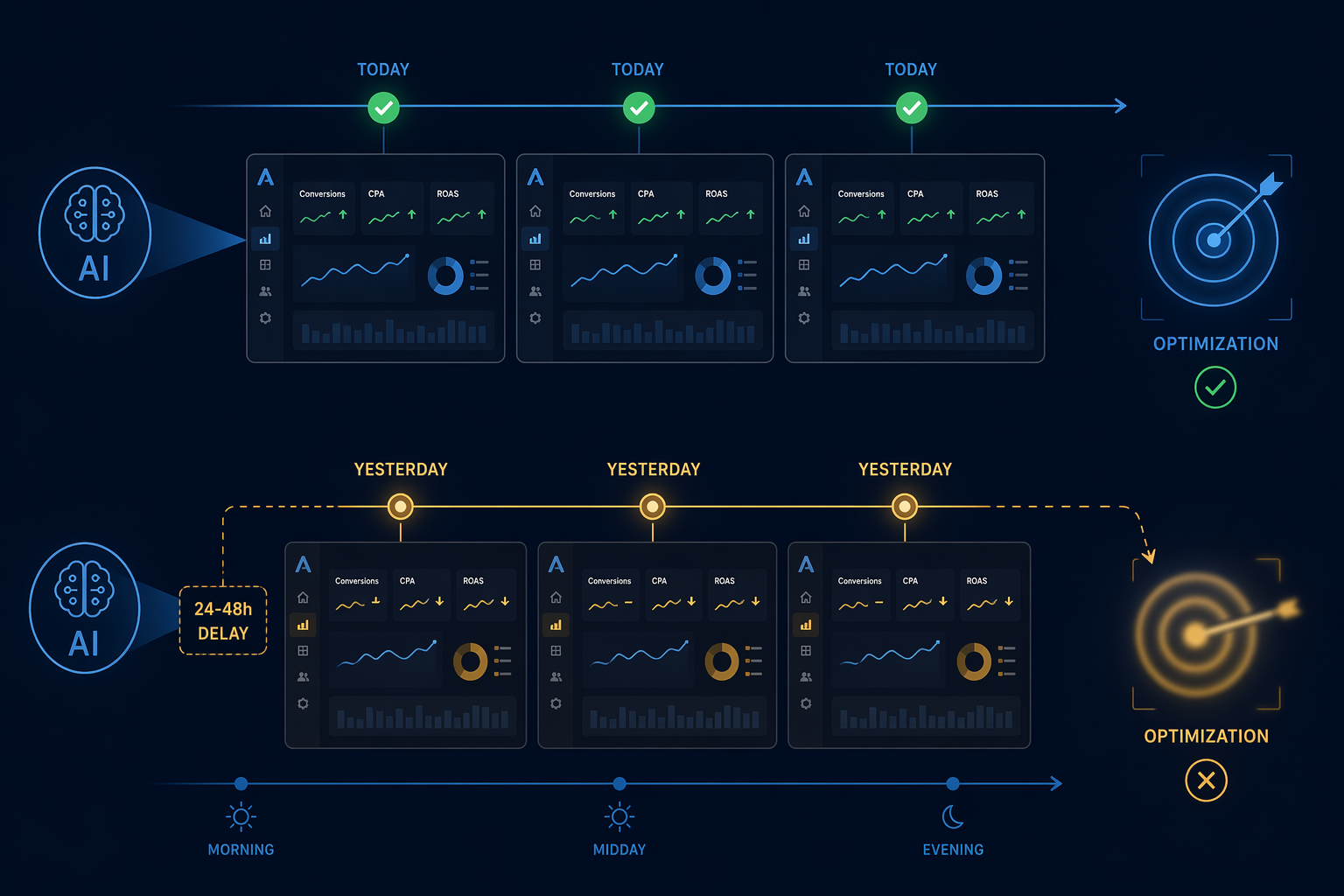
The consequences are easy to miss in daily pacing. A campaign may look weak in a high-intent audience because offline conversions have not landed yet. Budget shifts away. The next day's import fills in the missing conversions, but the system has already reduced exposure to the segment that worked. Repeat that for a week and the platform is no longer simply waiting for delayed data; it is learning from a distorted sequence of cause and effect.
Sub-24-hour latency is not a magic line published by every platform as a universal rule. It is a practical operating standard. If the platform can receive the conversion signal within the same decision cycle, automated bidding has a better chance of connecting spend to outcomes while the market conditions, creative rotation, and audience mix are still relevant.
The timestamp matters as much as the delivery time. If a lead converts on Monday but the platform receives a batch upload on Wednesday with Wednesday's timestamp, the system may associate the outcome with the wrong auction conditions. That can contaminate learning even when every conversion eventually arrives.
This is also where cross-channel attribution disputes become operational, not political. Improvado reports that eliminating duplicate attribution and budget conflicts across channels can deliver 15–25% CPA improvement, but that is a vendor-published claim rather than an independent benchmark.[1] The broader point does not depend on accepting the uplift figure as universal: if two platforms both claim the same conversion and both use that claim to justify more spend, automation will scale the conflict.
Volume Floors Are Not Suggestions
Conversion volume is the part of AI-driven advertising where optimism gets expensive. If the campaign cannot meet the platform's learning threshold, the problem is not that the media manager failed to trust automation. The problem is that the system does not have enough recent examples to distinguish a pattern from noise.
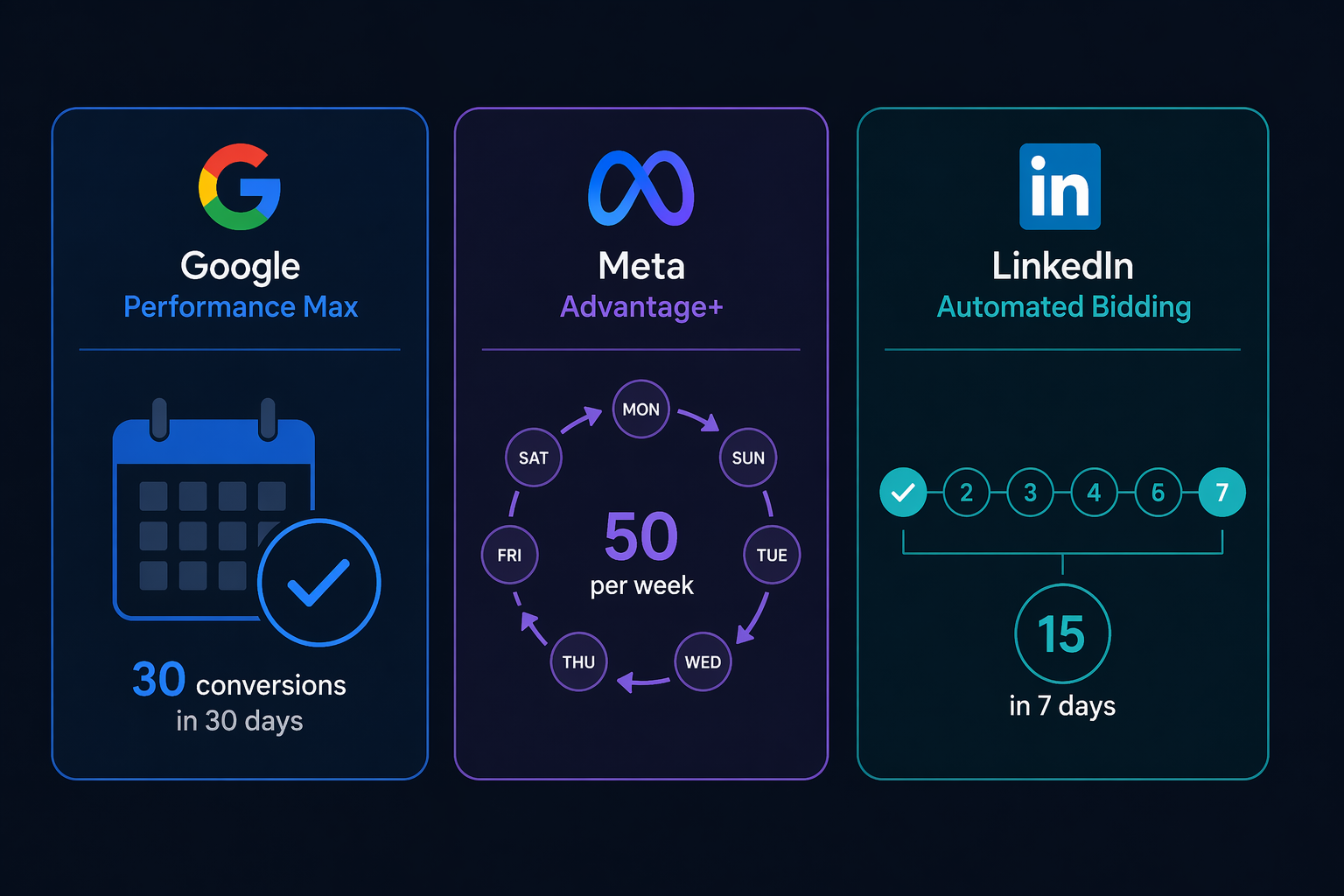
The platform floors are different because campaign mechanics and auction environments are different. Performance Max needs 30 conversions in 30 days. Advantage+ recommends 50 conversions per week per ad set. LinkedIn automated bidding requires 15 conversions in 7 days.[1] Those numbers should affect campaign design before launch, not become an excuse after performance is already unstable.
A low-volume campaign has several unattractive options. It can optimize toward a higher-funnel event with more volume and accept a weaker business signal. It can consolidate campaigns or ad sets so the learning system sees more conversions in one place. It can broaden audience constraints. It can extend the learning window and stop reacting to every short-term CPA swing. None of those choices is the same as “use more AI.”
This creates a structural advantage for high-volume advertisers. They can feed the machine with cleaner outcome data faster, test more creative, and recover from bad learning periods with less risk. Smaller advertisers often have to choose between signal quality and signal quantity. A qualified opportunity may be the right business event but too rare for platform learning; a lead form may be frequent enough but too weak to trust without downstream filtering.
The cleanest workaround is usually not to pretend the lower-funnel event has enough volume. It is to design the campaign around the volume reality: consolidate where possible, use a conversion event that has a defensible relationship to revenue, and measure downstream quality outside the platform. In B2B, that may mean LinkedIn automated bidding is appropriate for one segment and manual or rule-based controls remain safer for another until the account crosses the 15-conversion-in-7-days floor.[1]
The same judgment applies inside Google and Meta. A Performance Max campaign that barely reaches 30 conversions in 30 days should not be managed like one generating that volume every few days.[1] An Advantage+ setup below the 50-per-week recommendation may still spend, but the buyer should expect noisier learning and less stable readouts.[1] For a deeper platform-specific view, the same readiness problem shows up in Advantage+ automation and in the way Performance Max creative inputs shape what the system can learn.
First-Party Data Helps Only If It Is Usable
First-party data belongs after tracking and volume because it sharpens a system that is already receiving usable signals. It does not rescue a campaign that is optimizing toward the wrong event or learning from conversions uploaded two days late.
When it is clean, first-party data helps platform AI separate meaningful intent from weak proxy signals. Customer lists, product interactions, lifecycle stages, purchase history, and qualified-lead markers can all give the system better context than a broad behavioral audience alone. In dynamic ads, the same principle extends to product and feed quality; weak product attributes limit what creative automation can assemble, even if the bidding layer is strong. That is why the feed-to-creative pipeline is part of the performance system, not a separate production detail.
StackAdapt reports that advertisers using first-party data or AI-based contextual targeting see up to 2X higher ROAS compared with third-party targeting.[2] That figure is useful directionally, but it is vendor-published. It should not be treated as an independent guarantee that uploading a CRM list will double return.
The practical test is whether the data can be activated without muddying the optimization signal. A stale customer list may suppress the wrong people. A lifecycle stage that sales updates inconsistently may train the platform on internal process lag. A value field that mixes gross revenue, net revenue, and estimated pipeline may create value-based bidding that looks mathematically sophisticated and commercially confused.
Clean activation usually means fewer, better signals. Use audiences and conversion values that have a clear source, update cadence, and business meaning. If a data field cannot be explained to the person responsible for CPA, it probably should not be used to steer automated spend yet.
Vendor Uplift Claims Are Useful, Not Portable
There are credible reasons to invest in the infrastructure. Improvado reports that properly set up AI-driven campaigns require 60–70% less manual optimization time and deliver 15–30% CPA improvement over rule-based automation.[1] Those numbers are worth noticing, especially for teams still spending hours on bid and budget adjustments that platforms can handle. They are also vendor-reported outcomes, not neutral benchmarks that every account can plug into a forecast.
Adoption data tells a similar story. StackAdapt and Ascend2 found that 39% of agencies had significantly integrated AI into day-to-day workflows, while 18% had barely started.[2] Smartly's public 2026 trend highlights say 42% of marketers are still in initial testing, and 46% report creative adoption of AI.[3] The market is not uniformly mature. Many teams are still deciding whether their operating model can support the automation they have already enabled.
That context matters because it keeps the performance claims in the right place. AI may reduce manual optimization work when the account has clean event routing, enough conversion volume, and stable creative inputs. It may also accelerate a bad feedback loop when those inputs are wrong. The difference is rarely visible in the launch deck.
A Readiness Standard Before Scaling
The decision is not whether to use platform AI. In most paid media accounts, that decision has already been made by product direction, auction design, and available campaign types. The better question is whether the campaign has earned the right to scale.
Before increasing budget, the media lead should be able to answer four questions without opening five conflicting dashboards:
- What exact conversion event is training the campaign?
- How quickly does that event reach the platform after the customer action?
- Does the campaign meet the platform's recent conversion-volume floor?
- Which first-party data fields or audiences are active, and are they fresh enough to trust?
If the answers are unclear, the campaign is not giving AI optimization a fair test. It is asking the platform to infer business value from fragmented, delayed, low-volume, or polluted signals. That does not mean automation is the wrong direction. It means the account is still in infrastructure work, not scale mode.
Creative quality, offer strength, landing page fit, and budget still matter. Clean data will not make a weak offer compelling or give a small account the learning velocity of a large one. But without the conversion event, latency window, volume floor, and first-party signal in place, AI-driven advertising is mostly optimizing the account's measurement problems faster.
References
- AI Targeted Advertising: Complete 2026 Guide, Improvado.
- AI in advertising: How to use it the right way in 2026, StackAdapt.
- 2026 Digital Advertising Trends Report, Smartly.

Comments
Join the discussion with an anonymous comment.