

The Feed-to-Creative Pipeline: How AI Product Enrichment Powers Dynamic Ads
This article explains how to connect enriched product feed data to dynamic ad creative across Meta, Google, and TikTok, and what performance gains are realistically achievable based on aggregated benchmarks and vendor-published case studies.
Most ecommerce brands already have the parts needed for product feed AI creative optimization: a product catalog, campaign templates, platform rules, and someone somewhere maintaining attributes. The problem is that those parts usually sit in different workflows. Feed management is treated as Shopping hygiene. Creative production is treated as a design queue. Paid social gets whatever the catalog can pass through, then wonders why the “dynamic” ads all look like the same product tile with a price.
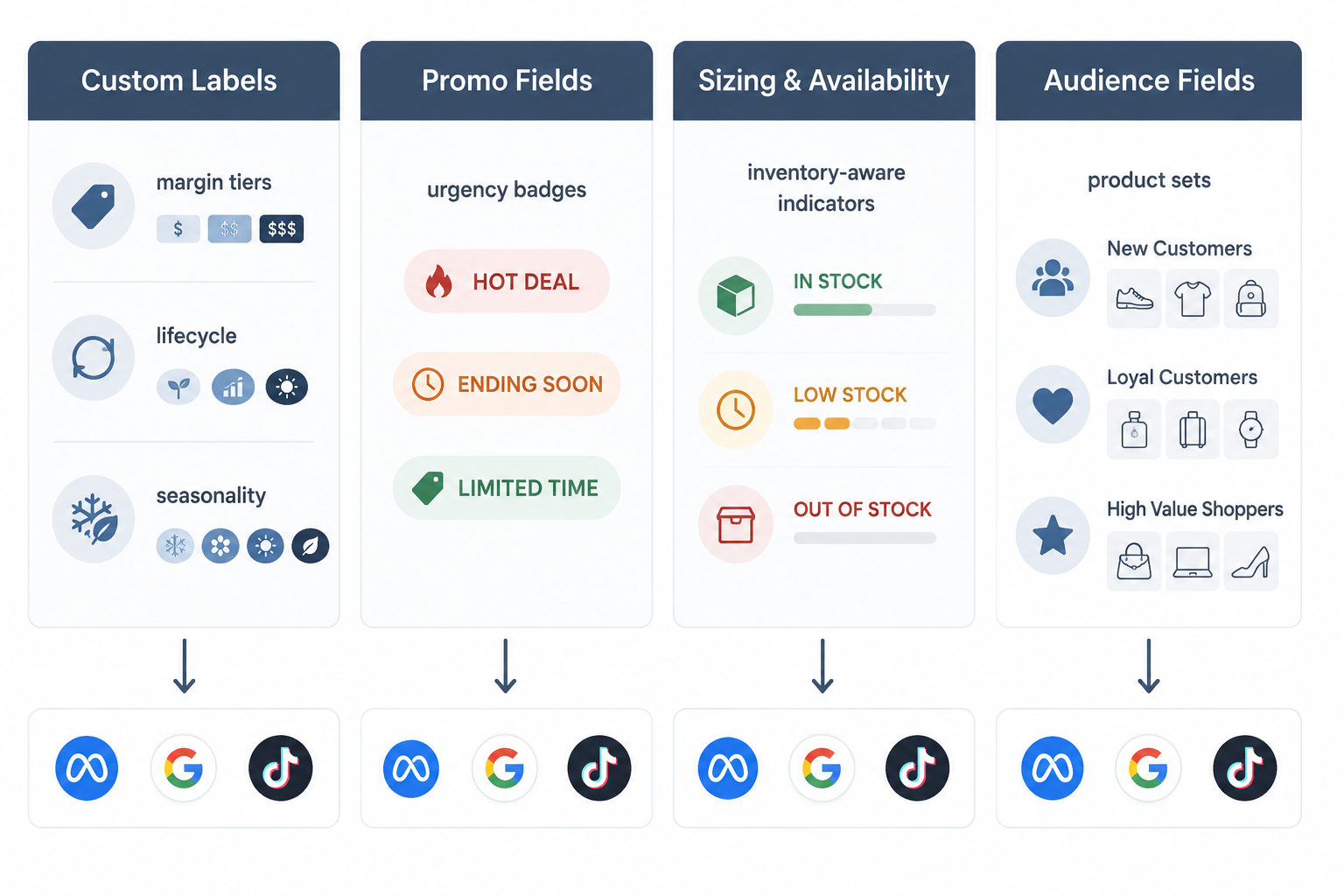
The useful version of AI feed enrichment is less glamorous and more operational. Clean product data gets enriched with fields that a shopper can actually respond to: margin tier, lifecycle stage, promo status, availability, size depth, audience fit. Those fields are then mapped into Meta, Google, and TikTok as labels, product sets, overlays, template rules, and copy variants. The result is not a replacement for human creative strategy. It is a production layer for dynamic ads, current to how ecommerce teams are using the major ad platforms in Q3 2026.
A workable feed-to-creative pipeline usually looks like this:
- Clean the product feed so IDs, titles, variants, prices, images, and availability are reliable enough to automate against.
- Enrich the feed with creative-relevant fields: custom labels, promotion status, sizing and availability, and audience or use-case attributes.
- Map those fields into platform rules, product sets, templates, overlays, headlines, and exclusions.
- Launch dynamic variants across Meta, Google, and TikTok without turning every test into a custom design request.
- Measure by AOV, audience temperature, and platform instead of collapsing all dynamic creative into one blended ROAS number.
That last point matters because the best case studies in this category are impressive, but they are not average outcomes. Twillory reported a 127% increase in Meta DPA ROAS after using custom labels in its feed to serve product-level creative, with 82% of revenue coming from retargeting; Ridge reported a 53% ROAS improvement and 20 hours per week saved in creative production after connecting enriched product data to dynamic ad templates; Cozy Earth scaled catalog ads from 10 campaigns to 40 using AI-assisted dynamic creative from feed data.[1] Those are useful signals. They are also vendor-published customer cases, not independent proof that every catalog account should expect the same lift.
The fields that actually become creative
The feed fields that matter are not always the ones that look most important in a spreadsheet. A perfect product title helps Google parse the item. A clean variant ID prevents campaign waste. But the creative leverage tends to come from fields that decide what is shown, emphasized, grouped, or suppressed.
| Enrichment field type | What it can control in creative | Common owner |
|---|---|---|
| Custom labels | Margin tier, lifecycle stage, seasonality, bestseller status, product priority | Feed manager with merchandising and paid media input |
| Promo fields | Sale badges, urgency language, limited-time overlays, promotion-specific headlines | Merchandising, ecommerce, or revenue operations |
| Sizing and availability | Inventory-aware messaging, exclusions, size-depth signals, low-stock or back-in-stock variants | Operations, ecommerce, or inventory systems |
| Audience fields | Product sets by use case, shopper intent, gender, category affinity, or lifecycle segment | Paid media, CRM, or analytics |
These fields are where the handoff either becomes a system or collapses into one-off campaign cleanup. If margin tier lives only in a finance export, it cannot protect paid media from pushing low-margin bestsellers too aggressively. If lifecycle stage lives only in a merchandiser’s head, the creative team keeps producing generic “new arrival” frames after the product has already moved into markdown. If availability is updated but never mapped into templates, the platform can keep spending against products that technically exist but are weak conversion candidates because key sizes are gone.
Custom labels: the quiet control panel
Custom labels are often treated as bidding or reporting helpers. In a feed-to-creative pipeline, they become the control panel for what the shopper sees. A label can separate full-margin products from clearance items, newness from evergreen catalog, seasonal products from year-round items, or hero SKUs from long-tail variants.
For Meta dynamic product ads, this is where the Twillory result is most interesting. The headline number was the 127% DPA ROAS lift, but the mechanism was product-level creative driven by custom labels, and the revenue concentration was heavily retargeting at 82%.[1] That reads less like “AI creative beats everything” and more like “warm shoppers responded when the catalog stopped treating every product the same.”
A practical custom-label setup might give paid media a way to build different treatments for high-margin evergreen products, seasonal new arrivals, markdown items, and back-in-stock products. The same template can then behave differently without a designer rebuilding it four times. High-margin evergreen products might get benefit-led copy. Markdown products might get a sale frame. Seasonal items might get contextual language tied to timing. The point is not the label itself; it is the decision the label allows the ad system to make.
Promo fields: useful until they cheapen the product
Promo fields are the easiest enrichment fields to understand and the easiest to overuse. They can drive sale badges, free-shipping language, percentage-off overlays, limited-time copy, and campaign-specific product sets. For low-consideration products, especially in retargeting, that can reduce friction. A shopper who already viewed the item does not always need a fresh concept; sometimes they need to see that the product is still relevant and the offer has changed.
The risk is letting automation turn price into the only creative idea. If every higher-margin product gets a dynamic urgency badge because the feed technically has a promo field, the brand trains the template to erode positioning. The better rule is to decide which product groups are allowed to use discount-forward creative and which should use value, material, fit, guarantee, or use-case messaging instead.
Sizing and availability: stop advertising the version shoppers cannot buy
Availability is usually framed as a feed accuracy issue. In creative, it is also a trust issue. A product can be technically in stock while the sizes that matter are gone. A color can be available while the core variant is broken. If sizing and availability fields are not part of the creative logic, catalog ads keep presenting products as if the buying experience behind the click is intact.
Inventory-aware creative does not need to be complicated. Products with full size depth can stay in prospecting sets. Products with limited sizes can be restricted to retargeting or suppressed from templates that imply broad availability. Back-in-stock items can receive a different treatment from new arrivals because the shopper context is different. The feed manager, paid buyer, and ecommerce owner need to agree on the thresholds before the campaign is live, not after spend has already moved into broken variants.
Audience fields: product sets are creative decisions
Audience fields are where feed enrichment starts to look like media strategy. A product can be tagged by use case, category affinity, lifecycle stage, gender expression, giftability, replenishment behavior, or customer segment. Those tags can create product sets for different audiences without forcing the team to rebuild campaigns by hand every time merchandising changes.
This is also where sloppy logic creates waste. “Audience field” should not mean inventing segments that the media team cannot target or measure. If a product is tagged for “commuter,” “travel,” and “office,” each tag should lead to a different product set, message, or reporting cut. Otherwise the feed gets busier without making the creative more useful.
The same enriched feed behaves differently by platform
A feed-to-creative pipeline should not push the same field logic into every platform and call the job done. Meta, Google, and TikTok use product data differently, and that changes which enrichments deserve attention.
Meta needs visual consistency and product-level variation
Meta catalog ads benefit when the feed gives the system enough structured variation to assemble relevant product creative without making the brand look stitched together. Custom labels can determine which frame, overlay, badge, or headline a product receives. Engagement signals then have a cleaner set of variants to work with because the creative differences are tied to product logic rather than random template swaps.
This is why visual consistency matters. Dynamic does not mean every SKU should look like it came from a different campaign. If high-margin products use one treatment, markdown products use another, and new arrivals use another, the rules still need a shared design system. Ridge’s reported 53% ROAS improvement is notable partly because the case paired performance with production relief: 20 hours per week saved in creative production by connecting enriched feed data to templates.[1] In messy accounts, saving production time is not a side benefit. It is often the only way the testing plan survives the calendar.
Google cares about attributes before aesthetics
Google Shopping and Performance Max put more weight on attribute completeness, product relevance, and query matching than on the kind of visual template logic that dominates paid social. Feed enrichment still matters, but the creative pathway is different. Better titles, product types, descriptions, availability, sale pricing, and structured attributes help the system understand what the product is and when it is eligible to show. Dynamic creative here is less about a clever overlay and more about making the product legible to the auction.
Fashion&Friends reported a 73% higher ROAS on Google Shopping using feed-based creative personalization.[2] That case is useful because it moves the conversation outside Meta, where dynamic product ads are more familiar. It does not prove that a badge or template caused the entire lift. It does support the narrower point that feed-based personalization can improve Shopping performance when the platform has better product context to work with.
TikTok punishes stale context faster
TikTok’s feed-to-creative problem is recency. A product feed that updates weekly may be acceptable for slow-moving Shopping maintenance, but it is weak for a platform where trend context, product freshness, and creator-style variation age quickly. The enriched fields that matter most are the ones that keep the ad close to what is currently sellable and currently interesting: newness, availability, promo status, use case, seasonality, and product group.
Dynamic creative optimization in ecommerce is generally about using structured product data to scale creative variations across placements and audiences, but the platform determines which inputs have leverage.[3] On TikTok, a stale “new arrival” field is worse than no field because it gives the template permission to say something the merchandising calendar no longer supports.
Ownership is the part most teams underbuild
The workflow sounds clean until someone has to own the fields. AI can suggest missing attributes, classify products, rewrite titles, or populate labels, but the system still needs rules for approval, refresh cadence, and exceptions. Otherwise the brand ends up with more campaign debris: duplicate labels, stale promo copy, product sets that no one trusts, and templates that keep running because nobody knows who is allowed to pause them.
A practical ownership model separates source data, enrichment logic, creative rules, and performance review:
- Feed or ecommerce operations owns core product accuracy: IDs, variants, price, availability, images, and required platform attributes.
- Merchandising owns commercial meaning: margin tier, lifecycle, seasonality, promo eligibility, and product priority.
- Paid media owns activation logic: campaign mapping, audience use, platform rules, exclusions, and reporting cuts.
- Creative owns template integrity: brand consistency, hierarchy, copy boundaries, and when automation needs a human concept.
- Analytics or growth owns measurement: AOV splits, retargeting versus prospecting, incrementality where possible, and comparison against human-made creative.
AI product feed optimization tools can help identify missing data, normalize attributes, and speed up feed management workflows, but those vendor claims should be treated as workflow context rather than independent proof of performance lift.[4] The real operating question is whether the team can keep enrichment fields current enough that the creative remains true.
Possible uplift is not expected uplift
The strongest argument for feed-to-creative work is that it can join performance improvement with production relief. Twillory’s 127% DPA ROAS lift, Ridge’s 53% ROAS improvement and 20 hours per week saved, Cozy Earth’s move from 10 to 40 catalog campaigns, and Fashion&Friends’ 73% higher Google Shopping ROAS all point in the same direction: when structured product data becomes creative logic, ecommerce teams can scale more relevant variants without producing every asset manually.[1][2]
The limiting evidence is just as important. Digital Applied’s Q1 2026 benchmark, based on more than 50,000 ad variations, found that above $100 AOV, AI-driven creative from feed data still showed an approximately 8% conversion gap against human creative.[5] That does not make the pipeline weak. It makes the fit narrower: strongest for sub-$100 AOV products, retargeting pools, replenishable or low-friction purchases, and catalogs where product relevance already carries a lot of the persuasive load.
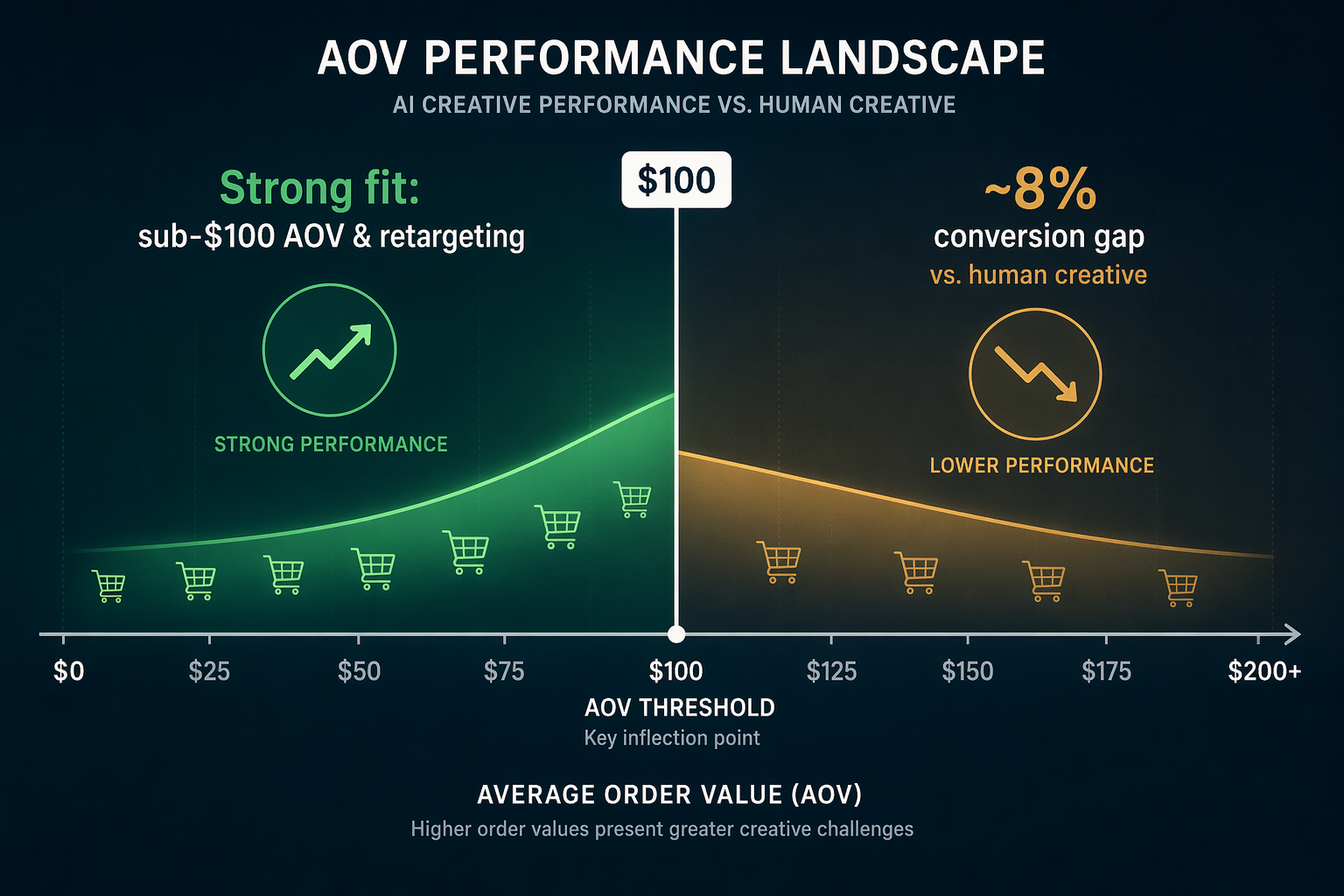
That $100 line should not be treated as permanent. The same benchmark context notes that the threshold has moved upward from $25 in early 2025 to $100 in Q1 2026, with projections pointing toward $200 by late 2026.[5] The direction is favorable for automation, but current buying decisions still need current boundaries. A brand selling $38 accessories can lean harder into feed-driven dynamic creative than a brand selling $400 considered purchases, even if both have clean catalogs.
The measurement trap is blending everything together. If retargeting revenue carries the result, the team should say that. If sub-$100 products lift and higher-AOV bundles lag, the reporting should show that. If Google improves because product attributes are cleaner while Meta improves because custom-label templates are sharper, those are different wins. A single account-level ROAS number can hide the actual mechanism.
Where the pipeline is worth deploying first
The best first deployment is not the category with the loudest stakeholder. It is the place where feed relevance already matters and the downside of automation is manageable. That usually means enough SKUs or variants to make manual production inefficient, a clean enough catalog to trust the source data, active retargeting pools, and products where the shopper can act without needing a full human-led persuasion arc.
A reasonable first test might start with one category, one retargeting audience, and two or three enrichment fields. For example, the team could map lifecycle stage, promo eligibility, and availability depth into Meta catalog templates, while keeping a human-made creative control for higher-AOV products. On Google, the same category might focus less on overlays and more on attribute completeness, title structure, and product grouping. On TikTok, the test might only include products with fresh availability and current seasonal relevance.
The quality gate should happen before launch. Are the promo fields approved for the products using urgency language? Are margin tiers allowed to influence spend or only creative treatment? Are low-stock products excluded or labeled differently? Are custom labels documented well enough that a new media buyer will not create product sets from the wrong field? These are not enterprise governance luxuries. They are the difference between a useful dynamic system and a faster way to ship bad ads.
Higher-AOV categories deserve a stricter test design. Feed-driven creative can still assist with relevance, product grouping, and offer accuracy, but it should be compared against human-led concepts rather than treated as the new default. If the human creative is carrying trust, differentiation, material proof, or lifestyle context, a catalog template with a smarter badge may not replace it.
A practical deployment standard
AI feed enrichment can power better dynamic ads when the enriched fields change what the shopper sees in a meaningful way. A custom label that changes a product set, a promo field that controls an approved badge, an availability signal that suppresses weak variants, or an audience tag that routes products into a more relevant template is creative infrastructure. A field that exists only because a tool populated it is just more catalog clutter.
The pipeline is most defensible for brands with clean catalog data, enough SKUs or variants to benefit from automation, sub-$100 AOV products, active retargeting pools, and a team willing to maintain enrichment fields as creative inputs. Start where product relevance already influences the sale. Compare against human creative where AOV is higher. Treat the system as a tactical supplement first; if the fields stay current, the templates stay governed, and the measurement keeps separating audience temperature and price point, it can become a durable production layer.
References
- How AI is Optimizing Product Feeds, Marpipe
- Dynamic Creative Optimization Case Study, Hunch
- How DCO empowers scalability in ecommerce, Productsup
- AI Product Feed Optimization for E-commerce Ads, Ryze AI
- AI Ad Creative Benchmarks 2026, Digital Applied
Comments
Join the discussion with an anonymous comment.