
AI SMS Marketing ROI: Benchmarks, Revenue-Per-Send Data, and Attribution Framework for 2026
A data-driven ROI framework for mid-level marketing managers and demand gen leads who need to justify AI SMS investment to leadership. Covers the real meaning behind the $71-per-$1-spent headline, revenue-per-send benchmarks by flow type, why RPS is plateauing, and how to calculate AI SMS ROI with proper attribution.
The $71 ROI Stat: What It Actually Means and Where It Falls Short
If you have researched SMS marketing ROI in the past year, you have almost certainly encountered the $71-per-$1-spent figure. It appears in vendor decks, blog posts, and conference slides as a shorthand for "SMS is the highest-ROI channel you are not using enough." The number originates from Infobip, which reports that businesses earn roughly $71 for every dollar spent on SMS marketing — a 7,100% return. It is an arresting headline, and it is not fabricated.
But it is also not the full picture. The $71 figure represents a seasonal peak, not a sustainable baseline. Sakari, another SMS platform, places the typical ROI range between $21 and $41 per dollar spent, with the $71 peak occurring during high-volume promotional periods like Black Friday or end-of-quarter clearance events. The difference between $21 and $71 is not trivial — it is the difference between a channel that performs well and one that looks like a miracle.
The gap between these numbers matters because it reveals a structural problem in how SMS ROI is reported. The headline figure is real but context-dependent: it reflects campaigns with high-intent lists, aggressive segmentation, and often a seasonal tailwind. The median experience for a brand running a standard promotional broadcast is closer to the lower end of that range. This article exists to bridge that gap — to give you a defensible, data-backed framework for calculating AI SMS ROI that accounts for flow type, attribution window, and list maturity, so you can present a number to leadership that survives scrutiny.
For a broader look at how AI ROI varies across channels — including email, paid search, and content — see our AI for Sales and Marketing ROI Reality Check, which covers adoption gaps and where the real value concentrates.
Revenue-Per-Send: The Cleanest Metric for SMS ROI
Aggregate ROI figures like $71-per-$1 are useful for executive summaries, but they are too coarse for operational decision-making. They conflate high-performing automated flows with low-performing broadcast blasts, mix attribution windows, and obscure the variance between segments. For practitioners who need to decide where to allocate budget and which flows to optimize, a more granular metric is required: revenue-per-send (RPS).
RPS measures the direct revenue generated by each individual SMS sent. It is calculated by dividing total attributed SMS revenue by the total number of messages sent over a given period. Unlike open rate or click-through rate, RPS ties directly to the bottom line. It is the metric that allows you to compare the performance of an abandoned-cart flow against a promotional broadcast on equal footing.
According to 2026 benchmarks from Klaviyo and Postscript — based on data from over 183,000 ecommerce customers — the median ecommerce SMS RPS is $0.71. The top quartile of performers achieves $1.46 per send. For DTC subscription brands, the median RPS is $0.92, reflecting the higher average order value and recurring purchase behavior typical of subscription models.
| Segment | Median RPS | Top Quartile RPS |
|---|---|---|
| Ecommerce (all) | $0.71 | $1.46 |
| DTC Subscription | $0.92 | Not specified |
| B2B | Not available | Not available |
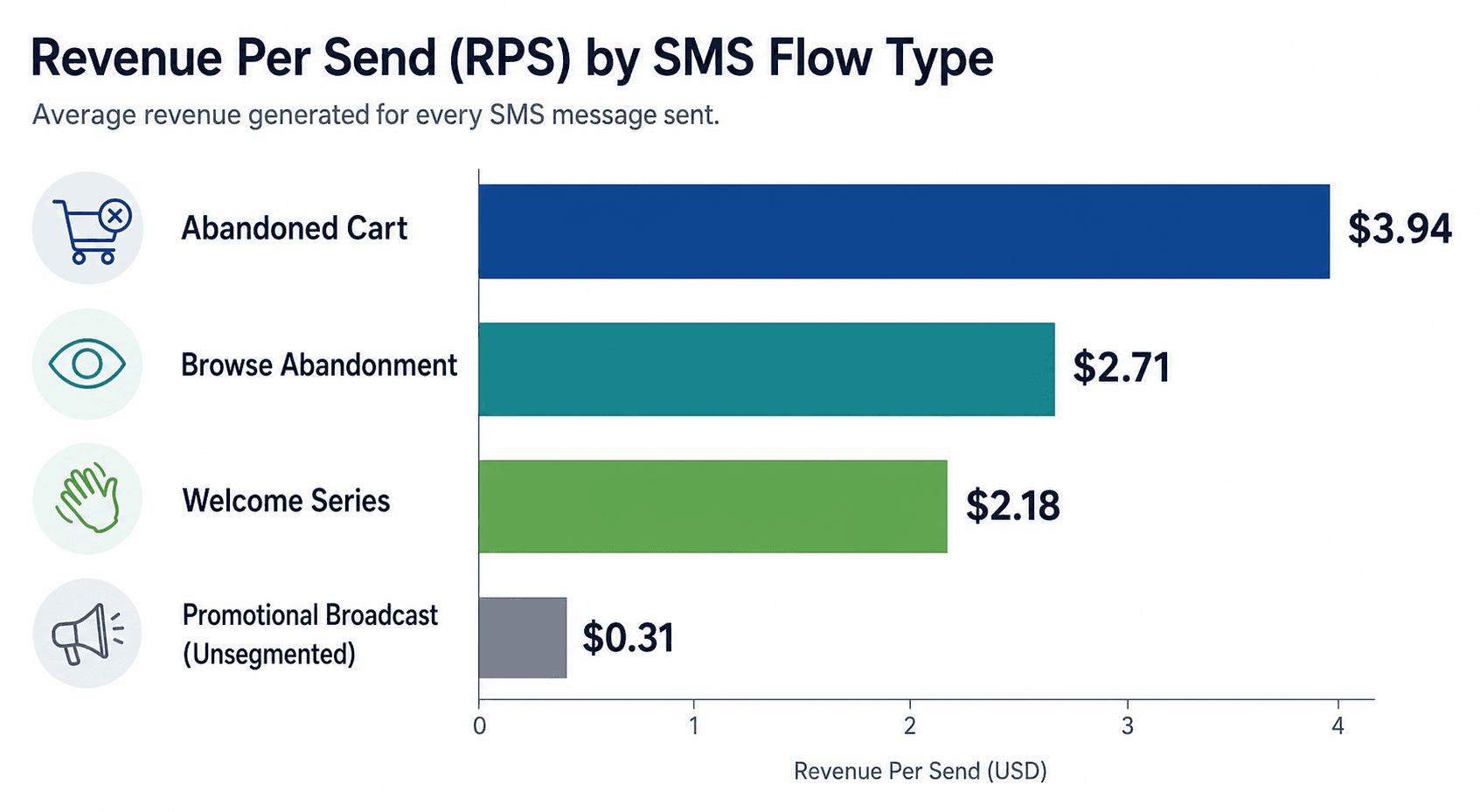
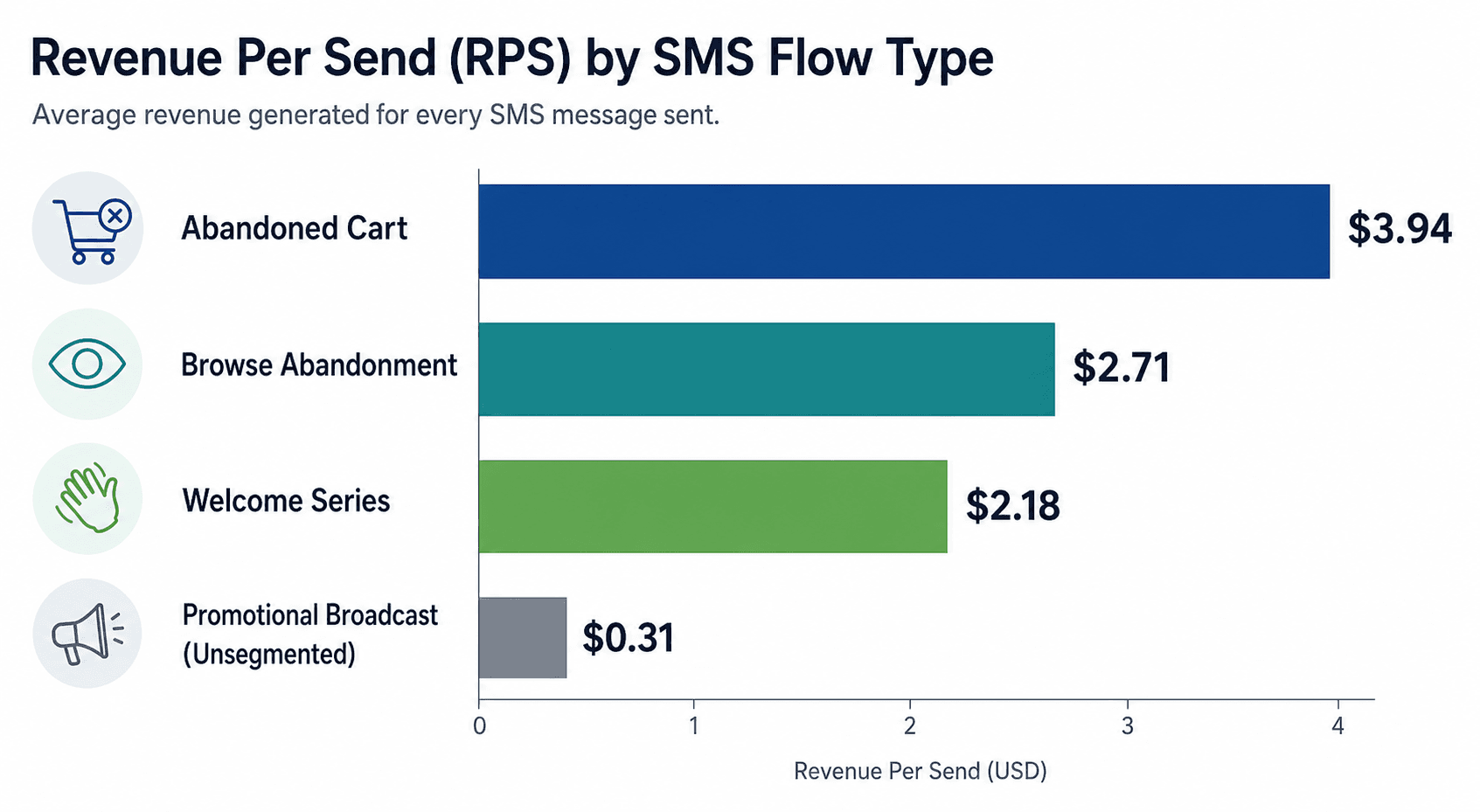
RPS is more actionable than aggregate ROI because it isolates the unit economics of each send. If your abandoned-cart flow generates $3.94 per send and your promotional broadcast generates $0.31 per send, you know exactly where to invest optimization effort. The aggregate ROI figure would mask that 12x difference entirely.
RPS by Flow Type: Where the Real Revenue Lives
Not all SMS sends are created equal. The most important distinction in SMS marketing is between flows (automated, triggered messages) and campaigns (manual, broadcast messages). Klaviyo's 2026 data reveals a stark imbalance: SMS flows account for just 7.6% of total sends but drive 45.2% of total SMS revenue. Flows generate roughly 8x higher revenue per recipient (RPR) than campaigns.
Within flows, the variance is equally dramatic. The following table breaks down RPS by specific flow type, based on 2026 benchmarks from Digital Applied:
| Flow / Campaign Type | RPS | Notes |
|---|---|---|
| Abandoned Cart | $3.94 | Highest-performing flow; triggered by cart abandonment |
| Browse Abandonment | $2.71 | Triggered by product page visits without cart action |
| Welcome Series | $2.18 | First-touch onboarding sequence for new subscribers |
| Promotional Broadcast (Segmented) | $0.84 | Targeted list based on behavior or demographics |
| Promotional Broadcast (Unsegmented) | $0.31 | Send to entire list without targeting |
The gap between the top and bottom of this table is not a small difference — it is a 12.7x multiplier. An abandoned-cart flow at $3.94 RPS is generating more revenue per send than an unsegmented broadcast generates in 12 sends. This is not a marginal optimization opportunity; it is a structural argument for prioritizing triggered flows over broadcast campaigns.
The implication for your AI SMS strategy is clear: if you are investing in AI tools to optimize send times, generate dynamic content, or predict customer behavior, apply those capabilities first to your highest-RPS flows. Optimizing an abandoned-cart flow from $3.94 to $4.50 has a much larger revenue impact than optimizing a broadcast from $0.31 to $0.40, even if the percentage lift is smaller.
Why RPS Is Plateauing — and What That Means for Your Program
If you have been running SMS for more than 18 months, you may have noticed that your RPS is no longer climbing the way it did in 2023 or 2024. You are not alone. Multiple sources in the 2026 benchmark data point to a plateau in RPS growth, particularly in mature ecommerce stacks.
The primary driver is list saturation. By 2025, 84% of consumers had opted into at least one business SMS list. As more brands adopt SMS — 60% of businesses already used it in 2024 — the average consumer receives more promotional texts than ever. Attention is finite, and the incremental response from each additional send diminishes as the list grows and the competitive noise increases.
This plateau is not a failure of AI SMS. It is a natural maturation of the channel. The early adopters who jumped into SMS in 2020–2022 enjoyed a first-mover advantage: lower list fatigue, higher engagement, and less competition for the consumer's attention. As SMS becomes a standard channel — like email — the baseline performance normalizes.
The data supports this shift. While broadcast RPS is flat or declining, flow-based RPS remains strong. The top 10% of SMS flows achieve an RPR above $5, according to Klaviyo. The brands that maintain high RPS are those that invest in triggered, behavior-based messaging rather than relying on broadcast volume. AI tools — predictive analytics for timing, dynamic content generation, and send-time optimization — are the primary levers for maintaining RPS in a saturated market.
How to Calculate AI SMS ROI Properly: Formula, Attribution Windows, and UTM Parameters
Calculating SMS ROI sounds straightforward — revenue divided by cost — but the details of attribution and cost allocation can swing the result by 200% or more. A defensible ROI calculation requires three components: a consistent formula, a clearly stated attribution window, and proper UTM tagging.
The Formula
The standard ROI formula for SMS is:
ROI (%) = [(Total Attributed Revenue - Total SMS Cost) / Total SMS Cost] × 100Total SMS cost should include platform subscription fees, per-message charges (if applicable), AI tool costs (if you are using a separate AI optimization layer), and any agency or labor costs for campaign management. Do not exclude the AI tool cost from the denominator — if you are claiming AI SMS ROI, the AI investment must be in the cost base.
Attribution Windows Matter More Than You Think
The attribution window you choose has a massive impact on reported ROI. A 7-day click-through attribution window will capture only direct, same-week purchases. A 28-day last-touch window will attribute significantly more revenue to SMS, including purchases that may have been influenced by other channels. Neither is wrong, but they tell very different stories.
For internal reporting, use a consistent window and state it explicitly. For leadership presentations, consider running the calculation under both windows and presenting the range. If your 7-day ROI is 500% and your 28-day ROI is 1,200%, the truth is somewhere in between — and being transparent about that range builds credibility.
UTM Parameters: The Non-Negotiable Foundation
Without consistent UTM tagging, your attribution data is unreliable. Every SMS link should include at minimum the following parameters:
- utm_source=sms
- utm_medium=text
- utm_campaign=[campaign-name]
- utm_content=[flow-type-or-variant]
For AI-powered dynamic content, include a parameter that identifies which AI-generated variant was served. This allows you to compare RPS between AI-optimized and non-AI sends within the same flow, which is the cleanest test of AI's incremental value.
AI vs. Non-AI SMS Performance: What the Data Shows
The case for AI in SMS rests on three capabilities that traditional broadcast SMS cannot match: predictive analytics for timing and targeting, dynamic content generation, and send-time optimization. The available data — while largely vendor-published — consistently shows material lifts across all three.
| AI Capability | Reported Lift | Source |
|---|---|---|
| Predictive analytics for conversion | 15–25% increase in conversion rates | Sakari |
| Send-time optimization (CTR) | Up to 40% improvement in click-through rate | Vibes |
| Send-time optimization (retention) | 20% average improvement in subscriber retention | Vibes |
| AI chatbot deflection of service tickets | 14–22% of customer service tickets deflected | Digital Applied |
| Overall SMS performance (AI adopters) | 81% of AI adopters report improved SMS performance | Digital Applied |
| Time savings from AI automation | 4–6 hours per week saved | Digital Applied / Sakari |
Despite these caveats, the pattern across multiple sources is consistent and credible: AI-powered SMS outperforms traditional broadcast SMS on every measured dimension. The magnitude of the lift varies by use case and implementation quality, but the direction is not in dispute.
The most operationally useful finding is the 15–25% conversion lift from predictive analytics. This means that AI can identify which subscribers are most likely to convert and prioritize them for send-time optimization or dynamic content. In a plateauing RPS environment, that 15–25% lift is the difference between a flat program and a growing one.
Industry-Specific ROI Ranges and Budget Allocation Benchmarks
ROI benchmarks vary significantly by industry, and applying ecommerce figures to a B2B program — or vice versa — will produce misleading projections. The following table summarizes the available ROI ranges by vertical, along with budget allocation benchmarks.
| Vertical | Typical ROI Range | Key Context |
|---|---|---|
| Retail / Ecommerce | 500%–7,100% (peak) | Highest variance; seasonal peaks drive upper end; median closer to 2,100% |
| DTC Subscription | 1,500%–3,000% | Higher AOV and recurring purchase behavior support sustained ROI |
| B2B | ~500% (typical) | Lower volume, longer sales cycles; less benchmark data available |
| SMS+Email Combined | 56% higher ROI than email alone | Sakari; applies across verticals |
On the budget side, companies that actively use SMS allocate roughly 18–20% of their digital marketing budgets to the channel, according to Sakari. This is a significant share — comparable to what many brands allocate to paid social — and reflects the channel's proven ROI. For brands just starting SMS, a more conservative 5–10% allocation is reasonable, with the expectation that it will grow as flows mature and RPS data accumulates.
One of the strongest arguments for SMS investment comes from the combined channel effect. SMS+email lifecycle programs lift customer LTV by 18% over email-only programs, according to Digital Applied. The mechanism is straightforward: SMS captures attention that email misses (90% of SMS messages are read within three minutes, compared to much slower email response rates), and the two channels reinforce each other in the purchase journey. For brands already running email programs, adding AI-powered SMS is not a replacement — it is a multiplier.
For a detailed look at how AI is transforming the email channel specifically — including workflow automation, personalization, and testing — see our complete practitioner's guide to AI in email marketing.
Building Your AI SMS Business Case for Leadership
If you are preparing a proposal to invest in or expand AI-powered SMS, the data in this article gives you the raw materials. The following structure organizes that data into a concise, defensible business case.
1. Total Addressable ROI
Present the ROI range — not a single number. Use $21–$41 per $1 spent as your conservative baseline (Sakari) and $71 as your aspirational peak (Infobip). State explicitly that the conservative figure is used for projections. This preempts the objection that you are cherry-picking the highest number.
2. Required Investment
Itemize the costs: SMS platform subscription, per-message fees, AI optimization tool (if separate), and labor. If you are already paying for an email platform that includes SMS, the marginal cost is lower. Be transparent about the AI tool cost — it is a small fraction of the total and is justified by the 15–25% conversion lift from predictive analytics alone.
3. Key Metrics to Track
- Revenue-per-send (RPS): The primary operational metric. Track it by flow type, not in aggregate.
- Revenue per recipient (RPR): Useful for comparing flows vs. campaigns. Flows should be ~8x higher.
- Flow vs. campaign revenue split: If flows are not generating 40%+ of SMS revenue, you are under-investing in automation.
- Attribution window: State it. Track it. Do not change it mid-year.
4. Compliance Considerations
The regulatory environment for SMS marketing tightened significantly in 2026. The FCC's one-to-one consent rule, effective January 2026, closes the lead-generator loophole: each brand must obtain its own consent directly. TCPA penalties remain severe at $500–$1,500 per message with no cap, and TCPA litigation through mid-2025 was up nearly 95% year-over-year. State-level "mini-TCPA" laws in Texas, Virginia, Florida, and Connecticut impose additional requirements. AI-generated messages are classified as "artificial voices" under the FCC's February 2024 declaratory ruling, which may trigger additional disclosure obligations.
5. Recommendation: Start with Flows, Then Scale
The data is unambiguous: flows outperform broadcasts by 8x in RPR. The highest-RPS flow (abandoned cart at $3.94) generates over 12x the revenue per send of an unsegmented broadcast ($0.31). The recommended path is to launch with three core flows — abandoned cart, browse abandonment, and welcome series — before investing in broadcast campaigns. Apply AI optimization (predictive analytics, send-time optimization) to these flows first. Once they are producing consistent RPS above the median benchmark, expand to segmented broadcasts and SMS+email lifecycle programs.
This approach minimizes risk, generates early ROI data to support further investment, and builds the list hygiene and consent infrastructure needed for compliant scaling. It is not the fastest path to volume — but it is the most defensible path to sustainable ROI.

Comments
Join the discussion with an anonymous comment.