
AI Self-Checkout Data Is a Marketing Goldmine for Retailers
AI self-checkout systems generate granular, item-level transaction data that most retail marketers haven't tapped. This article explains what data exists, why it matters for personalization and loyalty programs, and how to start activating it — with sourced outcomes from Sam's Club and Kroger.
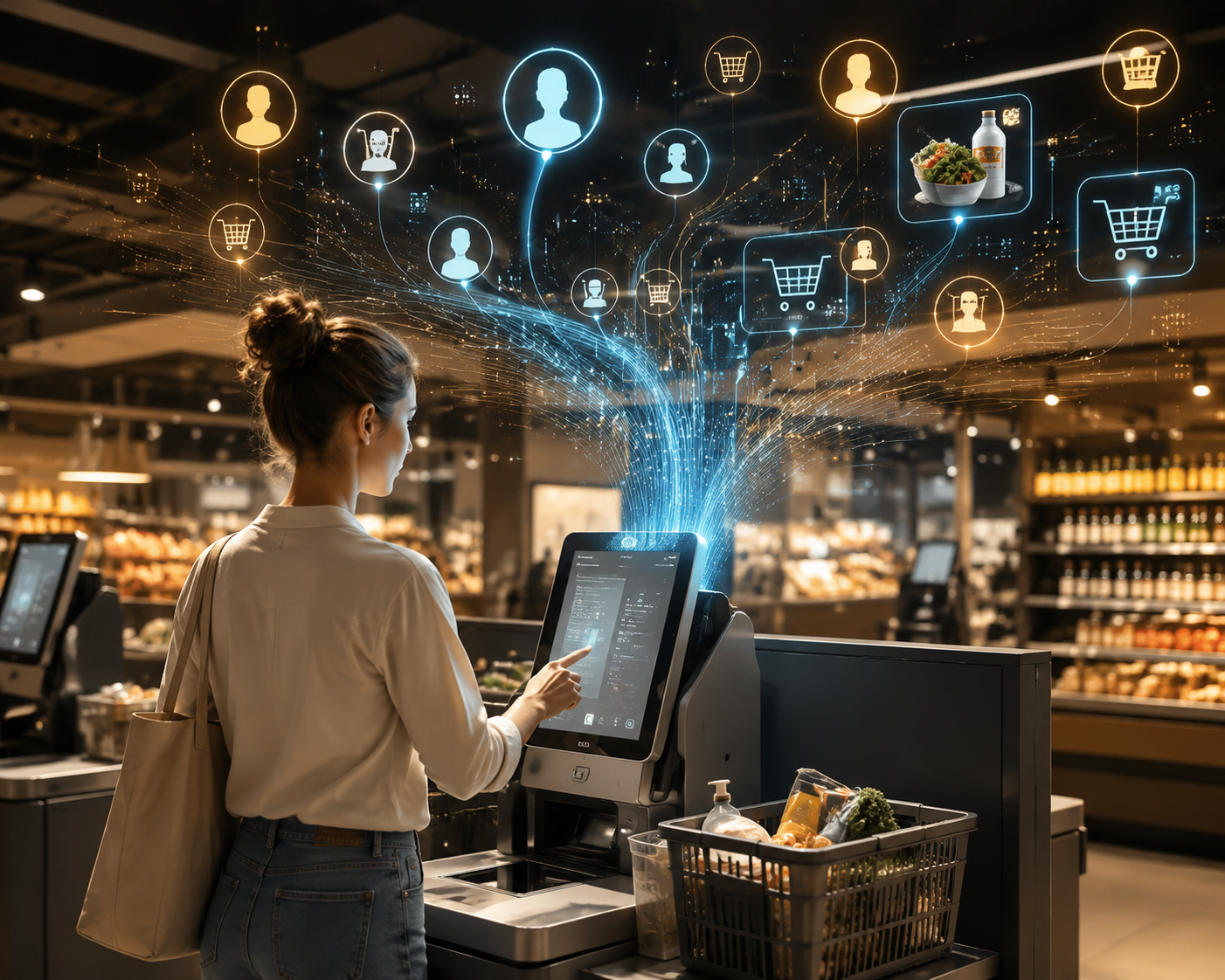
The most interesting thing happening at the self-checkout lane is not that the line moves faster. It is that a physical store is watching a basket form item by item, in sequence, under a known store, time, device, and sometimes customer identity. For years, retail marketers have envied the behavioral trail that e-commerce gets by default: product views, cart additions, substitutions, abandonment, frequency, and response to offers. A growing share of grocery transactions now creates a physical-store version of that trail, but the data often lives with store operations, loss prevention, or checkout technology teams rather than CRM.
That makes the marketing impact of AI self-checkout easy to underestimate. ECR Retail Loss reports that fixed self-checkout is used by 96% of grocery retailers in its global study, and that self-checkout handles up to 80% of transactions in some supermarket formats.[1] This is not a fringe pilot buried in a flagship store. In many retailers, it is already one of the largest behavioral data collection points in the business.
The marketing opportunity is not that self-checkout data magically proves intent. It does not. A scan can be late, duplicated, corrected, overridden, or interrupted by an associate. But that messiness is also why the data has been organizationally stranded. Loss-prevention teams care about scan accuracy, interventions, misreads, and shrink. Store teams care about throughput and customer frustration. Marketers tend to receive only the cleaned receipt after the fact, if they receive anything more granular than a POS transaction at all.
That is a missed use of existing infrastructure. The question is not whether self-checkout should become a marketing system. The question is whether the behavioral signals it already generates can responsibly feed the personalization systems retailers already run.
What AI self-checkout actually sees
A traditional receipt tells marketing what was bought. AI-assisted self-checkout can add context around how the basket came together: when items were scanned, which products appeared together, where an exception happened, whether the shopper needed intervention, and whether a correction changed the final basket. Not every retailer captures every field, and not every vendor exposes it in a marketer-friendly way. Still, the raw signal set is more useful than a receipt export.
| Signal | What it can mean for marketing | What to be careful about |
|---|---|---|
| Item-level purchase timing | A loyalty platform can distinguish a weekly replenishment pattern from a one-off pantry stock-up. | Timing reflects trip context, not necessarily long-term preference. |
| Basket composition | CRM teams can identify product combinations that should shape bundles, offers, and content. | A household basket may mix multiple people’s needs. |
| Product affinity | Promotion engines can test offers based on recurring adjacency, such as complementary categories. | Affinity should be validated against repeat behavior, not inferred from one trip. |
| Scan behavior | Friction patterns can help separate smooth journeys from trips where the customer struggled. | Slow scanning can come from the machine, the customer, the item, or store conditions. |
| Interventions and corrections | Lifecycle teams can suppress tone-deaf offers after a poor checkout experience or route experience signals to service teams. | An intervention is not always negative; some are routine age checks or assistance moments. |
| Error signals | Data teams can decide which transaction events are reliable enough for segmentation. | Errors create noise if marketing treats every pre-correction scan as intent. |
The first marketing use is usually not a dazzling new campaign. It is better identity and segmentation input. A retailer that already has loyalty IDs, app sessions, digital receipts, payment tokens, or account-based offers can ask whether self-checkout events can be matched to the same customer profile. If they can, the retailer can move from “this loyalty member bought these items” to “this loyalty member tends to build this kind of basket, at this time, with this level of checkout friction.”
That distinction matters. A receipt-level transaction might show that a shopper bought baby food, oat milk, and frozen meals. The event stream can show whether those items were part of a routine weekday trip, a larger stock-up basket, or a trip that required repeated assistance. Marketing should not overinterpret any single session, but over time those patterns become useful inputs for offer timing, replenishment reminders, audience suppression, and journey design.
The workflow from lane data to usable audience signal
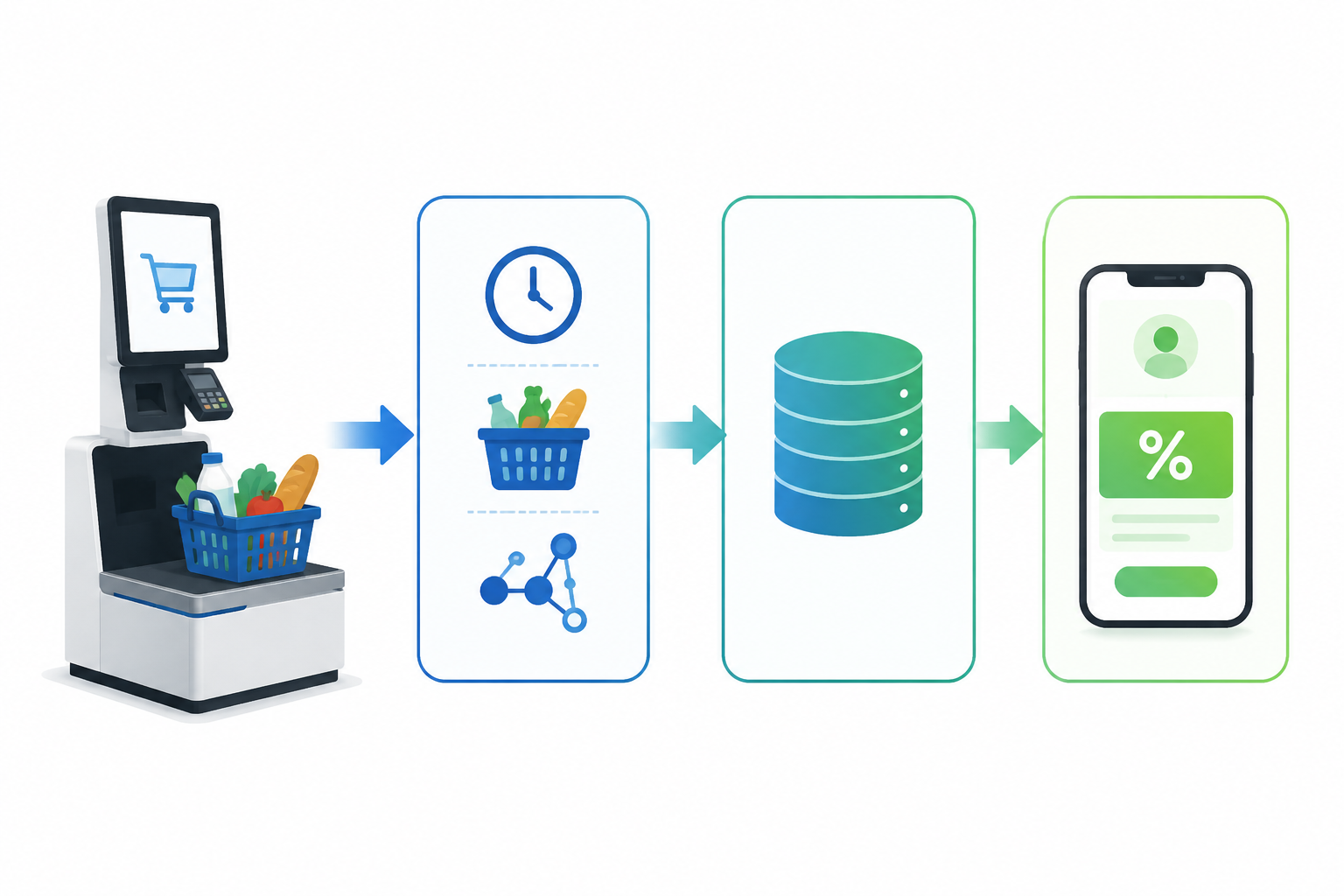
The practical path is narrower than most AI checkout decks suggest. Marketing does not need every camera event, weight variance, or exception log. It needs a governed subset of events that can improve existing customer decisions.
- Capture: identify which self-checkout events are stored today, including scans, voids, substitutions, overrides, interventions, payment completion, loyalty attachment, and receipt delivery.
- Clean: separate final purchased items from abandoned, corrected, duplicate, or exception-driven events.
- Match: connect reliable transaction events to loyalty IDs, app accounts, digital receipts, payment tokens, or other approved identity links.
- Model: turn repeated patterns into usable traits such as category affinity, replenishment interval, promotion sensitivity, stock-up behavior, and checkout friction history.
- Activate: send only approved traits and triggers into the CDP, loyalty platform, promotion engine, email service provider, app messaging system, or media audience tool.
- Measure: test whether the new signal improves an existing decision, rather than claiming that checkout data alone caused a lift.
The biggest unlock often sits between “clean” and “match.” If marketing receives only final POS line items, it can still personalize. If it receives self-checkout event context tied to the same customer profile, it can avoid crude assumptions. A voided item should not automatically become a retargeting audience. A repeated produce lookup error should not be treated like product interest. A completed basket with stable category recurrence is far more useful than a noisy scan trail.
This is where CRM and store operations need each other. Operations knows which events are trustworthy. Marketing knows which signals are worth activating. Data teams know whether the identity graph and consent rules allow those signals to move. The handoff cannot be a raw dump into the CDP with a cheerful field name like “checkout_intent.” It has to be a governed event model with clear definitions.
Basket composition becomes more than a receipt
Basket composition is the most obvious place to start because retailers already use it. The difference is cadence and context. If a shopper repeatedly buys ingredients that cluster around quick dinners, a loyalty program can test recipes, meal bundles, or app reminders. If the same shopper shifts into larger baskets before holidays or school periods, the promotion engine can adjust offer timing. These are not exotic AI use cases. They are better inputs for decisions marketers already make.
The discipline is to avoid turning every co-purchase into a permanent identity label. A single basket should rarely define an audience. Repeated basket behavior, attached to a known profile and cleaned of corrections, can support more credible segmentation. That may sound mundane, but mundane is where loyalty economics usually live: fewer irrelevant coupons, better replenishment timing, and less waste in offer funding.
Scan behavior can protect the customer experience
Self-checkout behavior can also tell marketing when not to market. A shopper who had multiple interventions, a failed scan, and a long assisted checkout may not be in the right moment for a cheerful post-trip upsell. The better action may be suppression, service recovery, or a softer lifecycle message. That is still marketing impact, even if it does not look like a new revenue campaign.
Intermarché’s AI-powered checkout work is useful here because the reported operational outcome is about cleaner transactions and fewer interruptions, not personalization. Diebold Nixdorf’s case material says erroneous transactions fell from 3% to less than 1%, while SeeChange describes cashier interventions falling by nearly 15%.[4][5] Those figures do not prove a marketing lift. They do suggest that reducing checkout noise can make the underlying experience and transaction data more usable.
Where the business case is strong, and where it is not proven
The broader personalization case is already well supported. McKinsey has found that retail personalization can grow average basket size by 10% to 20%, and that targeted promotions can produce a 1% to 2% sales lift with a 1% to 3% margin improvement.[2] McKinsey also reported in 2021 that 71% of consumers expect personalized interactions and 76% get frustrated when they do not receive them.[2] Those are not self-checkout-specific results. They are the benchmark for why richer first-party behavioral data is worth fighting for.
The checkout-specific evidence is promising, but it needs cleaner attribution language. ScanWatch.tech cites Sam’s Club Scan & Go as driving a 27% increase in basket size, and Kroger smart carts as boosting customer satisfaction by 30% and transaction values by 12%.[3] Those are meaningful outcomes for any growth lead. They are also retailer-reported or secondary-source figures in the cited material, not audited proof that self-checkout data alone caused the gains.
That distinction should shape the internal pitch. The evidence supports a practical claim: AI-assisted checkout and scan-and-go systems can be associated with larger baskets, higher transaction values, and improved satisfaction in reported retailer cases. It does not support a lazy claim that connecting self-checkout events to a CDP will automatically raise revenue. The value comes from using the data to improve specific decisions: which offer to fund, when to send it, who to exclude, and which experience signals should change the next message.
Market growth projections can help explain why technology vendors are investing here, but they should not carry the strategy. Market.us projected the AI-powered checkout market to grow from $6.67 billion in 2025 to $138.14 billion in 2035, a 35.4% CAGR.[6] That trajectory says the infrastructure will keep expanding. It does not say a retailer’s marketing team has usable access to the data tomorrow morning.
The data quality problem is not a footnote
Self-checkout data has a built-in contamination risk because not every event reflects deliberate customer behavior. A shopper may scan the wrong barcode, place an item in the bagging area too early, need an age check, abandon an item, or receive associate help. ECR Retail Loss notes that accidental customer behavior is a material part of the self-checkout shrink conversation, which is exactly why marketing should not treat operational exception data as clean intent.[1]
This is the part of the work that will decide whether the program earns trust. Before a checkout event becomes an audience trait, someone has to define whether it is final, corrected, inferred, or excluded. The definitions should be boring and explicit. “Purchased organic dairy twice in four weeks” is usable. “Touched organic dairy at checkout” is probably not, unless the retailer can explain what “touched” means and why it predicts anything useful.
There is also a privacy and consent boundary. First-party data is not automatically fair game for every activation just because the retailer collected it. Customers may understand that a store keeps purchase history for receipts, loyalty points, returns, and fraud prevention. They may not expect every checkout friction event to influence messaging or media audiences. Retailers need clear governance around consent, data minimization, retention, and which event types are appropriate for personalization.
The safest starting point is not the most sensitive signal. Use final basket data, category recurrence, replenishment timing, and loyalty-linked purchase behavior before considering exception or computer-vision-derived signals. Keep intervention history closer to experience management and suppression logic unless there is a strong reason to use it elsewhere.
How this fits into the marketing stack
Self-checkout data does not need a separate personalization universe. It should strengthen the systems already making customer decisions. In a CDP, cleaned checkout traits can enrich profiles. In a loyalty platform, they can improve reward relevance and offer eligibility. In a promotion engine, they can refine funding choices. In lifecycle messaging, they can change cadence, suppression, and replenishment timing. In retail media, they can improve audience quality if consent and clean-room rules allow it.
The payback case should be built around a few high-value decisions, not a giant transformation deck. A grocery retailer might start by testing whether self-checkout-enriched basket traits improve weekly offer redemption among loyalty members. A mass retailer might test replenishment timing for consumables. A convenience chain might use basket and daypart signals to refine app offers. These examples are hypothetical, but the evaluation method is the same: compare the existing decision rule against the enriched rule and measure incremental lift.
For teams already prioritizing AI investments, self-checkout data integration belongs in the same conversation as any other use case competing for engineering, analytics, and change-management capacity. A retailer can use an internal business case similar to the one described in The AI Marketing ROI Stack: start with the decision being improved, the reachable audience, the expected lift range, and the operational cost of getting the data into production.
It also belongs inside a broader AI marketing strategy, not beside it. If the organization has not agreed on identity resolution, consent, measurement, and model governance, checkout data will expose those gaps quickly. The framework in How to Build an AI Marketing Strategy in 2026 is useful context for deciding whether this is a near-term activation project or a maturity problem that needs groundwork first.
The internal audit to run before building campaigns
The next step is not to brief an agency on “AI checkout personalization.” It is to find out what the retailer already captures and who can approve access. In many organizations, the answer will be scattered across POS architecture, self-checkout vendors, loss-prevention analytics, loyalty data, app teams, and privacy counsel.
- What self-checkout events are stored today, and at what level of granularity?
- Which fields distinguish final purchases from scans, voids, corrections, overrides, and interventions?
- Who owns the data operationally: store operations, loss prevention, IT, analytics, the checkout vendor, or a shared data platform?
- Can events be matched to loyalty IDs, app accounts, digital receipts, payment tokens, or customer profiles under current consent rules?
- Which event types are appropriate for personalization, which are only appropriate for experience management, and which should be excluded?
- Which existing marketing decision would improve first: offer eligibility, replenishment timing, segmentation, suppression, lifecycle messaging, or retail media audiences?
That audit will usually reveal a gap that is less glamorous than AI and more important than a model: marketing cannot activate what it cannot access, cannot trust, and cannot tie responsibly to identity. The retailers that solve that plumbing first will be in a better position to turn checkout behavior into loyalty relevance, not just operational reporting.
References
- Global Study on Self-Checkout in Retail, ECR Retail Loss.
- Unlocking the next frontier of personalized marketing, McKinsey.
- How AI Can Reduce Checkout Lines and Improve Customer Satisfaction, ScanWatch.tech.
- Intermarché Case Study Video, Diebold Nixdorf.
- Self Checkout Benefits for Store Teams, SeeChange.
- AI-Powered Checkout Market, Market.us, January 2026.

Comments
Join the discussion with an anonymous comment.