
Real ROI from AI Landing Page Personalization: Case Studies with Measured Results
Sourced case studies show conversion lifts ranging from 40% to over 700% from AI landing page personalization, providing marketing managers with verifiable data to justify tool investments and focus on segment quality.
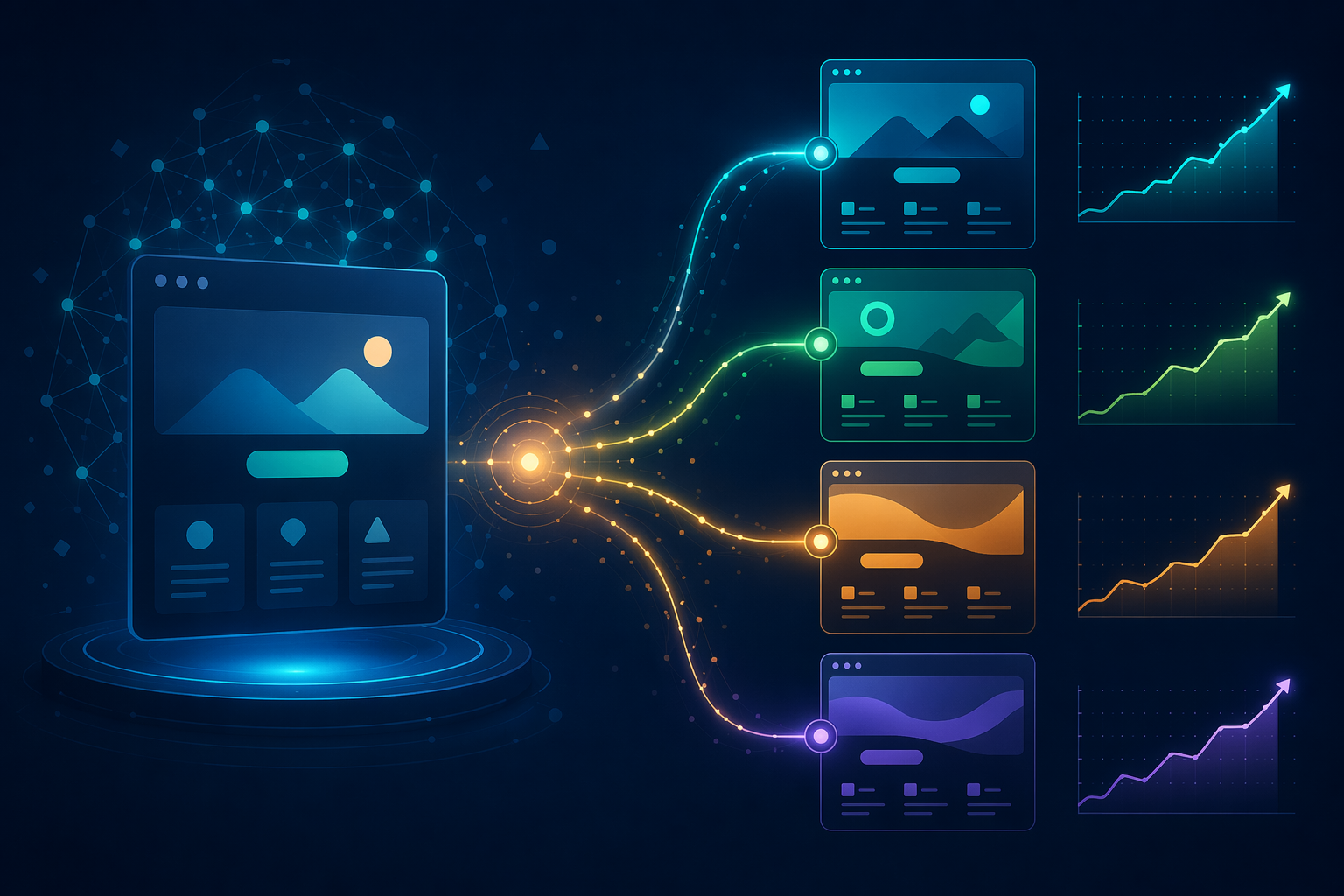
AI landing page personalization examples are useful only if they survive the first finance question: compared with what? The measured results in public case studies are real enough to take seriously, but they are not interchangeable. A 202% lift across a large CTA data set does not prove the same thing as a 700% lift from a persona-page pilot, and neither should be treated like a guaranteed forecast for a new tool rollout.
The credible range in the available evidence runs from modest revenue and conversion improvements to very large outlier lifts. McKinsey has reported that personalization can drive a 10–15% revenue lift, with a 5–25% range depending on sector, and can reduce customer acquisition costs by up to 50%; that is directional executive-context evidence, not a 2026 landing page benchmark.[1] HubSpot’s CTA data set is more operational: across more than 330,000 CTAs over six months, personalized CTAs converted 202% better than default versions.[2] At the high end, Tokeo saw one persona-specific landing page segment convert 700% better than a generic version, but that result came from a pilot that did not scale into production.[3]
| Source | Brand or data set | Personalization method | Measured result | Caveat worth putting on the slide |
|---|---|---|---|---|
| McKinsey | Personalization research, 2021–2023 | Broad customer personalization across sectors | 10–15% revenue lift; 5–25% range by sector; CAC reduction up to 50%.[1] | Useful for executive framing, but not a landing-page-specific or 2026 forecast. |
| HubSpot | 330,000+ CTAs over six months | Personalized calls to action | Personalized CTAs converted 202% better than default CTAs.[2] | Broad and practical, but CTA performance is not the same as full-page personalization. |
| Landingi / Tokeo | Tokeo pilot with 11+ persona-specific pages | Persona-specific landing pages | One digital marketer segment converted 700% better than the generic version.[3] | A high-upside outlier; the project never scaled past pilot. |
| Medallia / BSH Group | BSH ecommerce personalization | AI-driven product and experience personalization | 106% increase in overall conversion rate and 22% increase in add-to-cart rate.[4] | Strong ecommerce signal, but vendor-published and not a pure lead-gen landing page test. |
| Crazy Egg | AI-generated landing page A/B test | AI-created page against human-designed control | 44.83% conversion lift at 99% confidence.[5] | Only 300 total visitors: 176 in one group and 124 in the other. |
| Landingi / Pixers | B2C and B2B personalized landing pages | Segment-specific landing pages without a lead magnet | Up to 15% conversion in B2C and 5% in B2B segments.[3] | Useful implementation shape, but reported through a vendor case-study source. |
Why the Lift Ranges from 40% to 700%
The range looks chaotic until the personalization methods are separated. A personalized CTA is a smaller intervention than a persona-specific page. A behavior-based ecommerce recommendation is not the same job as an AI-generated landing page variant. Each can improve conversion, but each changes a different part of the visitor’s decision path.
HubSpot’s CTA result is probably the cleanest broad benchmark in the set because it has scale: more than 330,000 CTAs observed over six months.[2] It does not require a buyer to believe that an entire landing page was rebuilt around every visitor. It says something narrower and still valuable: when the action offered on the page is more relevant to the visitor, conversion can rise materially. For a demand generation team, that is often the first business-case wedge. The initial budget does not have to fund a fully dynamic site; it can fund better audience rules, cleaner content mapping, and CTA variants matched to lifecycle stage or intent.
Tokeo sits at the other end of the table. The 700% lift is the number people will remember, so it deserves the least lazy interpretation. In the Landingi case study, Tokeo built more than 11 persona-specific landing pages, and the digital marketer segment converted 700% better than the generic version.[3] That is not proof that persona pages normally create sevenfold conversion gains. It is proof that, under pilot conditions, a sharply matched page can beat a generic page by a huge margin when the original page is poorly matched to the visitor’s context.
That distinction matters in a budget meeting. A pilot can expose missed upside; it cannot, by itself, price a production rollout. Tokeo’s result is useful as an upside ceiling and a diagnostic clue: if one segment responds radically better to a tailored message, the generic experience was probably blending audiences that needed different proof, language, or offers. But because the project did not scale past pilot, the safer claim is not “expect 700%.” It is “persona fidelity can create large gains when the control is generic and the segment is meaningfully distinct.”
The More Useful Split: CTA, Page, Recommendation, or Generated Variant
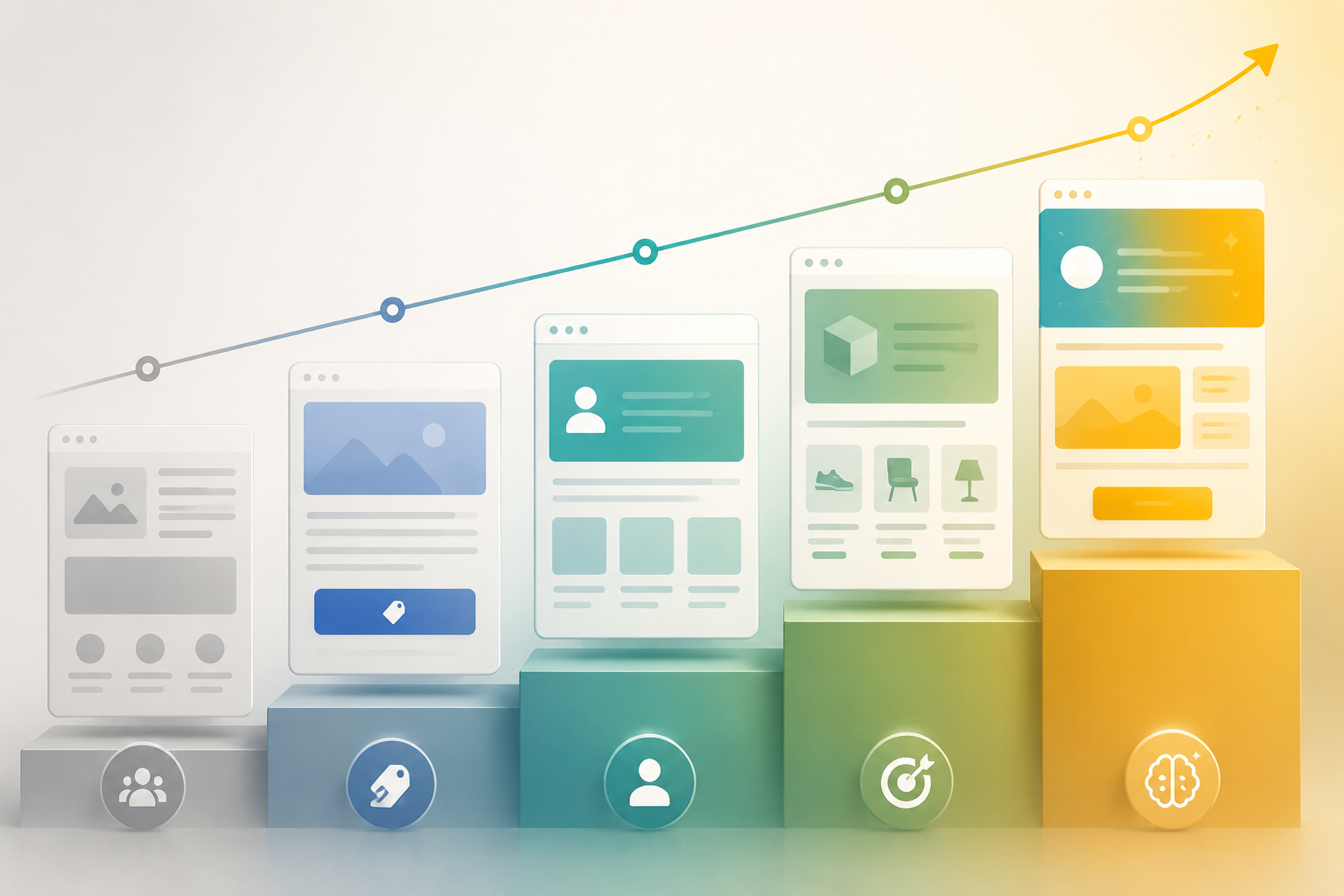
For business-case purposes, “AI personalization” is too broad. The cases point to four different motions, and the expected evidence should change with each one.
- CTA-level personalization changes the next action, not necessarily the whole page. HubSpot’s 202% CTA lift belongs here.[2]
- Persona-specific landing pages change the message, proof points, and offer for a defined audience. Tokeo and Pixers belong here.[3]
- Behavior-based ecommerce personalization changes recommendations, product exposure, or on-site experience based on observed behavior. BSH Group belongs closest to this category.[4]
- AI-generated page variants test whether machine-created copy, layout, or creative can beat a human control. Crazy Egg’s A/B test belongs here.[5]
These categories do not form a maturity ladder that every team must climb. A B2B software company running account-based campaigns may get more value from role-specific landing pages than from product recommendations. An ecommerce brand with rich browsing and cart data may see faster payback from behavior-based modules. A content-heavy business with many offers may start with CTA personalization because the asset library already exists.
BSH Group is useful because it is not just a landing page anecdote. Medallia reports that AI personalization produced a 106% increase in overall conversion rate and a 22% increase in add-to-cart rate for BSH.[4] That gives the result an ecommerce behavior hook: the lift was not only a form-fill or click; it reached a shopping action closer to revenue. The caveat is source type. Medallia is a vendor-published source, so the case should be treated as selected evidence, not an average outcome across all implementations.
Crazy Egg gives a different kind of evidence. Its AI-generated landing page beat a human-designed page with a 44.83% lift at 99% confidence, but the test included 300 total visitors: 176 in one group and 124 in the other.[5] That is exactly the kind of result worth testing again before it becomes a procurement claim. The confidence level says the observed test result was unlikely to be random within that experiment; the small visitor count says the team should still want replication, especially if traffic mix, acquisition source, or seasonality changes.
Pixers is less dramatic and, in some ways, more believable for teams that have been burned by miracle percentages. Landingi reports that Pixers reached up to 15% conversion in B2C personalized landing pages and 5% in B2B segments, without using a lead magnet.[3] That does not create a neat lift percentage against a control in the way a strict A/B test would. It does show another implementation shape: segmented landing pages can work even when the offer is not artificially sweetened by a gated asset.
What a Manager Can Responsibly Claim
A defensible internal slide should not average these numbers. Averaging a 10–15% revenue lift, a 202% CTA lift, a 700% pilot lift, and a 44.83% small-sample test would create a number with no operational meaning. The better slide groups the evidence by what changed: CTA relevance, persona-page fit, behavior-based recommendation quality, and AI-generated variant performance.
| Claim | Safe wording | What not to imply |
|---|---|---|
| Personalization can improve revenue and acquisition efficiency. | McKinsey reports 10–15% revenue lift and CAC reduction up to 50% from personalization, with sector variation.[1] | Do not present this as a 2026 forecast for landing page software. |
| CTA personalization has broad evidence behind it. | HubSpot found personalized CTAs converted 202% better across more than 330,000 CTAs over six months.[2] | Do not imply every full landing page will triple conversions. |
| Persona-specific pages can produce very large gains. | Tokeo’s digital marketer segment converted 700% better than the generic page in a pilot.[3] | Do not call this a typical or production-scaled result. |
| AI-generated variants can beat human controls. | Crazy Egg reported a 44.83% lift at 99% confidence.[5] | Do not ignore the 300-visitor sample size. |
| Ecommerce personalization can affect deeper buying actions. | BSH saw a 106% conversion-rate increase and 22% add-to-cart increase.[4] | Do not treat a vendor-published ecommerce case as a universal lead-gen benchmark. |
That structure is less glamorous than a single blended ROI number, but it is harder to embarrass. It lets a marketing manager say: here is the evidence that personalization can work, here is the kind of personalization closest to our use case, and here is the caveat that keeps us from over-claiming.
For teams building a broader AI marketing evidence deck, these landing page cases fit best alongside broader case-study pattern work, not inside a generic AI adoption narrative. Signal & Convert’s analysis of 119 AI marketing case studies is a useful companion because it separates recurring implementation patterns from isolated wins. The counterweight is equally important: the AI marketing evidence ranking treats personalization as promising but case-dependent, which is the right level of confidence for the current public evidence.
The ROI Math Is Simple; the Inputs Are Not
The basic economics are straightforward. If a landing page converts more of the same traffic, effective CPA falls. If more of those conversions become qualified opportunities, pipeline efficiency improves. If the personalized experience helps the buyer reach the right offer faster, sales may receive leads with clearer intent.
The weak point is usually hidden in the phrase “same traffic.” A conversion-rate lift is worth less if the test coincides with a better traffic source, a seasonal spike, a different offer, or a looser definition of conversion. A landing page that increases demo requests but lowers sales acceptance has not improved demand generation; it has moved the problem downstream. That is why the better pilots measure both the page event and the next commercial checkpoint: qualified lead rate, opportunity creation, revenue, add-to-cart, purchase, or retention, depending on the business model.
The segmentation input deserves the most scrutiny. Personalization works when the page knows something useful: search intent, role, company size, industry, lifecycle stage, previous behavior, or product interest. It fails quietly when the segment is decorative. “Enterprise” is not useful if every enterprise visitor sees the same proof points regardless of role. “Returning visitor” is not useful if the page cannot distinguish someone comparing pricing from someone reading an educational article.
For B2B teams, this is where AI landing page personalization overlaps with ABM and demand generation operations. Role-based pages, industry proof, account-tier messaging, and intent-triggered CTAs can be valuable, but only if the routing logic is trusted. Teams applying this to pipeline programs may want the adjacent AI in B2B demand generation guide rather than a generic personalization playbook.
How to Read Vendor Case Studies Without Throwing Them Out
Most of the landing page personalization evidence available publicly comes from vendors or vendor-adjacent sources. That does not make it useless. It does mean the case studies are more likely to show strong outcomes than typical outcomes. A vendor has every reason to publish Tokeo’s best segment, BSH’s conversion gain, and Crazy Egg’s winning test. It has less reason to publish flat tests, messy implementations, or pilots that failed because the audience data was too thin.
The practical answer is not to discard the evidence. It is to downgrade the claim to the level the evidence can actually support. A large multi-month data set can support a broader benchmark. A single pilot can support a hypothesis. A statistically confident test with 300 visitors can justify a follow-up test, not a company-wide forecast. An ecommerce case can support investment in recommendation and experience personalization, but it may not transfer cleanly to a B2B demo-request page.
A clean pilot brief should answer five questions before the tool purchase becomes the story: what segment will see a different experience, what specific message mismatch is being fixed, what control will remain unchanged, what downstream metric will be checked, and how long the test needs to run to avoid declaring victory on noise.
Where AI Personalization Deserves Budget
The strongest case for investment is not “AI will personalize everything.” It is narrower: the team has enough traffic to test, enough segment data to make different experiences meaningful, and enough content or offer variation to act on what the model or rules identify. In that environment, the public evidence supports a reasonable expectation of measurable lift, with occasional very large wins when a generic page has been masking a high-intent segment.
The weakest case is a personalization layer sitting on poor data. If the CRM fields are unreliable, paid-search intent is not preserved, anonymous traffic cannot be meaningfully grouped, and downstream lead quality is not measured, the AI tool becomes a faster way to create page variants no one can evaluate. The conversion rate may still move, but the business will not know whether it bought pipeline efficiency or just more form fills.
AI landing page personalization can produce measurable gains, sometimes very large ones. The repeatable lesson from the cases is not that every team should expect triple-digit lift. It is that better segment fidelity and cleaner behavioral data create the conditions where personalized experiences can outperform generic ones. Invest when the team can name the audience, define the control, measure the downstream outcome, and explain why the personalized page should match intent better. Be skeptical when the only evidence is a vendor average, an unscaled pilot, or a personalization engine pointed at data the team does not trust.
References
- The value of getting personalization right—or wrong—is multiplying, McKinsey
- Personalized Calls-to-Action Convert Better [Data], HubSpot
- Landing Page Personalization Case Studies, Landingi
- How Brands Are Using AI Personalization to Improve Customer Experience, Medallia
- AI vs. Human Landing Page, Crazy Egg

Comments
Join the discussion with an anonymous comment.