
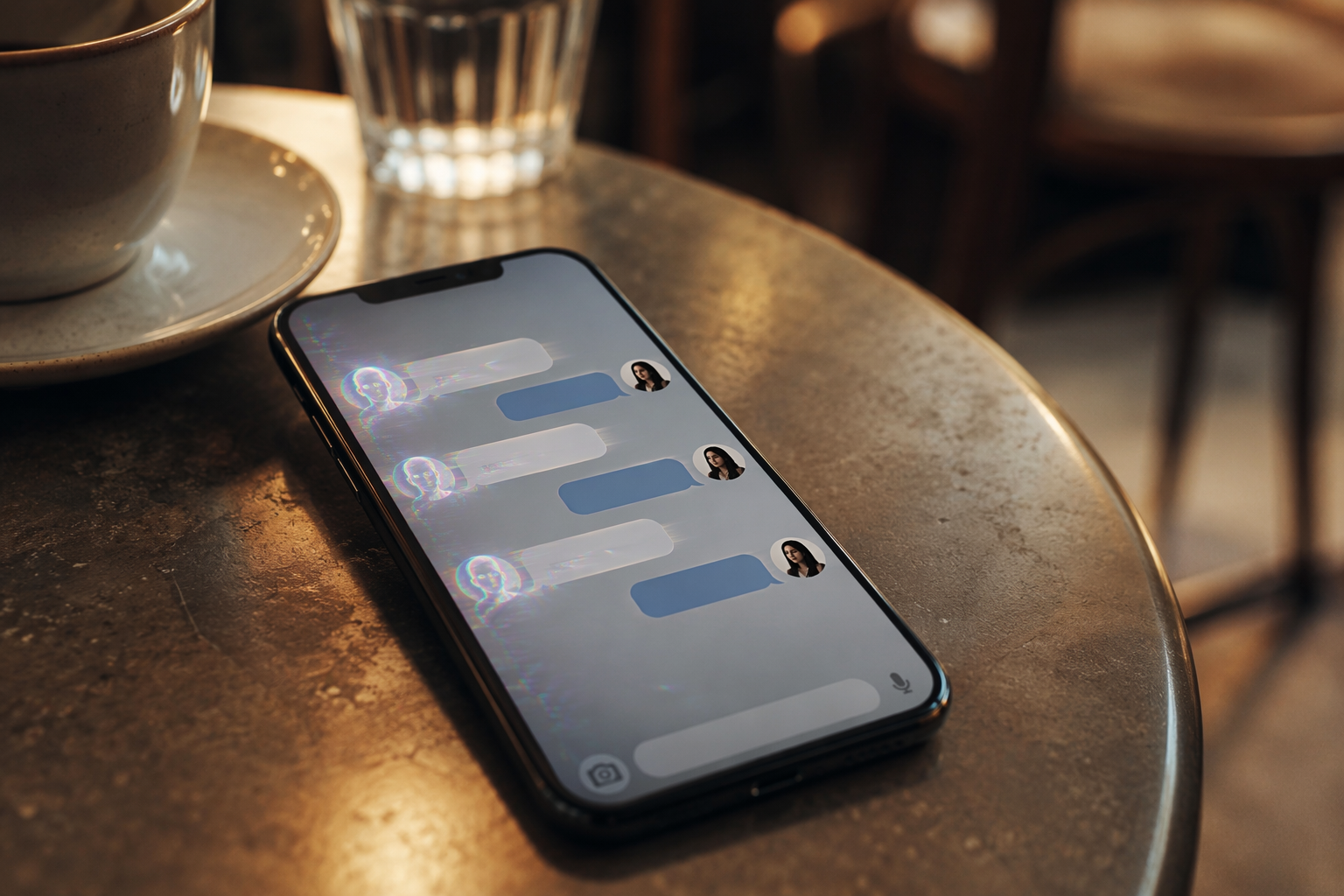
AI Chatfishing: A Trust Crisis for Dating App Marketers
Over a quarter of U.S. singles used AI for dating in 2025, yet 33% say fully AI-generated conversations are a dealbreaker. This article explains why dating app marketers should embrace transparency and first-party AI tools instead of bans — and how this approach can differentiate their brand.
Dating app marketers are being asked to sell confidence in a product environment where AI is already changing the behavior of the people inside it. In 2025, 26% of U.S. singles said they had used AI for dating, up from 6% in 2024 — a 333% year-over-year increase.[1] At roughly the same moment, one-third of daters said a fully AI-generated conversation would be a dealbreaker, and 40% said the same about AI-altered photos.[2]
That collision is the marketing problem behind AI chatfishing. The issue is not whether someone asks a tool to make a first message less awkward. The sharper problem is substitution: a dater believes they are responding to another person’s spontaneous interest, humor, vulnerability, or flirtation, when a large part of that interaction has been quietly outsourced to AI.
For growth teams, this is bigger than a copywriting trend. Dating apps already operate in a low-trust category: users are evaluating strangers, moderating their own exposure, and deciding whether an app is worth returning to after disappointment. Undisclosed AI does not merely add another feature question. It changes what the conversation itself appears to mean.
The boundary users are drawing is not anti-AI
The easiest misread is to treat the dealbreaker data as evidence that daters want AI gone from dating altogether. The adoption numbers do not support that. Many users are experimenting with AI because dating apps ask them to perform a difficult set of tasks: be original, concise, attractive, emotionally available, funny, and safe, often after years of swipe fatigue.
A person who uses AI to sharpen a profile prompt may still feel misled when a match conducts an entire conversation through a chatbot. That is not necessarily hypocrisy. It is a boundary distinction between assistance and impersonation.
| User behavior | How it tends to feel to the other person | Marketing risk |
|---|---|---|
| Getting help making a profile answer more specific | Coached self-expression | Manageable if the product makes the role of AI clear |
| Using AI to brainstorm a first message | Light assistance, especially if edited by the user | Low to moderate, depending on how much is disclosed |
| Letting AI generate replies throughout a live conversation | Synthetic intimacy if undisclosed | High, because the other person may feel deceived |
| Using AI-altered photos without clear context | Misrepresentation | High, especially when appearance affects match decisions |
This distinction matters because most dating app positioning still talks about AI in broad terms: smarter matching, better profiles, better conversations, less friction. Those benefits may be real in narrow use cases. But if the user’s felt experience is, “I can’t tell whether I’m talking to a person,” the promise of smoother conversation starts to sound like a threat to the core product.
The perception gap is familiar outside dating, too. Marketers often move faster toward AI-enabled experiences than consumers move toward comfort with those experiences. Teams planning dating-specific AI messaging should read that broader gap alongside category data, not treat dating as exempt because users are already adopting AI tools. See The AI Ad Perception Gap for the same trust mismatch in advertising contexts.
Why opacity is more dangerous than adoption
Adoption alone does not create the trust crisis. Hiddenness does. Six in 10 dating app users believe they have encountered at least one conversation written by AI.[1] That figure measures belief, not confirmed AI use, but belief is exactly what marketers have to worry about. A marketplace can be damaged by the suspicion that interactions are synthetic even when some of those suspicions are wrong.
Once users start looking for signs that a match is not really present — oddly polished replies, generic emotional mirroring, timing that feels automated, or the same style appearing across different people — the dating app loses something no campaign can easily buy back. The product no longer feels like a room full of people. It feels like a room where some people may be proxies.
The scam context raises the stakes without making every AI-assisted dater a scammer. In February 2026, Barclays reported that 84% of UK adults believed tech companies should do more to prevent scams on their platforms, and that 67% of romance scam reports originated on dating sites or social media.[3] Those numbers do not prove chatfishing causes romance fraud. They do show the environment in which users are interpreting unclear digital intimacy.
That same Barclays release said 56% of Gen Z singles now prioritize in-person meetings over dating apps, compared with a cross-generational average of 42%.[3] For marketers, the important point is not that Gen Z has abandoned apps. It is that app-based dating is competing with a renewed desire for proof: proof that someone is real, proof that attention is authentic, proof that the platform is not asking users to absorb all the risk.
Bans sound clean until you look at enforcement
A strict “no AI” posture can be tempting because it gives marketers a simple line: real people, real conversations. The problem is that it is hard to enforce, easy to evade, and likely misaligned with how users already behave. If a meaningful share of singles are using AI somewhere in the dating process, a blanket ban turns ordinary profile assistance and full conversational impersonation into the same policy category.
Detection is not a strong enough foundation for that strategy. Scientific American, citing a 2024 Nature study, reported that humans were about 57% accurate at detecting AI-written text — only modestly better than chance.[1] In practice, that means a detection-centered user experience can create two bad outcomes at once: some AI-generated conversations pass as human, while some real users get treated as suspicious because they write in a polished, generic, or non-native style.
Automated detection has its own product risks. False positives can punish sincere users. False negatives can create a false sense of safety. Publicly leaning on detection can also train users to hunt for superficial tells instead of evaluating the actual quality and consistency of interaction.
The more credible path is not to pretend AI can be kept outside the category. It is to define where the product welcomes AI, where it restricts it, and where it requires disclosure. Marketing then has something concrete to communicate: not “we use AI,” but “here is how AI can and cannot participate in the interaction.”
First-party coaching gives marketers a cleaner position
Hinge’s Prompt Feedback feature is a useful example because it points AI at a bounded problem. The tool evaluates whether a user’s profile prompt response is too basic and suggests ways to make it more specific.[4] The product is not presented as a hidden operator inside a match conversation. It is closer to a writing coach standing beside the user before the interaction begins.
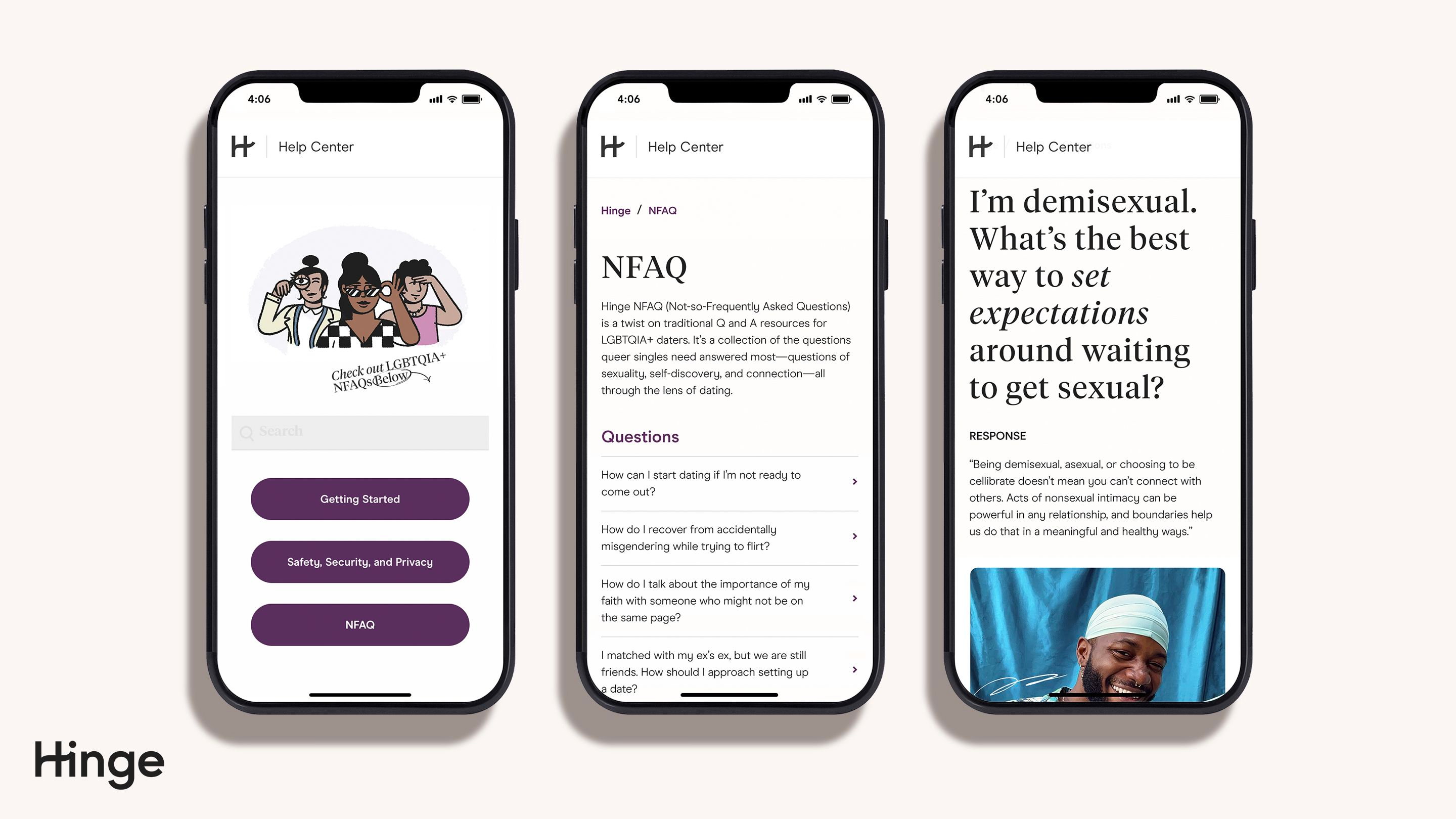
That design choice creates a different marketing story from “AI will date for you.” It says the app can help a user reveal more of themselves. It reduces blank-page friction without replacing the person. For shy users, burned-out users, or people who know what they mean but struggle to phrase it, that distinction is not cosmetic. It is the difference between support and synthetic performance.
First-party coaching also gives the platform more control than third-party AI workarounds. If users are already copying profile answers into external tools, the app has little visibility into what is being generated, how much is being edited, or whether the result crosses into misrepresentation. A native feature can set boundaries in the interface itself: suggest specificity, discourage clichés, preserve the user’s own wording, and avoid generating a full substitute identity.

The strongest product-led differentiation will likely come from this kind of visible constraint. A dating app does not need to claim that its AI is more magical than everyone else’s. It can claim that its AI is more honest about what role it plays.
What dating app marketers can actually position around
The marketing response should begin in product language, not campaign language. Users should be able to understand AI’s role at the moment it affects them. A buried policy page may be necessary, but it will not carry the trust burden by itself.
Label assistance where it changes the interaction
If AI helps write or substantially rewrite profile content, the app can disclose that in a lightweight way near the content or inside the creation flow. If AI is used only to suggest that an answer needs more detail, the disclosure can be different from a label for generated text. The point is to avoid flattening every AI touch into one vague badge.
Marketing teams need the same tiering internally. A practical disclosure policy should distinguish low-risk productivity support from user-facing generated content and high-risk synthetic interaction. For a working model, see How to Build a Three-Tier AI Disclosure Policy for Marketing Teams.
Separate coaching from generation in the interface
A coaching feature can ask better questions: “Can you add a specific place, habit, or opinion?” A generation feature writes the answer. Those two experiences should not be marketed as the same thing, because users do not experience them as the same thing when they discover AI on the other side of a match.
The safest positioning is to frame AI as a tool that helps users become more legible, not more optimized. “Say what you actually mean more clearly” is a very different promise from “get more matches with AI-written charm.” The latter may improve short-term engagement metrics while degrading the meaning of a match.
Avoid the claim that AI will fix dating
The category has broader headwinds than message quality. Match Group stock was down more than 75% over five years, and Bumble paying users fell 18% year over year. Those figures are not proof that AI caused dating-app fatigue; they are a reminder that AI features are entering a market already dealing with churn, skepticism, and changing user expectations.
That is why “AI will bring back users” is a fragile story. If users feel that apps are adding automation to a place already short on authenticity, the message can backfire. A more durable claim is narrower: the app uses AI in specific, disclosed ways to reduce friction while protecting the user’s ability to judge real interest.
Treat disclosure as a product feature
Disclosure is often treated as legal housekeeping. In dating, it can become part of the value proposition. A user who understands when AI is present, what it is allowed to do, and how the platform handles synthetic behavior has more reason to keep participating than a user asked to simply trust the brand.
That does not mean every AI-assisted comma needs a warning label. Over-labeling can become noise. The more useful standard is whether AI materially affects another person’s interpretation of identity, intent, attractiveness, or attention. When it does, the case for disclosure becomes much stronger.
Teams should also coordinate product disclosure with advertising and lifecycle messaging. If a campaign promotes AI-enhanced dating outcomes, the app should be ready to explain how the feature works, what users control, and what is off-limits. The FTC angle is not theoretical for marketers using AI claims in public-facing messaging; FTC Disclosure Requirements for AI-Generated Content covers the broader disclosure considerations.
The useful promise is not more AI. It is more accountable AI.
AI chatfishing puts dating app marketers in an uncomfortable position: the behavior is too widespread to ignore, too useful in some contexts to condemn outright, and too trust-damaging when hidden to treat as harmless experimentation.
The apps with the clearest position will not be the ones pretending users can be pushed back to a pre-AI dating culture. They will be the ones that make a visible distinction between coaching and impersonation, give users context when AI changes what they are seeing, and resist turning synthetic intimacy into a growth hack.
Transparency and first-party coaching will not solve dating-app churn by themselves. They do, however, give marketers a credible way to compete on trust at the exact moment trust is becoming part of the product.
References
- The Rise of AI 'Chatfishing' in Online Dating Poses a Modern Turing Test, Scientific American
- The rise of the AI wingman, Business Insider, Dec 2025
- AI deepfake concerns see Gen Z 'swiping left' on dating apps, Barclays, Feb 2026
- Hinge's new AI feature determines if your prompt response is too basic, TechCrunch, Jan 2025

Comments
Join the discussion with an anonymous comment.