
Persado
This article analyzes Persado's emotional language AI through controlled tests at Ally Financial and JPMorgan Chase, revealing that the mechanism driving lift is urgency-to-excitement/intimacy substitution, not personalization or send timing. For B2B demand generation managers and CRM directors evaluating enterprise AI investments.
Outcome
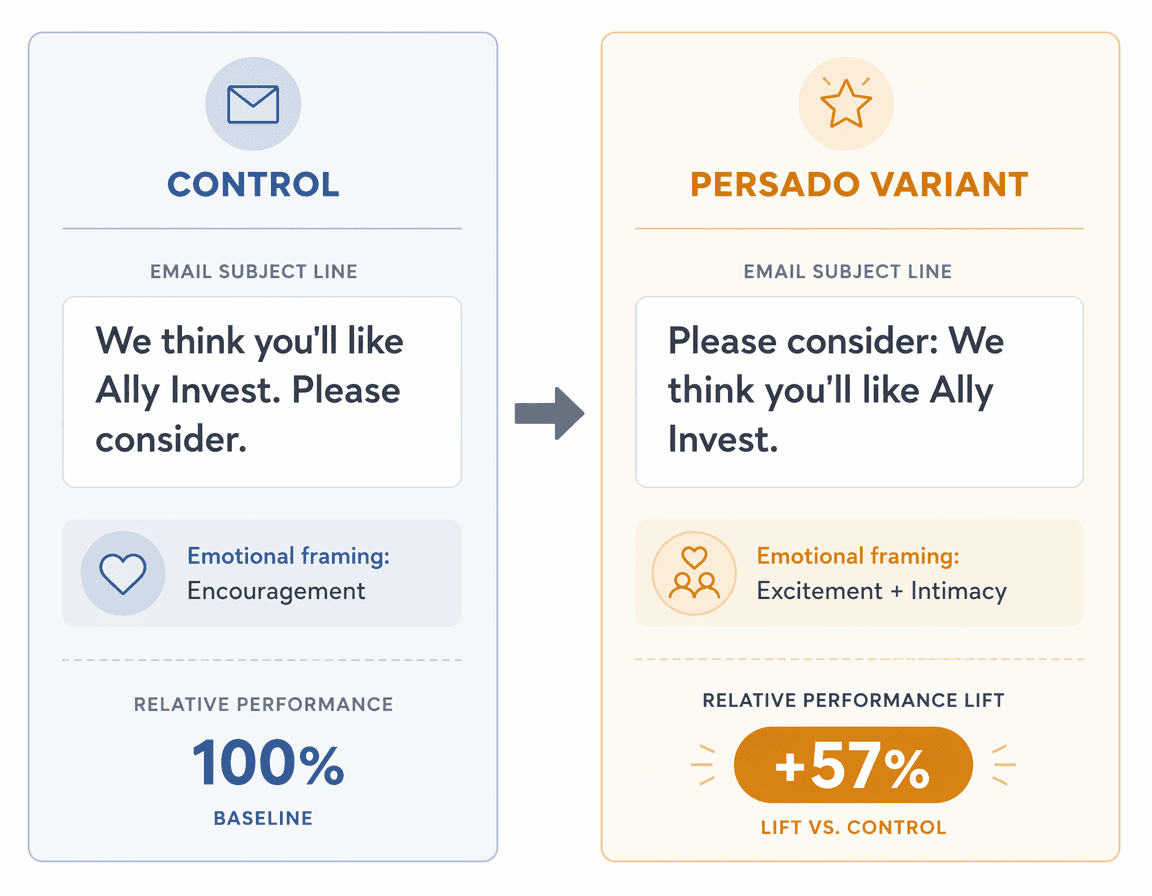
Ally Financial achieved 2x CTR lift, +57% new accounts, and +16% average conversion lift by shifting email copy from Encouragement to Excitement + Intimacy framing — source: Persado case study.
AI Tools Used
This outcome is independently verified via the primary source linked above.
The 450% CTR Claim That Demands a Second Look
In July 2019, JPMorgan Chase announced a five-year, enterprise-wide deal with Persado after a pilot that began in 2016. The pilot, run across Chase's Card and Mortgage businesses, produced a headline number that still gets cited in AI marketing presentations: ads with Persado-generated copy saw as high as a 450% lift in click-through rate compared to human-written copy, which ranged between 50% and 200%. Kristin Lemkau, then CMO of JPMorgan Chase, told the press that the AI "rewrote copy and headlines that a marketer, using subjective judgment and their experience, likely wouldn't have. And they worked."
The five-year deal itself is the stronger signal for B2B marketers evaluating Persado. JPMorgan Chase did not renew a pilot or expand a departmental test. It committed to an enterprise-wide integration covering marketing creative, internal communications, and eventually customer service prompts. That level of institutional commitment — from one of the most compliance-heavy organizations in the world — suggests the mechanism driving Persado's results is real, repeatable, and defensible under regulatory scrutiny.
But the question most demand generation managers and CRM directors need answered is not whether Persado works. It is what, exactly, makes it work. If the answer is "better subject line personalization" or "smarter send-time optimization," then the investment case is weak — those capabilities are available from cheaper, more flexible tools. If the answer is something fundamentally different — a mechanism that standard A/B testing and ESP-native optimization cannot replicate — then the enterprise price tag starts to make sense.
How Persado's Motivation AI Differs from Generic LLMs
Persado's platform is not a wrapper around GPT-4 or Claude. It is built on a proprietary language knowledge base — millions of words and phrases that have been tagged and scored across emotional dimensions — and trained on data from 1.2 billion consumer interactions. The system uses natural language generation, machine learning, and experimental design to predict which emotional framing combination will produce the highest conversion rate for a given audience and channel.
This is a fundamentally different architecture from the generative AI tools most B2B marketers are experimenting with today. ChatGPT and Claude generate copy based on patterns in their training data — the open internet. They can produce plausible subject lines, but they cannot systematically test whether "Excitement + Intimacy" outperforms "Encouragement + Safety" for a specific segment, because they have no framework for categorizing language along emotional dimensions.
- Persado's language knowledge base contains millions of tagged and scored words and phrases, not raw internet text.
- The platform is trained on 1.2 billion consumer interactions across financial services, retail, telecom, travel, and healthcare — not general web data.
- Built-in compliance guardrails cover 20+ regulatory frameworks, which is why Persado reports zero post-deployment compliance incidents across 10+ years of work with 8 of the top 10 U.S. banks.
- Every variant is generated within an experimental design framework that isolates emotional framing as the independent variable, controlling for length, structure, and call-to-action placement.
For B2B marketers, the compliance angle matters more than the creative one. Financial services, healthcare, and regulated B2B industries face legal and brand-risk constraints that make generic AI copy generation dangerous. Persado's 90% reduction in compliance rejections and zero post-deployment incidents over a decade is a stronger value proposition for a regulated B2B enterprise than any CTR lift figure.
Ally Financial: 12 Experiments, One Clear Mechanism
The most detailed controlled test of Persado's emotional language mechanism comes from Ally Financial, documented by David Hixon, Executive Director of CRM & Marketing Analytics. Between September 2020 and March 2022, Ally ran 12 experiments across email and web channels, structured in two phases.
| Phase | Period | Scope | Key Results |
|---|---|---|---|
| Pilot | Sep 2020 – Feb 2021 | 3 language experiments | 25–58% improvement over Ally's human-written control messages |
| Full-service contract | May 2021 – Mar 2022 | 9 experiments across email and web | 2x CTR lift above all control messages; +57% new Ally Invest accounts from one email experiment; +16% average conversion lift across diverse campaign types |
The pilot phase is the most instructive for understanding the mechanism. Ally's control messages used what Persado classifies as "Encouragement" framing — supportive, confidence-building language that a human copywriter would naturally produce for a financial services audience. Persado's winning variants shifted to "Excitement + Intimacy" — a combination that feels slightly counterintuitive for banking products.
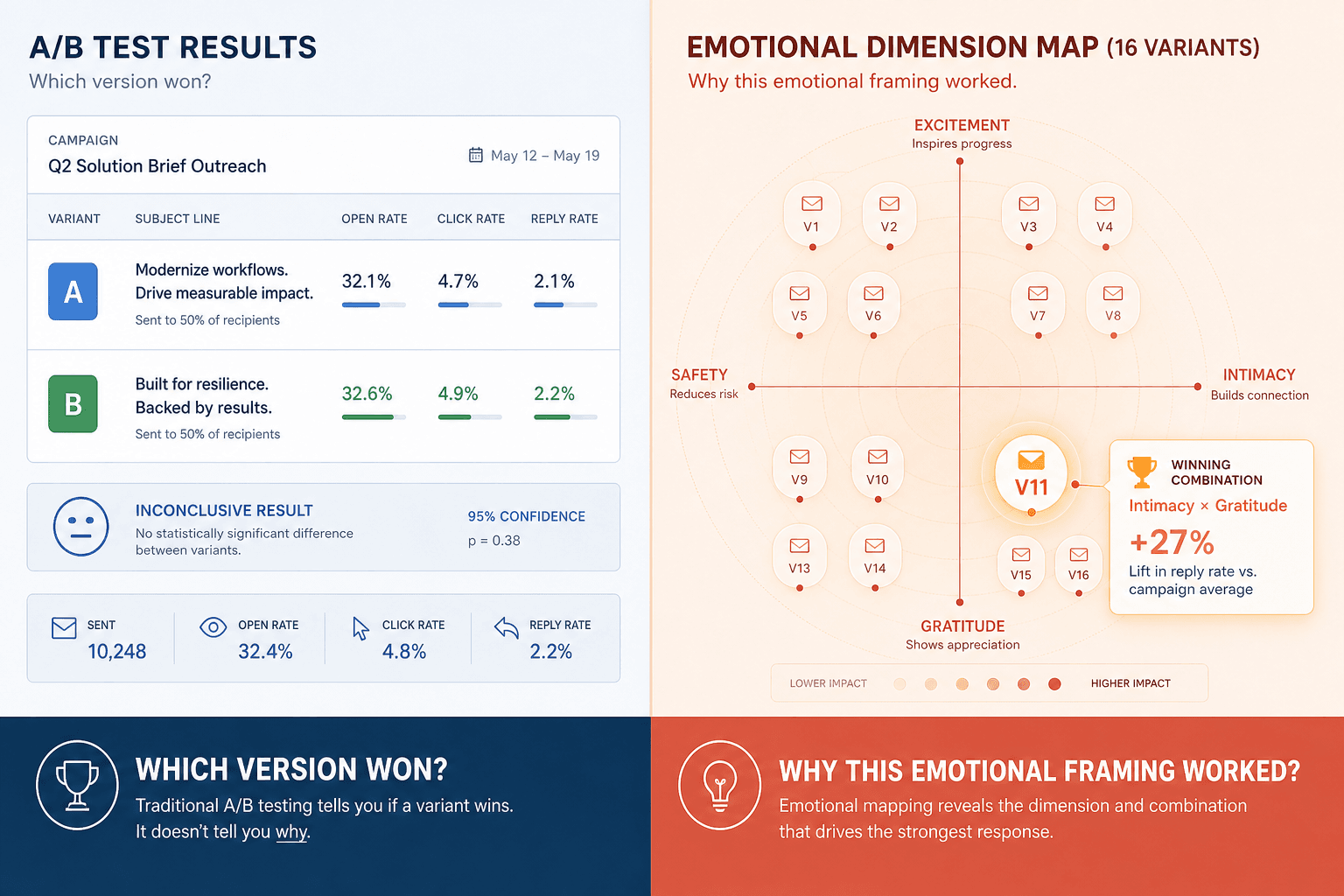
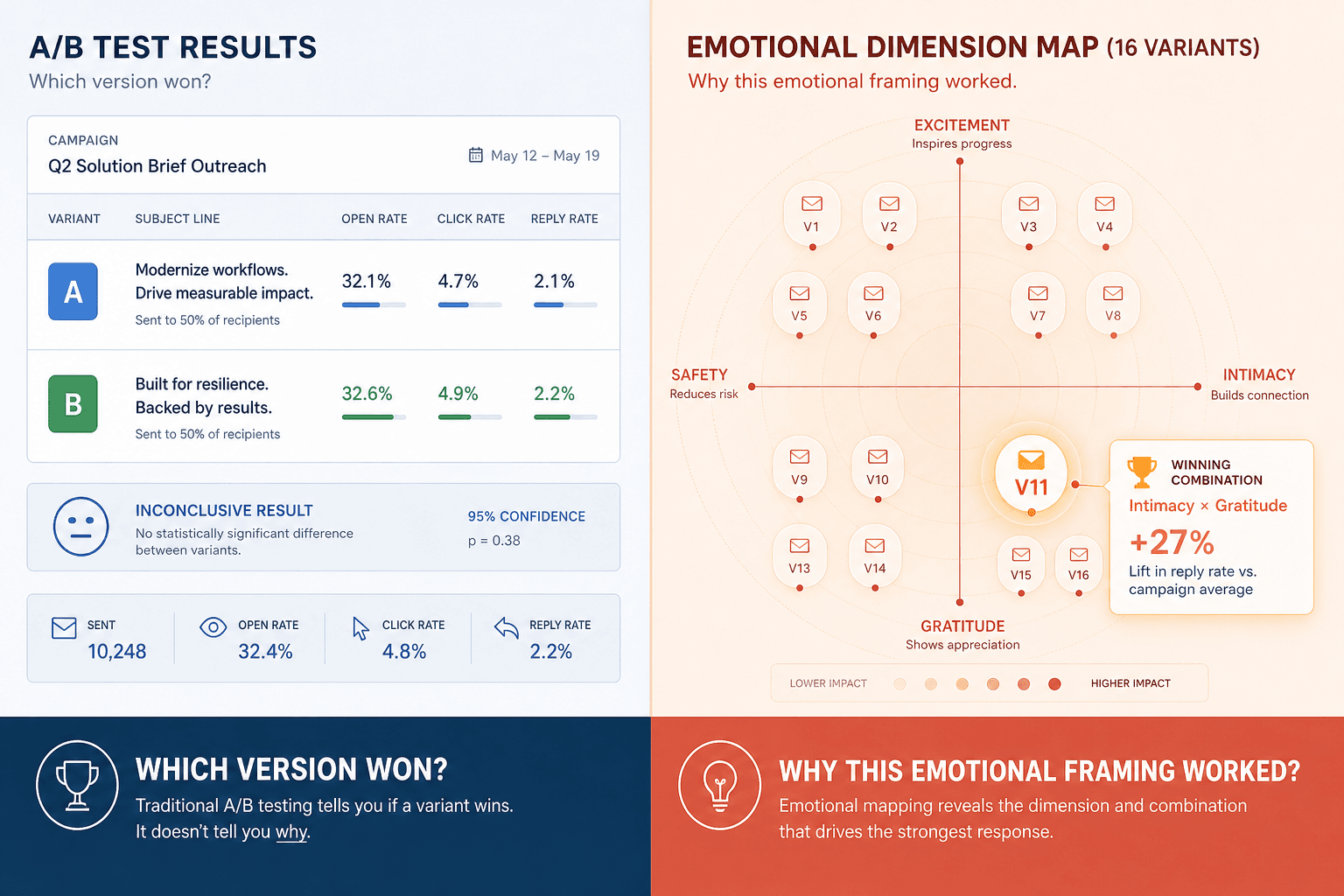
Hixon valued the "why" insights from post-campaign debriefs as much as the lift numbers. Standard A/B testing tells you which version won. Persado's experimental design tells you which emotional dimension drove the win, enabling Ally to apply that learning across future campaigns rather than starting from zero each time.
Before and After: What the Subject Lines Actually Looked Like
The concrete before-and-after examples from Ally Financial and Vodafone Italy reveal that the copy changes are subtle — the emotional framing shift is what changes, not the offer or the structure.
| Brand | Control (Human-Written) | Emotional Framing | Persado Variant | Emotional Framing | Lift |
|---|---|---|---|---|---|
| Ally Financial | "Build out your portfolio with Ally Invest" | Encouragement | "Please consider: We think you'll like Ally Invest." | Excitement + Intimacy | +57% new accounts |
| Vodafone Italy (push notification) | "MY VODAFONE — Read me immediately! Special offer: 1000 minutes confirmed with a click." | Urgency | "Just for you, get 10GB of 4G, 1000 minutes and 1000 SMS every month! Don't miss your only chance to get it all for only [Renewal_Cost] euros each month." | Excitement + Safety | +40% conversion rate lift |
The Ally example is particularly revealing. The control subject line is perfectly reasonable B2C financial copy — it states the benefit, uses active language, and avoids jargon. The Persado variant is softer, more tentative ("Please consider"), and introduces a relational element ("We think you'll like"). The shift from "Encouragement" to "Excitement + Intimacy" is not about being louder or more urgent. It is about creating a sense of personal recommendation rather than a transactional offer.
The Vodafone Italy example is the mirror image. The control message leads with urgency ("Read me immediately!") and a command structure. The Persado variant replaces the urgency frame with a personalization frame ("Just for you") and a safety cue ("Don't miss your only chance") — still creating scarcity, but wrapping it in a benefit-forward, customer-centric structure rather than an imperative one.
Why Urgency Words Underperform Across Every Segment Tested
Persado's Content Intelligence team analyzed 21.6 billion consumer email impressions from 8.6 billion message variations across travel, finance, and retail campaigns between January 1, 2022 and December 15, 2022. The findings directly contradict the conventional B2B email playbook of urgency-based scarcity language.
| Word Category | Examples | Performance |
|---|---|---|
| Past-tense reassurance words | "dropped," "confirmed," "scored," "arrived," "earned" | Top 10 best-performing words across all segments |
| Urgency-imperative language | "last chance," "don't miss out," "last" | Least-performing words; no imperatives appeared in top performers |
| FOMO language | "ASAP," "redeem" | Underperformed relative to gratitude and reassurance frames |
| Gratitude expressions | "thank you," "appreciate" | Consistently drove higher engagement than urgency equivalents |
For B2B email programs, this finding has structural implications. B2B sales cycles are longer than B2C cycles, involve multiple stakeholders, and require considered decision-making. Urgency-based subject lines ("Last chance to register," "Don't miss this offer") may actually suppress engagement from B2B buyers who are not in a position to act immediately and who interpret urgency language as pushy or inauthentic. Past-tense reassurance words ("Your report is ready," "The proposal has been reviewed") align better with the B2B buyer's mental model of receiving completed work and making informed decisions.
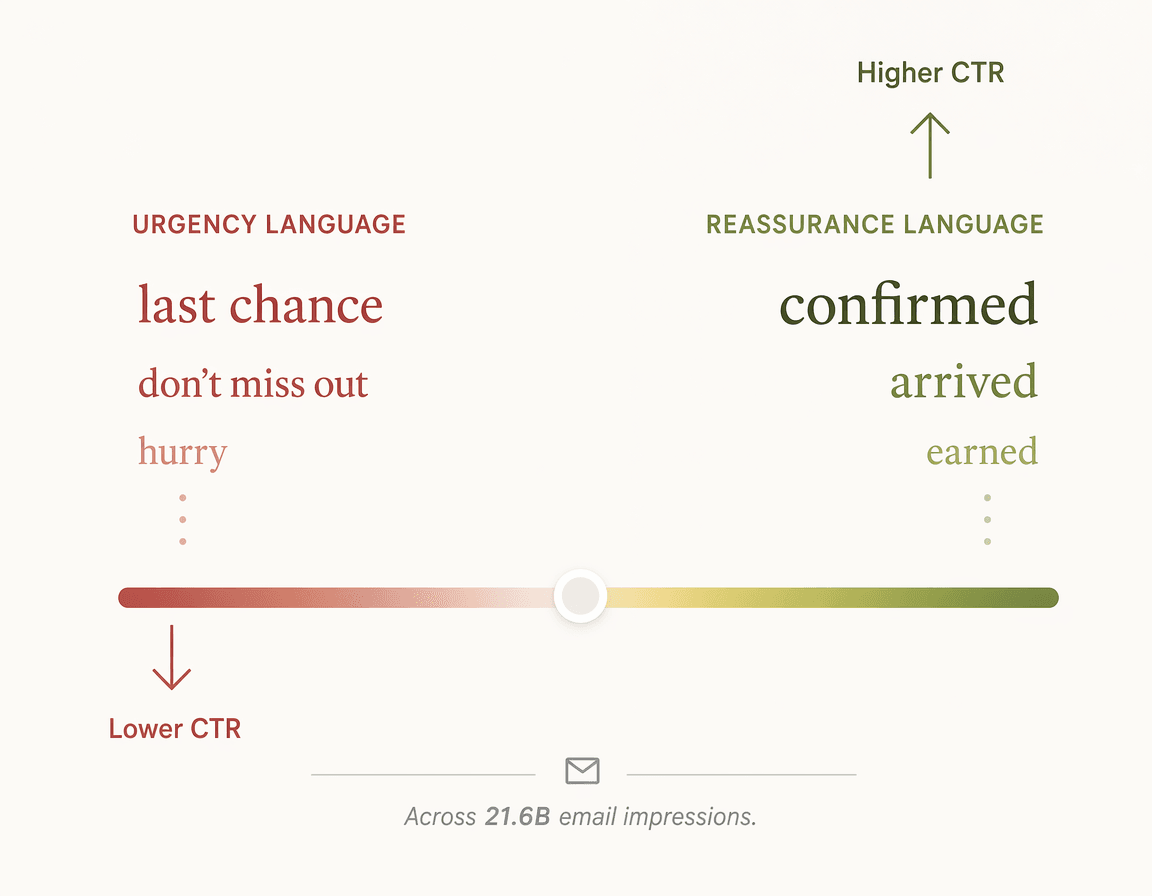
Lisa Spira, VP of Content Intelligence at Persado, noted that customers responded well to expressions of gratitude and that FOMO language underperformed. The recommendation is clear: marketers should avoid urgency-based ultimatums and instead highlight long-term value. For B2B demand generation teams running nurture sequences and account-based campaigns, this is a directly actionable insight that does not require a Persado license to implement.
What Persado Cannot Replace: The Additive Nature of B2B Email Optimization
Every Persado case study published to date is B2C or regulated-B2C — financial services, telecom, retail. The closest B2B-adjacent example is a Dell case study reporting a 45% conversion lift, but that data was not independently accessible during research. This is not a minor caveat. B2B email operates under fundamentally different dynamics: longer consideration cycles, multiple decision-makers, smaller list sizes, and higher per-email revenue stakes.
The second caveat is that emotional language optimization is additive to — not a replacement for — the standard B2B email optimization stack. Persado's own Dynamic Email product, launched in March 2025, integrates with existing ESPs and marketing automation platforms rather than replacing them. The product cuts email operations time by up to 75% for financial services clients and delivers approximately 20% average conversion lift across triggered and batch campaigns. But it still depends on the underlying infrastructure: send-time optimization, behavioral triggers, list segmentation, and CRM data quality.
- Send-time optimization: Persado does not replace your ESP's send-time algorithms. It optimizes the copy that gets sent at whatever time the ESP selects.
- Behavioral triggers: Persado can generate variants for triggered campaigns, but the trigger logic (abandoned cart, content download, webinar attendance) must still be configured in your marketing automation platform.
- List segmentation: Persado's emotional framing recommendations can be applied segment-by-segment, but the segmentation strategy itself is a human input.
- CRM data quality: Persado's integrations do not require access to PII, but the quality of personalization tokens and behavioral data depends on your existing data infrastructure.
The third caveat is pricing. Persado does not publish pricing publicly, but the enterprise-tier positioning — 8 of the top 10 U.S. banks as clients, five-year enterprise deals, dedicated implementation teams — suggests an annual commitment in the range of $150,000 to $500,000 or more. For a B2B organization with a six-figure email marketing operations budget, this is a material investment that requires internal advocacy and multi-stakeholder buy-in.
For readers evaluating Persado against alternatives, the AI Email Marketing ROI Benchmark Data 2024 article provides broader context on what enterprise AI email tools typically deliver. The AI Email Personalization in B2B SaaS: Campaign Results and What They Actually Show case study offers a direct B2B comparison point for Persado's B2C-heavy evidence base.
Transferable Principles for B2B Email Programs
Even without a pure B2B Persado case study, the controlled-test evidence from Ally Financial, Vodafone Italy, and the 21.6B-impression word analysis yields several principles that B2B demand generation teams can apply immediately — with or without a Persado license.
- Test emotional framing substitution before investing in personalization or timing optimization. The Ally pilot showed 25–58% improvement from changing the emotional frame alone — no personalization tokens, no send-time changes, no segmentation adjustments. If your current email program has not systematically tested emotional framing as a variable, that is the lowest-effort, highest-potential optimization available.
- Urgency-based scarcity language may be counterproductive for considered purchases with multiple stakeholders. The 21.6B-impression analysis is unambiguous: past-tense reassurance words outperform urgency imperatives across every segment tested. For B2B nurture sequences and account-based campaigns, subject lines that signal completion ("Your report is ready") or confirmation ("Your access has been granted") are likely to outperform urgency frames ("Last chance to register").
- The operational efficiency gains from Persado's Dynamic Email product (75% time reduction, ~20% average conversion lift) may justify the investment even before creative lift is measured. For B2B marketing operations teams managing hundreds of triggered and batch email campaigns per quarter, the time savings alone can shift the ROI calculation.
- Compliance is a stronger value proposition than creative lift for regulated B2B industries. Persado's zero post-deployment compliance incidents across 10+ years and 8 of the top 10 U.S. banks is a track record that no generic AI tool can match. If your B2B email program operates under regulatory constraints (financial services, healthcare, legal), the risk-reduction argument for Persado may outweigh the creative optimization argument.
For readers who want a broader foundation on how AI is reshaping email marketing before evaluating specific vendors, the AI in Email Marketing: A Complete Practitioner's Guide provides the contextual framework for understanding where emotional language optimization fits within the broader AI email stack.


Comments
Join the discussion with an anonymous comment.