
Is the AI data center buildout inflating Demand Gen costs?
Google's Demand Gen switch from CPC to CPM billing on Discover with view-through conversion optimization went live July 15, 2026: most accounts can opt out in one setting, and the real cost exposure is concentrated in low-CTR creative. This is the concrete test case for whether AI data center buildout costs are reaching advertiser billing — and what the change does and doesn't prove.
- Platform
- Google Ads
- Bid strategy
- View-through conversion optimization
- Difficulty
- Low
- Last reviewed
- 0-07-31
No specific Benchmarks record is cited for this tactic yet — treat it as directional, not evidence-backed.
The practical answer starts in the Google Ads settings, not in an AI data center. Google’s Demand Gen billing change went live on July 15, 2026, and it is narrower than the panic version: it applies to Discover placement inventory when a Demand Gen campaign is optimizing for view-through conversions, shifting that exposure from CPC billing to CPM billing. View-through conversion optimization is off by default, and the opt-out is not a negotiation with a rep; disable VTC optimization and the campaign is no longer in the affected billing condition. Digital Applied’s June 19 playbook, which traces the change through Search Engine Land coverage and Google help documentation, is the most useful operating source for the date, eligibility, and opt-out mechanics. [1]
For anyone trying to connect AI data center expansion to advertising infrastructure impact, this is the kind of change worth watching because it is dated, checkable, and account-level. It does not prove Google is passing AI infrastructure costs into Demand Gen. Google’s stated rationale is value-based pricing for view-through campaigns. But the billing model plainly moves more non-click exposure to the advertiser when the affected setting is on. That is enough to deserve an account audit before anyone reaches for a market-wide CPM thesis. [1]
The setting that decides whether the change touches you
The change requires two things at the same time: Discover placement exposure and view-through conversion optimization. A Demand Gen campaign without VTC optimization enabled is not in the affected lane. A campaign that is not serving on Discover is also outside the practical issue, even if other Demand Gen surfaces are running. That distinction matters because many cost alarms treat “Demand Gen” as if the whole product moved from CPC to CPM. It did not. [1]
The immediate account work is therefore small but important:
- Open affected Demand Gen campaigns and confirm whether view-through conversion optimization is enabled.
- Confirm whether Discover placement inventory is active for those campaigns.
- If the client did not deliberately choose VTC optimization, turn it off before treating the July 15 change as a new unavoidable media cost.
- If VTC optimization is intentional, flag the campaign as CPM-exposed and review creative CTR before comparing post-change cost movement.
Signal & Convert does not have a first-party spend benchmark for this July 15 switch yet. Until there is enough post-launch data to publish a real Benchmark record, this should be handled as a dated Tracker item and a campaign-level diagnostic, not as proof that all Demand Gen costs are rising. The related cost pass-through watchlist is kept in AI infrastructure squeeze ad budgets, while the upstream-cost methodology is documented in the SK Hynix HBM4 CPM impact file.
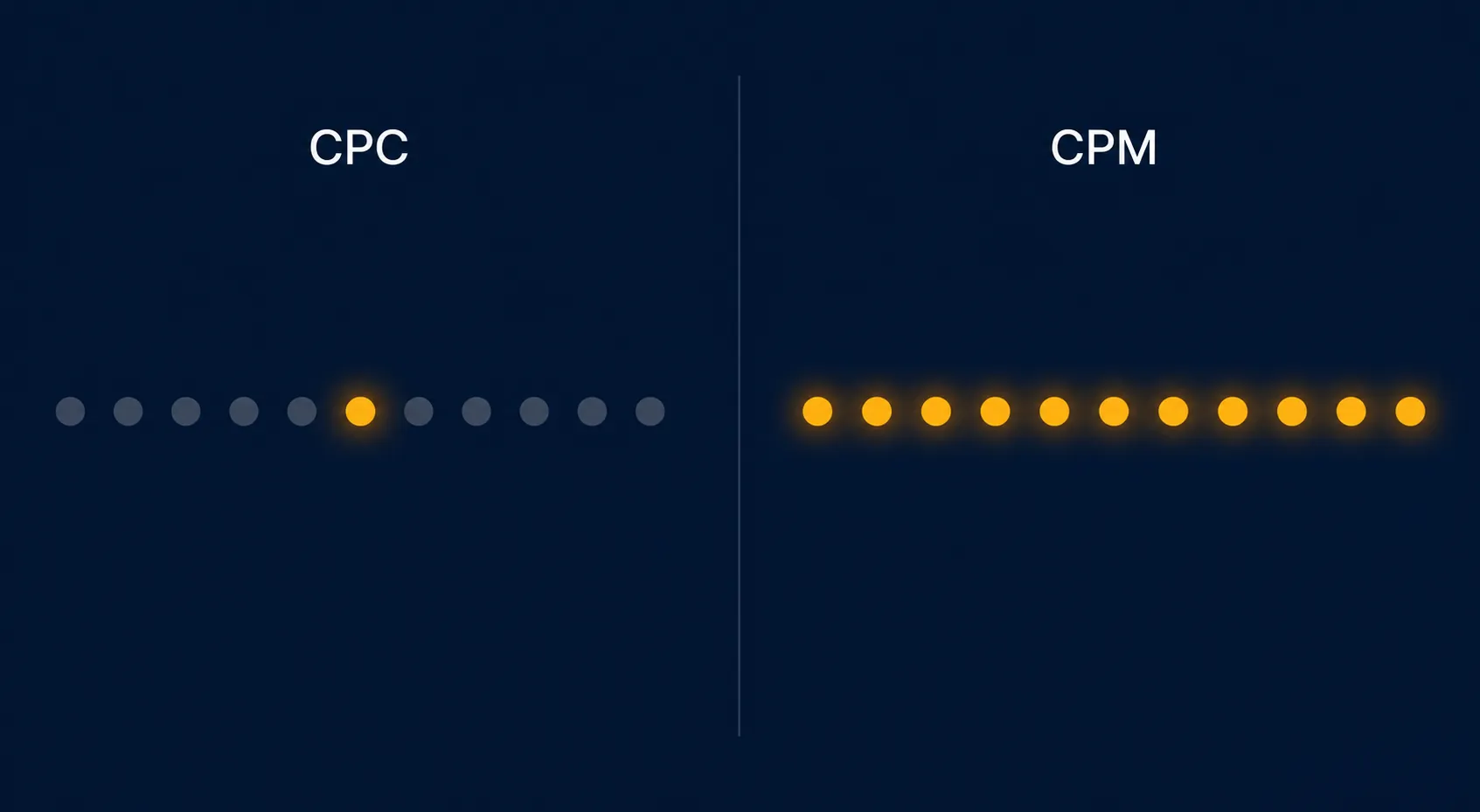
The cost transfer is simple, and that is why low-CTR creative is exposed
Under CPC billing, weak engagement naturally limits spend. If impressions are served and people do not click, the platform has delivered exposure that the advertiser has not directly paid for on a click basis. Under CPM billing, the advertiser pays for the served impressions whether or not a click happens. The campaign may look calm in the UI — no dramatic disapproval, no obvious auction shock — while the economics have changed underneath the same creative.
The hinge is the breakeven CPM. If you know the old CPC and the campaign’s click-through rate, you can translate the old click-based economics into an impression-based equivalent:
Breakeven effective CPM = CPC × CTR × 1,000

CTR should be entered as a decimal.
Example: 1% CTR = 0.01
In plain account terms: the lower the CTR, the lower the CPM that breaks even with the former CPC economics. That is why low-CTR creative carries the most risk after a CPC-to-CPM switch. The creative does not need to get worse for cost efficiency to deteriorate; it only needs to keep generating impressions without generating enough clicks.
| Hypothetical CTR | Hypothetical old CPC | Breakeven effective CPM | What it means |
|---|---|---|---|
| 0.25% | $2.00 | $5.00 | A modest CPM can exceed the old click-based economics. |
| 1.00% | $2.00 | $20.00 | The campaign has more room before CPM billing is more expensive. |
| 2.00% | $2.00 | $40.00 | Strong engagement makes the CPM switch less dangerous on a click-equivalent basis. |
This is also where the often-cited CPM proxy needs discipline. Digital Applied uses a YouTube-derived effective-CPM proxy band of $4 to $10 as an illustrative framework, not as a pre-change Discover benchmark. There is no first-party Signal & Convert benchmark for Discover CPM under this July 15 condition, and the YouTube proxy should not be treated as a market figure for Discover inventory. [1]
The safest comparison is campaign-specific. Pull pre-change CPC, CTR, spend, and conversion behavior for the campaigns that actually had Discover plus VTC optimization enabled. Then watch post-change CPM, effective CPC, CTR, view-through conversions, and downstream conversion quality. If CTR falls while impressions keep scaling, the advertiser now owns more of that non-click exposure.
Why this looks like a direction of travel, not a one-off setting
The forward read is stronger than the proof. YouTube in-stream and Shorts surfaces in Demand Gen already bill on CPM, while the July 15 change brings affected Discover/VTC inventory into the same impression-billed logic. Standalone Display is also being folded into Demand Gen, with a manual migration deadline in January 2027. Taken together, that makes impression-based billing look less like an exception and more like the operating shape of Google’s AI-mediated buying surfaces. [1]

That does not mean every advertiser should expect an immediate Demand Gen cost jump. A high-CTR campaign may clear the breakeven math comfortably. A campaign without VTC optimization may never enter the affected condition. A campaign with weak creative, broad reach, Discover exposure, and VTC optimization enabled is the one that deserves the uncomfortable budget conversation.
The January 2027 Display migration deadline matters because it reduces the number of legacy surfaces sitting outside the Demand Gen framework. When more inventory is bought through automated, creative-heavy, AI-assisted campaign types, the billing basis becomes part of the risk allocation. If the platform optimizes toward modeled value and the advertiser pays on impressions, the quality of non-click exposure becomes a budget issue, not just a reporting issue.
Where the AI data center buildout fits — and where it does not
The macro backdrop is real, but it should stay in the background of this particular analysis. CNBC and Futurum both framed 2026 hyperscaler AI capex in the roughly $660 billion to $700 billion range during the early-2026 earnings cycle, and McKinsey projected $5.2 trillion in data center capital expenditures by 2030. Those are useful pressure indicators, not a receipt attached to a Demand Gen invoice. [2][3][4]
Advertisers are watching billing surfaces because the economics of AI serving have to be recovered somewhere. The Current has argued that marketers will ultimately face the bills from the data center buildout, and Rob Leathern has described the ad business as one way the model factory can be underwritten by the ad factory. Deloitte’s 2026 technology outlook also keeps attention on inference economics: even if unit costs improve, usage volume can keep total compute demand high. [5][6][7]
Still, the Demand Gen change should not be described as Google disclosing an AI infrastructure surcharge. It did not. The supported claim is narrower: the July 15 change transfers more impression risk to advertisers in a specific Discover/VTC condition, and that transfer is directionally consistent with a market where AI-mediated ad products carry heavier infrastructure demands.
That distinction is the difference between a useful operating note and a theory wearing a spreadsheet costume. The dated chain from data center policy to ad cost monitoring is tracked separately in Trump data center regulation ad costs, including the important caveat that no platform has disclosed a clean AI infrastructure surcharge. This Demand Gen item belongs in that chain because it changes who pays for an impression, not because it proves why Google made the change.
What to check now
Before explaining a Demand Gen cost change to a client or finance lead, isolate the exposure. Start with the campaigns that were live across July 15, 2026. Do not average the whole account and call it a platform shift.
- Was view-through conversion optimization enabled before or after July 15?
- Was Discover active for the affected campaigns?
- Did CTR sit low enough that a modest CPM would exceed the old CPC-equivalent breakeven?
- Did impressions rise while clicks, engaged visits, or downstream conversions failed to keep pace?
- Did view-through conversions improve in a way the business actually values, or did the campaign simply buy more non-click exposure?
- Was the setting enabled intentionally, or did it survive from an earlier test nobody now owns?
If VTC optimization is off, this specific July 15 switch is probably not your cost explanation. If VTC optimization is on and Discover is active, the next review is creative-level CTR and post-click quality. Low-CTR assets are the first place to look because CPM billing charges for the impression even when the ad fails to earn the click.
The disciplined read is limited but useful: the change can raise costs for affected low-CTR Discover/VTC campaigns; it is narrow enough that many accounts are untouched; and it fits a broader move toward impression-based billing across AI-assisted buying surfaces. The next question is not whether the AI data center buildout definitely inflated your Demand Gen costs. It is whether your own campaigns were in the affected setting, whether the creative economics made CPM exposure dangerous, and whether future Tracker and Benchmark records turn this plausible pattern into something measurable.
References
- Google Ads Demand Gen CPM Billing 2026: Advertiser Playbook — Digital Applied, 2026-06-19
- Google, Microsoft, Meta and Amazon AI cash — CNBC, 2026-02-06
- AI Capex 2026: The $690B Infrastructure Sprint — Futurum Group, 2026-02-12
- The cost of compute: A $7 trillion race to scale data centers — McKinsey, April 2025
- The bills for data centers will leave advertisers — The Current, 2025-09-30
- Rob’s Notes #29: The AI Ads Cash Machine — Rob Leathern, 2025-09-22
- Tech Trends 2026 — Deloitte, 2025-12-10