
Why Chris Hansen bought ads before 'Primetime' screenings
The Chris Hansen TruBlu preshow buy before every 'Primetime' screening is a cinema-adjacency case, not a stunt: the placement targets the film's already-gathered audience, a QR code adds a direct-response layer, and a renewable four-week flight caps the downside — with no spend or results disclosed, the plan itself is the story.
- Platform
- Cinema
- Bid strategy
- Renewable four-week flight
- Last reviewed
- 0-08-28
Grounded in benchmark case file: AdQuick 2026 cinema advertising guide
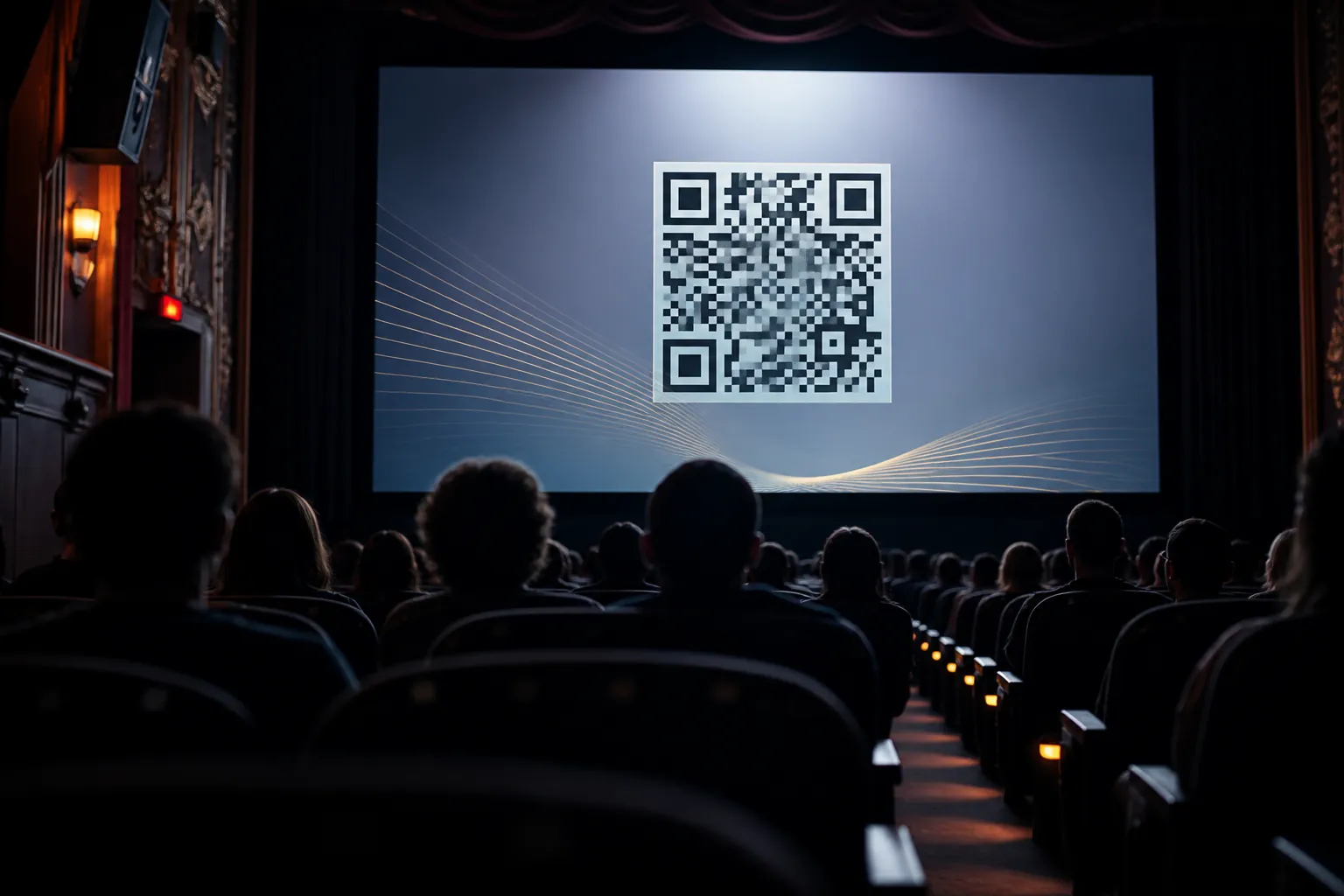
The useful way to read Chris Hansen’s TruBlu campaign is to start with the inventory, not the argument around the film. TruBlu bought a spot to run exclusively before screenings of A24’s Primetime, added placements in theater lobbies, and booked the initial flight for four weeks. The buy can be renewed if the film performs. A QR code in the spot sends viewers to TruBlu. Those details make this a compact paid-media plan: a defined environment, a concentrated audience, a response path, and a limit on how long the advertiser is exposed. [1]
As of August 28, 2026, the film has not opened. TruBlu has not disclosed the spend, and there are no campaign results to report. So the defensible conclusion is not that the placement worked. It is that the plan’s targeting logic is unusually easy to inspect.
The film is doing the audience targeting
Most media plans would ask a platform to approximate an audience interested in Chris Hansen, true-crime programming, or the controversies represented by the film. This buy skips that approximation. It reaches people who have already selected a movie about Hansen strongly enough to purchase a ticket and sit through the preshow block.
Shawn Rech, TruBlu’s president, described the opportunity as reaching “a very concentrated group of people who either know Chris or are going to know some version of Chris.” [1] That is the practical rationale for title-level adjacency. The film title, its trailer, the theater location, and the ticket purchase are collectively performing much of the demographic and interest work that a data segment would normally attempt.
This is the inverse of a campaign such as targeting a title’s fans when you cannot buy that title’s inventory. TruBlu is not inferring interest from browsing behavior. It is buying the moment in which the interest has already assembled in one physical place.
:max_bytes(150000):strip_icc()/Primetime-Robert-Pattinson-To-Catch-a-Predator-Chris-Hansen-082626-e0024eb6a9c34a9db6f42bd72696243e.jpg)
The timing strengthens the logic. Primetime is scheduled to premiere at Venice on September 5, reach select theaters on September 25, and expand nationwide in October. [6] A four-week initial flight therefore sits across the film’s release window rather than committing TruBlu indefinitely to a national cinema campaign.
That is a meaningful distinction in a media plan. The audience may be concentrated, but its volume is still uncertain before release. The renewable structure lets TruBlu buy the opening period, observe whether the film actually draws people, and decide whether additional inventory is justified. Renewal is not proof that the campaign will be renewed; it is the mechanism that prevents the initial assumption from becoming a long-term obligation.
The creative answers the context, then gives it somewhere to go
The placement would be less useful if the creative merely announced TruBlu. Its context is the reason the audience is there, so the ad uses Hansen’s recognizable presentation: a kitchen set and the phrase “take a seat right over there.” [3] The viewer has just chosen a film centered on a dramatized version of Hansen; the spot presents the real subject before the feature begins.
The original creative reportedly included a closing reference to the film as a “Hollywood fantasy version” of events. That line was cut amid concerns about backlash against A24. [3][4] Removing it matters less as celebrity drama than as message discipline. A direct attack could have made the placement read as a feud bought with media dollars. The remaining concept can still establish contrast between the real Hansen and the film’s portrayal without making the ad’s central action depend on viewers taking a side.
The QR code is the more important planning decision. The spot ends with a route to TruBlu rather than asking the advertiser to treat a remembered name as a sufficient outcome. [2] A viewer can scan during the preshow, visit after the film, or ignore it. In each case, the campaign has a defined response event that can be measured separately from attendance and recall.
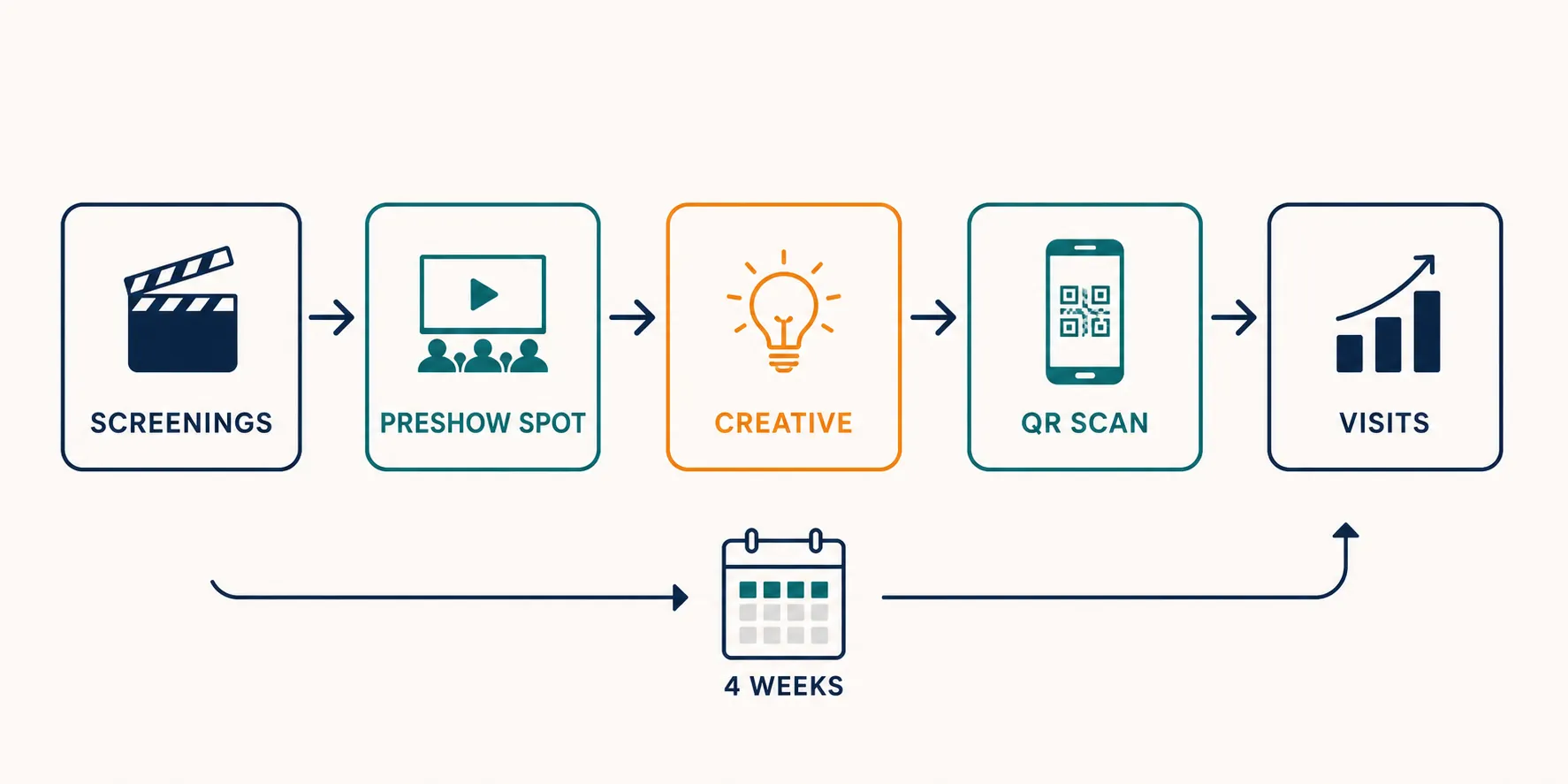
That does not turn a cinema impression into a subscription automatically. The scan is a visit, not a paid conversion. TruBlu would still need to connect visits to sign-ups or other meaningful downstream actions, and those outcomes are not yet available. The QR code simply prevents the placement from ending at an untestable awareness claim.
What the format can tell us—and what it cannot
AdQuick’s 2026 cinema advertising guide lists national preshow CPMs of roughly $20 to $50, ad recall above 85%, more than two hours of captive dwell time, and audience attention at approximately twice that of TV or CTV. [5] These are format benchmarks, not TruBlu campaign results. They explain why the environment is attractive, but they do not establish how many people saw this particular spot, scanned its code, or subscribed to TruBlu.
| Planning question | What is known | What remains unknown |
|---|---|---|
| Where did TruBlu buy? | Before Primetime screenings, with theater-lobby placements | The exact theater list, impression volume, and inventory cost |
| Who was the likely audience? | People attending a film about Chris Hansen or his public persona | The final audience size and its conversion quality |
| What could viewers do? | Scan a QR code directing them to TruBlu | Visits, sign-ups, subscriptions, and cost per acquisition |
| How long was the commitment? | Four weeks initially, with renewal if the film performs | Whether TruBlu renewed and on what terms |
Using the published CPM range, one could derive a cost bracket for a hypothetical impression volume. That would be a planning estimate, not disclosed spend. Without the number of screenings, theaters, contracted impressions, or actual rate, even a carefully calculated bracket would describe possible economics rather than this campaign’s invoice.
This is the same evidentiary problem that appears in campaigns where the public can see the creative but not the spend or outcome. A useful record of how to judge efficiency when campaign metrics are undisclosed is therefore more relevant than a guessed return-on-ad-spend figure. The right accounting stops at the boundary of the evidence.
The downside is controlled, not eliminated
The four-week renewable flight is the campaign’s clearest risk-control feature. TruBlu is testing a release-linked opportunity while keeping the initial commitment finite. If the film underperforms, the advertiser has a stopping point. If the film generates the concentrated audience Rech expects, the buy can continue.
The structure also matches the difference between an awareness placement and a performance campaign. Cinema gives TruBlu attention in a highly relevant setting; the QR code creates an immediate response path. That pairing does not make the media format behave like search or paid social. It gives the operator a way to compare the attention opportunity with actual traffic and later acquisition data. A broader discussion of that budget split appears in how a brand-versus-performance framework can guide ad spend.
There is a limitation to this clean reading of the mechanics. Hansen’s association with the film may create emotional or reputational effects that a CPM, dwell-time figure, or QR scan cannot capture. He declined A24’s screening agreement over reported concerns involving his name, image, and brand rights, and he has not seen the film. Reporting has differed over whether the agreement involved a standard nondisclosure agreement, while A24 declined to comment. [7] Those facts establish that TruBlu’s ad is a paid reply rather than a partnership; they do not establish what viewers will think of either the film or the response.
The same caution applies to claims about the trailer’s reach. Reports and online discussion have offered differing descriptions of its view count and ranking, so those claims should not be treated as a settled forecast of theater attendance. The buy is designed around the possibility that the film’s marketing creates demand. It has not yet demonstrated that demand.
As of August 28, 2026, the evidence supports calling the placement a disciplined, measurable media experiment: its audience selection, response path, and initial downside are unusually clear, but its customer-acquisition performance remains unknown.
References
- Chris Hansen Buys Ad Before ‘Primetime’ Screenings — Entertainment Weekly, 2026
- Chris Hansen Buys Ads Before Every Screening of A24’s ‘Primetime’ — World of Reel, August 26, 2026
- Chris Hansen Is Buying Ads to Play Before Every ‘Primetime’ Showtime — People, 2026
- Chris Hansen Buys Ad Space Before ‘Primetime’ Showings — TMZ, August 26, 2026
- Movie Theater & Cinema Advertising — AdQuick, 2026
- Chris Hansen’s ‘Primetime’ TruBlu Theatrical Ad Purchase — TheWrap, 2026
- Chris Hansen Declined A24’s ‘Primetime’ Screening Agreement — Variety, 2026