
How to Target Neuromancer Fans Without Apple TV+ Ads
Apple TV+ has no ad-supported tier, so you can't buy in-show inventory for Neuromancer. This article outlines alternative targeting strategies including programmatic CTV, audience proxies, and a campaign calendar leading up to the January 2027 premiere.
- Platform
- Amazon DSP
- Creative type
- video
- Last reviewed
- 0-07-26
Neuromancer premieres on Apple TV+ on Jan. 22, 2027, with Callum Turner playing Case. That makes the ad-targeting angle obvious for entertainment, gaming, AI, consumer tech, and speculative-culture advertisers. It also creates the first planning problem: there is no Apple TV+ ad inventory to buy against the show.[1]
That is not a footnote. Apple TV+ remains the major premium streaming outlier without an ad-supported tier, and Eddy Cue's reported position in late 2025 was not a hard lifetime promise, but a softer "no plans yet." Apple also has a clearer direct ad revenue path in Maps and the App Store, where its ad business has been projected around $10 billion, than in forcing an ad tier into Apple TV+.[2]
So the clean answer is also the useful one: you cannot buy Neuromancer inside Apple TV+. You can buy around the households, devices, content affinities, purchase behaviors, and calendar moments that are likely to form around it.
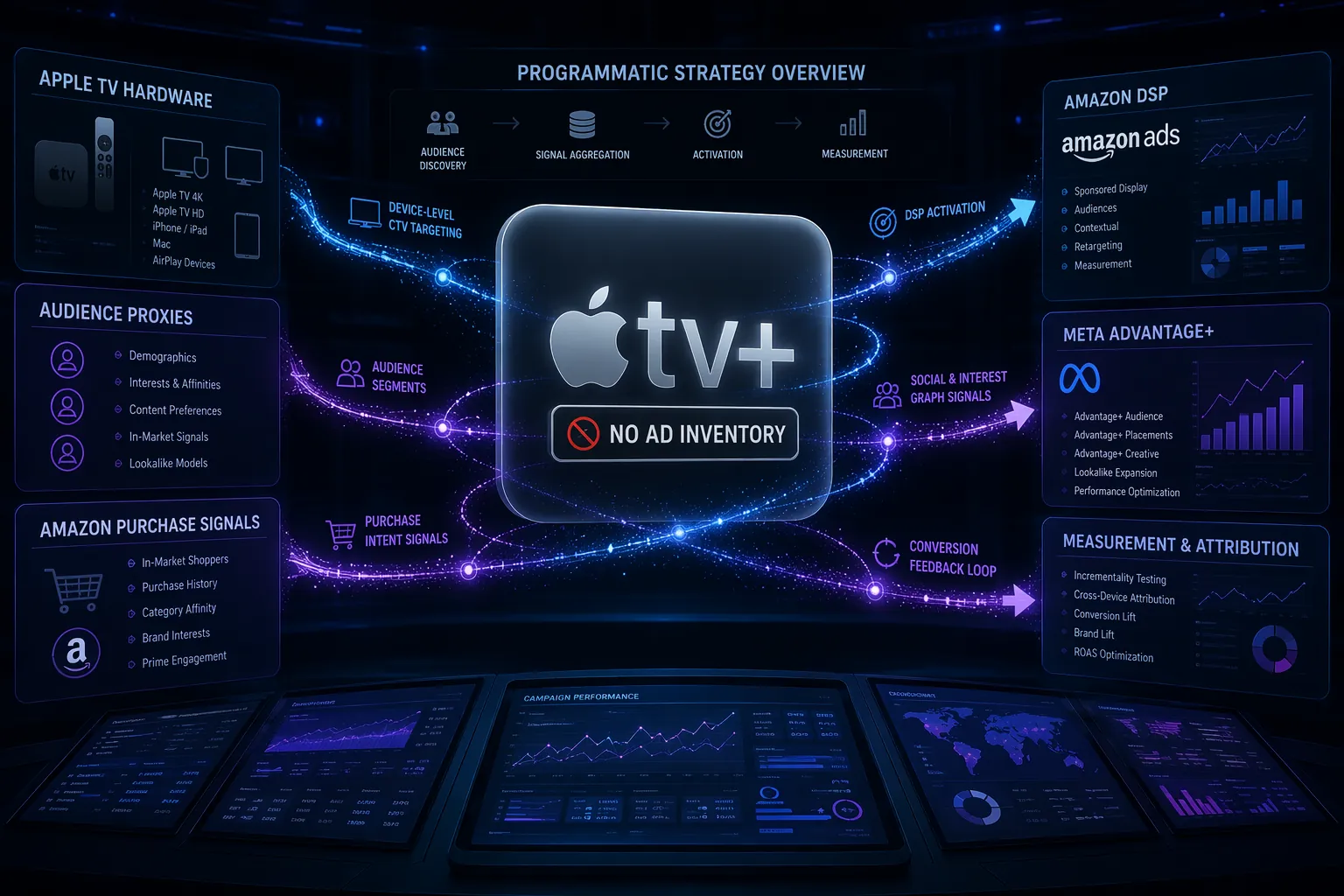
The blocked buy is the starting point, not the end of the plan
A sponsor asking to be "around Neuromancer" is not asking for a literary seminar. The brand usually wants one of four things: reach among high-intent sci-fi viewers, credibility with cyberpunk and gaming audiences, adjacency to a premium streaming event, or access to tech-forward households before the show becomes a broader conversation.
Apple does not currently sell the neatest version of that ask. There is no in-episode spot, no pause ad, no first-party Neuromancer segment from Apple TV+, and no official sponsorship unit sitting beside the stream. Treating that as a dead end wastes the part of the audience that is already measurable elsewhere.
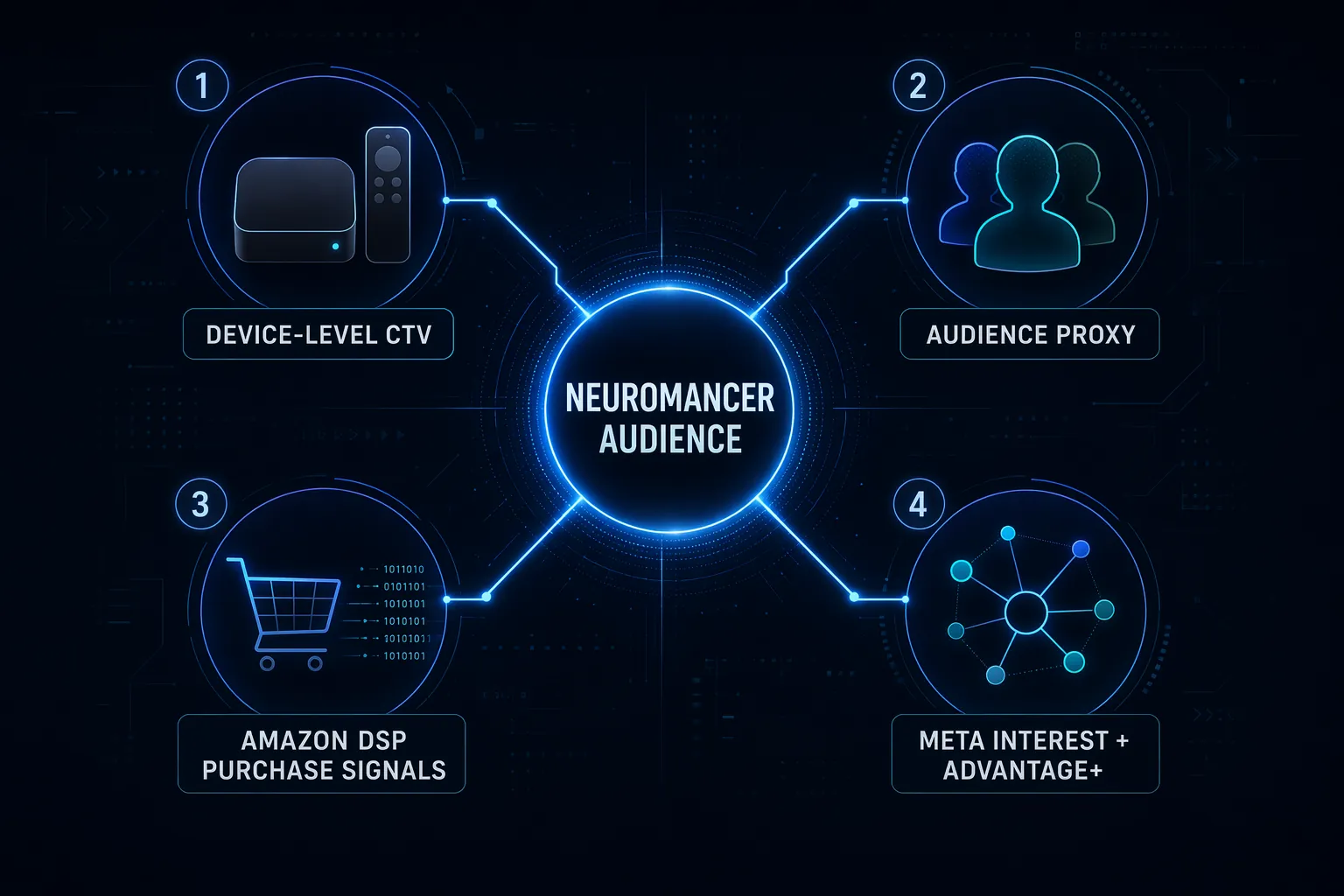
The more workable architecture has four routes. None proves that a household watched Neuromancer unless Apple creates and sells that signal. Each can still create a disciplined proxy plan.
| Route | What it can do | What it cannot prove | Best timing |
|---|---|---|---|
| Device-level CTV on Apple TV hardware | Reach viewers using ad-supported apps on Apple TV devices | That the viewer opened Apple TV+ or watched Neuromancer | Teaser scaling, premiere burst, episodic sustain |
| Audience proxies | Reach likely overlap among sci-fi, prestige TV, gaming, AI, and tech-forward audiences | One-to-one fandom membership | From SDCC signal through finale |
| Amazon DSP purchase signals | Build audiences from book, electronics, gaming, and tech purchase behavior | Viewing intent on Apple TV+ | Prospecting before premiere, retargeting during run |
| Meta interest plus Advantage+ expansion | Capture declared or modeled interest around Gibson, the book, and adjacent culture | That manual interests will remain available unchanged in 2027 | Early testing, creative signal discovery, launch-week amplification |
Why Callum Turner matters as a media signal
Callum Turner's casting as Case is not just cast trivia. Deadline reported the casting in April 2024, after Turner had fresh visibility from Masters of the Air and was moving through Bond-rumor attention cycles.[3] That matters because different audience pools leave different buyable traces.
Masters of the Air creates a prestige-war-drama and Apple-adjacent awareness path. Bond speculation creates broader entertainment press reach, especially among viewers who may not follow William Gibson closely. Neuromancer's book audience creates another path entirely: older sci-fi readers, cyberpunk fans, and people who recognize the title before they recognize the actor.
The show also sits inside a much larger AI conversation. At SDCC 2026, showrunner Graham Roland framed Gibson's relevance directly: "He wrote about the collision of artificial intelligence and human intelligence before artificial intelligence existed."[4] That does not make every AI buyer a fit. It does make the campaign legible for brands selling AI tools, developer platforms, gaming hardware, cybersecurity products, productivity software, and high-consideration consumer tech.
The practical targeting angle is overlap, not identity. A person who buys cyberpunk fiction, plays Cyberpunk 2077, streams premium sci-fi, and owns multiple connected devices is not guaranteed to watch Neuromancer. But that person is a better proxy than a broad "sci-fi fans 18-49" bucket with no timing discipline.
Build the plan around dated audience moments
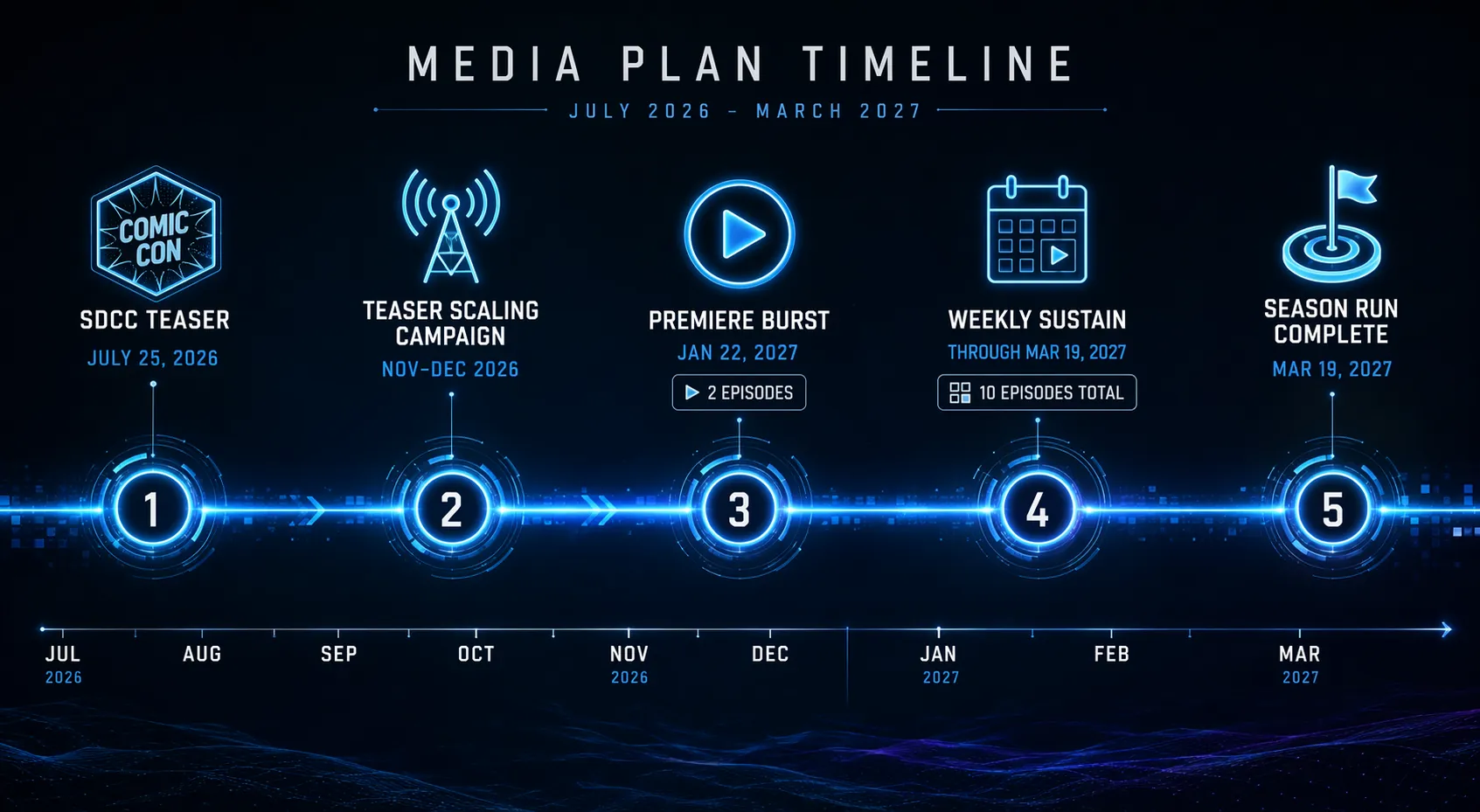
The campaign calendar is the piece that keeps the plan honest. Without Apple TV+ ad inventory, timing has to come from public attention moments: teaser drops, press cycles, search behavior, social discussion, watchlist intent, premiere week, and weekly episode cadence.
| Window | Planning job | Primary surfaces |
|---|---|---|
| Jul. 25, 2026 | Capture the first measurable fan and press signal from the SDCC teaser | Search, social video, Meta testing, contextual sci-fi and AI placements |
| Nov.-Dec. 2026 | Scale teaser audiences before CPMs and competition tighten | CTV prospecting, YouTube, publisher video, Amazon DSP |
| Jan. 22, 2027 | Concentrate reach around the premiere burst, when two episodes drop | CTV, high-impact video, creator amplification, paid social retargeting |
| Jan. 23-Mar. 19, 2027 | Sustain frequency across weekly discussion and episode release behavior | CTV retargeting, sequential creative, Amazon DSP, Meta Advantage+ |
The SDCC teaser on July 25, 2026 is the first real audience-signal event, not just a fandom milestone.[4] It is where planners can start watching which creative angles pull response: Callum Turner, Gibson, AI, cyberpunk visuals, gaming-adjacent language, or premium Apple series positioning.
The November and December window should do more prospecting than victory-lap retargeting. By then, teaser assets and entertainment coverage should give buyers enough language to test. The mistake is waiting until premiere week and then discovering that every proxy audience is more expensive, less tested, and being chased by the same brands.
The premiere on Jan. 22, 2027 carries a different job because Apple is releasing two episodes at launch.[1] That makes the first weekend the highest-pressure reach window: viewers are sampling, press is reviewing, fans are comparing the adaptation to the book, and social algorithms are deciding which discussion threads travel.
After that, Neuromancer becomes a sustain problem. The 10-episode run continues weekly through Mar. 19, 2027.[1] A brand does not need to spend as if every Friday is another premiere. It does need enough continuity to avoid showing up loudly on launch day and disappearing while the show is still generating conversation.
CTV buys can follow the hardware, not the Apple TV+ stream
Apple TV hardware is not Apple TV+ inventory. That distinction matters in every client deck. Programmatic CTV can reach ad-supported apps running on Apple TV devices, but the ad appears in those apps, not inside Neuromancer.
That route is still useful. If the buyer wants higher-income, tech-forward, streaming-native households, Apple TV device-level targeting can sit beside broader CTV buys across Roku, Fire TV, smart TVs, and premium video publishers. It is a hardware and household strategy, not show adjacency.
Digital Applied's 2026 CTV guide gives the budget argument some urgency: CTV accounts for 43.8% of TV usage but only 7.7% of ad spend.[5] That gap does not guarantee cheap reach in a specific auction, but it does explain why early planning around an Apple TV+ tentpole can still find underused connected-TV attention outside Apple's subscription stream.
The completion-rate case is also stronger on CTV than on smaller screens. Digital Applied reports average 30-second non-skippable CTV completion rates around 96%, compared with about 62% on mobile and PC.[5] That is a format-level benchmark, not a promise that Neuromancer proxies will perform at that level, but it supports using CTV for the campaign's highest-value creative.
Self-serve options make this accessible before a brand commits to a larger programmatic package. Roku Ads Manager is cited with an approximate $500 minimum and benchmark CPMs around $20 to $60, while Hulu Ad Manager is cited with an approximate $500 minimum and benchmark CPMs around $25 to $35.[6][7] Those are market benchmarks, not audited rate cards. A January 2027 launch, premium video supply, targeting layers, frequency controls, and creative length can all move actual clearing prices.
The audience proxy map
A proxy plan should separate the reason each audience is in the buy. Otherwise, the campaign becomes a pile of plausible interests with no way to judge which signal is doing work.
- Prestige TV overlap: Masters of the Air viewers, Apple original-series audiences where available, and high-attention premium drama viewers.
- Cyberpunk and sci-fi overlap: William Gibson readers, Neuromancer book interest, cyberpunk fiction, and speculative TV audiences.
- Gaming overlap: Cyberpunk 2077, RPG, immersive-world, and high-end gaming hardware audiences.
- AI and tech overlap: AI software, developer tools, cybersecurity, productivity technology, and connected-device households.
- Actor-led entertainment overlap: Callum Turner awareness from Masters of the Air and broader casting-rumor press.
These are not all equally strong for every advertiser. A gaming peripherals brand may care more about Cyberpunk 2077 and high-performance PC behavior than about prestige drama. An AI productivity platform may care more about the SDCC quote, developer households, and tech publishers. A premium auto or financial brand may use the show as a high-income CTV moment and care less about deep Gibson fandom.
The measurement plan should follow that logic. Do not ask a Callum Turner proxy audience to prove book-fan intent. Do not ask a Cyberpunk 2077 audience to prove Apple TV+ subscription behavior. Judge each route by the job it was hired to do: qualified reach, video completion, site visits, lead quality, add-to-cart behavior, search lift, or retargetable audience creation.
Amazon DSP is useful when the proxy needs purchase behavior
Amazon DSP deserves its own lane because it can bring purchase and retail-intent signals into the plan. The relevant use case is not "Amazon knows who will watch Neuromancer." It is that Amazon can help buyers reach households connected to sci-fi books, electronics, gaming products, smart-home devices, computer accessories, and adjacent shopping behavior.
Amazon DSP reaches more than 127 million U.S. households, giving it enough scale to support both prospecting and retargeting around the premiere window.[8] The scale is especially useful for brands that need more than fandom signals: hardware makers, streaming bundles, book retailers, software companies, and consumer tech advertisers can build audiences around actual product categories rather than only declared interests.
There is also a premium-video reason to keep Amazon in the plan. Netflix inventory became buyable through Amazon DSP starting in Q2 2026.[8] That does not create Neuromancer adjacency. It does give buyers another premium streaming surface to reach entertainment-heavy households while Apple TV+ remains closed to ads.
Meta can test language, but verify the interests before launch
Meta remains useful earlier in the cycle because it can test creative language quickly and cheaply compared with premium CTV. As of January 2026, WordStream's guide still listed Meta interest-targeting support for segments including William Gibson, Neuromancer, and Cyberpunk 2077.[9]
That needs a launch-week warning label. Meta has been reducing granular interest targeting, and anything available in January 2026 may not be available in January 2027. Manual interests should be checked at campaign setup, not copied from an old plan.
If the named interests shrink or disappear, the backup is broader signal design: seed the system with site visitors, video engagers, lookalike-style sources where available, and creative variants that clearly separate the campaign's angles. Meta's Advantage+ audience expansion can help the platform move beyond narrow manual selections; SignalConvert's Meta Advantage+ AI Ad Automation Tool Profile is the more relevant internal read when the plan needs to shift from handpicked fandom interests to modeled expansion.
How the budget can move across the run
The budget should not sit still from July to March. The audience is not in the same state at every point, and the media job changes as the show moves from announcement energy to actual viewing.
| Phase | Budget emphasis | Reason |
|---|---|---|
| SDCC signal capture | Small paid social, search monitoring, contextual tests | Find which angle produces measurable response before larger CTV spend |
| Teaser scaling | CTV prospecting, Amazon DSP, premium video | Build qualified reach before premiere competition rises |
| Premiere burst | Highest CTV and video concentration | Two-episode launch creates the strongest attention window |
| Weekly sustain | Frequency-managed CTV, retargeting, sequential creative | Maintain presence without paying premiere-level intensity every week |
For a brand with a modest test budget, the right first move is not to chase every surface. Run Meta and contextual tests after SDCC, identify whether Gibson, AI, Callum Turner, or cyberpunk gaming language produces the cleanest response, then carry the winning angle into CTV and Amazon DSP closer to the premiere.
For a larger advertiser, the plan can split by role. CTV carries attention and premium perception. Amazon DSP supplies purchase-based scale. Meta and short-form video test creative signals and build retargeting pools. Search captures active demand created by trailers, press, and episode discussion. No single channel has to pretend it is the missing Apple TV+ ad unit.
What to recheck before January 2027
The conditions that matter most are not static. Apple could change its position after this article publishes; "no plans yet" is not the same as "never." If Apple TV+ introduces an ad-supported tier or sells sponsorship inventory before launch, the plan should be rebuilt around the new supply rather than treating the workaround as a point of pride.[2]
Meta interests need the same check. A campaign built in summer 2026 should not assume that William Gibson, Neuromancer, or Cyberpunk 2077 will remain selectable in the same form by January 2027. Keep screenshots, but do not rely on screenshots.
CPMs also need live confirmation. The Roku and Hulu figures are useful planning benchmarks, not guaranteed clearing prices.[6][7] A buyer should refresh estimates close to the Nov.-Dec. scaling window and again before the Jan. 22 premiere burst.
Neuromancer is still a viable campaign opportunity without Apple TV+ ads. The viable version is just less literal: device-level CTV where the hardware fits, proxy audiences where the behavior fits, Amazon DSP where purchase signals fit, and a calendar that spends when the audience is actually leaving signals.
References
- Neuromancer premiere schedule and 10-episode rollout, Apple TV+, 2026.
- Eddy Cue says Apple has no plans yet for Apple TV+ ads, MediaPost, Apr. 2026.
- Callum Turner to star as Case in Apple TV+'s Neuromancer, Deadline, Apr. 2024.
- Neuromancer SDCC 2026 teaser presentation, SDCC, Jul. 25, 2026.
- 2026 CTV Advertising Guide, Digital Applied, 2026.
- Roku Ads Manager benchmark CPM and minimum spend information, Roku Ads Manager.
- Hulu Ad Manager benchmark CPM and minimum spend information, Hulu Ad Manager.
- Amazon DSP U.S. household reach and Netflix inventory availability, Amazon Ads, 2026.
- Meta interest targeting guide, WordStream, Jan. 2026.
This is a record of what happened and what was tested, not legal advice. Compliance determinations require qualified counsel.