
What Colgate's IU campaign reveals about K-pop influencer ROI
Colgate's 18-market K-pop influencer campaign with IU generated extensive earned-media buzz but disclosed no paid-media spend or performance metrics. This article benchmarks the campaign against 2026 influencer data to help media buyers evaluate whether mega-influencer deals deliver real efficiency.
- Platform
- Meta
- Campaign type
- Influencer Collaboration
- Spend range
- High
- Timeframe
- 0
- Engagement Rate
- 0-2%
- Verdict
- mixed
- Industry vertical
- Beauty & Personal Care
- Last reviewed
- 0-07-29
Colgate’s IU campaign is the kind of K-pop influencer brand collaboration that makes a media plan look bigger than its line item. It had the celebrity gravity, the fan-led reveal, the regional scale, the commerce hooks, and enough product repositioning to move toothpaste out of the bathroom cabinet and into a beauty routine. What it does not have, at least publicly, is the part a buyer needs before calling it efficient: paid-media spend, attribution window, CPA, ROAS, incremental lift, or a clean paid-versus-earned split.
That distinction matters because the visible campaign signals are real. Colgate did not simply hire IU and wait for star power to do the work. The brand built an 18-market APAC push for Colgate Optic White Purple across TV, digital, social, out-of-home, retail, live commerce, and limited-edition merchandise, with WPP CP and Ogilvy teams across Singapore, Hong Kong, and Korea involved in execution.[1][2][3] The campaign’s public record supports a strong awareness story. It does not support a verified performance ROI story.

| What is public | What is still missing for ROI evaluation |
|---|---|
| 18 APAC markets and multi-channel distribution across TV, digital, social, OOH, retail, live commerce, and merchandise | Total media spend by channel |
| IU as the campaign’s K-pop celebrity ambassador for Colgate Optic White Purple | Talent fee, retainer structure, usage rights, and production cost |
| Beauty-hack positioning that reframed whitening toothpaste as part of a beauty routine | Incremental sales lift, conversion rate, CPA, ROAS, or matched-market test results |
| Fan speculation created by unnamed teaser visuals | Paid-versus-earned reach split and amplification budget |
| Commerce and live-commerce layers included in the architecture | Attribution window, assisted-conversion model, and retail sell-through data |
The campaign architecture deserves credit before the ROI claim gets tested
The smartest part of the IU launch was not the press-release line that a beloved Korean star was joining a toothpaste campaign. It was the way Colgate let fans do the discovery work. Before IU was named, the brand released teaser visuals that gave fans enough clues to identify her from silhouettes and jewelry, turning the reveal into a small detective exercise across fan communities.[4] That kind of mechanic is hard to buy directly. Paid media can distribute a clue; fandom decides whether the clue is worth solving.
The product frame was also more disciplined than a standard celebrity endorsement. Colgate Optic White Purple was positioned less as oral-care maintenance and more as a beauty hack, which gave the campaign a reason to live near makeup, selfies, creator routines, and idol aesthetics.[1][2] In category terms, that matters. Toothpaste usually has to fight through functional claims. Here, the brand gave fans a social object: a purple product tied to whitening, beauty prep, and collectible behavior.
Samir Singh, Colgate-Palmolive APAC EVP Marketing, described the model as “omni-demand generation,” a useful phrase because it refuses to pretend the campaign sat in one bucket.[5] This was content, commerce, fandom, retail visibility, and purchased media working together. For brand teams, that is the appeal. For performance teams, it is also where the accounting fog starts.
Once a campaign crosses that many channels, a view count or a social mention count is no longer enough. Some people saw the work because they follow IU. Some saw it because fans pushed the teaser. Some saw it because Colgate paid to put it in front of them. Some encountered it in retail or live commerce. Those are not interchangeable impressions, and they should not be priced as if they are.
Earned media can be visible without proving paid efficiency
A fandom loop has its own value. The unnamed teaser gave Colgate a way to borrow fan behavior before the formal campaign had fully declared itself. Fans spotting IU from partial cues is a stronger signal than passive exposure because it shows attention, recognition, and voluntary distribution. In an awareness brief, that belongs in the results conversation.
But earned attention is not automatically media efficiency. A buyer still needs to know what Colgate paid to create the conditions for that attention. If a brand spends heavily on talent, production, regional media, retail displays, commerce integrations, and paid social amplification, the earned layer may be a meaningful bonus without making the total buy efficient. The denominator is not optional.
This is where celebrity case studies often slide from evidence into mood. “Fans were talking” becomes “the campaign worked.” “The launch was everywhere” becomes “ROI was strong.” Those may all be directionally encouraging, but they answer different questions. Awareness asks whether enough of the right people noticed. Performance asks what it cost to move a measurable action.
For the IU campaign, the public materials support the first question much better than the second. They show scale, integration, cultural timing, and an engineered discovery loop. They do not disclose the numbers needed to calculate efficiency.
The 2026 benchmarks make the missing denominator harder to ignore
Mega-influencer pricing is not a small planning assumption. 2026 benchmark sources put mega-influencer posts for creators with more than 1 million followers at $100,000 or more per post.[6][7][8] That does not mean IU’s Colgate arrangement cost $100,000 per post. It was likely a broader ambassadorship-style agreement with regional usage, production, channel rights, and campaign assets rather than a simple post buy. The actual fee is undisclosed.
The benchmark is still useful because it tells a buyer where the conversation starts. A top-tier K-pop celebrity does not enter a plan at micro-creator economics. The fee is buying mass recognition, pressworthiness, brand lift potential, and fan mobilization. If someone then presents the campaign as a performance-efficient acquisition engine, the proof burden rises.
| Benchmark lens | 2026 benchmark | Why it matters for IU-style deals |
|---|---|---|
| Mega-influencer pricing | $100K+ per post for 1M+ followers | Talent economics usually require awareness-scale outcomes or unusually strong conversion proof |
| Mega-influencer engagement | 0.5% to 2% | Large audiences can be broad and less interaction-dense |
| Micro-creator engagement | 3% to 7% | Smaller creators often create cleaner test cells and stronger interaction rates |
| Beauty vertical average engagement | 5.3% | Beauty has a favorable baseline, so celebrity results should be judged against a high-performing category |
| Beauty vertical average ROI | 6.2x | A performance claim needs enough cost and revenue data to compare against the category |
| TikTok vs. Instagram Reels engagement | TikTok 4.25% vs. Reels 1.23% | Channel mix affects expected interaction before creative quality is judged |
| Micro vs. macro cost per engagement | $0.20 vs. $0.33 | The CPE gap makes portfolio creator testing a serious alternative to one-star concentration |
The engagement spread is the uncomfortable part. Mega-influencers are benchmarked at roughly 0.5% to 2% engagement, while micro-creators are benchmarked at 3% to 7%.[6] That does not make mega-influencers bad. It means their job is usually different. They create reach, salience, cultural association, and press gravity. They are not automatically the cheapest way to generate a click, save, comment, add-to-cart, or purchase.
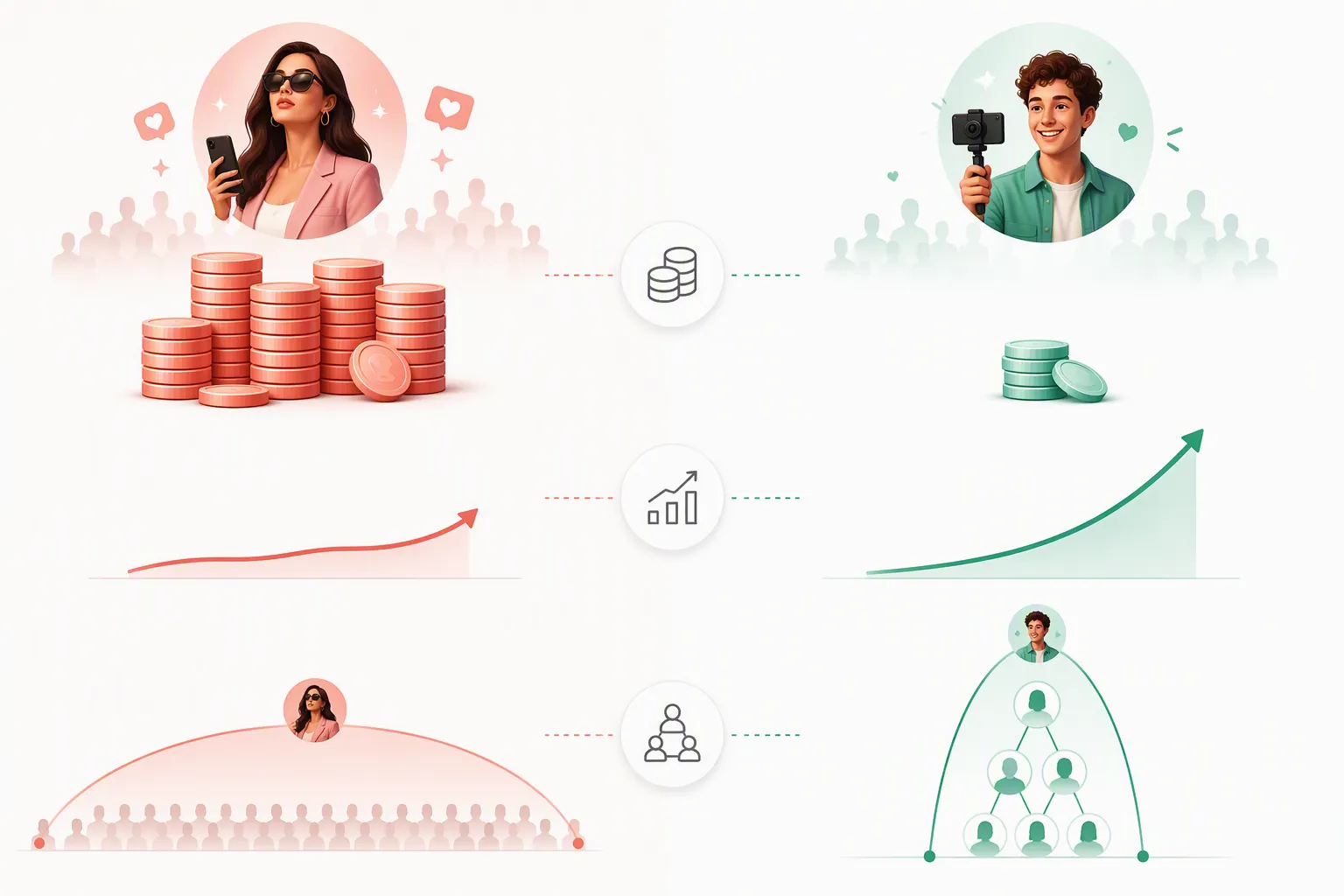
Beauty makes the evaluation even less forgiving because the category already performs well in influencer environments. 2026 benchmarks put beauty at 5.3% average engagement and 6.2x average ROI, described as the strongest vertical after gaming.[9][10] A beauty-adjacent toothpaste campaign can benefit from that context, especially when the product is framed as a whitening beauty hack. But if the category average is already strong, a mega-celebrity campaign cannot claim efficiency just for producing visible buzz.
Channel also matters. 2026 benchmark data puts TikTok engagement at 4.25% versus Instagram Reels at 1.23%.[11][12] If a campaign leans heavily into TikTok-native behavior, the expected engagement floor differs from a campaign carried mainly by Reels or polished brand assets. Public writeups of the IU campaign describe a broad channel mix, but they do not provide a platform-level performance breakout.
Cost per engagement is where many celebrity decks lose their shine. Hubfluence’s 2026 benchmarks place micro-creators at $0.20 cost per engagement versus $0.33 for macro creators, a 40% gap.[6] That gap does not capture the full value of a K-pop star, because it excludes brand heat, earned press, and retail theater. It does, however, explain why a media buyer should ask whether the celebrity role is being priced as fame or defended as efficiency.
How a buyer should pressure-test a campaign like this
The responsible move is not to dismiss the campaign because the public numbers are incomplete. Most brands do not publish the data a buyer would need to evaluate a celebrity deal properly. The responsible move is to separate what the campaign has proved from what it has merely made plausible.
- Treat fan speculation, teaser pickup, press coverage, and merch interest as earned-awareness evidence, not conversion evidence.
- Benchmark the talent layer against mega-influencer economics, while noting that IU’s actual fee and contract structure are undisclosed.
- Ask for paid-versus-earned reach by market and channel before accepting total impressions as a media result.
- Require commerce metrics if the campaign is described as demand generation: click-through rate, add-to-cart rate, conversion rate, CPA, ROAS, and assisted revenue.
- Compare the celebrity plan with a creator-portfolio alternative using the same spend, timing, markets, and attribution window.
A hypothetical planning exercise shows the difference. If a brand allocates a large share of budget to one celebrity asset and then uses paid media to distribute it across regional markets, the buyer should not evaluate the campaign only on engagement rate. They should ask how much of the engagement came from organic fan behavior, how much was bought, whether retail demand rose in exposed markets, and whether a portfolio of mid-tier beauty creators could have produced the same commerce outcome with more testable audiences.
That comparison is not anti-celebrity. It is how planning trade-offs work. A single star can make a brand feel culturally present in a way a spreadsheet of creators cannot. But the spreadsheet often produces cleaner learning: which hook worked, which audience moved, which platform converted, which creator segment deserved more money.
Colgate’s adjacent creator moves are useful context, not IU proof
Colgate’s later Purple Café work is worth watching because it changes the campaign architecture. In June 2026, Colgate Optic White Purple rolled out a six-part episodic K-drama series on TikTok using six Asian influencers, including Andrea Nicole and Evan Tan, with an AI-antagonist participatory mechanic.[13] As of July 29, 2026, no public performance results have been published for that campaign. So it cannot be used to claim Colgate improved on IU. It can be read as a structural shift toward episodic, platform-native, multi-creator storytelling.
That shift makes sense from a testing perspective. Six mid-tier influencers give a brand more creative surfaces, more audience segments, and more chances to observe which character, joke, format, or product cue earns attention. A TikTok-exclusive series also gives the campaign a clearer behavioral environment than a broad TV-digital-social-OOH-retail mix. Cleaner does not always mean bigger. It often means easier to learn from.
The India Visible White Purple campaign is another useful boundary case. Colgate-Palmolive India’s 2024-25 annual report cites more than 60 million organic views from a separate campaign with actress Rashmika Mandanna, amplified through influencers and paparazzi.[14] That is not an IU result, and it should not appear in an IU ROI slide as if it were. It does show that the product line has produced large organic-view outcomes in other celebrity-led contexts.
The same caution applies to Colgate’s separate 12-month UGC program. We Are SNS reports 31.6 million reach against a 12.7 million target, more than 6 million Instagram engagements, a 144% engagement rate, and 27.8 million TikTok views, without celebrity talent cost.[15] Those numbers do not validate the IU campaign. They do give buyers a reminder that creator-led systems can generate public outcomes with very different cost structures.
The limited verdict
Colgate’s IU campaign looks strong as awareness engineering. The 18-market scope, beauty-hack repositioning, teaser speculation, commerce layer, and limited-edition merchandising all point to a brand that understood how to turn a celebrity partnership into a participatory launch rather than a static endorsement.
Its performance ROI remains unverifiable. Public materials do not disclose the spend base, paid amplification, talent economics, attribution model, conversion metrics, or incremental sales lift needed to benchmark the campaign against 2026 influencer ROI standards. The available benchmarks make that absence material, not academic: mega-influencers are typically priced for awareness, while micro and mid-tier creator systems often provide stronger engagement efficiency and cleaner testability.
For media buyers, the lesson is not to reject K-pop mega-influencers. It is to price them honestly. Buy the fame, the fandom behavior, the earned-media possibility, and the brand-fit halo if those are the objectives. If the seller calls it performance, ask for the denominator.
References
- Colgate taps K-pop icon IU in new campaign, positioning oral care as a beauty essential, MARKETECH APAC
- IU Shares Her Beauty Hack in Colgate Optic White Purple Campaign, Branding in Asia
- Colgate taps K-pop icon IU for star power and sparkle, Marketing-Interactive
- Colgate partners with IU in K-pop-driven beauty campaign, ContentGrip
- LinkedIn post on omni-demand generation, Samir Singh
- 2026 Benchmark Report, Hubfluence, 2026
- 2026 influencer pricing benchmark, InfluenceFlow, 2026
- 2026 influencer pricing benchmark, Influencer Marketing Hub, 2026
- 2026 beauty vertical influencer benchmark, Charle Agency, 2026
- 2026 beauty vertical influencer benchmark, CreatorIQ, 2026
- 2026 TikTok engagement benchmark, Sociallyin, 2026
- 2026 Instagram Reels engagement benchmark, Socialinsider, 2026
- Colgate Optic White Purple rolls out episodic influencer K-drama series, MARKETECH APAC, June 2026
- Colgate-Palmolive India 2024-25 Annual Report, Colgate-Palmolive India, 2024-25
- Colgate Social Media 12 Month Case Study, We Are SNS
Built on this evidence
No Bidding tactic or Creative record currently cites this case file. Compare it against other results in Benchmarks.
Related benchmark reading
Report a corroborating or contradicting result
Seeing something different in your own account? Feed the data-integrity loop instead of leaving an open comment.