
X Money and Premium Subscribers Are Shrinking Your Ad Inventory
X Money's invite-only launch caps a multi-year structural shift that shields the most valuable users from ads. This article traces how ad-free Premium tiers, creator payout restructuring, and the new closed-loop financial system collectively shrink X's addressable ad inventory, and what performance media buyers should do about it.
- Platform
- X
- Campaign type
- Standard
- Spend range
- All budget levels
- Timeframe
- July 2026
- Ad revenue
- 1.8B
- Verdict
- mixed
- Last reviewed
- 2026-07-30
X Money’s July 27-28, 2026 launch looks like a payments story until the invitation rule hits the media plan. The product began rolling out invite-only to U.S. X Premium and Premium+ subscribers, with a 6% APY savings account, Visa debit card, real-time peer-to-peer transfers, and Cross River Bank and Visa handling the financial rails.[1] That means the first users invited into X’s money layer are not just any users. They are the same paid users who already sit behind different ad-exposure rules.
For buyers, the immediate question is not whether X can become a financial app. It is whether the users X is treating as its most commercially valuable class are still meaningfully reachable through ads. X’s own help documentation says Premium users see about 50% fewer ads in the For You and Following timelines, while Premium+ is ad-free except for occasional sponsored content.[2] Put the X Money invitation rule on top of that, and the first audience with access to the new financial product is also the audience with reduced or removed ad exposure.

That does not make X unusable for advertisers. It does change what the top-line audience number can be trusted to mean. A platform can report a large monthly user base and still make its highest-intent or highest-monetization segments harder to buy before the auction even starts. CPM and CTR can look efficient inside the remaining pool while the pool itself quietly loses the users a campaign was meant to reach.
The invitation rule matters because Premium was already a different ad market
X’s Premium subscriber base is small compared with the whole platform, but that is not the point. SpaceX S-1 analysis published after the May 2026 filing identified 4.4 million X Premium and Premium+ paid subscribers, against roughly 550 million monthly active users, or about 0.8% of MAU.[3] On a reach slide, that share looks tiny. In an auction, it is more interesting: these are the users who have already shown willingness to pay X directly.
A paid subscriber is not automatically a better customer for every advertiser. Still, paid users tend to become important in platform strategy because they carry direct revenue, authenticated behavior, payment credentials, and more predictable account economics. When those users see fewer ads, or no standard timeline ads at all, advertisers are not just losing random impressions. They are losing some portion of the users the platform itself has selected for deeper monetization.
The tier breakdown matters, and X does not disclose enough to model it cleanly. The S-1 analysis separates X paid subscribers from Grok subscribers, but it does not provide a public split across Basic, Premium, and Premium+ tiers.[3] So no buyer should claim that all 4.4 million paid subscribers are ad-free. The narrower, defensible conclusion is enough: a disclosed paid class exists, and the ad-exposure policy for higher X subscription tiers is materially different from the standard user experience.
| Layer | What changed | Why it matters to ad buyers |
|---|---|---|
| Premium ad exposure | Premium users see about 50% fewer ads in For You and Following; Premium+ is ad-free except for occasional sponsored content. | Reach into paid users is constrained before bidding begins. |
| Premium targeting | X introduced targeting of Premium subscribers as a distinct audience in January 2024. | The platform acknowledged paid subscribers as a commercially separate segment. |
| Creator payouts | Creator compensation shifted away from ad-revenue share toward Premium engagement. | Creator incentives became less dependent on standard ad impressions. |
| X Money | Invite-only rollout began with U.S. Premium and Premium+ subscribers. | The financial layer starts with users already receiving reduced or removed ad exposure. |
The compounding effect started before X Money
The mistake is treating X Money as a new branch of the product tree. For ad planning, it is better read as another layer over decisions X had already made. Premium tiers reduced ad exposure. Premium-subscriber targeting, introduced in January 2024, made those users legible as a separate commercial audience. Then, in October 2024, X changed creator payouts so creators were no longer paid based on ad revenue, but on engagement from Premium users.[4]
That payout change deserves more attention than it usually gets in advertiser conversations. Under the prior ad-revenue-share logic, creator compensation and advertising had a more direct connection: ads around creator content helped fund payouts. Under the newer structure, Premium engagement became the key input, and reporting at the time said up to 25% of Premium subscription revenue would go into a creator pool.[5] That makes Premium users doubly important: they are subscription revenue on one side and payout-triggering engagement on the other.
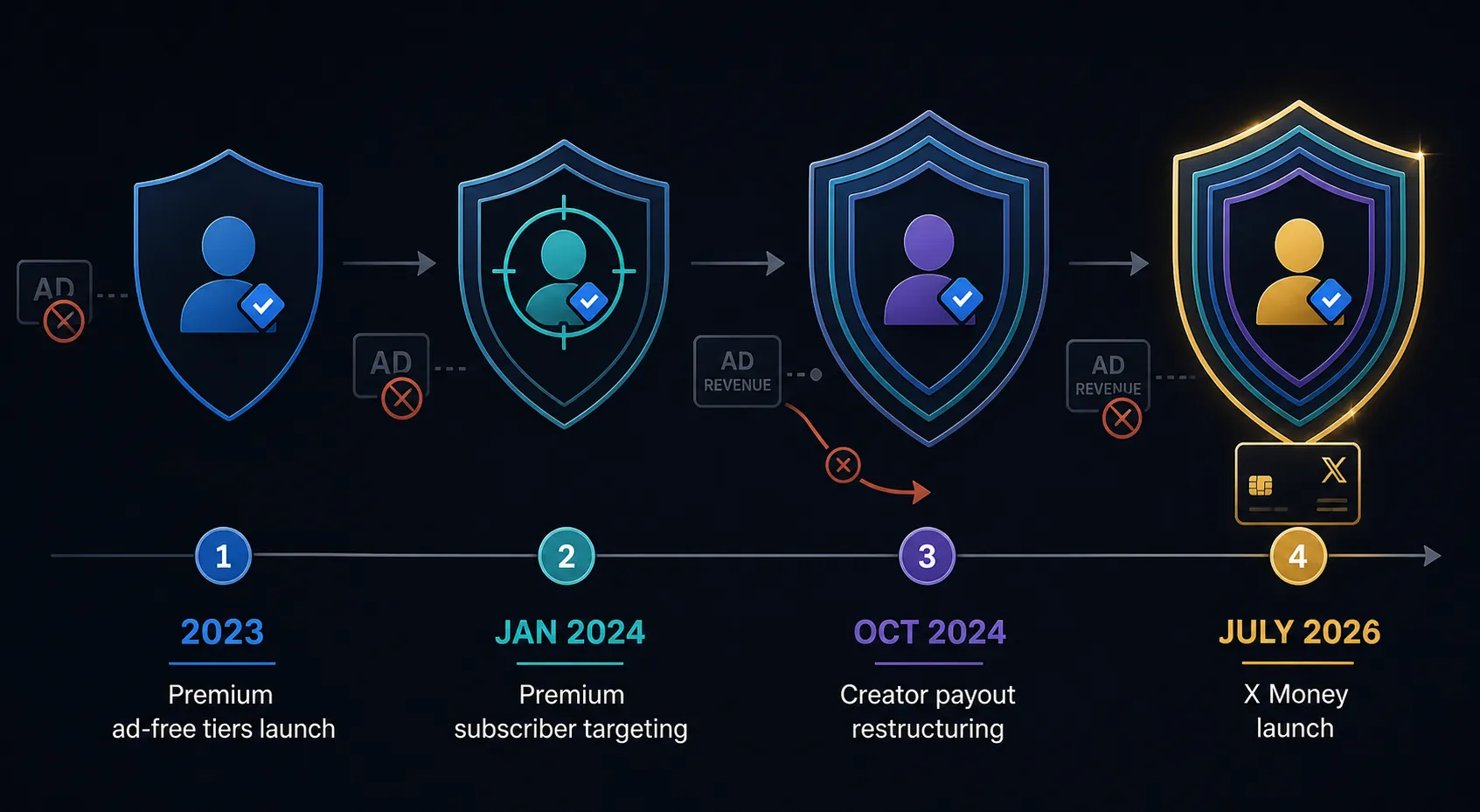
Once that incentive changes, the advertiser is no longer the obvious center of the creator economy on X. Creators can be pushed to create content that earns Premium engagement. X can fund the pool from subscription revenue. Users who pay can receive a lighter ad load or an ad-free experience. X Money then adds a financial account and payment behavior to the same class of users.
This does not prove that X Money has already reduced ad inventory. The rollout is too early, invite-only, and limited for that claim. What it does show is strategic direction. X is building more ways for value to circulate through paid accounts, creator payouts, and financial products rather than through advertiser-funded impressions alone.
A closed loop changes the platform’s center of gravity
The cleanest version of the X Money strategy is not “people can send money inside X.” It is that money earned, stored, and spent by high-value users may stay closer to X. Forbes fintech analyst Ron Shevlin described the strategic play as keeping the “velocity of money” inside the platform, especially if creator payments that once left for external bank accounts can remain inside X Money.[6]
For advertisers, the issue is not jealousy over a new revenue stream. Platforms should diversify revenue. The issue is whether the product roadmap still has a strong reason to expand ad-addressable reach. If Premium subscriptions, Premium engagement, creator payouts, and financial balances become the flywheel X cares about most, then standard ad inventory becomes one monetization layer among several. It may still be valuable, but it is less obviously the product’s organizing principle.
That distinction affects campaign diagnostics. When frequency rises faster than expected, when marginal CPMs move oddly, or when conversion curves flatten after an initial pocket of performance, the explanation may not be creative fatigue or bid strategy alone. It may be that the reachable portion of the audience is structurally thinner than the reported user base implies.
The launch is real, but scale is still constrained
There is a second planning trap here: overreacting to the launch as if the whole X audience suddenly moved into a wallet. It did not. The July 2026 rollout was invite-only and limited to U.S. Premium and Premium+ subscribers.[1] Ars Technica also reported that New York and Massachusetts were excluded because X did not have money transmitter licenses in those states.[7] Those are not small edge cases for a financial product; they are two major U.S. markets missing at launch.
So the near-term media impact should be framed carefully. X Money’s direct effect on available ad inventory has not been measured publicly. There is no public adoption curve, no disclosed share of Premium users invited, and no evidence yet that X Money users behave differently in ad auctions. The stronger claim is structural, not measured performance: X is giving its paid, partially shielded users another reason to become more valuable outside the conventional ad model.
Ad revenue pressure makes the incentive shift harder to ignore
The revenue backdrop is not flattering. Social Media Today, citing analysis of SpaceX’s S-1, reported X platform ad revenue of about $1.8 billion in FY2025, down roughly $100 million year over year and about 39.9% of Twitter’s $4.51 billion 2021 peak.[8] That $1.8 billion figure should be attributed to analyst interpretation of the filing, not treated as a clean single line item from X’s own public segment table. The filing’s narrower AI-segment advertising line was reported at $116 million, which is not the same thing as total X platform ad revenue.[3]
Even with that caveat, the direction matters. A platform under ad revenue pressure can respond by making advertisers happier, by finding other revenue pools, or by doing both. X appears to be doing both, but the most consequential product mechanics are not all advertiser-first. Reduced ads for paid users, Premium-funded creator payouts, and a payments product seeded through Premium all point toward monetization that does not require maximizing standard ad impressions.
Advertiser trust also remains a practical constraint. Kantar Media Reactions 2025, as cited by True Interactive in July 2026, reported that 29% of marketers planned to decrease spend on X and ranked X last for trust among measured platforms.[9] That is survey sentiment, not audited spend. But sentiment still matters when clients ask why a platform deserves incremental budget, especially if the reachable inventory story is getting murkier at the same time.
Grok-powered safety tools do not solve the inventory question by themselves
X is not ignoring advertisers. In March 2026, ADWEEK reported on a 44-slide advertiser deck pitching Grok-powered brand safety capabilities, positioning AI as part of the platform’s retention and reassurance strategy for marketers.[10] That matters. Brand safety controls, placement filtering, and better suitability tools can keep budgets from leaving for reasons unrelated to performance.
But safety tooling and addressable reach are separate problems. A cleaner placement environment does not restore impressions that Premium users no longer see. Better classification does not tell a buyer how much of a target audience sits in Premium+ versus standard inventory. Grok can help explain where an ad should not appear; it does not, by itself, prove that the users a campaign needs are still available at scale.
That is where platform decks often talk past buying reality. A buyer can appreciate improved controls and still ask for tier-exposure data. They can test X Money-related audience hypotheses without pretending an invite-only financial rollout has already become mass adoption. They can keep X in the plan for cultural velocity, breaking conversations, and pockets of intent while refusing to grade the platform on historical reach assumptions.
The planning rule changes
The wrong response is a blanket “leave X.” Plenty of campaigns still find usable pockets there. The better response is to stop treating reported MAU, platform-wide CPM, or early CTR as proof of scalable reach. X now needs to be planned as a tiered inventory environment where the most monetizable users may be less ad-addressable than the average user.
- Ask for current placement-level inventory and do not assume historical X delivery patterns still apply.
- Separate standard users, Premium users, and Premium+ exposure wherever reporting or platform tools allow it.
- Watch frequency and marginal CPA by audience segment, not only blended CPM and CTR.
- Treat X Money audiences as a hypothesis until invite scale, state eligibility, and adoption behavior are visible.
- Require incrementality checks before moving from opportunistic spend to scaled budget.
The structural signal is clear: X is building a protected, paid, financially enabled user class while creator incentives depend more on Premium engagement than ad revenue. That does not remove X from the media plan. It changes the burden of proof before spend scales.
References
- X Money launch coverage, TechCrunch, July 2026, link
- X Premium ad exposure policy, X Help Center, link
- SpaceX S-1 analysis of X subscribers and advertising figures, Digital Applied, May 2026, link
- X creator payout restructuring coverage, TechCrunch, October 2024, link
- X Premium creator revenue pool coverage, MediaPost, October 2024, link
- X Money and velocity of money analysis, Forbes, April 2026, link
- X Money transmitter license exclusions coverage, Ars Technica, July 2026, link
- X ad revenue analysis citing SpaceX S-1, Social Media Today, May 2026, link
- Kantar Media Reactions 2025 coverage, True Interactive, July 2026, link
- X Grok-powered brand safety advertiser deck coverage, ADWEEK, March 2026, link
Built on this evidence
No Bidding tactic or Creative record currently cites this case file. Compare it against other results in Benchmarks.
Related benchmark reading
Report a corroborating or contradicting result
Seeing something different in your own account? Feed the data-integrity loop instead of leaving an open comment.