
Tesla's Full Self-Driving Ruling Underscores New AI Advertising Regulation
California's false-advertising determination against Tesla's 'Full Self-Driving' label is the leading example of stricter AI capability claim enforcement that now applies to every advertiser using AI claims. This article examines the Tesla case, the FTC's Operation AI Comply actions, and new state-level AI disclosure laws to help media buyers understand the claim substantiation burden in 2026.
- Platform
- Meta Ads
- Campaign type
- Performance Max
- Spend range
- General
- Timeframe
- Dec 0 - Feb 2026
- Accuracy
- 0%
- Verdict
- loss
- Industry vertical
- Automotive
- Last reviewed
- 0-07-25
On Dec. 16, 2025, California’s DMV adopted an administrative ruling that treated Tesla’s “Full Self-Driving” name as more than aggressive positioning. The ruling found that the phrase was “actually, unambiguously false and counterfactual,” because Tesla vehicles still required human supervision rather than operating as fully self-driving cars.[1][2] For anyone buying media around AI products in 2026, that sentence matters more than the automotive drama around it. It is a regulator reading a capability claim literally.
The consequence was not theoretical. The DMV gave Tesla 60 days to comply, creating a public deadline around language that had already become part of the product’s commercial identity.[2] By Feb. 17, 2026, Tesla had made compliance changes: it killed standalone Autopilot, added “(Supervised)” to the Full Self-Driving naming, and moved the offering to subscription-only pricing at $99 per month.[3] Six days later, on Feb. 23, Tesla sued the DMV to reverse the false-advertising finding.[3]
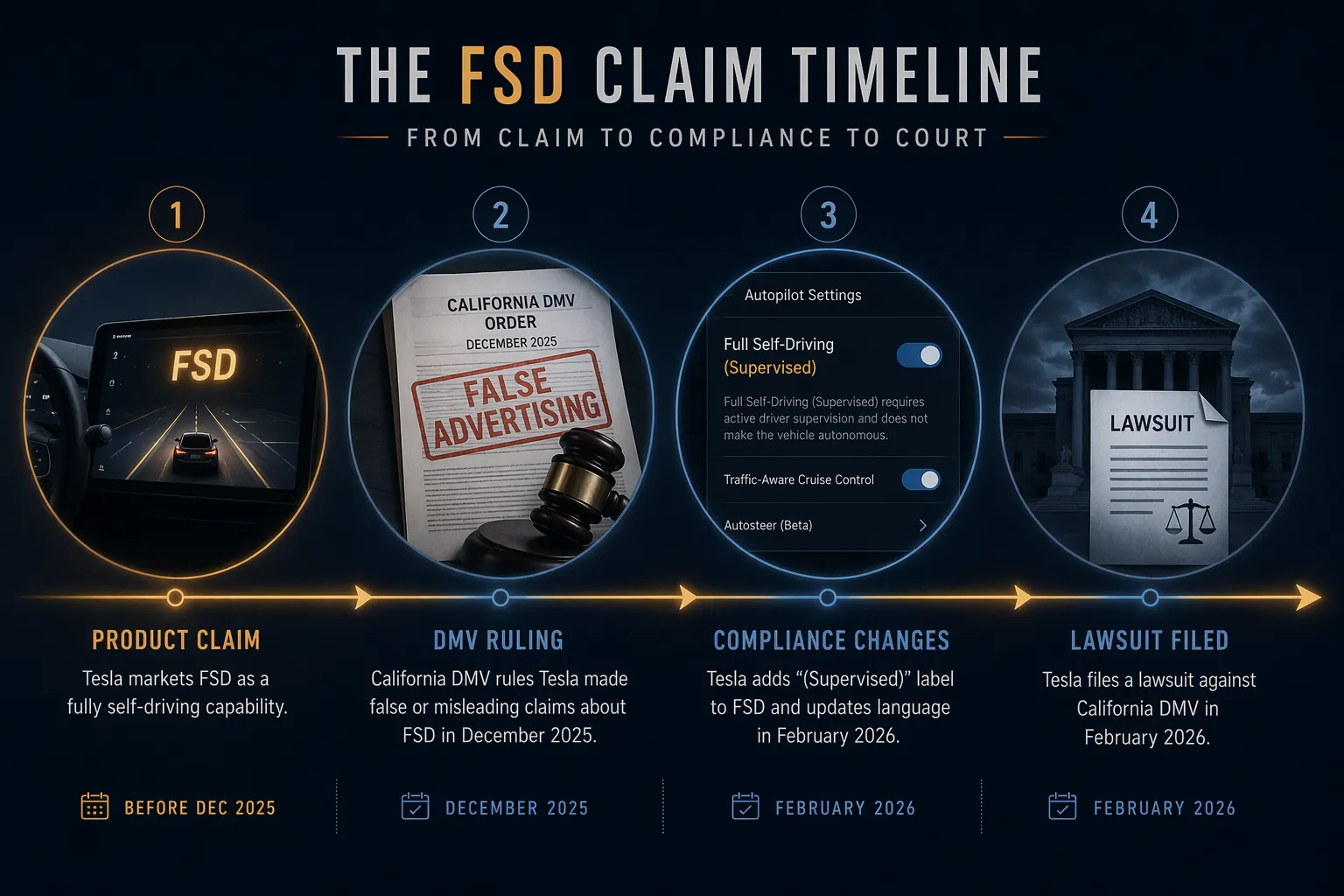
That sequence is the useful part: claim, finding, remedy, reputational damage, litigation. The lawsuit is not just a refusal to accept a regulator’s wording preference. A formal false-advertising determination is a record that can travel into future ads, platform reviews, investor communications, competitor complaints, and plaintiff arguments. Tesla’s decision to comply first and then sue shows how quickly a naming issue can become both an operational constraint and a reputational liability.
The Problem Was the Capability the Name Promised
“Full Self-Driving” did not need to sound reckless to create the problem. It sounded like a product category. That is why the ruling is a useful AI advertising precedent for marketers who are not selling cars. Many AI claims are built from the same move: take a capability that exists in a supervised, bounded, or partial form, then compress it into a cleaner commercial phrase.
The familiar substitutions are easy to recognize. A workflow tool “automates” what still requires review. A sales assistant “books meetings” when it drafts messages for a rep. A legal or finance product “handles” a task when it prepares inputs for a licensed professional. The risky part is not the presence of AI. It is the distance between what a normal buyer could reasonably understand and what the product could prove at the time the ad ran.
Tesla’s post-ruling change to “(Supervised)” is the kind of qualifier that often gets treated as UX or legal polish after the growth team has already settled on the hero claim. In this case, the qualifier became part of a compliance response. That should make media buyers less comfortable with the idea that “AI-powered,” “autonomous,” “agentic,” or “self-driving” can be rescued by a softer footnote if the main message overpromises the product’s actual operating conditions.
Operation AI Comply Uses the Same Substantiation Logic
The FTC’s Operation AI Comply, announced in September 2024, makes the Tesla ruling look less like an automotive exception and more like one prominent application of a broader advertising rule: if an AI capability claim is material to the sale, the advertiser needs evidence for that claim before it runs.[4] The campaign targeted deceptive AI claims and schemes, including claims about what AI systems could do, how much money users could make, and whether a product’s claimed automation worked as advertised.[4]
Growth Cave is the cleanest severity signal among the FTC examples. In January 2026, the FTC announced a $48.6 million settlement that banned the Growth Cave defendants from marketing or selling business opportunities, required asset liquidation, and identified assets including a house, a Rolls-Royce, and a Ferrari.[5] The case involved AI-related marketing around business opportunities, but the enforcement theory was not exotic: unsupported earnings and capability claims used to sell a product are still advertising claims.
That distinction matters. The FTC was not penalizing the use of AI language because the language was fashionable. It was pursuing the gap between what buyers were led to believe and what the advertiser could substantiate. For a media buyer, the practical question is not whether the product team can describe the model architecture or whether the founder believes the roadmap. It is whether the ad claim, as a buyer would understand it today, is backed by current evidence.
The other Operation AI Comply examples point in the same direction. DoNotPay’s “world’s first robot lawyer” positioning drew FTC action because the claim was unsupported.[4] Workado claimed 98% accuracy, while the FTC said testing showed 53% accuracy.[4] Click Profit resulted in judgments exceeding $20 million.[4] These are different markets, but they create the same review pattern: named capability, measurable implication, evidence check, enforcement consequence.
| Claim Pattern | Regulatory Question | Why It Matters for AI Ads |
|---|---|---|
| “Full Self-Driving” | Would a reasonable buyer understand the product to drive itself without human supervision? | Product names can be treated as claims, not just branding. |
| “World’s first robot lawyer” | Was the legal capability supported when advertised? | Category-defining language still needs substantiation. |
| “98% accuracy” | Did observed performance match the advertised number? | Precise performance metrics invite direct proof checks. |
| AI business opportunity claims | Were earnings and automation promises supported? | AI framing does not soften ordinary deceptive-advertising standards. |
A law-firm review described Operation AI Comply as continuing through 2025 and 2026 rather than ending as a one-time sweep.[6] HumanAds AI, in a 2026 compliance guide, reported that the FTC’s maximum civil penalty reached $53,088 per violation in 2026, that enforcement cases increased 40% in 2025, and that a dedicated AI enforcement unit was established in January 2026.[7] The penalty figure and structural-enforcement claims are useful signals, but the reported 40% increase should be treated as attributed secondary analysis unless verified against FTC docket data.
What Changes for Paid AI Campaigns in Q3 2026
The immediate change is not that marketers must stop making strong claims. Strong claims can be valuable when they are specific and documented. The change is that AI capability language now needs to be reviewed as if a regulator will read it without generosity. “Autonomous,” “self-driving,” “agent,” “lawyer,” “analyst,” “done for you,” and “fully automated” are not harmless vibes if they describe a capability the user does not actually receive.
Before launch, the review should preserve the administrative trail that regulators later reconstruct:
- The exact claim as it appears in the ad, landing page, product name, demo script, and checkout flow.
- The buyer interpretation a reasonable customer is likely to take from that language.
- The dated evidence supporting the claim before the campaign goes live.
- Any conditions that materially narrow the claim, such as human supervision, limited data sources, review requirements, or excluded use cases.
- The placement of qualifiers, especially whether they appear near the main claim or only after the buyer has already absorbed the promise.
This is where many AI ad reviews fail. The team checks whether the product uses AI, then treats the advertising claim as directionally true. That is not the substantiation question. The question is whether the specific promised outcome, level of independence, or performance metric is supported. A tool can use AI and still be falsely advertised if the claim describes a higher level of capability than the product delivers.
Product Names Need the Same Review as Ad Copy
Tesla is the reminder that the claim is not limited to a headline or Meta primary text. A product name can carry the promise. So can a pricing tier, feature label, onboarding screen, comparison chart, case-study title, or demo CTA. If the legal team only reviews campaign copy after the naming decision is frozen, the highest-risk wording may already be outside the media buyer’s control.
For AI products, the naming review should happen before the paid campaign structure is built. A campaign built around a phrase like “autonomous SDR,” “AI CFO,” or “self-running support desk” will produce derivative claims across ads, extensions, retargeting, and landing pages. Once those assets are live, replacing the phrase is not a copy edit. It is a compliance migration.
Performance Numbers Are Easier to Attack Than Adjectives
Workado’s accuracy gap is the kind of problem that should scare a campaign owner more than vague branding disputes. A claimed 98% accuracy rate and an observed 53% accuracy rate do not leave much room for interpretive defense.[4] If an AI ad uses a number, the backup needs to answer what was tested, when it was tested, on what data, under what conditions, and whether the advertised audience will experience similar performance.
That does not mean every campaign needs to avoid metrics. It means the metric cannot be borrowed from a narrow demo, internal benchmark, cherry-picked customer, or unreleased model and then placed in front of general buyers as if it describes normal performance. If the number is real only in a controlled setting, the ad needs to say so plainly enough that the buyer does not have to reverse-engineer the limitation.
State Disclosure Rules Add Another Review Layer
Federal substantiation is no longer the only exposure point. A 2026 advertising-law compliance review from ArentFox Schiff identified New York’s AI disclosure law as effective in June 2026, adding state-level obligations around AI-generated advertising content.[8] HumanAds AI reported a $5,000 to $10,000 per-violation penalty range for failures to disclose AI-generated advertising content, though that penalty detail should be checked against primary legal materials before it is used for formal risk budgeting.[7]
For media buyers, disclosure review is separate from capability substantiation. A campaign can disclose AI-generated content and still overstate what the product does. It can also make a truthful product claim while missing a state-required content disclosure. In Q3 2026, AI ad review needs both tracks: what the ad says the product can do, and whether the ad itself triggers AI-content disclosure duties in the jurisdictions where it runs.
The Practical Line for AI Capability Claims
The safest line is not weak copy. It is copy that keeps the product’s actual operating conditions visible. If human review is required, say that before the buyer forms the impression of independence. If the AI drafts, recommends, flags, or prioritizes, use those verbs instead of letting “automates” imply completion. If performance depends on integrations, data quality, user configuration, or a supervised workflow, the claim should not read as if the system performs the outcome on its own.
A defensible AI ad claim usually has three traits: it names the function, states the boundary, and can be tied to dated proof. “Drafts support replies for agent review” is less glamorous than “autonomous support agent,” but it tells the buyer who still reviews the output. “Identifies likely invoice errors based on uploaded records” is narrower than “AI accountant,” but it does not ask the buyer to supply the qualifier.
Tesla fought the DMV finding because a false-advertising label attached to a flagship capability is hard to contain. That is the lesson outside automotive. AI advertising claims now require dated substantiation, careful naming, and disclosure review before launch, because enforcement has moved beyond obvious scams into ordinary product capability language.
References
- Tesla engaged in deceptive marketing for Autopilot and Full Self-Driving, judge rules, TechCrunch, Dec. 16, 2025
- DMV Finds Tesla Violated California State Law, California DMV
- Tesla sues California DMV to reverse FSD false advertising ruling, Electrek, Feb. 23, 2026
- FTC Announces Crackdown on Deceptive AI Claims and Schemes, Federal Trade Commission, Sept. 2024
- FTC Secures Settlement Banning Growth Cave Defendants from Marketing or Selling Business Opportunities, Federal Trade Commission, Jan. 2026
- One year in, Operation AI Comply continues under new administration, Benesch Law Firm
- FTC AI-Generated Content Disclosure, HumanAds AI
- Advertising Law Compliance 2026: Five Developments Every Advertiser, ArentFox Schiff, 2026
Built on this evidence
No Bidding tactic or Creative record currently cites this case file. Compare it against other results in Benchmarks.
Related benchmark reading
Report a corroborating or contradicting result
Seeing something different in your own account? Feed the data-integrity loop instead of leaving an open comment.