
Sam Altman Warned of Authoritarian AI. Advertisers Should Care.
Sam Altman publicly warned that ads erode trust and that authoritarian AI poses a threat. Months later, OpenAI launched ads on ChatGPT; this article examines whether media buyers can trust the platform given Altman's own words and its current performance limitations.
- Platform
- ChatGPT
- Campaign type
- Sponsored product cards
- Spend range
- $0 minimum
- Timeframe
- Jan-Jun 2026
- CPM
- $0
- Verdict
- mixed
- Last reviewed
- 0-07-27
Sam Altman’s AI authoritarianism warning matters to advertisers for a more practical reason than the phrase first suggests. In 2024, he framed trust as the central line between healthy AI and dangerous AI. He also called ads “uniquely unsettling” and described them as a last resort. By January 2026, OpenAI had launched ads inside ChatGPT. By February, Altman was telling users that ads did not influence answers and that OpenAI was not selling conversation data to advertisers. The issue is not that a CEO changed his mind. The issue is that the company is asking advertisers to buy into a trust-sensitive surface before the buying and measurement layer gives them much to verify.
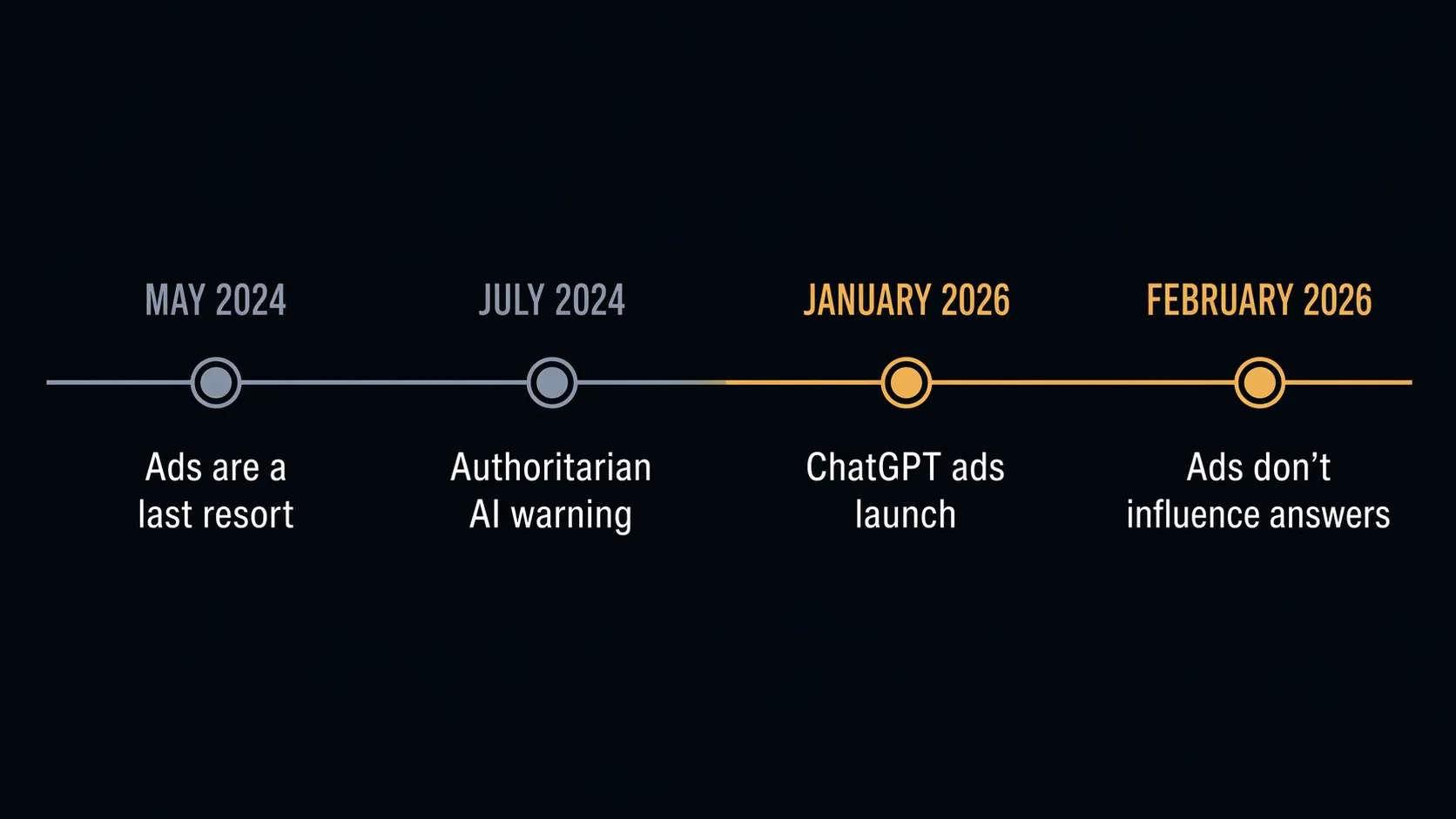
| Date | What happened | Why advertisers should care |
|---|---|---|
| May 2024 | Altman said at Harvard that ads were a “last resort” and warned that ads erode trust in AI products.[1] | The later ad product has to be judged against OpenAI’s own trust standard, not only against normal media-channel standards. |
| July 2024 | Altman warned about a contest between democratic AI and authoritarian AI, placing trust and governance at the center of the AI debate.[2][3] | This widened the frame: AI systems are not neutral ad slots when users rely on them for answers. |
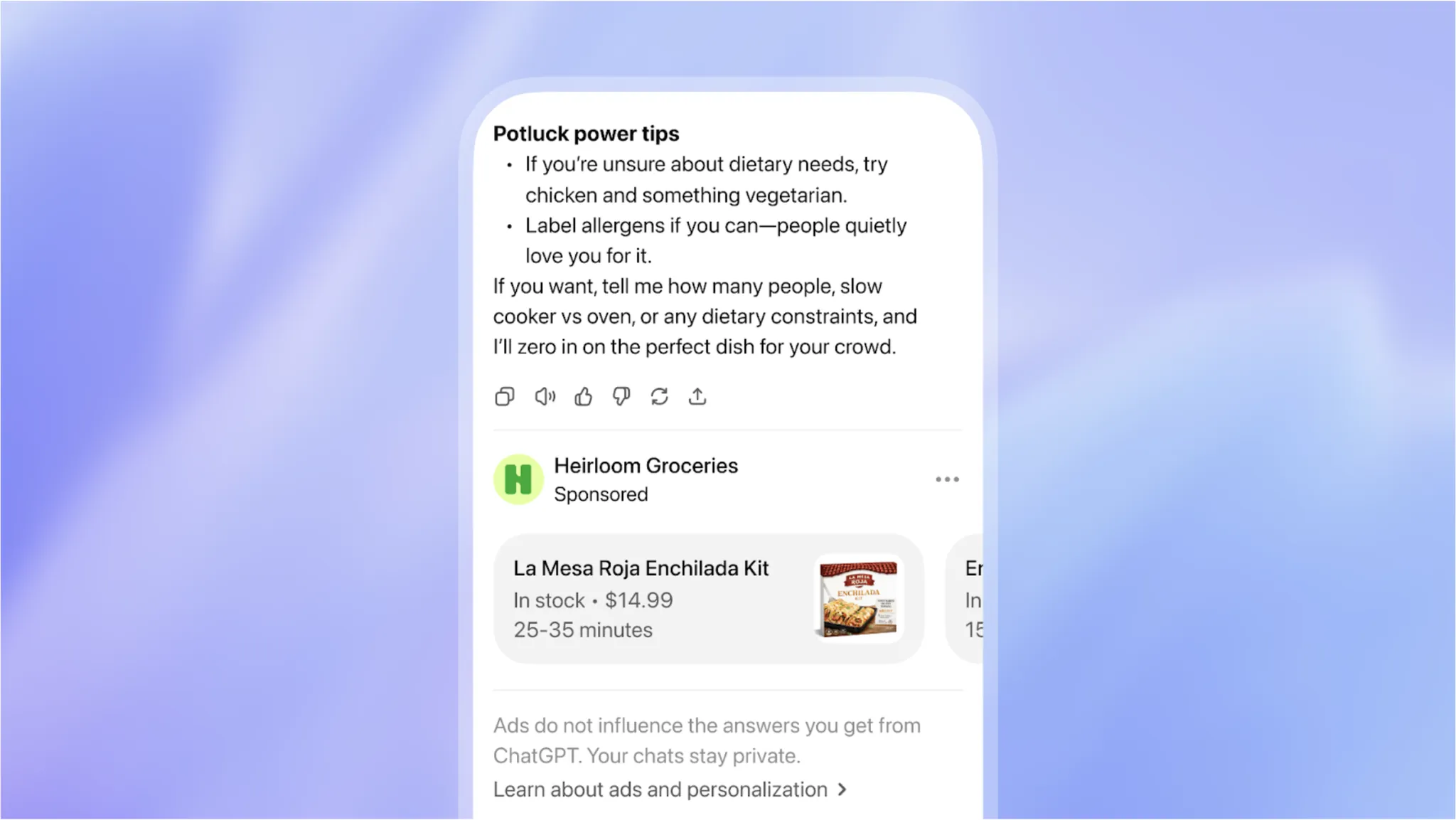
| January 2026 | OpenAI began adding ads to ChatGPT, including sponsored product cards in some user experiences.[1] | The platform moved from moral caution to monetized inventory in about 20 months. |
| February 2026 | Altman said ads do not influence ChatGPT’s answers and that OpenAI does not sell conversation data to advertisers.[4] | That is the reassurance buyers receive, but the available reporting does not establish an independent audit of those claims. |
That timeline is the cleanest way to read the reversal. It is not a personality story, and it does not need to become one. A company can prefer not to sell ads, run into the economics of operating frontier AI, and decide the least bad monetization path now includes advertising. That is plausible. What is harder to accept is the industry habit of treating “trust us” as a measurement plan.
The reversal is financially legible
OpenAI’s ad turn looks less mysterious when it is placed next to the company’s reported economics. The reporting around the launch points to roughly $5 billion in annual losses in 2024, an HSBC projection of a $207 billion funding gap by 2030, and about $1.4 trillion in infrastructure commitments.[1] Those numbers do not make ads automatically good for users or advertisers. They do make ads feel less like an optional experiment and more like a pressure release valve.
That distinction matters. If ads are a minor side bet, OpenAI can afford to move slowly, keep buyer expectations modest, and overbuild trust before chasing spend. If ads are part of the answer to a capital-intensive business model, the incentive changes. The company benefits from opening demand early, proving a market exists, and moving advertisers through the learning curve before the product has the reporting depth they would expect from a mature paid channel.
There is nothing shocking about that from a platform-business perspective. Google, Meta, Amazon, TikTok, and retail media networks have all asked buyers to fund inventory while the rules, formats, and attribution layers were still in motion. The difference with ChatGPT is the surface. An ad inserted near an answer engine inherits the trust burden of the answer engine. A sponsored product card in a chat response is not psychologically identical to a right-rail display unit or a promoted marketplace listing.
Altman’s trust framing raises the bar for the ad product
Altman’s July 2024 authoritarian AI warning should not be stretched into a claim that ChatGPT ads are authoritarian. The sources do not support that. The relevant point is narrower: he publicly argued that AI trust, control, and governance are not decorative issues. When the same company then sells ads inside an AI answer product, buyers should not treat trust as a soft brand concern off to the side. Trust becomes part of the inventory quality.
User research makes that risk concrete. Ipsos data cited in the available reporting found that 63% of U.S. adults say ads in AI search reduce their trust in the output, while Partnercentric data found that 57% trust the brand less when it appears in that context.[5] Those are attitude measures, not proof that every ChatGPT ad will depress conversion or brand lift. Still, they identify the exact place performance marketers often underrate: the ad is not only borrowing attention; it may also be borrowing, and potentially spending, the credibility of the answer.
For a buyer, the question is not whether OpenAI executives sincerely care about trust. The question is whether the advertiser can observe enough to decide if the ad created value, damaged trust, or merely looked interesting in a deck. That is where the product is still thin.
Pricing already shows OpenAI is searching for demand
The reported pricing shift is the market signal worth watching. Early ChatGPT ad access reportedly started around $60 CPM with $200,000 minimum commitments. By the January-to-June 2026 window, reporting around Criteo showed CPC pricing and minimums closer to $10,000.[5] A move from high-commitment CPM buying to lower-minimum CPC buying is not just a billing change. It tells buyers the platform is still discovering where demand clears.
That can be healthy. Lower minimums make experimentation possible for more advertisers. CPC pricing also shifts some burden away from paying for impressions that may be hard to contextualize. But it does not solve the real problem if the advertiser still cannot see enough about where the ad appeared, who saw it, what the surrounding answer implied, and what happened after the click.
A founder may tolerate a $10,000 test to learn whether ChatGPT ads exist as a viable future channel. A CFO asking whether the channel acquired profitable customers needs a different conversation. “We got clicks from ChatGPT” is not the same as “we can audit the path from prompt context to qualified pipeline.”
The measurement ceiling is the buyer problem
The most important reported constraint is not the existence of ads. It is the measurement layer around them. Current reporting points to a ceiling of seven native metrics, with no demographic data and no placement-level visibility.[1][4][5] That leaves advertisers with a channel that may be novel and high-intent, but hard to reconcile against the standards used to defend budget elsewhere.
A media buyer can work with imperfect attribution. That is the job. Search has query loss, social has modeled conversions, retail media has walled gardens, and every platform has its own version of selective clarity. The line gets crossed when the platform’s claimed value depends on a context the buyer cannot inspect. In ChatGPT, context is the product. If the advertiser cannot see meaningful placement or audience signals, the buyer is being asked to buy the aura of intent without the normal tools for separating useful intent from expensive curiosity.
That is why the existing tracker piece on why ChatGPT Ads is not yet working for performance advertisers treats the channel as experimental rather than performance-ready. A reported CTR benchmark can be useful as a directional sign, but CTR is not a business outcome. It does not tell the buyer whether the click came from a commercially qualified user, whether the answer context made the brand look endorsed, or whether the eventual conversion matched the audience the advertiser actually wants.
The privacy-and-measurement tradeoff is not simple either. OpenAI’s February reassurance that ads do not influence answers and that conversation data is not sold to advertisers is important, and it should not be casually dismissed.[4] It also does not answer the operational question: what can an advertiser independently verify? The site’s deeper breakdown of ChatGPT’s data privacy design blocking ad measurement is the useful frame here. A platform can protect user data and still leave advertisers with too little evidence to defend spend. Both things can be true at the same time.
Privacy claims need more than reassurance
OpenAI benefits from saying ads do not shape answers. Users benefit if that claim is true. Advertisers benefit too, because an ad marketplace attached to manipulated answers would become radioactive fast. But the current public record, as summarized in the available reporting, is still a vendor disclosure rather than an independently audited operating fact.[4]
That does not mean OpenAI has broken a promise. The sources do not prove that. The point is more disciplined: when the same company controls the model behavior, the ad serving surface, the privacy policy, and the reporting interface, the buyer’s ability to verify outcomes is structurally limited. A media team can accept that limitation for a test. It should not pretend the limitation is gone because the platform has strong language about trust.
The April 2026 privacy shift discussed in ChatGPT Ads Privacy Shift Introduces Account Security Risks complicates the narrative further. Privacy protections, account security, ad targeting, and conversion measurement are not separate debates in an answer engine. They collide in the same user session. Every additional claim about what is or is not used for advertising increases the need for verification that does not depend only on the platform’s dashboard.
What a defensible ChatGPT ads test can and cannot be
There is a legitimate version of early adoption here. A brand may want to understand how its products appear in AI-mediated shopping or research journeys. A marketplace seller may want to learn whether sponsored cards generate assisted discovery. A category leader may decide the strategic cost of being late is higher than the cost of a controlled test. Those are watchlist and learning-budget arguments.
They should be labeled that way. A defensible test budget would set expectations before launch: what the company can observe natively, what it can validate through its own analytics, what it cannot know, and what result would justify a second test. The reporting conversation should happen before the insertion order, not after a dashboard arrives with impressive-looking but incomplete platform metrics.
- Treat ChatGPT ads as experimental spend unless the buyer can connect clicks to qualified downstream behavior in its own systems.
- Separate brand-learning goals from performance goals; do not let one quietly subsidize the other.
- Ask what is observable at the prompt, response, placement, audience, click, and conversion levels.
- Document which OpenAI claims are vendor disclosures and which claims can be independently checked.
- Decide in advance whether the result is meant to inform media allocation, product positioning, search behavior, or executive curiosity.
The broader market lesson is the same one explored in How Waymo’s Transparency Premium Applies to AI Ad Platforms: verification can become a commercial advantage. The platform that lets buyers see more, audit more, and reconcile more will not merely look more virtuous. It will be easier to fund.
The narrow verdict
Altman’s reversal is financially rational enough. The reported losses, funding gap, and infrastructure commitments make advertising look like a monetization path OpenAI was always going to have to reconsider. The reversal is still relevant because Altman himself set the trust standard. He said ads could erode trust. He warned about the stakes of AI systems that people cannot trust. Advertisers do not have to turn those statements into a scandal to take them seriously.
For now, ChatGPT ads can be a learning test, a strategic watchlist item, or a controlled brand experiment. They are much harder to defend as a data-driven performance buy when reported native metrics are limited, demographic and placement visibility are missing, and key privacy and answer-integrity claims remain vendor assertions rather than independently verified operating facts. OpenAI may be right that ads do not influence answers. Buyers still need measurement strong enough to prove what the ads influenced. Trust has to be measured before it can be bought.
References
- After Sam Altman warning ads hurt trust, OpenAI now adds them to ChatGPT anyway — India Today, Jan 2026
- Sam Altman issues call to arms to ensure democratic AI will defeat authoritarian AI — Fortune, July 2024
- Sam Altman warns of authoritarian AI future — The Decoder, July 2024
- ChatGPT Has Started Showing Ads to Some US Users — Business Insider, Feb 2026
- FAQ on ChatGPT Advertising: Formats, costs, and early strategies to win — EMARKETER
Built on this evidence
No Bidding tactic or Creative record currently cites this case file. Compare it against other results in Benchmarks.
Related benchmark reading
Report a corroborating or contradicting result
Seeing something different in your own account? Feed the data-integrity loop instead of leaving an open comment.