
How Game Removals Made Sony's Cancel-Flow Discounts Beat Paid Ads
When PS Plus subscribers try to cancel, Sony offers them up to 50% off. This article analyzes why that cancel-flow discount program may be more efficient than paid retargeting for subscription winback, using real discount data and industry benchmarks.
- Platform
- Google Ads
- Campaign type
- Retargeting
- Spend range
- Varies
- Timeframe
- 2025-2026
- ROAS
- 5X
- Verdict
- mixed
- Industry vertical
- Gaming
- Last reviewed
- 2026-07-25
The useful part of Sony’s reported PlayStation Plus retention tactic is not that subscribers are unhappy about game removals. Subscription libraries rotate, people complain, and some of them cancel. The useful part is what appears after the cancellation intent is already explicit: some PS Plus subscribers attempting to cancel have reported being shown discounts ranging from 25% off an annual Premium plan to 50% off a three-month Extra plan, with offers varying by tier and term rather than appearing as one blanket save offer.[1][2][3]
That matters for anyone comparing PS Plus game-removal churn against paid-ad winback. A subscriber who clicks “cancel” is not an inferred audience segment. They are not a lookalike, a lapsed visitor, or a retargeting pool that still needs paid media to rediscover intent. They are standing inside the product, at the moment the revenue is about to leave.

The Offer Appears Before Churn Becomes A Media Problem
Digital Trends reported a 25% discount offer on an annual PS Plus Premium subscription shown during cancellation, and also noted that the offer was not universal across all users or plans.[1] Push Square reported 33% off annual plans for some subscribers cancelling in protest.[2] Gaming Bible reported both 33% annual-plan offers and a 50% discount on a three-month Extra subscription for users attempting to leave.[3] LowerMySubs separately describes the PS Plus retention discount as something users may encounter while going through cancellation, which helps corroborate the mechanics even though it does not turn the program into an official Sony announcement.[4]
The caveat belongs near the top because it changes how much weight the tactic can carry. These discounts are user-reported and press-aggregated from cancellation experiences, Reddit posts, and social platforms. Sony has not publicly confirmed a standardized PS Plus cancel-flow retention program. That means the pattern is visible enough to analyze, but not clean enough to treat as a disclosed campaign with known eligibility rules, save rates, or margin impact.
| Reported offer | Plan context | What it implies operationally |
|---|---|---|
| 25% off | Annual Premium | Sony may be willing to protect a high-ARPU tier with a smaller annualized discount |
| 33% off | Annual plans | The save offer may favor longer commitments over short-term appeasement |
| 50% off | Three-month Extra | A deeper discount can still be capped by a shorter renewal window |
| Variable by user, tier, and duration | No universal public promo | The cancellation flow can behave more like segmented retention than broad discounting |
The most interesting detail is not the largest percentage. It is the variability. A public promo trains the entire market to wait. A cancel-flow offer limits exposure to people who have crossed a much harder behavioral threshold. Even if the same discount percentage appeared in an ad later, the ad would have to pay to find the user again, hope the user notices, and compete with whatever else has filled the gap after cancellation.
Game Removals Create The Trigger, But They Are Not The Whole Story
The cancellation pressure around PS Plus is easy to reduce to outrage over removed games. That is too thin. Sony has framed catalog changes as part of managing and refreshing the service; IGN quoted Sony’s Nick Maguire explaining that games leave because the company is “always looking to refresh and add new games” and because some titles are rotated out as others arrive.[5] For a subscription-content business, removals are not an accident outside the model. They are part of the model, and they carry retention risk.
That distinction matters because the marketing problem does not begin when a game disappears from the catalog. It begins when a subscriber decides the current bundle no longer clears the price they are paying. Game removals, price increases, tier confusion, and perceived value drift all push in that direction. The cancel flow is simply where those pressures become measurable at the user level.
Gaming coverage quite reasonably spends time on which titles left and whether players feel wronged. A retention operator sees a different object: a high-intent exit event with authenticated user history attached to it. The subscriber is logged in. Their plan is known. Their renewal structure is known. Their tier is known. Their cancellation action is fresh. That is cleaner signal than most paid audiences ever get.
Discount Margin Is A Different Cost Than Retargeting CAC
Paid retargeting can work. RevenueCat, citing AppsFlyer, says retargeting ads generate 5X higher ROI than other user-acquisition tactics, and RevenueCat also reports that 12% of churned monthly subscribers reactivate within a year in typical subscription apps.[6] Those are not trivial benchmarks. They are a useful reminder that winback is not a fantasy channel and that lapsed subscribers often remain more valuable than cold prospects.
They are also not Sony-specific proof. RevenueCat’s benchmark comes from mobile app subscription context, not PS Plus. It does not reveal Sony’s retargeting CAC, PS Plus reactivation rate, paid-media incrementality, or the overlap between cancel-flow savable users and users who would later return through ads. The comparison has to stay structural unless Sony publishes campaign economics.
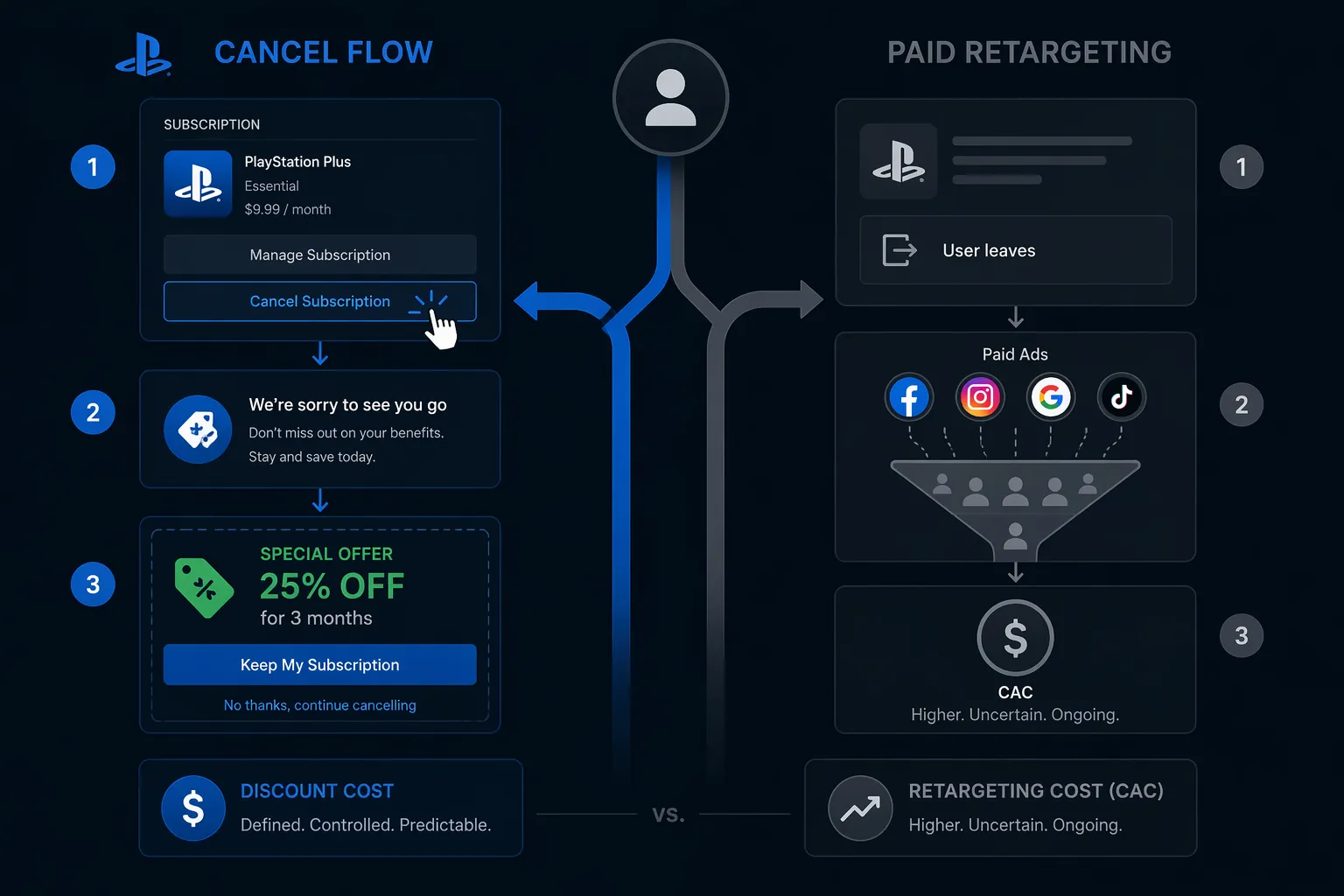
Structurally, though, the cancel-flow offer starts with two advantages that paid ads have to buy their way back toward. First, the audience definition is exact: subscribers trying to cancel. Second, the cost is bounded by the offer design. If Sony shows 25% off an annual Premium renewal, the maximum concession on that transaction is knowable before the subscriber accepts. If it shows 50% off three months of Extra, the deeper discount is constrained by a shorter period.
Paid retargeting works through a less tidy chain. The subscriber churns, enters an audience, becomes reachable only where identity resolution and platform rules allow, sees impressions that cost money whether or not they return, and may need multiple touches before any conversion is measurable. None of that makes retargeting bad. It does mean a reacquired subscriber is not automatically a clean “win” until the media cost, discount cost, and incrementality are all counted.
The cancel-flow segment is self-selected
A cancellation click does not prove a subscriber is price-sensitive. Some users have made up their minds. Some are leaving because the product no longer fits. Some are testing whether Sony will bargain. But as a segmentation input, it is still unusually direct. The subscriber is not merely disengaged; they have taken the procedural step that ends the relationship.
That is why the offer variability matters. A retention system can afford to be more selective inside a cancel flow than in a public campaign. It can reserve deeper discounts for shorter terms, different tiers, or users whose plan structure makes the save economically attractive. The public reporting does not tell us Sony’s rules. It does show that users are not all seeing the same generic coupon.
At PS Plus Scale, Small Retention Differences Become Real Money
The scale is why this is worth treating as more than a customer-service curiosity. Sony last published 47.4 million PS Plus subscribers in March 2023, while later industry estimates put the base around 50 million. Secondary reports have cited 7.8% annual churn in 2025, described as the lowest in five years, alongside network-services revenue figures and a 40% mix on Extra and Premium tiers.[7]
Those figures need care. The 7.8% churn claim appears in secondary reporting rather than a clearly traceable Sony disclosure. The roughly 50 million subscriber figure is an estimate, not the last official count. Still, the broad shape is enough for a retention benchmark discussion: PS Plus is a large recurring-revenue base with meaningful tier mix above the entry plan. When that kind of subscriber base gets irritated by price or catalog changes, the cheapest saved cancellation is usually the one intercepted before the subscriber leaves.
The tier mix is especially relevant. A Premium or Extra subscriber carries a different revenue profile than an Essential subscriber, so a one-size discount would be a blunt tool. The reported offers look more like an attempt to preserve plan value and commitment length than a panic giveaway. A 33% annual-plan discount can keep a subscriber locked into a longer renewal. A 50% three-month Extra offer can buy time without repricing a full year.
Germany Shows Why Retention Can Matter More Than Another Price Move
There is also a legal and pricing constraint behind the retention math. A 2024 Kammergericht Berlin ruling involving Sony’s grandfather-clause practices means Sony cannot simply raise prices on existing subscribers in Germany without consent, according to available reporting. That kind of constraint makes retained consent and plan continuity more valuable than they look in a simple discount-versus-price calculation.
A price increase can lift ARPU only when the subscriber accepts it. If the increase triggers cancellation, the account moves from revenue expansion to revenue rescue. In that environment, a targeted save offer is not just a discount; it is a way to preserve a paid relationship when the alternative may be churn, complaint handling, and later reacquisition spend.
Where Paid Retargeting Still Belongs
None of this eliminates paid retargeting. Cancel-flow discounts only reach users who actually enter the cancellation path and remain eligible to receive an offer. They miss subscribers who disable auto-renewal earlier, stop engaging without cancelling, let payment fail, or leave through account paths where no save offer appears. Paid media can still reach lapsed subscribers after a major catalog addition, a seasonal sale, a new console purchase, or a plan refresh.
The better comparison is not “discounts good, ads bad.” It is sequence. If a subscriber is already in the cancellation flow, paying later to reacquire them is an expensive way to use a signal the product already had. Retargeting is more defensible after the cancel-flow opportunity has failed, expired, or become ineligible.
A clean measurement setup would separate those groups: users shown a cancel-flow offer, users who cancel without seeing one, users who reject the offer, and users later reached through paid winback. Without that separation, a media report can claim reacquisition while quietly including subscribers who could have been saved earlier for a known discount cost.
The Claim Sony Can Make, And The One It Cannot
Sony’s reported cancel-flow discounts are structurally better positioned than paid retargeting for subscribers who have already initiated cancellation. The timing is sharper, the audience is more explicit, and the cost exposure is defined by the offer rather than by auction prices, frequency, identity match rates, and post-churn delay.
The stronger ROAS claim remains unproven. To close it, Sony would need to disclose or allow measurement of cancel-flow offer eligibility, redemption rate, incremental save rate, retained-term value, discount cost, later churn, paid retargeting CAC, and paid winback incrementality. Public reporting gives us the mechanism, not the full performance ledger.
That is still enough to draw the practical benchmark. When game removals, price changes, or tier dissatisfaction push a PS Plus subscriber into cancellation, the product has the cleanest possible retargeting signal before any ad platform gets involved. Letting that subscriber churn and then buying them back later may still work. It just starts from a worse position.
References
- Trying to cancel PS Plus? Sony might just make you an offer, Digital Trends
- PS Plus Discounts Being Offered to Fans Cancelling in Protest, Push Square
- PlayStation Plus 50% discount offered as subscribers attempt to leave en masse, Gaming Bible
- PS Plus Retention Discount, LowerMySubs
- Sony VP Nick Maguire on catalog rotation rationale, IGN
- Retargeting ads: An overlooked tactic for winback & reactivation, RevenueCat
- PS Plus subscriber and churn statistics, Icon Era / Co-op Board Games
Built on this evidence
No Bidding tactic or Creative record currently cites this case file. Compare it against other results in Benchmarks.
Related benchmark reading
Report a corroborating or contradicting result
Seeing something different in your own account? Feed the data-integrity loop instead of leaving an open comment.