
How P&G's Earnings Impact Your Advertising Budget in FY2027
P&G's FY2026 earnings showed just 1% organic growth and $1B in cost headwinds, yet the company boosted media spend. This article decodes what the world's largest advertiser's reinvestment signal means for media buyers planning FY2027 budgets and ad pricing expectations.
- Platform
- Multi-platform
- Campaign type
- Brand Awareness
- Spend range
- Multi-billion
- Timeframe
- FY0-FY2027
- Marketing Reinvestment Rate
- 0
- Verdict
- mixed
- Industry vertical
- CPG
- Last reviewed
- 0-07-30
P&G's earnings signal for advertising budgets is not hiding in a cheerful revenue headline. It is in the part of the release where most budget planners start asking what gets cut first.
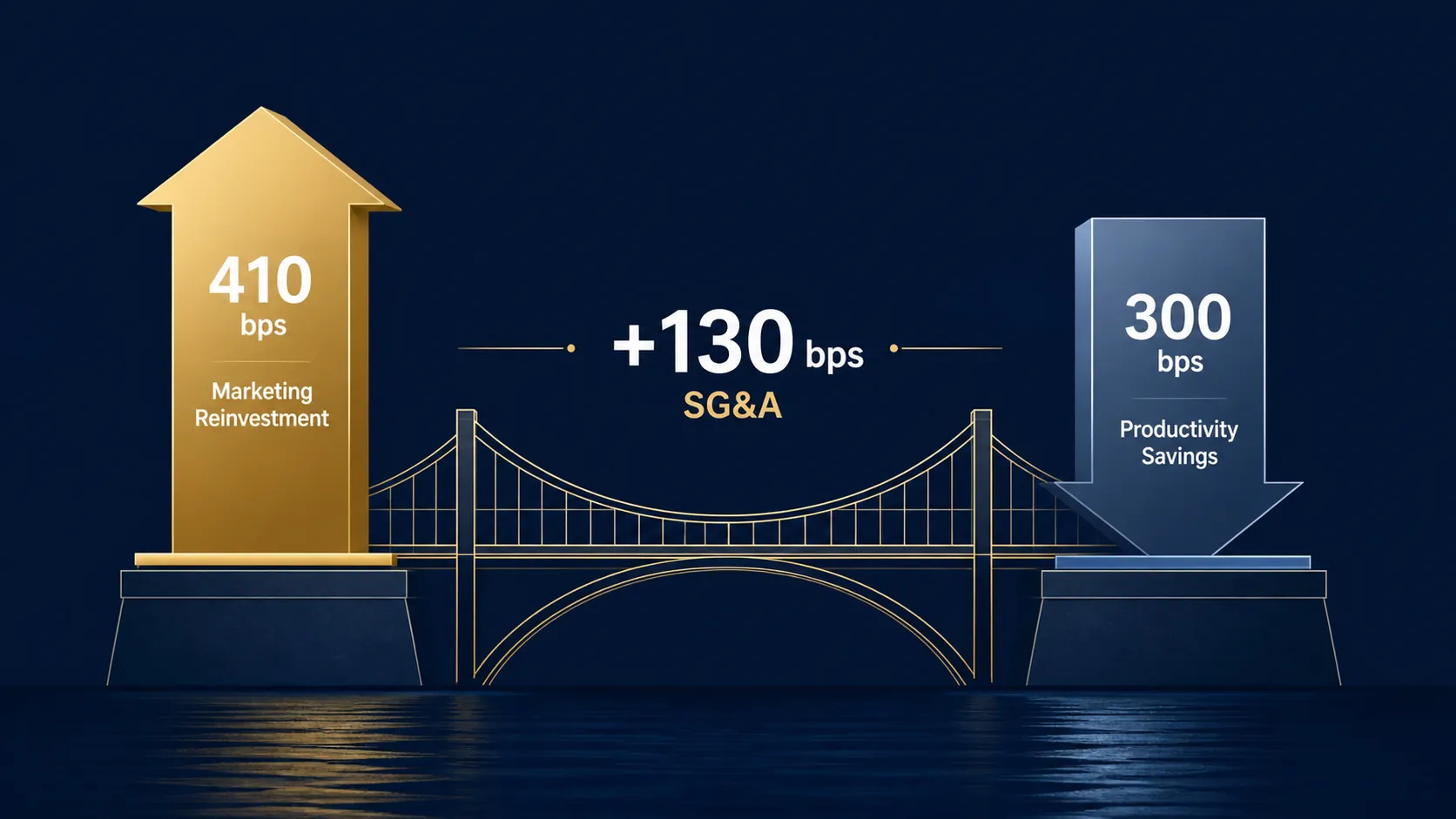
P&G finished FY2026 with $87.0 billion in net sales, up 3% on a reported basis, but organic sales grew only 1%, its weakest organic growth since FY2019. For FY2027, management guided to $1 billion in after-tax cost headwinds from raw materials, energy, and transportation, including $400 million from tariffs, plus $150 million in higher interest costs. In the same update, Q4 core SG&A rose 130 basis points to 29.9% of sales because 410 basis points of reinvestments, primarily in marketing, were only partly offset by 300 basis points of productivity savings.[1]
That is the planning signal. A company with slowing organic growth and visible FY2027 cost pressure did not present marketing as the first place to protect margin. It pushed more money into the line.

The Signal Is Strong, but It Is Not a 410 Basis Point Media Number
The useful read starts with the SG&A bridge, because it shows an actual tradeoff inside the P&L. P&G did not merely say it believes in brands. It showed a larger reinvestment line and a nearly as visible productivity offset in the same quarter.
| FY2026 Q4 SG&A item | What it says | What it does not prove |
|---|---|---|
| Core SG&A up 130 bps to 29.9% of sales | Operating expense pressure increased in the quarter | That every dollar went to paid media |
| 410 bps of reinvestments primarily in marketing | P&G chose to add marketing-related spend despite weak organic growth | That digital, retail media, social, search, or TV each rose by that amount |
| 300 bps of productivity savings | The reinvestment was paired with cost discipline | That P&G has stopped looking for marketing efficiency |
That distinction matters for anyone converting the release into FY2027 media assumptions. Core SG&A bundles marketing, overhead, and selling costs. The 410 basis points are marketing-related reinvestments inside that broader line; they are not a clean paid-media-only number. Treating them as a direct increase in digital ad spend would overstate what the filing supports.
The cleaner paid-media signal came from CFO Andre Schulten, who said on July 29 that P&G plans to “spend more on media,” even while discussing fragmentation and AI-driven changes in digital commerce.[2] That does not tell a buyer which auction gets the next dollar. It does confirm that media, not only trade promotion or internal operating spend, remains part of the FY2027 growth plan.
Why the Cost Headwinds Make the Media Choice More Useful
A large advertiser increasing media in a strong demand cycle is not much of a signal. The more useful case is when the company has obvious reasons to conserve cash and still decides the next dollar belongs in market.
P&G’s FY2027 guide gives finance teams plenty of reasons to ask for restraint. Management expects organic sales growth of 1% to 3%, core EPS of $6.89 to $7.11, and Q1 EPS down more than 5%. The same guidance includes the $1 billion after-tax cost headwind and the $400 million tariff component, which are not abstract macro worries; they are explicit hits management put into the forward model.[1]
That is why the reinvestment line is more interesting than a generic “advertising works” argument. If P&G believed the marginal media dollar could not clear its internal return threshold, the cheaper narrative would have been productivity, pricing, and wait-and-see consumer caution. Instead, the company put more marketing into the bridge and separately confirmed more media.
There is one important qualifier: P&G is not a distressed spender trying to buy time. It generated $19.6 billion in operating cash flow, $16.1 billion in net earnings, and 100% adjusted free cash flow productivity in FY2026.[1] The company can afford to invest. The signal is not desperation; it is capital allocation under pressure.
This Is More Credible Because P&G Has Cut Waste Before
The wrong read is that P&G is simply large enough to spend through weak growth. Its recent marketing history points in the other direction: the company has been willing to remove media and agency costs when it believes the dollars are not working.
In 2017, P&G cut $200 million from digital ad spending and said it saw no negative impact on growth. By early 2018, CNBC reported that P&G had cut agency and production costs by $750 million and reduced the number of agencies it worked with by 50%.[3]
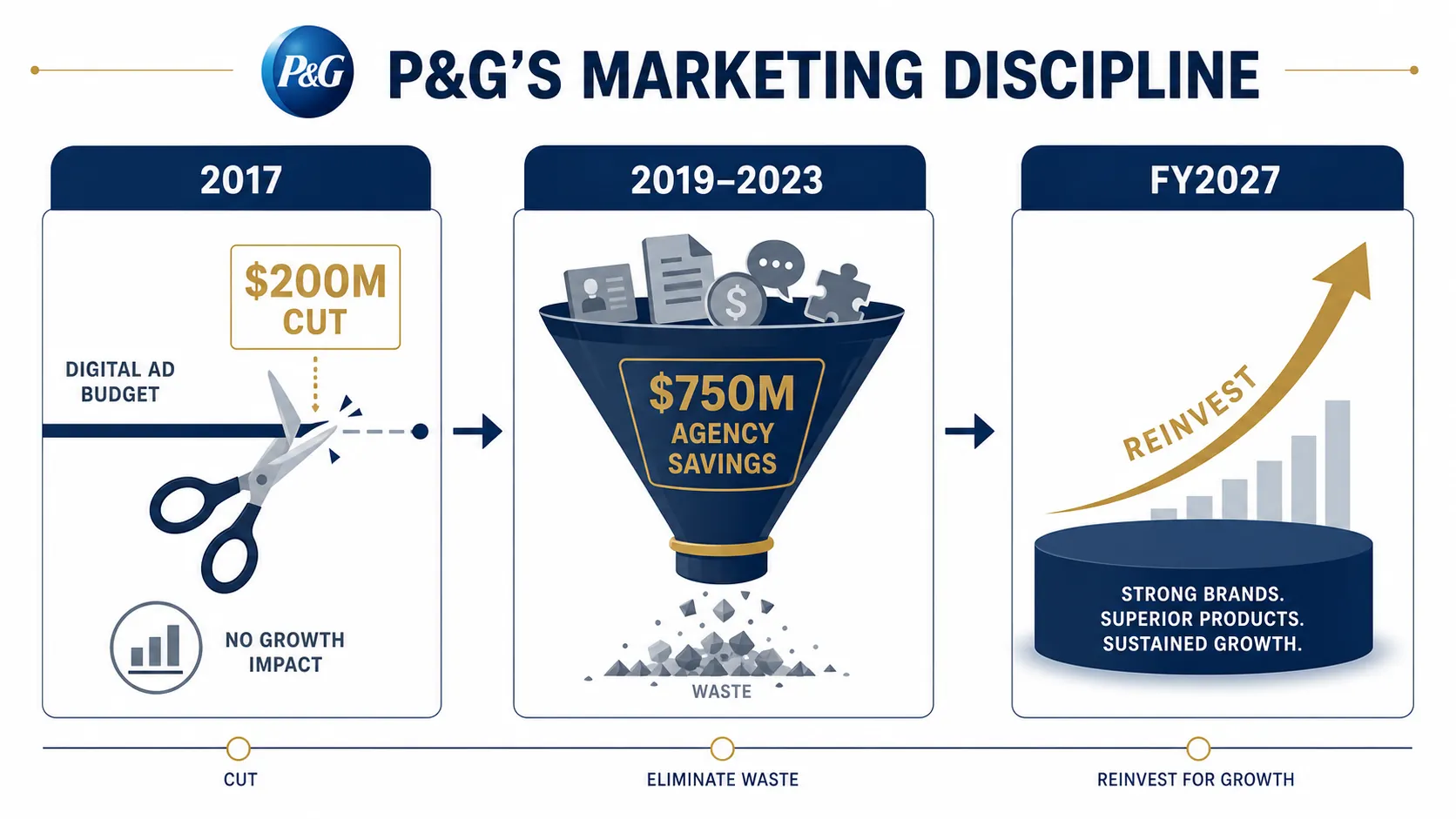
That history changes how the FY2026 reinvestment should be weighted. A company that previously cut digital waste, consolidated agencies, and kept looking for productivity is not automatically rewarding every impression supplier in the market. It is more likely reallocating toward inventory, formats, and measurement setups it believes can still carry incremental return.
The time caveat is real. The 2017 and 2018 efficiency moves happened before today’s mix of AI bidding, retail media expansion, signal loss, and cookie-deprecation planning. The exact playbook does not transfer cleanly. The discipline does.
What Media Buyers Can Reasonably Put Into FY2027 Plans
For FY2027 planning, P&G’s earnings do not justify a blanket budget increase across every channel. They do justify a stronger assumption that high-quality ad demand will remain supported, especially from large advertisers that still see media as a growth lever despite margin pressure.
- Use it as a market-level demand signal, not a platform forecast. P&G does not disclose how the added media will split across Google, Meta, Amazon, retail media networks, TV, or other channels.
- Expect more scrutiny on waste, not less. The 300 bps productivity offset in Q4 sits right beside the 410 bps marketing reinvestment, so higher budgets are likely to come with tougher performance and measurement asks.
- Separate pricing pressure from effectiveness confidence. If more large advertisers fund media, auctions can become more expensive; that does not mean every buyer’s marginal ROAS improves.
- Do not model P&G’s move as proof that smaller advertisers can spend through the same headwinds. P&G’s cash flow and portfolio scale make its tolerance for reinvestment different from a mid-market brand’s.
The softer demand context should stay in the model. Organic growth has slowed from the stronger rates P&G posted earlier in the decade to 1% in FY2026, and management’s FY2027 organic sales guide is only 1% to 3%.[1] In some categories, that can make media dollars more important because brands are fighting for incremental demand. In others, it can make volume response harder to generate. The earnings signal supports confidence that P&G sees media returns worth funding; it does not remove the need to test incrementality by market, category, and channel.
The Budget Conversation This Helps You Have
The practical use of the release is in the next budget defense. If finance asks why media costs may not soften in FY2027 despite slower consumer growth, P&G offers a clean example: even under cost pressure, one of the largest and most disciplined advertisers is putting more money behind media rather than relying only on cuts.
That argument should be narrow. It is not “P&G is spending more, so we should spend more.” It is: large, sophisticated advertisers still appear willing to fund media where they believe measurement and returns justify the capital. That can support higher demand and firmer pricing in the channels that clear those standards.
For a media buyer, the strongest FY2027 planning takeaway is pressure with selectivity. Build scenarios where premium, measurable, or commerce-proximate inventory gets more competitive. Keep weaker placements exposed to cuts. Ask vendors to show where spend is incremental rather than merely easier to automate. P&G’s earnings make the market feel more investable, not less accountable.
References
- PG Announces Fourth Quarter and Fiscal Year 2026 Results, Procter & Gamble, July 29, 2026.
- Procter & Gamble (PG) Q4 2026 earnings, CNBC, July 29, 2026.
- P&G slashes ad budget by $750 million and agencies by 50 percent, CNBC, January 24, 2018.
Built on this evidence
No Bidding tactic or Creative record currently cites this case file. Compare it against other results in Benchmarks.
Related benchmark reading
Report a corroborating or contradicting result
Seeing something different in your own account? Feed the data-integrity loop instead of leaving an open comment.