
What the Nvidia-Apple $5T Rivalry Means for AI Ad Costs
The Nvidia vs Apple $5 trillion market cap battle is a leading indicator of AI ad platform cost pressure. This article explains how the tug-of-war between infrastructure GPU pricing and monetization platform revenue directly affects the CPA floors media buyers face.
- Platform
- Google Ads
- Campaign type
- Performance Max
- Spend range
- All tiers
- Timeframe
- Q3 2026
- CPA
- Structural floor
- Verdict
- Mixed
- Last reviewed
- 2026-07-29
Apple passing Nvidia on July 27, 2026, is useful to media buyers only if it gets translated out of market-cap theater. On that date, Apple was valued at $4.95 trillion, up 24% year to date, while Nvidia sat at $4.77 trillion, up 4% year to date.[1] That is not a campaign optimization tip. It is a quarterly signal about where AI economics are being captured: by the companies selling the compute, or by the companies turning AI into distribution, fees, services, and ads.
For anyone buying PMax, Advantage+, AI Max, or other machine-led inventory, that distinction matters because the auction does not run on a spreadsheet. It runs on prediction, ranking, conversion modeling, creative assembly, budget pacing, fraud checks, and bid decisions that have to happen fast enough to be useful. If the expensive part of the stack remains Nvidia-controlled compute, platforms have a structural cost floor under all that automation. If the market starts rewarding Apple-style monetization more than raw infrastructure, pressure may rotate away from chips, but it does not automatically become cheaper for advertisers.

The market-cap race is really a cost-location question
The lazy read is that Nvidia slipping behind Apple means the AI infrastructure trade is cooling. That is too neat. Nvidia was still worth $4.77 trillion in the July snapshot, and a 4% year-to-date gain at that scale is not collapse.[1] The more useful read is that investors were marking a difference between two ways to extract value from AI.
Nvidia captures value when someone else needs more accelerated compute. Ad platforms, cloud providers, model companies, exchanges, measurement vendors, and enterprise AI products all sit downstream from that bottleneck. Apple captures more of its AI-era value through devices, operating-system control, services, privacy positioning, app distribution, and eventually more advertising surface. That model does not require Apple to build at hyperscaler intensity before it can monetize.
That is why the rivalry belongs in a bidding conversation. A stubborn CPA floor can come from weak creative, poor offer-market fit, measurement loss, audience saturation, or bad account structure. But it can also be shaped by the cost of the machinery deciding which impression is worth bidding on. Market-cap leadership is not a direct CPA forecast; it is a clue about which layer has the leverage to keep charging everyone else.
Apple’s lighter capex model is the cleaner contrast
The market-cap snapshot is the hook. The capex divide is the substance. Apple spent $12.7 billion on capital expenditures in 2025, about 2.5% of sales. Amazon, Alphabet, Meta, and Microsoft collectively spent $360 billion, about 39% of sales.[2] That comparison is not just a finance-table curiosity. It says Apple can participate in AI monetization without carrying the same infrastructure burden as the companies training, serving, and operating massive AI systems at hyperscaler scale.
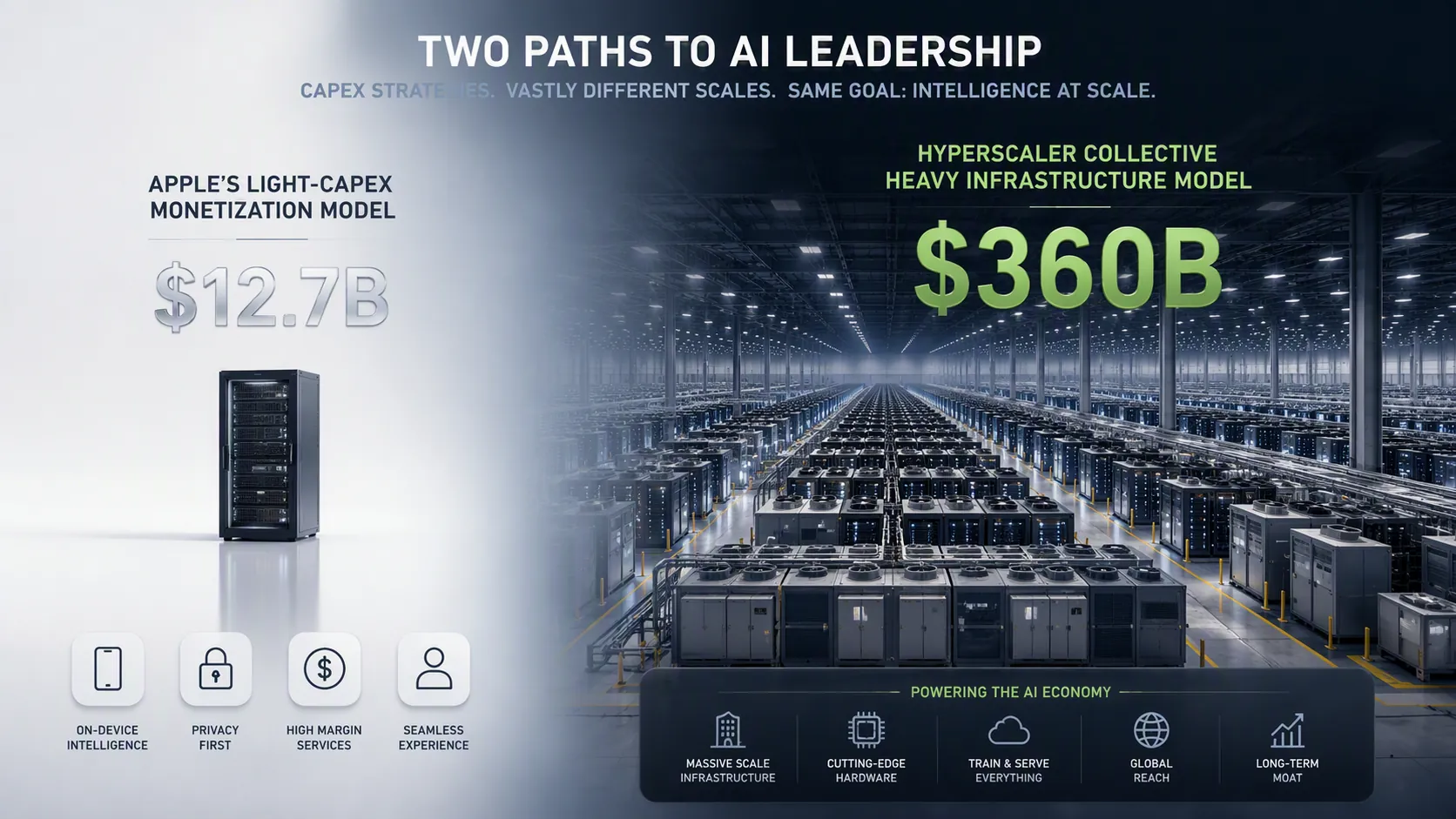
That matters because ad platforms cannot simply decide to be light-capex businesses when their product promise is real-time AI decisioning across billions of auctions. A platform can optimize its stack, negotiate supply, build custom silicon, use multiple chip vendors, or shift workloads. It cannot remove inference from the auction and still sell the same kind of automated bidding product.
| Layer | What it monetizes | Why media buyers should care |
|---|---|---|
| Nvidia-style infrastructure | GPUs, accelerated compute, data-center demand | Higher upstream compute pricing can keep platform automation expensive to operate |
| Hyperscaler ad platforms | AI bidding, ranking, measurement, creative assembly, auction participation | Compute-heavy delivery systems can raise the minimum efficient cost of campaign participation |
| Apple-style monetization | Devices, services, distribution, privacy-controlled surfaces, ads | AI value can be captured through platform control even with lighter direct capex |
The 28x capex gap between Apple and the four hyperscalers is not proof that Apple is better positioned in every AI market.[2] It is proof that the economics are different. Apple can be rewarded for monetizing the interface. Google, Meta, Amazon, and Microsoft have to fund the infrastructure that makes much of the AI interface work, including the ad systems that buyers use every day.
That is the part that shows up in planning calls. A buyer may refresh creative, clean up exclusions, rebuild audience signals, and still find that the campaign needs more budget to exit volatility than it did a year earlier. Not every case is an infrastructure story. But when the platforms themselves are spending at hyperscaler intensity, it is hard to pretend the auction’s operating cost is irrelevant.
Where GPU cost becomes auction mechanics
The PubMatic and Nvidia case is useful because it avoids vague “AI arms race” language. PubMatic integrated Nvidia L40S GPUs and reported that inference latency fell from the 5–10 millisecond industry standard to about 1 millisecond, with auction timeouts down 85%.[3] That is the ad-tech version of compute showing its face.
A timeout is not a branding problem. It is a missed shot at a bid, a lost opportunity to evaluate an impression, or a degraded decision made under time pressure. In real-time bidding, shaving milliseconds is not vanity engineering; it changes how often the system can participate, how much inventory it can evaluate, and how reliably machine-learning models can be used before the auction window closes.
That is also where the cost argument becomes more disciplined. The PubMatic case does not prove that every advertiser’s CPA rises when GPU prices rise. It proves a narrower and more important operational point: AI inference performance is now part of ad delivery economics. Faster compute reduced timeout loss inside the auction.[3] Once that is true, compute is no longer a distant data-center line item. It is part of the machinery that decides whether spend can be deployed efficiently.
This is why the Nvidia side of the rivalry cannot be dismissed as chip-sector noise. Nvidia reported FY2026 revenue of $215.9 billion, up 65% year over year, a 55.6% net margin, and $62.3 billion in data-center revenue in Q4 alone.[4] Those numbers describe pricing power. Every platform using Nvidia-heavy infrastructure has to operate somewhere downstream from that power, even if the exact commercial terms vary by cloud contract, internal buildout, chip generation, workload mix, and procurement timing.
There are other cost layers too. GPU pricing is not the whole stack. Memory bandwidth, supply constraints, and alternative accelerators also shape inference economics. That is why the AMD-side context in How Meta’s AMD GPU Deal Could Lower Your Advantage+ Costs and the memory-side pressure described in SK Hynix’s Memory Surge Is Raising AI Ad Platform Costs belong near this discussion. Nvidia is the most visible toll collector, not the only one.
Meta shows why ad platforms fight for compute
The clearest platform example is Meta after Apple’s App Tracking Transparency changes. Former Facebook manager Dave Morin said Meta redirected GPUs originally bought for other AI projects toward ads, and described Meta as “the greatest beneficiary of AI technology right now.”[5] That claim is not an audited allocation schedule, but it lines up with the operational reality buyers saw after signal loss: the platform needed more machine learning, not less, to rebuild targeting and measurement performance.
That pivot explains why AI compute is not a side project for ad platforms. When deterministic signals weaken, the platform leans harder on modeled conversion probability, creative matching, predicted intent, value optimization, and aggregation. Those systems do not just require better models. They require enough compute to run those models at auction speed.
For the buyer, the important lesson is not “Meta bought GPUs, therefore your CPA rose.” That would be too clean. The traceable chain is more careful: Nvidia shows durable infrastructure pricing power; hyperscaler ad platforms need inference capacity; auction systems reward lower latency and fewer timeouts; platforms then manage their own margins, pacing rules, auction thresholds, product packaging, and budget incentives. Somewhere in that chain, the minimum cost of effective participation can move up even when no one labels it a fee increase.
What this means for CPA floors
A CPA floor is not published like a rate card. It appears when the account keeps needing a certain budget level, conversion density, or target looseness before the machine can find enough eligible conversions. Buyers usually experience it as a familiar pattern: lower the target too far and volume collapses; push budget without enough signal and the system overpays; refresh creative and get a temporary lift, then settle back into a higher clearing cost.
Infrastructure cost is not the only explanation for that pattern. Auction competition, offer fatigue, landing-page quality, privacy constraints, measurement gaps, seasonality, and inventory quality can all raise effective CPA. The useful claim is narrower: when the AI systems behind automated bidding become more expensive to run, platforms have less room to let marginal advertisers participate cheaply.
- If infrastructure pricing power stays with Nvidia, assume automation-heavy campaigns continue to carry structural cost pressure.
- If AMD and other accelerators create real competition, expect any relief to show up first in platform infrastructure planning, not instantly in next week’s CPA.
- If memory and data-center bottlenecks intensify, lower GPU prices alone may not be enough to ease inference cost.
- If monetization platforms gain leverage, cost pressure may shift from compute scarcity to distribution control, fees, and closed measurement surfaces.
The AMD caveat matters. A deal that expands alternative GPU supply could eventually weaken Nvidia’s toll position, which is why How AMD’s Core Scientific AI Deal Could Lower Ad Platform Costs is relevant context. But a competing chip cycle is not the same as immediate buyer relief. Platforms still have to procure hardware, migrate workloads, tune models, and decide whether savings improve advertiser economics or simply protect platform margin.
The other side is also true. Nvidia’s market-cap lag behind Apple does not mean GPU costs are about to fall. It may only mean investors are paying more attention to companies that can monetize AI without matching hyperscaler capex intensity. That would change who investors reward before it changes what an advertiser pays to acquire a customer.
Apple is not just the low-capex contrast
Apple deserves careful treatment here because it is not merely the company proving that AI value can be monetized with lighter capex. It is also an advertising business. Omdia, cited by Business Insider, estimated Apple’s ad revenue at $7 billion in 2026.[6] That figure is small beside Google or Meta, but large enough that Apple cannot be treated as a neutral referee in the future of paid acquisition.
Apple’s advantage is different from Nvidia’s. It can influence what gets measured, what gets permissioned, what gets surfaced in its ecosystem, and where advertisers have to buy attention. If the market rotates toward Apple-style monetization, that may ease some fear around runaway infrastructure spend. It could also mean more value gets captured by platform access, privacy-controlled distribution, and ad products sitting closer to the user interface.
That is not a prediction that Apple will lower ad costs or that Apple’s ad platform will automatically become the buyer-friendly alternative. It is a reminder that cheaper capex at the corporate level does not guarantee cheaper acquisition at the campaign level. A company can avoid the AI capex trap and still have pricing leverage over advertisers if it controls enough demand, surface area, or measurement.
How to use the Nvidia-Apple signal in budget planning
The practical use of the Nvidia-Apple market cap rivalry is not forecasting next month’s CPA. It is setting the right default assumption before a quarterly planning meeting. If the infrastructure layer still has pricing leverage, do not build a plan that assumes platform automation gets cheaper just because your account has more history or better creative. If monetization platforms are gaining the market’s favor, do not assume relief either; ask whether cost pressure is shifting from compute to access.
A cleaner planning read looks like this: watch Nvidia’s margins and data-center growth for infrastructure leverage; watch hyperscaler capex for how much cost ad platforms are carrying; watch auction-level case studies for whether compute is improving participation efficiency; watch Apple’s services and ad ambitions for signs that monetization platforms are capturing more of the AI value chain.
That framework keeps the link honest. There is no source proving a simple pass-through from Nvidia GPU pricing to a Meta, Google, TikTok, or Amazon CPA. The evidence supports a chain, not a receipt: high-margin infrastructure, heavy AI capex, compute-sensitive auctions, and automated ad products that need more machine work behind the scenes.
So the July 2026 Apple-Nvidia reversal should sit in a media buyer’s quarterly notes, not in the bid strategy column. Treat it as a signal for where AI pricing power is sitting. If it stays with GPUs, expect stubborn cost floors around automation-heavy campaigns. If it shifts toward monetization platforms, pressure may rotate, but there is no reason to assume it disappears.
References
- Apple passes Nvidia as most valuable company — CNBC, July 27, 2026, link
- Apple’s AI Strategy Avoids the Capex Trap — 247WallSt, July 2026, link
- PubMatic Integrates NVIDIA L40S GPUs to Advance AI-Powered Advertising — PubMatic/NVIDIA, October 2025, link
- NVIDIA Announces Financial Results for Fourth Quarter and Fiscal 2026 — NVIDIA, 2026, link
- Meta redirected GPUs toward ads after ATT — Tipsheet.ai, November 2025, link
- Apple’s advertising revenue estimated by Omdia — Business Insider, April 2026, link
Built on this evidence
No Bidding tactic or Creative record currently cites this case file. Compare it against other results in Benchmarks.
Related benchmark reading
Report a corroborating or contradicting result
Seeing something different in your own account? Feed the data-integrity loop instead of leaving an open comment.