
How LV Used the BamBam x WWD Shoot as a Paid Ad Content Engine
Louis Vuitton's cover shoot with BamBam for WWD Thailand wasn't just editorial—it was a paid-ad content production run. This article benchmarks the strategy: 2-3x engagement/CPA lift versus brand creative, a 200+ concurrent ad scale, and what media buyers can learn about sourcing ambassador assets for paid social.
- Platform
- Meta Ads
- Campaign type
- Advantage+
- Spend range
- Over $0k
- Timeframe
- October 0
- CPA
- 0-3x improvement
- Verdict
- mixed
- Industry vertical
- Luxury Fashion
- Last reviewed
- 0-07-30
Start with the asset count, because that is where the paid-social value sits. In October 2025, WWD Thailand’s inaugural issue put BamBam on the cover in Louis Vuitton Men’s FW25 and produced a 9-image editorial set that could be broken into crops, formats, hooks, and audience angles rather than treated as a finished magazine moment.[1][2] The stronger benchmark is not a public Louis Vuitton ROAS number; there is no campaign-level ROAS, CAC, or CPA disclosure for this shoot. The usable benchmark is broader: impact.com’s 2026 performance research cites influencer and ambassador content used in paid ads as producing 2-3x higher engagement and lower CPAs than brand-generated creative.[3] Pair that with Enrich Labs’ case-study claim that Louis Vuitton can run 200+ paid ads simultaneously during campaigns, and the BamBam x WWD Thailand photoshoot starts to look less like a cover story and more like a content production run feeding a very large media machine.[4]
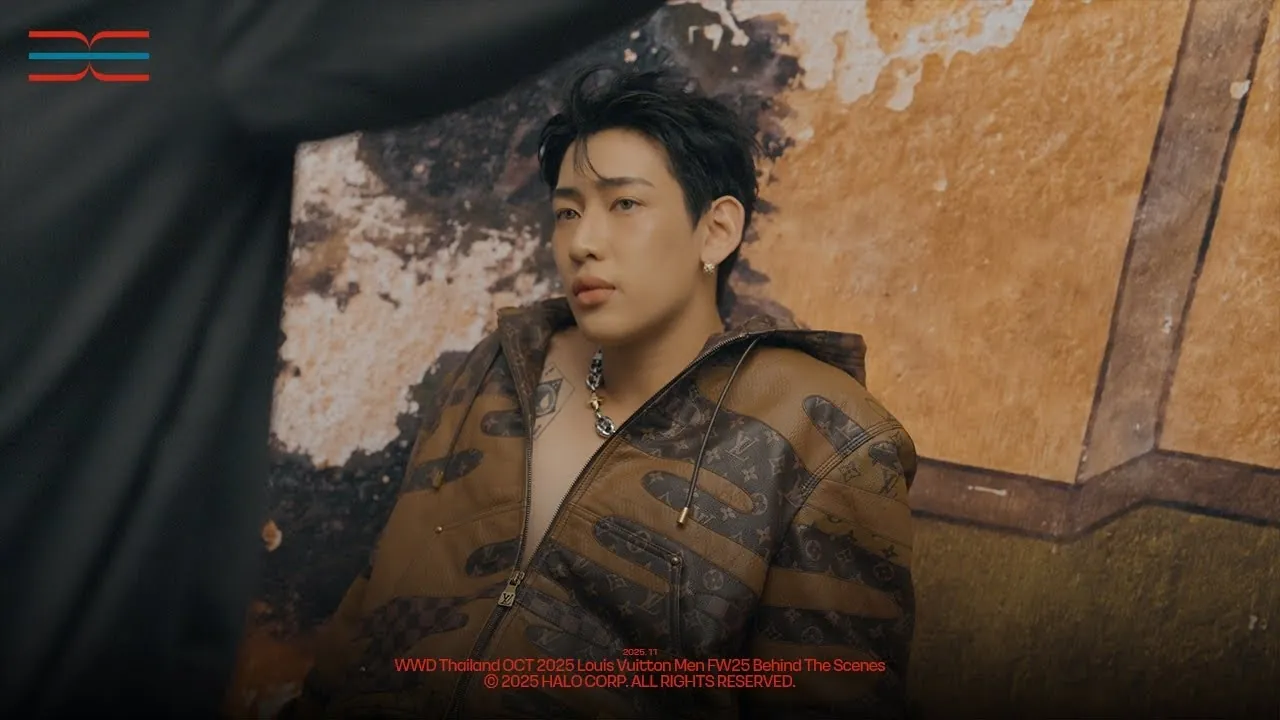
The shoot matters because it creates controlled inventory
A luxury brand does not need another random creator asset as much as it needs usable assets that will survive brand review. That is the practical difference between a celebrity appearance and a controlled editorial shoot. The BamBam x WWD Thailand package gave Louis Vuitton brand-safe styling, a known ambassador, a collection-specific wardrobe story, studio-level production, and enough image variation to build paid-social tests without asking a brand team to approve a new concept every time performance fatigue appears.
The nine images are the important unit. A single cover image is prestige. A 9-image set is source material. One image can become a portrait crop for Instagram Stories, a square feed unit, a product-led carousel opener, a dark-background retargeting asset, or a creator-handle whitelist test if rights and platform permissions are in place. None of that proves these exact WWD Thailand images were whitelisted; the public sources do not show that. It does show why the shoot had the shape of something a paid team could use.
| Editorial Asset | Paid-Social Use | What It Lets A Buyer Test |
|---|---|---|
| Cover image | High-recognition prospecting creative | Ambassador-first hook versus product-first hook |
| Full-body editorial frame | Collection and silhouette-led ad unit | Fashion authority angle versus celebrity angle |
| Close crop | Stories, Reels cover, or retargeting still | Face-led thumb-stop rate and audience familiarity |
| Nine-image set | Carousel, sequential retargeting, format variants | Creative fatigue, sequencing, and asset longevity |
That distinction matters because paid social burns through creative faster than editorial teams usually want to admit. The glossy final image is not the operating plan. The operating plan is how many compliant variations can be made before the buyer is back in Slack asking for more assets.
The audience existed before the media spend
BamBam was not brought into the WWD Thailand shoot as a cold face for a fashion image. When Louis Vuitton named him a brand ambassador in February 2024, WWD reported that the hashtag #BamBamXLVFW24 had generated more than 2.1 million cross-platform impressions from his front-row appearance; that figure was reported by Louis Vuitton to WWD, so it should be treated as brand-reported rather than independently audited.[5] The same WWD report cited his audience scale at 17.7 million Instagram followers and 11.6 million X followers.[5]
For a media buyer, that changes the job. The question is no longer whether the celebrity is recognizable. The question is how to convert existing attention into addressable distribution: warm social audiences, lookalike pools, engagement retargeting, account-based whitelisting where authorized, and sequential creative that lets the same ambassador moment reach different buying stages.
This is where a lot of fashion-ad commentary gets lazy. Earned impressions are not conversions. Follower counts are not incremental reach. A cover shoot is not automatically a paid campaign. But those inputs do lower the creative and audience risk before a campaign launches. If a front-row appearance can generate measurable social spillover, a controlled editorial shoot gives the brand cleaner material to test against that same attention base.
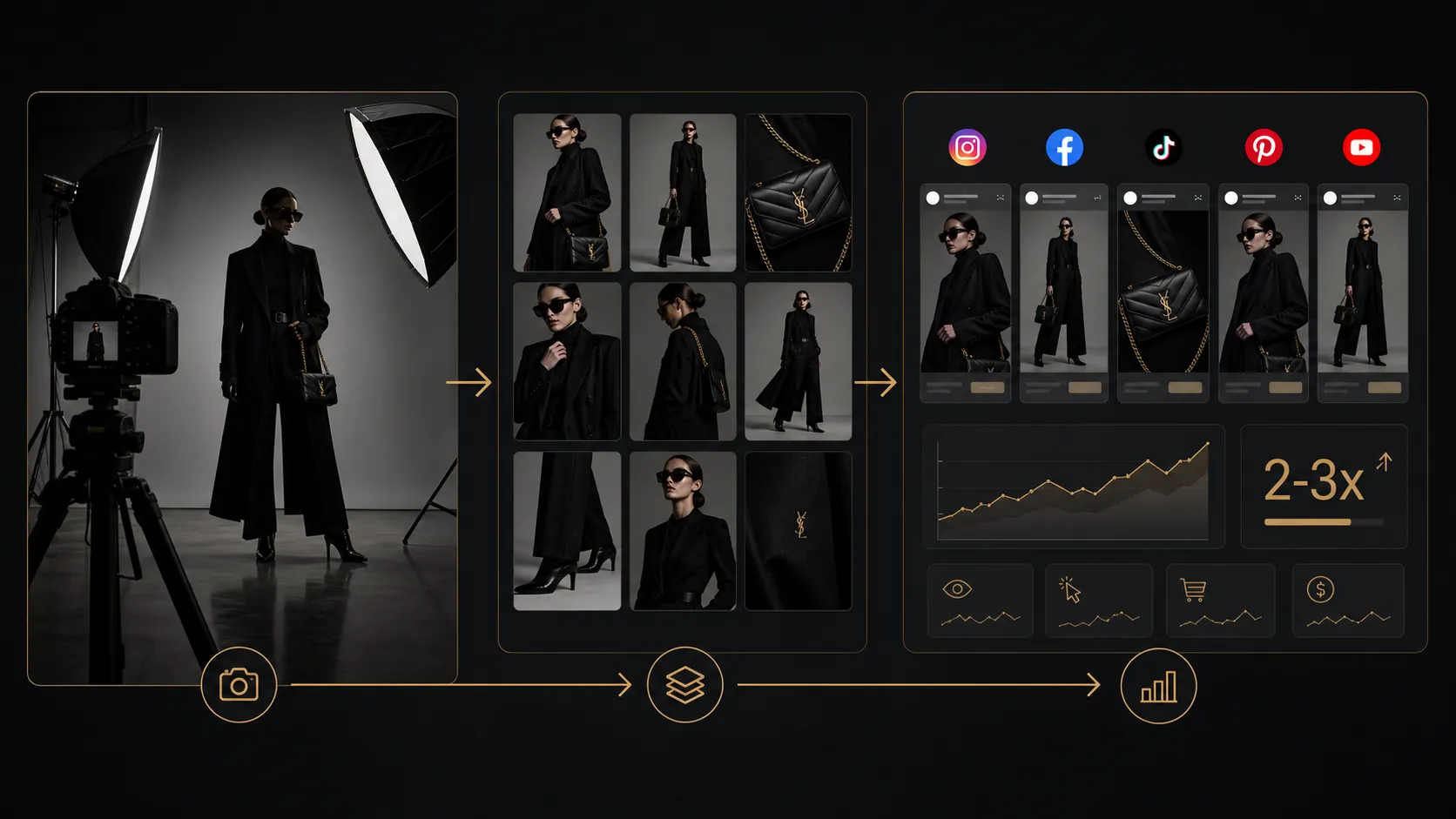
What the paid-ad machine needs from a luxury editorial shoot
Enrich Labs’ Louis Vuitton case study is useful because it gives a scale number: 200+ paid ads running simultaneously across platforms during campaigns.[4] That does not mean the BamBam x WWD Thailand shoot alone supplied 200 ads. It means the creative system around a brand like Louis Vuitton has to support that kind of ad volume, and editorial-origin assets are one way to keep the machine fed without losing image control.
A nine-image shoot can stretch further than it looks if the rights and approvals are handled up front. The practical version of the pipeline looks like this:
- Start with approved editorial stills: cover, portraits, full-body images, product-visible frames, and alternate crops.
- Separate concepts by buying job: prospecting thumb-stopper, collection education, retargeting reminder, store or ecommerce prompt, and audience reactivation.
- Create format variants: 9:16, 4:5, 1:1, carousel, story card, short motion edit if source material supports it.
- Rotate copy angles without changing the visual system: ambassador recognition, Men’s FW25 collection, WWD Thailand cover, Louis Vuitton styling, or runway-calendar continuity.
- Hold back alternates for fatigue: the point is not to launch every crop on day one, but to avoid returning to production after the first learning cycle.
That is the media-buyer value of treating the shoot as a fashion-ad input rather than a fashion-ad endpoint. The real benchmark is whether a premium editorial production can create enough variation to support the same kind of test volume that performance teams already need.
The 2-3x benchmark is useful, but it is not an LV campaign result
The most transferable number in this case is the 2-3x engagement and CPA improvement benchmark from impact.com’s 2026 influencer marketing performance research, attributed to Kristina Nolan, VP at Monks.[3] It is useful because it speaks the language of paid social: engagement and acquisition cost versus brand-generated creative. It is also easy to misuse.
That benchmark does not say Louis Vuitton achieved a 2-3x lift from the BamBam x WWD Thailand images. It does not disclose LV’s campaign CPA. It does not prove incremental sales from the October 2025 issue. What it supports is a planning target: if a brand can secure ambassador content that feels native, carries trust, and can be run through paid channels, the buyer can reasonably test it against standard brand creative with a 2-3x performance-improvement hypothesis rather than treating it as a pure awareness asset.
That hypothesis should be set up as a controlled test, not a deck claim. The clean version is ambassador/editorial creative versus brand-only creative, matched by audience, placement, budget window, and optimization event. If the account uses broad targeting or automated buying, the buyer still needs naming discipline and holdout logic where possible, because platform learning can make weak creative look better than it is and strong creative look less portable than it is.
A practical test structure
| Test Cell | Creative | Primary Read |
|---|---|---|
| Brand control | Standard Louis Vuitton-style product or campaign creative | Baseline CPA, CTR, engagement rate, and fatigue curve |
| Ambassador editorial | BamBam-style editorial stills or approved ambassador assets | Lift from familiar face and native-feeling content |
| Ambassador product-led | Same ambassador asset cropped or sequenced around collection details | Whether recognition or product clarity is doing the work |
| Retargeting variant | Close crop, cover frame, or carousel from the editorial set | Whether editorial authority improves return-visit efficiency |
The trap is expecting one hero image to carry all of those jobs. If an editorial shoot is going to become paid inventory, the shot list has to anticipate the media plan. Otherwise the buyer gets one beautiful asset, two awkward crops, and a performance problem by week two.
K-pop luxury math is not micro-creator math
The K-pop ambassador model also has a tension that should not be waved away. Puck reported in July 2026 that ambassador posts average around a 1% engagement rate, which is not impressive if the comparison set is small creators with tighter communities.[6] But the luxury K-pop play is not built only on engagement-rate purity. It is built on enormous audience pools, press pickup, social spillover, paid amplification, and repeated asset reuse.
Lefty’s Fashion Week analysis gives the category context: K-pop talent drove 60% of Men’s Fashion Week earned media value, from a $62 million total, while representing only 13% of top influencers.[7] That is why a 1% ambassador engagement rate does not automatically make the channel weak. In absolute terms, a low percentage on a very large audience can still create a serious retargeting pool and a meaningful earned-media layer.
For paid teams, the implication is simple but often missed: do not evaluate a K-pop luxury ambassador as if the only deliverable is one organic post. Evaluate the whole stack: organic reach, press syndication, fan repost behavior, paid whitelisting potential, asset library depth, and the number of campaign weeks the content can support.
Calendar stacking extends the shelf life
The WWD Thailand shoot did not sit alone on the calendar. By January 2026, BamBam walked the Louis Vuitton Men’s Fall/Winter 2026 runway, giving the brand another high-visibility moment connected to the same ambassador relationship.[8] That matters because paid-social creative does not age only by date; it ages by context. A later runway appearance can make earlier editorial assets feel current again, especially for retargeting and fan-aware audiences.
This is one of the parts smaller brands can copy without pretending to be Louis Vuitton. The move is not “hire a global K-pop star.” The move is to plan ambassador content around a sequence: announcement, editorial shoot, event appearance, product drop, behind-the-scenes cut, and paid refresh. Each moment gives the previous assets a new reason to re-enter the account.
What a non-LV media buyer can steal
Most brands cannot buy Louis Vuitton’s talent, production, or cultural permission. Fine. The operating lesson is still portable: stop commissioning creator or ambassador content as if the deliverable is a post, and start commissioning it as if the deliverable is a paid-media asset library.
- Buy usage rights before the shoot, not after performance improves and everyone realizes the asset is valuable.
- Ask for enough variation to support testing: clean backgrounds, product-visible frames, face-led crops, full-body shots, motion snippets, and vertical-safe compositions.
- Plan for whitelisting only where the creator, ambassador, platform, and contract actually allow it.
- Separate earned-media reporting from paid results; impressions, engagement, CPA, CAC, and ROAS answer different questions.
- Use the 2-3x benchmark as a test target, not as a forecast you promise to finance.
The budget implication is uncomfortable but useful. If the shoot fee consumes the whole plan and leaves no room for variant production, editing, paid distribution, and measurement, the brand bought content theater. A performance-ready ambassador shoot needs money allocated to the parts that happen after the camera stops.
The claims that remain unproven
The public evidence supports an editorial-to-paid-content pipeline inference. It does not support a claim that Louis Vuitton ran a standalone, publicly documented “BamBam x WWD Thailand fashion ad campaign” with disclosed spend, CPA, CAC, or ROAS. It also does not directly prove that the specific nine WWD Thailand images were whitelisted through BamBam’s accounts or used as paid ads.
That limitation is not a technicality. It is the difference between a useful benchmark and a fake case study. The verified pieces are strong enough: an October 2025 WWD Thailand editorial package, nine Louis Vuitton Men’s FW25 images, a large ambassador audience, prior brand-reported earned impressions, a documented Louis Vuitton paid-ad scale benchmark, and broader paid ambassador-content research showing 2-3x engagement and CPA improvement. The missing pieces are the campaign-specific ones marketers usually want most.
So the disciplined read is this: the BamBam x WWD Thailand shoot is best understood as editorial-origin content supply for paid social. It produced controlled creative inventory that could plausibly feed a high-volume Louis Vuitton ad operation and gave media buyers a clear benchmark to test against. It did not give the market public proof of LV campaign-level ROAS, and it did not prove that these exact images were whitelisted.
References
- GOT7 BAMBAM Shines in Louis Vuitton for WWD Thailand October 2025 Issue — Kpoppie.
- BamBam for the cover of WWD Thailand - October 2025 Issue — Kpopping.
- Influencer Marketing Trends 2026: Performance Insights — impact.com.
- Louis Vuitton Social Media Strategy: Case Study — Enrich Labs.
- Louis Vuitton Names K-pop Star BamBam Brand Ambassador — WWD, Feb 2024.
- Inside the Real R.O.I. of K-Pop Brand Ambassadors — Puck News, Jul 2026.
- The Power of K-Pop in influencer marketing — Lefty.
- BamBam Steps Onto the Runway for Louis Vuitton Men's Fall/Winter 2026 — L'Officiel Singapore.
Built on this evidence
No Bidding tactic or Creative record currently cites this case file. Compare it against other results in Benchmarks.
Related benchmark reading
Report a corroborating or contradicting result
Seeing something different in your own account? Feed the data-integrity loop instead of leaving an open comment.