
Humana's MA Cuts Force a Recalculation of Paid Ad Strategy
Humana's star ratings collapse removes the quality bonus revenue that subsidized member acquisition. This article recalculates the CPA and CPC thresholds Medicare Advantage carriers must hit in paid search and programmatic, and explains how to adjust bidding models and audience strategy to stay viable.
- Platform
- Google Ads
- Campaign type
- Search
- Spend range
- High
- Timeframe
- 0
- CPA
- $0
- Verdict
- loss
- Industry vertical
- Health Insurance
- Last reviewed
- 0-07-30
Humana’s Medicare Advantage cuts change paid advertising strategy in a very specific way: they make last year’s acquisition tolerance suspect. A carrier can still buy the click, book the lead, route the call, and celebrate the enrollment. The harder question is whether the plan still has enough downstream economics to justify the bid that won that member.
Humana’s problem is not a soft brand problem for media teams to monitor from a distance. The share of its Medicare Advantage members in plans rated 4 stars or higher fell from 94% in 2024 to 25% in 2025, a collapse that removes a quality-bonus cushion from a large part of the acquisition model.[1] That is landing in a paid media market where insurance already carries a $101.14 average Google Ads cost per acquisition, a $6.22 cost per click, a 2.53% click-through rate, and a 6.15% conversion rate, with insurance CPCs up 11% year over year.[2]

That is the broken equation. Acquisition costs are rising while the revenue support behind some members is shrinking. If a paid search account was already hovering around the insurance benchmark CPA, and if the plan economics behind that account just lost bonus support, the campaign did not become more efficient because the dashboard still shows enrollments. It became less forgiving.
The Lost Cushion Is Not The Whole Bonus Pool
The industry still has money flowing through quality bonuses. KFF estimates Medicare will spend $13.4 billion on the Medicare Advantage quality bonus program in 2026.[3] That number matters because it explains why acquisition teams became comfortable supporting expensive enrollment pushes in the first place. It does not mean every carrier, contract, county, or campaign still has the same room to spend.
Quality bonus revenue can quietly subsidize acquisition. When it is present, a media team can tolerate some leakage: a broad audience that includes lower-fit prospects, a TV-heavy plan with soft attribution, or a county expansion where call-center conversion lags. When it disappears, the same leakage becomes visible in payback.
The useful anchor is not a universal Humana loss per member. KFF’s employer-plan quality bonus reference of $466 per member is best treated as an illustration of the kind of per-member revenue that can sit behind the acquisition model, not as a precise amount that disappeared from every Humana enrollee.[3] The actual value varies by contract rating, benchmark, county economics, benefit design, risk adjustment, and member mix.
Still, even an illustrative bonus figure changes how a bid model should be audited. If a plan had been using a lifetime value model that implicitly assumed quality-bonus support, the paid media ceiling needs to be re-run without that support. A campaign that looked safe at a $120, $150, or $200 allowable CPA under the old economics may no longer clear finance review if the incremental member is coming into a lower-rated contract with higher medical cost pressure.
| Input | Why It Changes The Bid |
|---|---|
| 4+ star member coverage falls from 94% to 25% | A larger share of acquisition is no longer supported by the same quality-bonus economics. |
| $101.14 insurance CPA benchmark | This becomes a floor to test against, not a safe target, when plan-level margin compresses. |
| $6.22 CPC with 11% YoY CPC inflation | The account must either convert more efficiently or exclude more low-probability traffic. |
| 91.1% MLR in Q2 2026 | Less premium revenue remains after medical costs, reducing room for acquisition error. |
A $101 CPA Is Only Cheap If The Member Still Pencils Out
Insurance marketers tend to treat benchmark CPAs as a competitive reference: are we above or below the market? That is useful, but incomplete. For Medicare Advantage, the better question is whether the marginal enrollment acquired at that CPA still contributes enough after medical costs, plan benefits, broker compensation, call-center expense, compliance drag, and retention assumptions.
The $101.14 insurance CPA benchmark is not a Medicare Advantage-specific allowable acquisition cost. It is an aggregate insurance advertising benchmark.[2] A strong MA account can beat it. A weak one can miss it badly. The number is still operationally useful because it tells a media lead where the paid search market is already pricing intent. If the plan’s new allowable CPA is below that level, broad non-brand search is not a volume lever anymore. It is a selective harvesting channel.
The CPC math makes the squeeze clearer. At a $6.22 CPC and a 6.15% conversion rate, the implied CPA is roughly in line with the reported $101.14 benchmark.[2] If CPC rises another step and conversion rate does not move, CPA rises mechanically. There is no media-ops magic that cancels that out. The account needs better intent filtering, better landing-page and call routing, a narrower geography, a better close rate, or a lower bid.
For a Medicare Advantage campaign, the decision should move from account-level CPA to contract- and county-level allowable CPA. A county with a plan still supported by stronger economics can carry a higher bid cap than a county where benefits are being trimmed, provider access is weaker, or enrollment is likely to skew higher acuity. The old habit of setting one regional target CPA and letting the algorithm average out the mess is exactly how expensive members hide inside a clean blended number.
MLR Turns Media Waste Into A Faster Problem
Humana’s Q2 2026 medical loss ratio was 91.1%, up from 89.7% a year earlier.[4] That number is not an advertising metric, but it belongs in the bid sheet. A higher MLR means more premium revenue is being consumed by medical costs before the acquisition team’s spend is considered. When MLR rises at the same time bonus economics weaken, the allowable CAC does not merely get reviewed. It gets compressed from both sides.
This is where broad targeting becomes harder to defend. A campaign can show good platform efficiency while still worsening the member mix. Search terms around low-premium plans, dental allowances, grocery cards, or local plan comparisons may all produce leads, but the value of those leads depends on eligibility, county availability, plan fit, risk profile, retention, and whether the call center can close the right plan. The platform conversion is only the first checkpoint.
The practical response is not to stop buying traffic. It is to stop pretending every eligible click has the same expected value. Campaigns need negative geography, not just negative keywords. They need bid modifiers tied to plan availability, county margins, and call-center close rates. They need separate reporting for members acquired into contracts with different star-rating economics. If finance is measuring per-member payback, media cannot keep optimizing only to lead volume.
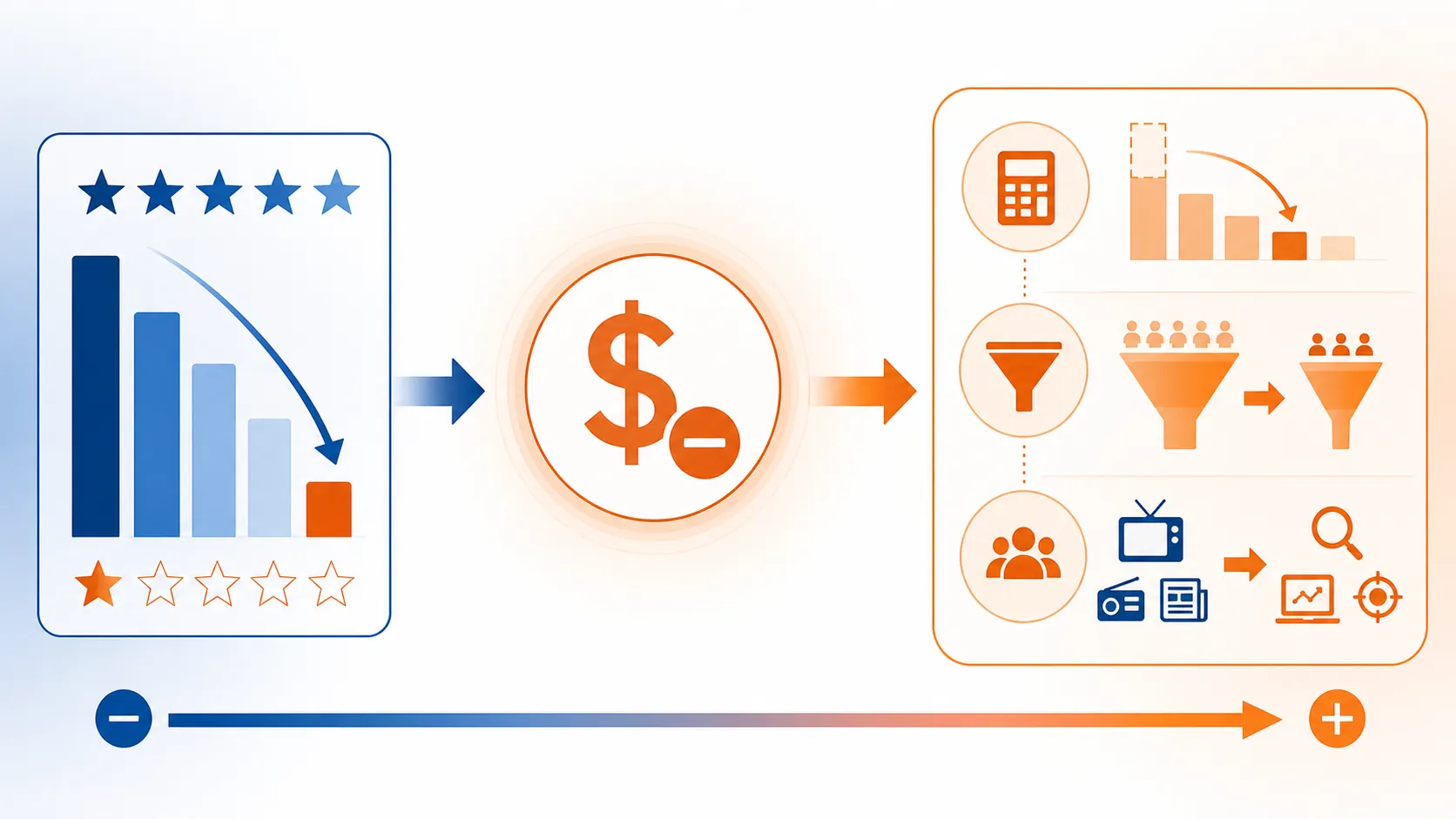
Humana’s Growth Paradox Is The Warning Label
Humana added 1.3 million members while cutting plans and exiting 194 counties.[4] That is the kind of line that should make a media team pause before celebrating volume. It does not prove that Humana overspent on advertising; Humana does not publicly disclose exact marketing or advertising budgets. But it does show why enrollment growth alone is no longer a clean success metric.
Growth can be valuable. It can also be mistimed, misallocated, or more expensive than the plan economics can absorb. If a carrier is adding members while exiting counties, narrowing benefits, or reviewing broker compensation, the acquisition model is already being rewritten outside the media platform. Paid media has to follow that rewrite rather than keep feeding last year’s campaign structure.
The commission changes make that visible. Humana planned to cut commissions on 288 Medicare Advantage plans, roughly one-third of its portfolio, as part of 2027 benefit adjustments.[5] Broker compensation and paid media are different levers, but they compete inside the same acquisition economics. When one acquisition lever is being cut or repriced, the other should not assume its old ceiling is intact.
For media planning, the lesson is straightforward: enrollment volume needs to be segmented by economic quality. A report that says one campaign produced 3,000 enrollments is not enough. The next questions are which counties, which contracts, which star-rating exposure, which broker or call-center path, which retention expectation, and which post-enrollment medical cost profile. Without that cut, a carrier can grow into the part of the book it is about to spend the next year repairing.
What Changes In Paid Search
Paid search is where the new discipline shows up first because the cost is explicit. The buyer sees the $6.22 click, the conversion rate, and how quickly a broad match setting can spend through a county that is no longer worth the same bid.
The first change is bid caps by plan economics, not by campaign convenience. If County A has stronger star-rating economics, better provider fit, and a call center that closes cleanly, it can carry a different target CPA than County B. That may mean separate campaigns or portfolio bid strategies instead of one blended automated target. The structure needs to match the financial boundary.
The second change is search-query discipline. High-intent queries around enrollment windows, specific plan names, carrier comparisons, and local availability deserve different treatment from broad benefit-seeking terms. A broad term can still work, but only if downstream data proves it. If the lead source produces low eligibility, weak close rates, or higher-cost members, the keyword does not get to stay because it lowers top-of-funnel CPA.
- Separate brand, competitor, and non-brand campaigns so blended CPA does not hide expensive prospecting.
- Set county-level exclusions where the plan is exiting, benefits are weaker, or expected margin no longer supports paid acquisition.
- Use call-center disposition data to optimize beyond form fills and first calls.
- Recalculate target CPA when CPC inflation changes the conversion rate required to break even.
- Keep remarketing pools separate by plan availability and eligibility stage, not just site behavior.
The uncomfortable part is that some campaigns will look smaller after this work. That is not failure. It is the account finally reflecting the plan’s current economics.
Programmatic And CTV Need Measurement, Not Just Migration
Tighter economics make measurable video and display more attractive than linear TV, but only if the measurement is real. The MM+M and Inmar 2026 trend report said digital overtook linear TV for the first time in the healthcare ad market, with total healthcare advertising at $26.52 billion, digital video and display up 70% year over year, CTV up 60%, and 36% of former linear budgets reallocated to CTV in 2025 alone.[6] That is a healthcare-wide signal, not proof that every Medicare Advantage CTV buy is efficient.
CTV deserves budget when it can answer the questions linear TV usually dodges: which households were exposed, which counties were reachable, which landing path or call path followed, which audience segment converted, and whether the enrollment came into a plan with an allowable acquisition cost above the media spend. Without that, CTV becomes linear TV with a cleaner dashboard.
Programmatic display has the same burden. Medicare Advantage marketers should not buy broad senior reach and call it efficient because CPMs are lower than search CPCs. Lower media cost does not solve low plan fit. A cheaper impression can still be expensive if it fills the funnel with members the plan cannot profitably retain.
The better use is narrower: county-qualified audiences, age and eligibility filters that respect compliance boundaries, exclusion lists for unavailable plans, suppression of existing members where appropriate, and measurement that connects exposure to call outcome and enrollment quality. Healthcare marketers are already increasing digital budgets; one 2026 health insurance marketing guide reported that 71% of healthcare marketers increased digital budgets in 2026.[7] The budget shift is directionally useful, but the Medicare Advantage question remains plan-specific: can the channel produce members below the new allowable CPA?
The New Bid Model Starts With LTV, Then Removes The Assumptions
A practical Medicare Advantage bid model should begin with lifetime value, but the work is in stripping out stale assumptions. The old model may have assumed bonus revenue, stable benefits, broad county availability, a predictable broker channel, and a retention pattern built from a healthier book. Humana’s star-rating decline and operating pressure show why those assumptions need current-year review.
| Model Field | Question To Re-Underwrite |
|---|---|
| Quality bonus support | Is this contract still supported by 4+ star economics, or was last year’s bonus assumption carried forward? |
| County availability | Is the plan still sold in this county, and does the county still support paid acquisition? |
| Medical cost expectation | Does the expected member mix fit the current MLR environment? |
| Broker and call-center cost | Are compensation changes or close-rate changes reflected in allowable CPA? |
| Channel attribution | Does the channel prove incremental enrollment quality, or only assisted activity? |
The result should be a set of allowable CPA bands rather than one target. A strong county-plan combination can support more aggressive search and CTV prospecting. A weaker combination may allow only brand defense, remarketing, or low-cost audience testing. A county scheduled for exit or major benefit reduction should not keep absorbing spend because it remains inside an old radius target.
This also changes how CPC is judged. A $6 click can be acceptable if the query has high intent, the county is profitable, and the call center converts the right members. A $2 impression path can be wasteful if it creates unqualified demand in counties where the plan economics are impaired. Paid media cost is only meaningful after it is attached to expected member value.
CMS Relief Comes Too Late For 2026 And 2027 Bidding
There is a policy caveat, but it should not be used as a planning escape hatch. CMS finalized a star-ratings overhaul in April 2026 that eliminates 11 measures and is projected to add $18.6 billion over 10 years.[8] That may improve future economics for some plans, depending on final measure effects, benefit design, payment policy, and possible Congressional action.
The timing matters. The benefit of those changes does not fully flow through to payment immediately, leaving a multi-year window where 2026 and 2027 acquisition decisions still need to be made under constrained economics. A media team cannot bid today against a bonus recovery that has not reached the revenue line.
Carriers should not abandon acquisition. They should abandon inherited bid caps, broad audience rules, soft attribution comfort, and county targeting that assumes quality bonuses will keep subsidizing enrollment volume. The paid media plan now has to match the current plan economics: lower allowable CPAs where bonus support is gone, stricter CPC tolerance where conversion quality is weak, tighter geography where exits or benefit changes are underway, and channel measurement that can survive a finance review.
References
- Humana reports major decline in Medicare Advantage star ratings, Becker's Payer
- Google Ads Benchmarks 2026: CPC, CTR, CVR by Industry, Digital Applied
- Medicare Will Spend More Than $13 Billion on the Medicare Advantage Quality Bonus Program in 2026, KFF
- Humana plans more market exits for 2027, CFO says, Fierce Healthcare
- Humana to adjust Medicare Advantage benefits in 2027 as funding gap widens, CEO says, Becker's Payer
- Healthcare Marketers Trend Report 2026: Digital ad spend overtakes linear TV, MM+M
- Health Insurance Marketing: 2026 Data-Driven Guide, Improvado
- April 2026 Medicare Advantage and Part D Final Rule, CMS, April 2026
Built on this evidence
No Bidding tactic or Creative record currently cites this case file. Compare it against other results in Benchmarks.
Related benchmark reading
Report a corroborating or contradicting result
Seeing something different in your own account? Feed the data-integrity loop instead of leaving an open comment.