
Claude's 157 Outages Cost Advertisers More Than Reported
Claude suffered 157 outage events in the first seven months of 2026, yet the financial cost to advertisers remains unquantified. This analysis builds the first cost estimate using documented workflow time-savings and PPC manager rates, and argues that the pattern makes single-provider AI dependency untenable for production ad campaigns.
- Platform
- Google Ads
- Campaign type
- Search
- Spend range
- All
- Timeframe
- 0-01 to 2026-07
- Lost acceleration hours
- 0
- Verdict
- loss
- Last reviewed
- 0-07-30
Claude had 157 reported outage events between January and July 2026, according to StatusGator data, but that headline number needs handling with care: it includes minor degradations as well as major incidents. The more useful signal for advertisers is narrower and uglier. Seven of those events were major multi-model disruptions, and the latest one, on July 30, lasted about 4 hours and 6 minutes. It also landed inside a July 25-30 run of five major disruptions in six days.[1][2]
That is the part that changes the workday. A one-off outage means someone rewrites a brief, moves a task, or tells the client the report will be late. Five major disruptions in a production week means the team has to ask a different question: how much paid-media capacity is now sitting behind one AI vendor’s status page?
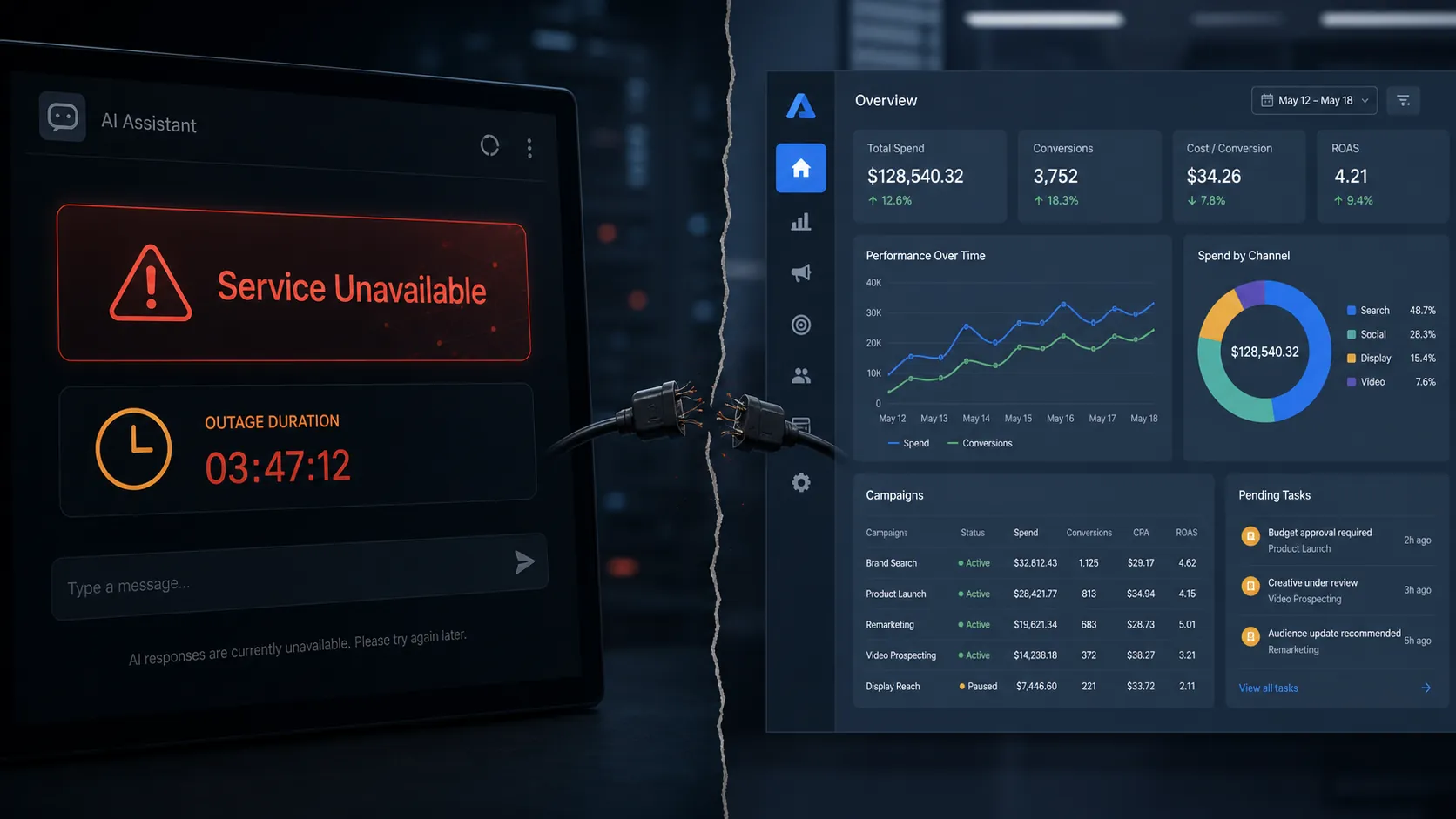
The public accounting has not caught up with how Claude is being used in ad operations. Developer productivity gets measured. Enterprise resilience gets discussed. Advertisers, meanwhile, are left with a softer category: delayed variants, paused query reviews, slower diagnosis, and reporting work pushed into the evening. Those are not dramatic failure modes, but they are billable hours and missed throughput.
Where the Outage Hits a Paid-Media Workflow
Claude is not usually the system of record for a campaign. It does not replace Google Ads, Meta Ads Manager, a bid strategy, a tracking plan, or a client approval process. Its operational value sits in the connective tissue: turning a brief into variants, expanding keyword sets, reading search queries, grouping themes, drafting account notes, and making reports coherent enough for someone else to review.
That makes downtime easy to underestimate. The campaign may still be live. Spend may still pace. Dashboards may still refresh. But the tasks that keep an account clean and moving start to queue.
| Workflow area | What Claude often accelerates | What outage time usually creates |
|---|---|---|
| Ad copy and variant generation | Turning one brief into multiple message angles, headlines, descriptions, CTAs, and landing-page-ad consistency checks | Fewer variants ready for review, slower testing cadence, more manual rewrite time |
| Keyword research | Expanding seed themes, clustering intent, spotting missing modifiers, drafting negatives for review | Delayed buildouts, thinner launch structures, slower exclusion updates |
| Search query analysis | Summarizing query patterns, separating waste from opportunity, drafting account notes | Late negatives, slower budget cleanup, more manual spreadsheet work |
| Campaign management | Explaining anomalies, preparing change rationales, comparing movement across campaigns | Longer diagnosis windows and more waiting between signal and action |
| Reporting | Drafting performance narratives, summarizing tests, translating account changes into client language | Reports pushed later or stripped down to numbers without useful interpretation |
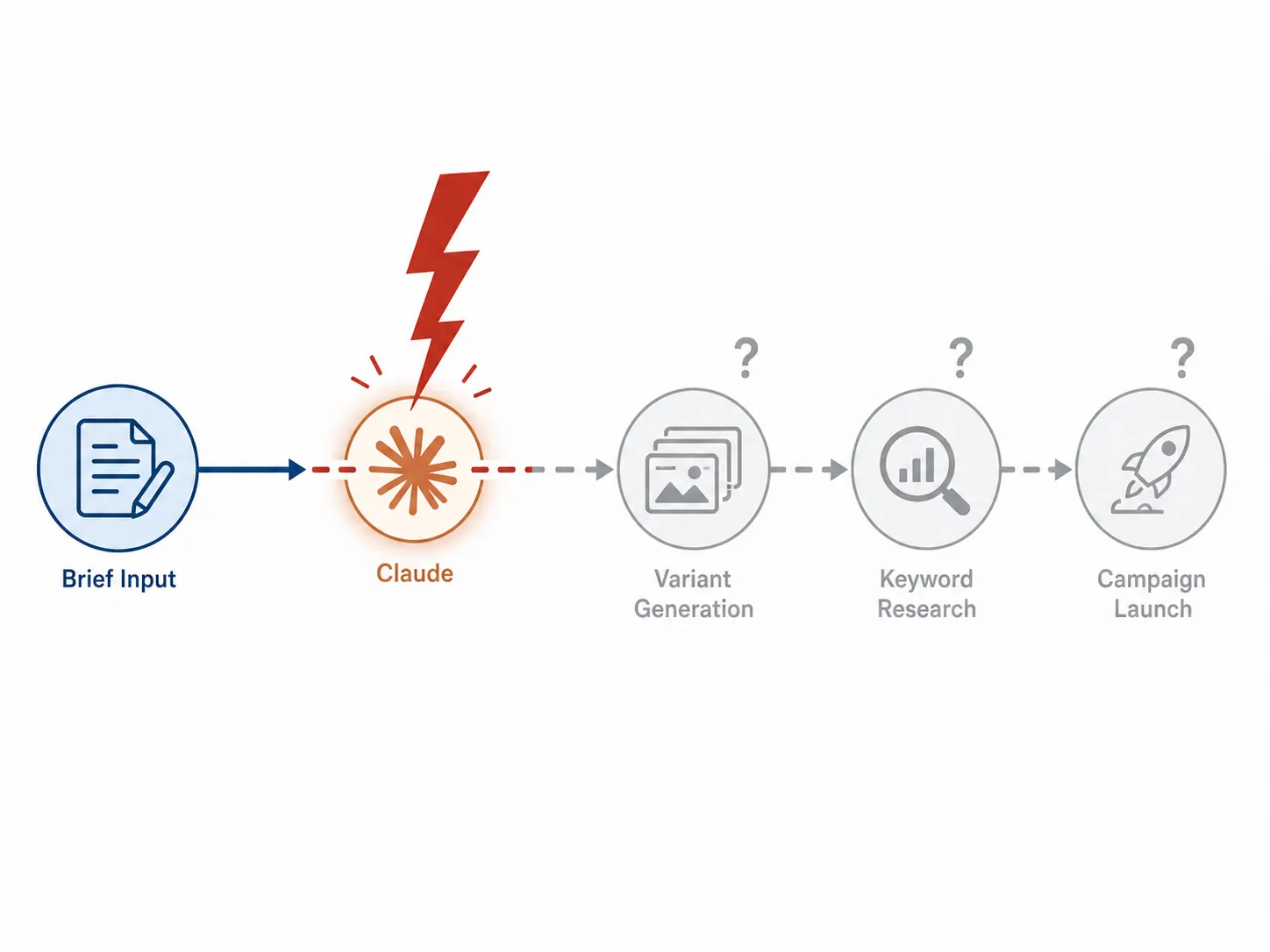
The automated ad creation pipeline is often described as a movement from brief input to creative generation, review, and launch. Ryze frames automated ad creation around a four-stage flow that moves from brief intake through output and campaign readiness.[3] Claude can sit in more than one place inside that chain. When it is unavailable, the break is not limited to copywriting; the downstream review queue, build queue, and launch queue can all lose shape.
A Practical Cost Model for Claude Downtime
No source in the available material directly measures dollars lost by advertisers per Claude outage hour. So the cleanest estimate is not a universal dollar claim. It is a capacity model that a team can plug its own loaded hourly rates and task volumes into.
The strongest advertiser-specific inputs are documented workflow savings. Metaflow reports an 85% reduction in time for ad copy generation, 75% for keyword research, and 60% for search query analysis when using Claude in paid ads workflows.[4] Those figures do not prove every advertiser saves that much, and they do not prove that an outage causes an equal financial loss. They do show how much labor compression a Claude-dependent workflow may have built into its daily plan.
| Task | Documented time reduction | If Claude is down for 4 hours 6 minutes during that work | Manual-equivalent work represented by that AI-assisted block |
|---|---|---|---|
| Ad copy generation | 85% | About 4.1 AI-assisted hours unavailable | About 27.3 manual hours of copy work |
| Keyword research | 75% | About 4.1 AI-assisted hours unavailable | About 16.4 manual hours of keyword research |
| Search query analysis | 60% | About 4.1 AI-assisted hours unavailable | About 10.3 manual hours of query analysis |
The math is simple, but it needs to be labeled. If a task is reduced by 85%, the AI-assisted version takes 15% of the original manual time. A 4.1-hour Claude work block for ad copy therefore represents roughly 27.3 hours of manual-equivalent copy work. The lost acceleration is the difference between those numbers: about 23.2 hours of labor compression that could not be used during that window.
That does not mean an advertiser lost 23.2 paid hours in cash on July 30. Some work may have been moved. Some may have been done manually. Some may not have been urgent. But for a team that scheduled copy production, keyword expansion, or query cleanup around Claude availability, the outage removed the very capacity multiplier that made the schedule realistic.
How to Price It Without Pretending the Answer Is Universal
A useful internal estimate has four inputs:
- Outage hours during the team’s active production window
- The share of that window assigned to Claude-dependent tasks
- The documented or observed time saving for each task type
- The loaded hourly cost of the people who absorb the delay or manual fallback
Manual-equivalent hours = Outage hours assigned to task / (1 - time-saving rate)
Lost acceleration hours = Manual-equivalent hours - outage hours assigned to task
Estimated labor exposure = Lost acceleration hours x loaded hourly cost
For a hypothetical example, if a team had 4.1 outage hours assigned entirely to Claude-assisted keyword research, and its own observed time saving matched the 75% figure, that outage window represented about 16.4 manual-equivalent hours of keyword work. The lost acceleration was about 12.3 hours. The team would then multiply those 12.3 hours by its own loaded hourly cost, not by a generic industry number.
This is deliberately narrower than the big AI downtime numbers often used in vendor resilience discussions. Introl cites a general AI downtime cost range of $100,000 to $500,000 per hour, but that is a boundary marker for broader AI-dependent operations, not a measured advertiser-specific Claude loss figure.[5] Importing it directly into a paid media team’s P&L would make the estimate look more confident than the evidence allows.
The July Cluster Matters More Than the 157 Count
The 157-event count is attention-grabbing, but it mixes small degradations with larger incidents. For production planning, the July 25-30 pattern is more important because it compresses risk into the same working period. Trending Topics described five major Claude disruptions in six days across July 25-30, with the July 30 event occurring after earlier disruptions on July 25-26 and July 29.[2]
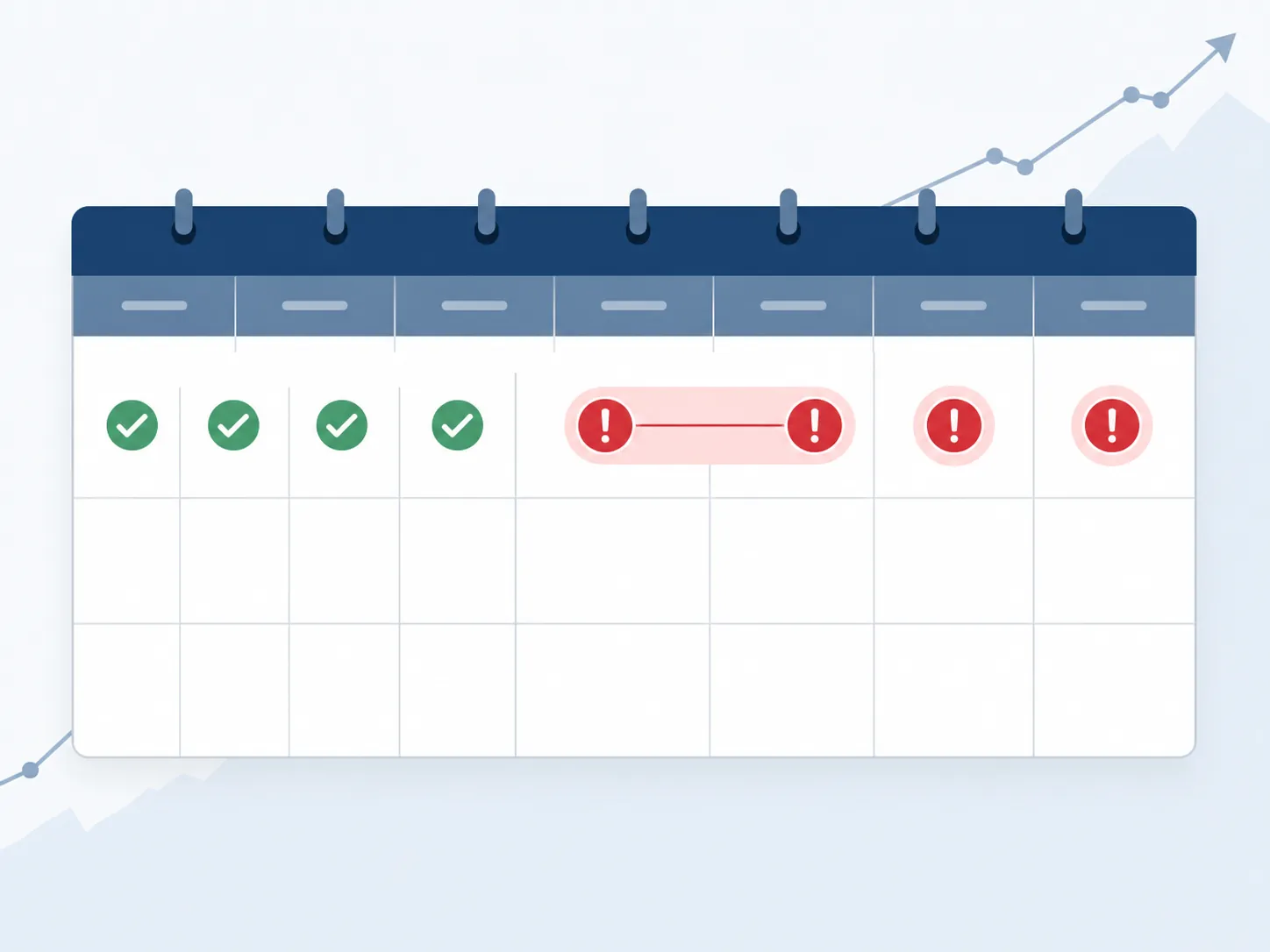
A repeated pattern changes staffing decisions. If Claude is down once, the PPC manager can move to budget checks, QA, or client email. If it is unstable across several days, the fallback work also starts competing for the same people. The person who manually reviews search queries is often the same person expected to rebuild copy variants, explain spend movement, and answer the client who was promised a refreshed test plan.
This is where the cost stops being only labor arithmetic. Paid media accounts have timing sensitivity. A delayed negative keyword review can let waste continue. A delayed anomaly diagnosis can leave budget misallocated for another cycle. A delayed report can turn a manageable performance explanation into a client-confidence problem. The available sources do not quantify those downstream advertiser losses, so they should not be presented as measured. They should be treated as risk categories that sit on top of the labor exposure.
One Workaround Will Not Cover Every Claude Failure
The reliability problem is not just that Claude has been unavailable. It is that the failure modes have varied enough that a team cannot assume the same workaround will keep working.
On March 2, the outage pattern was not uniform across access methods. DeployFlow’s timeline described a web experience failure while the API had a stability window for part of the incident, which meant some teams with API-based workflows had a route that web-only users did not.[6] For an ad team using Claude mostly through a browser, that distinction matters. For a team that had already connected Claude through internal tools, the day may have looked different.
On June 2, Thoughtworks described a sub-agent token-glitch failure mode affecting all access points.[7] That is a different operational problem. If the web app, API route, and integrated agent path all depend on the same broken token behavior, the fallback cannot simply be “use Claude another way.”
Then came the July 25-30 cluster, which is less about one technical shape and more about recurrence inside the same production week.[2] The practical lesson is not that every outage is catastrophic. It is that resilience plans built around a single alternate access point are too thin for a tool now embedded in daily campaign production.
| Incident pattern | What the available material supports | Operational implication for advertisers |
|---|---|---|
| March 2 | Web failure with an API stability window for part of the incident | Browser-only teams and API-enabled teams may have had different fallback options |
| June 2 | Sub-agent token glitch affecting all access points | Alternate Claude access paths may not have solved the problem |
| July 25-30 | Five major disruptions in six days | Teams needed continuity planning across several workdays, not just a one-time task shuffle |
Dependence Rose Before the Backup Plan Did
Claude’s marketing use is not a fringe behavior anymore. Guides for advertisers describe Claude-assisted workflows across campaign strategy, ad copy, audience messaging, content adaptation, and performance analysis.[8][9] CNBC also connected the March 2 outage to a period of heightened mainstream visibility, including Claude reaching No. 1 in Apple’s App Store and Anthropic’s work connected to a Pentagon migration context.[10]
Those facts do not prove advertiser dependency by themselves. App Store rank is not PPC workflow penetration. Pentagon context is not media buying adoption. But they help explain the timing: Claude became visible, useful, and normal inside professional workflows faster than many teams built reliability procedures around it.
The mistake is not using Claude heavily. The time savings are exactly why teams adopted it. A tool that cuts ad copy time by 85%, keyword research time by 75%, or search query analysis time by 60% is not a toy in a busy account.[4] It is part of the production surface. Once that is true, uptime belongs in the same planning conversation as tracking, feed health, landing page availability, and approval coverage.
What Advertisers Should Measure Now
The first fix is not a dramatic vendor switch. It is measurement. Most teams already know when Google Ads is down, when a landing page breaks, or when a feed import fails. Claude downtime should be logged with the same operational discipline if Claude is part of production work.
- Record outage windows against local working hours, not just vendor incident duration.
- Tag the blocked task type: copy, keyword research, search query review, reporting, diagnosis, or client response.
- Separate delayed work from manual fallback work, because they create different costs.
- Use observed internal time savings where possible; use published figures only as a starting estimate.
- Log downstream consequences separately, especially delayed exclusions, delayed anomaly review, and missed launch windows.
The second fix is redundancy that matches the failure mode. A backup browser bookmark is not redundancy if the problem affects every access point. A second model helps with drafting and summarization, but it may not preserve account-specific instruction libraries, internal evaluation criteria, or approved copy patterns. A manual fallback works only if someone has time reserved to use it.
For paid media teams, a credible fallback plan usually needs three layers: an alternate AI tool for language and analysis tasks, documented manual procedures for high-risk account hygiene, and a triage rule that says which work waits and which work must continue without Claude. Search query exclusions and spend anomaly diagnosis should not sit in the same priority bucket as a nice-to-have copy refresh.
The July 30 outage should be priced inside each team’s own operating model. If Claude was assigned to four hours of copy generation, the exposure looks different from four hours of search query review. If the affected person was a junior operator preparing variants, the cost looks different from a senior lead rebuilding a client narrative before a renewal call. The point is not to invent a universal advertiser-loss number. It is to stop treating the loss as unknowable.
Claude’s 2026 outage pattern is now large enough to be treated as a reliability exposure in paid media operations. The 157 reported events show noise and frequency. The seven major multi-model disruptions show severity. The July 25-30 cluster shows recurrence under real production pressure. For advertisers using Claude to compress copy, keyword, query, campaign management, and reporting work, downtime is not merely an interruption to a favorite assistant. It is measurable lost capacity, and it belongs in the media team’s risk model.
References
- Anthropic Claude Status, StatusGator, https://statusgator.com/services/anthropic
- Claude Outages Surge, Trending Topics, trendingtopics.eu/claude-outages-surge
- Automated Ad Creation, Get Ryze, get-ryze.ai/blog/automated-ad-creation
- Claude Code for Paid Ads, Metaflow, metaflow.life/blog/claude-code-for-paid-ads
- Mitigating the Cost of Downtime in the Age of Artificial Intelligence, Introl, introl.com/blog/mitigating-the-cost-of-downtime-in-the-age-of-artificial-intelligence
- Claude Anthropic Outage: Protect Claude Infrastructure, DeployFlow, deployflow.co/blog/claude-anthropic-outage-protect-claude-infrastructure
- Thoughtworks, thoughtworks.com
- Claude for Marketing Complete Guide, Adspirer, adspirer.com/blog/claude-for-marketing-complete-guide
- Claude AI for Advertising, VibeMyAd, vibemyad.com/blog/claude-ai-for-advertising
- Anthropic Claude AI Outage Apple Pentagon, CNBC, cnbc.com/2026/03/02/anthropic-claude-ai-outage-apple-pentagon.html
Built on this evidence
No Bidding tactic or Creative record currently cites this case file. Compare it against other results in Benchmarks.
Related benchmark reading
Report a corroborating or contradicting result
Seeing something different in your own account? Feed the data-integrity loop instead of leaving an open comment.