
What Makes Chick-fil-A's LTO Strategy So Effective
Chick-fil-A is famous for its deliberately limited menu, yet it heavily promotes limited-time offers. This case study examines how the chain treats LTOs as a disciplined innovation instrument — using the Honey Pepper Pimento Chicken Sandwich as the prime example — and what operational discipline makes them profitable rather than distracting.
Chick-fil-A is an awkward case for anyone who treats limited-time offers as a simple answer to menu boredom. The chain has built much of its operating reputation on restraint: a deliberately narrow menu, restaurants closed on Sundays, and stand-alone average unit volumes that still reached $9.2 million in 2025 as systemwide sales approached $23.9 billion.[1] That AUV figure also slipped 1.7% from $9.3 million in 2024, a useful reminder that even exceptional operators do not get unlimited growth from the same box forever.[2]
That is what makes its limited-time menu strategy worth studying. The brand is not using LTOs to become a variety-driven restaurant. It is using them to introduce novelty without asking the system to behave like a different system.
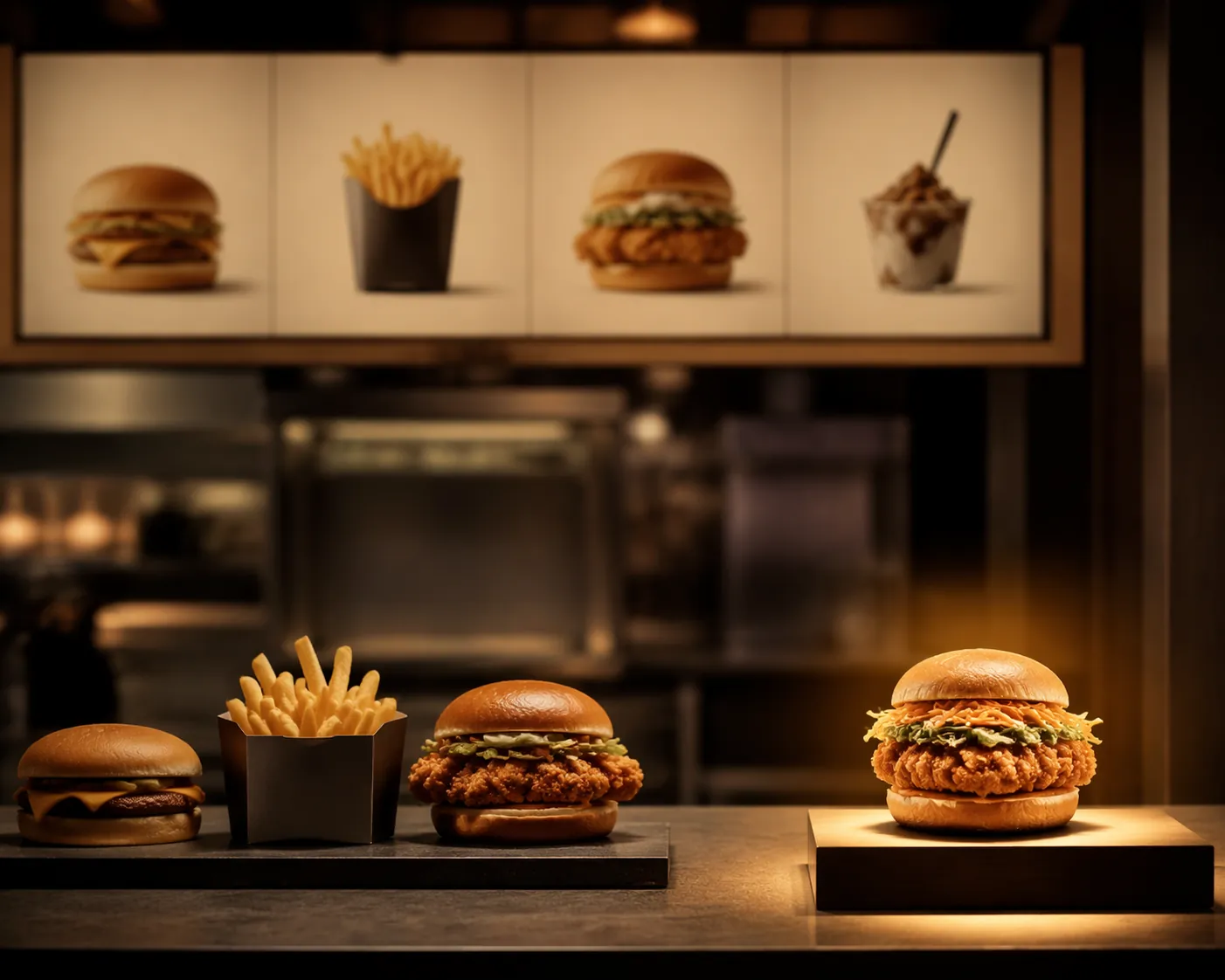
The business question comes before the flavor question: how does a high-throughput chain justify seasonal complexity when every extra build, topping, training note, and inventory line has to survive the lunch rush? The Honey Pepper Pimento Chicken Sandwich is the cleanest answer Chick-fil-A has put into market.
The LTO That Did Not Behave Like Menu Clutter
The Honey Pepper Pimento Chicken Sandwich launched nationally in August 2023 as Chick-fil-A’s first seasonal twist on its original chicken sandwich.[3] It later returned in 2024, skipped 2025, and came back for summer 2026 after being described by Nation’s Restaurant News as Chick-fil-A’s “best-selling seasonal offering of all time,” based on the chain’s characterization rather than a released item-level sales figure.[4]
The important part is not that the sandwich sounded new. It is that the newness sat on top of something the restaurants already knew how to make. The base was the existing Chick-fil-A chicken filet. The seasonal build added pimento cheese, pickled jalapeños, and a honey drizzle.[3] That is a very different operating proposition from introducing a new protein, a new cooking platform, a new holding process, and a new assembly rhythm at the same time.
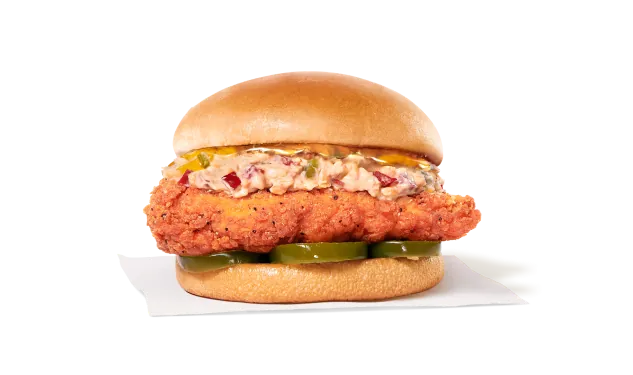
The sandwich also did not jump straight from brainstorm to national launch. Chick-fil-A said the item ranked first among more than 30 sandwich ideas during a development process that lasted more than a year, then tested it in the Carolinas before the 2023 national release.[3] That sequence matters because it separates a campaignable idea from an operationally tolerable one. A concept can test well in a conference room and still fail when a team member has to build it hundreds of times a day under speed pressure.
This is where many LTO programs become expensive theater. They generate a few weeks of social attention, then leave the restaurant with slow builds, half-used ingredients, vague retraining, and a brand team arguing that awareness was the point. Chick-fil-A’s HPP model does not eliminate those risks, but it reduces the number of ways the item can break the restaurant. The chain asked operators to execute a familiar sandwich with a short list of incremental ingredients, not to absorb a second menu.
Scarcity Works Better When the Window Is Real
The 2026 return also came with a fixed window. Chick-fil-A announced the Honey Pepper Pimento Chicken Sandwich, including an Original and Spicy filet version, for June 8 through August 22, 2026, while supplies lasted.[5] The phrasing is not decorative. A seasonal item with a real end date gives marketing a reason to talk, gives guests a reason to act, and gives operators a reason to plan inventory against a defined period instead of waiting to see whether headquarters quietly makes the item permanent.
The skip year is just as useful as the return year. After the 2023 launch and 2024 return, Chick-fil-A did not bring HPP back in 2025, then returned it in 2026.[4] That rhythm protects scarcity from becoming a costume. If an item returns every season on autopilot, guests learn that there is no need to hurry and operators learn that “limited time” may only mean “not yet admitted to the permanent menu.”
For a chain with Chick-fil-A’s volumes, the value of scarcity is not only demand stimulation. It is decision discipline. A temporary window lets the company ask whether the product can carry its promotional weight without committing the full menu board, supply chain, and training system indefinitely.
The Industry Is Launching More, but That Is Not a Strategy
Chick-fil-A is not operating in a quiet category. Technomic data cited by Nation’s Restaurant News found that restaurant LTO launches rose 157%, from 16,187 in 2019 to 41,707 in 2025.[6] The same reporting said 85% of operators changed menu items in the past year.[6] That is a lot of motion for a business where execution quality often shows up in seconds, not quarters.
There are reasons operators keep doing it. Technomic data presented around the 2026 National Restaurant Association Show found that checks containing LTOs run 26% higher on average than checks without them.[6] TouchBistro has reported that 62% of diners visit a restaurant specifically for an LTO.[7] Those numbers explain why the category keeps reaching for limited windows, seasonal names, collaborations, and returning fan favorites.
They do not prove that Chick-fil-A’s HPP sandwich increased profit, and they should not be read that way. The 26% check figure is industry-wide, not Chick-fil-A-specific. Chick-fil-A has not publicly released per-item HPP sales, margin, attachment, or traffic data. The defensible conclusion is narrower: the external environment rewards LTO capability, and Chick-fil-A appears to participate through a filter that keeps novelty subordinate to operating fit.
| Pressure in the market | Why it matters to Chick-fil-A | What the HPP case shows |
|---|---|---|
| More LTO launches across the industry | Guests are being trained to expect seasonal news | Chick-fil-A joins the cycle without widening the core menu indefinitely |
| Higher average checks on LTO-containing orders | Operators have a revenue reason to consider temporary items | The chain still has to protect throughput before chasing check lift |
| Diners say LTOs can trigger visits | Scarcity can create a behavioral prompt | A fixed summer window gives the offer a real reason to be urgent |
The Mechanism Is Narrower Than the Campaign
The visible campaign is the sandwich photo, the app placement, the return announcement, and the guest memory of last time. The mechanism underneath is much plainer.
- Start with a core product the kitchen already executes at volume.
- Add only a few ingredients that change the eating experience without changing the restaurant’s operating identity.
- Filter prototypes before national exposure.
- Use a limited market test before asking the full system to carry the item.
- Set a real window, then evaluate whether return, revision, or retirement makes sense.
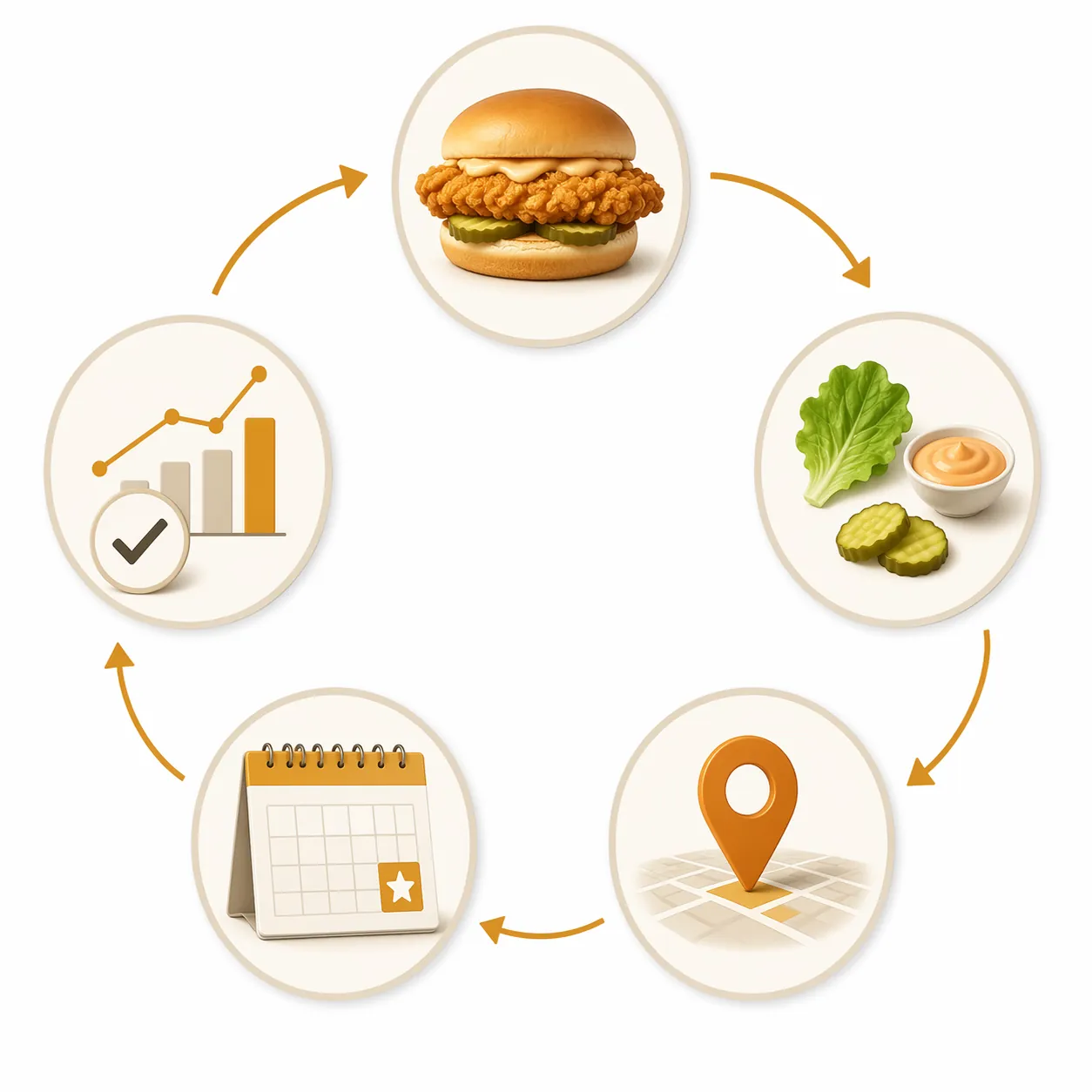
That sequence is the practical difference between an LTO as innovation and an LTO as clutter. Clutter asks the restaurant to absorb complexity because the calendar needs news. A controlled LTO asks whether a specific item can earn its temporary place in the system.
The same logic shows up in other QSR platform plays. In our case study on McDonald’s year-long biscuit marketing platform, the interesting move was not simply putting a breakfast item in more creative contexts. It was using a familiar product platform to test timing, cultural relevance, and premiumization without making every test a new operational universe. Chick-fil-A’s HPP sandwich belongs in that same family of disciplined product-platform marketing, even though the brand expression is different.
Newstalgia Adds Demand, Not the Operating Logic
Chick-fil-A’s 2026 “Newstalgia” framing gives the returning seasonal items a softer emotional wrapper. Vice President of Brand Strategy, Advertising and Media Khalilah Cooper described the campaign as “bringing legacy and lore to the forefront” and tapping into “the power around creating memories.”[8] That language matters because LTOs do not sell only through rational novelty. They also sell through recognition, missed chances, and the feeling that a product belongs to a shared brand timeline.
But nostalgia is not a substitute for build discipline. It can make a return feel warmer and more meaningful; it cannot make a slow assembly process faster or an awkward ingredient easier to manage. In the HPP case, the memory-and-lore layer works because the product underneath already passed through concept filtering, market testing, limited ingredient addition, and a defined availability window.
This is also where scarcity and surprise need to be handled carefully. Mystery, countdowns, and limited drops can be effective, as explored in our piece on the Mystery Cake Pops campaign. For restaurant operators, though, surprise is only useful if the back of house is not surprised. The guest can experience a chase; the system needs a plan.
Why the Six-Day Model Raises the Bar
Chick-fil-A’s closed-on-Sunday model is part of the strategic tension. A chain producing $9.2 million in stand-alone AUV while operating six days per week has less weekly trading time than seven-day competitors.[1] That does not mean every limited-time item is automatically risky, but it does mean the cost of slowing the line is harder to wave away.
A seasonal item that adds seconds, confusion, or rework during peak periods can tax the very machine that makes the brand unusually productive. This is why the HPP build is more instructive than its promotional copy. The sandwich changes the guest-facing experience with toppings and sauce; it does not appear to require the restaurant to learn a fundamentally new production model.
That restraint also helps explain why permanent menu status should not be treated as the default prize. For some LTOs, the best outcome is not graduation. It is learning: which flavor territories draw attention, which regions overperform, how returning demand behaves after a skip year, what supply planning looks like, and whether the item earns its place without distorting the core operation.
What Marketers Should Actually Take From Chick-fil-A
The easy lesson is to launch more LTOs. It is also the least useful one. The market already has more limited-time activity than it did a few years ago, and more launches can quickly become more noise, more training burden, and more inventory residue.
The better lesson is to make the temporary offer prove four things before the system has to carry it widely. It should fit a core product platform. It should create enough guest interest to justify the campaign. It should be executable by the restaurant team during real volume. And it should have an exit plan before the first ad runs.
For a QSR brand or multi-location restaurant group, that changes the approval conversation. The question is not only whether the item will photograph well or produce a spike in app orders. The harder questions are whether the item uses existing prep muscle, whether the incremental ingredients have a controlled supply plan, whether training can be explained without bloating the line, and whether the item teaches the brand something even if it never returns.
Chick-fil-A’s HPP sandwich does not prove a universal formula for LTO profitability. The chain has not disclosed the item-level figures needed for that claim, and 2026 campaign results are not yet public. What it does show is a disciplined way to let novelty into a simple system: filter hard, test before scale, build on the core, limit the ingredient burden, make scarcity real, and reserve the right not to make the item permanent.
References
- Chick-fil-A Dials Up Expansion as Sales Near $24 Billion — QSR Magazine
- Chick-fil-A's unit volumes hit a ceiling — Restaurant Business
- Chick-fil-A provides a seasonal twist on its signature chicken sandwich for the first time — Nation’s Restaurant News
- Chick-fil-A is bringing back its best-selling seasonal offering of all time — Nation’s Restaurant News
- Serves Up Some of Its Greatest Seasonal Hits — Chick-fil-A Press Room
- Limited-time offers have increased by triple digits since 2019 — Nation’s Restaurant News
- The Hidden Profits in Limited-Time Offers (And How to Capture Them) — Bite Blog
- Chick-fil-A marks 80 years with "newstalgia"-inspired campaign — Nation’s Restaurant News
Built on this evidence
No Bidding tactic or Creative record currently cites this case file. Compare it against other results in Benchmarks.
Related benchmark reading
Report a corroborating or contradicting result
Seeing something different in your own account? Feed the data-integrity loop instead of leaving an open comment.