
McDonald's
McDonald's ran three biscuit-focused campaigns in 2026, turning a regional, non-core menu item into a recurring product platform for trend testing, rapid cultural marketing, and premiumization. This case study examines the strategic context, campaign mechanics, and takeaways for product-led marketing at scale.
Outcome
McDonald's used the biscuit as a repeatable product canvas across three campaigns in 2026, demonstrating trend responsiveness, speed-to-culture, and premium signals without providing public campaign-level sales lift.
This outcome is independently verified via the primary source linked above.
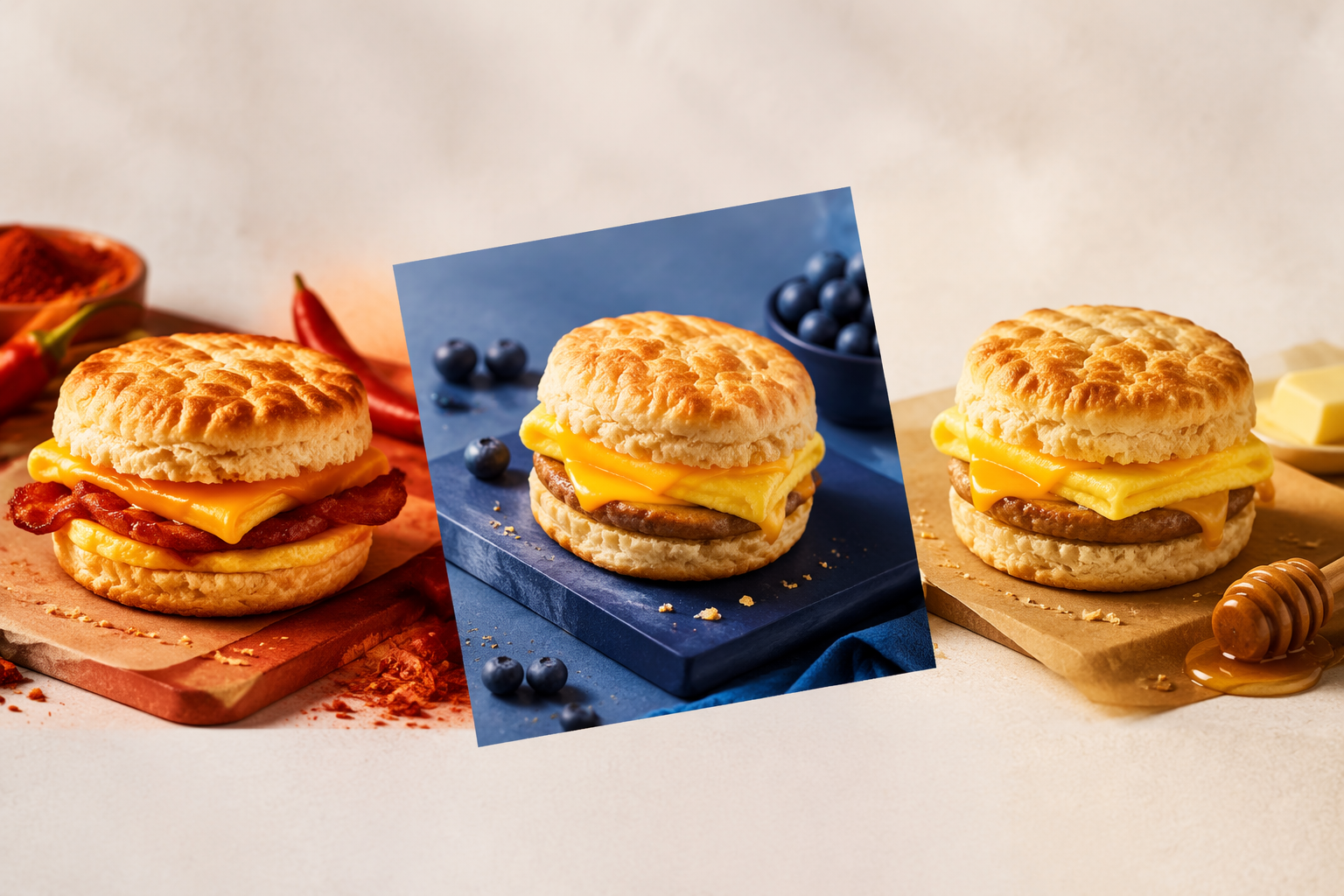
The interesting part of McDonald's new biscuit marketing campaign is not that McDonald's sold another breakfast sandwich. It is that, in 2026, the company kept returning to the biscuit as if it were a small operating system: Hot Honey in January, Horizontal Breakfast in February, and Honey Brown Butter Biscuits planned for July. One format carried three different jobs: flavor-trend response, post-Super Bowl cultural timing, and a more indulgent premium cue.
That choice is slightly counterintuitive. The biscuit is not the obvious national hero in the way a Big Mac, fries, McNuggets, or McMuffin might be. It is a familiar breakfast format, but also more regional and less central to the brand's global shorthand. That is what makes the sequence useful. McDonald's did not need the biscuit to explain the whole brand. It needed a manageable product canvas that could absorb different sauces, different creative systems, and different launch mechanics without forcing the organization to invent a new platform every time.
The caveat belongs near the front: there is no public campaign-level sales lift tying these biscuit efforts to revenue as of July 18, 2026. McDonald's reported stronger Q1 results and credited marketing broadly, but that is not proof that biscuits caused the lift. The case is better read as a study in campaign architecture and organizational readiness, not as an ROI victory lap.
The Biscuit Became a Repeatable Canvas
The first move came on January 27, when McDonald's introduced its first proprietary hot honey sauce across five menu items, including the Hot Honey Sausage Egg Biscuit. Fox Business reported the sandwich at $5.19 with 17 grams of protein, positioning it inside a broader push around hot honey and protein rather than as an isolated breakfast novelty.[1]
Less than two weeks later, the biscuit became the hero of Horizontal Breakfast, a post-Super Bowl campaign from Wieden+Kennedy New York. The creative conceit was blunt and unusually executable: after a long night watching football, people were horizontal, so McDonald's rotated the campaign sideways. Adweek reported that the idea was conceived and produced in roughly one week, with McDonald's U.S. marketing vice president JJ Healan confirming the accelerated turnaround.[2]
The third move, Honey Brown Butter Biscuits, shifts the flavor thesis again. Quartz reported that McDonald's was adding honey brown butter breakfast biscuits on July 21, while AllRecipes described two new sandwiches at about $5.19 each and noted an app-first discovery path.[3][4] The launch does not repeat the heat-and-sweet logic of hot honey. It uses the same base format to signal richer, bakery-adjacent indulgence.
| 2026 moment | Biscuit's job | What changed |
|---|---|---|
| Hot Honey, January 27 | Trend response and product-platform launch | A proprietary hot honey sauce spread across five items, including a sausage egg biscuit |
| Horizontal Breakfast, February 9 | Speed-to-culture after the Super Bowl | The hot honey sausage and egg biscuit became the hero of a sideways creative system |
| Honey Brown Butter, July 21 | Premium flavor signaling and app-first discovery | The biscuit shifted from swicy heat to richer honey brown butter cues |
Seen one by one, each activation is easy to file as a limited-time product push. Seen together, the discipline is clearer. McDonald's kept the product architecture stable enough for operations, then changed the cultural assignment around it.
Hot Honey Gave the Platform Its First Job
Hot honey was the cleanest product-led starting point because the sauce did most of the conceptual work. The trend already had a readable consumer promise: sweet plus heat, or the increasingly common “swicy” shorthand. McDonald's did not have to ask people to understand an unfamiliar breakfast format. It could ask them to understand a familiar biscuit with a new sauce.
That distinction matters at scale. A proprietary sauce gives a national chain something ownable without overcomplicating the base product. Fox Business reported that McDonald's put the hot honey sauce across five menu items, including chicken, fries, and the Hot Honey Sausage Egg Biscuit.[1] The biscuit was therefore not a lonely SKU. It was one expression of a broader flavor platform.
The Hot Honey Sausage Egg Biscuit also solved a breakfast-specific brief. At $5.19 and 17 grams of protein, as reported by Fox Business, it could be discussed in value, flavor, and satiety terms at the same time.[1] None of those claims proves consumer love or incremental traffic. But they do show why the item was useful to marketers: it had enough product detail to anchor messaging without requiring a complicated education cycle.
The operational advantage is just as important. A sauce-led LTO can create visible newness while leaving much of the underlying product system intact. For a company with McDonald's footprint, that is not a small virtue. The more a campaign depends on entirely new procedures, equipment, or crew behavior, the harder it is to defend as repeatable. The biscuit gave the January campaign a contained place to show the new flavor.
Horizontal Breakfast Tested Whether the Organization Could Move Fast
Horizontal Breakfast is the most revealing of the three because it was not primarily a flavor story. The hero item was still the hot honey sausage and egg biscuit, but the campaign's real product was timing. McDonald's and Wieden+Kennedy New York took a post-Super Bowl behavioral observation — fans recovering on couches and beds — and turned it into a sideways creative system in about a week.[2]
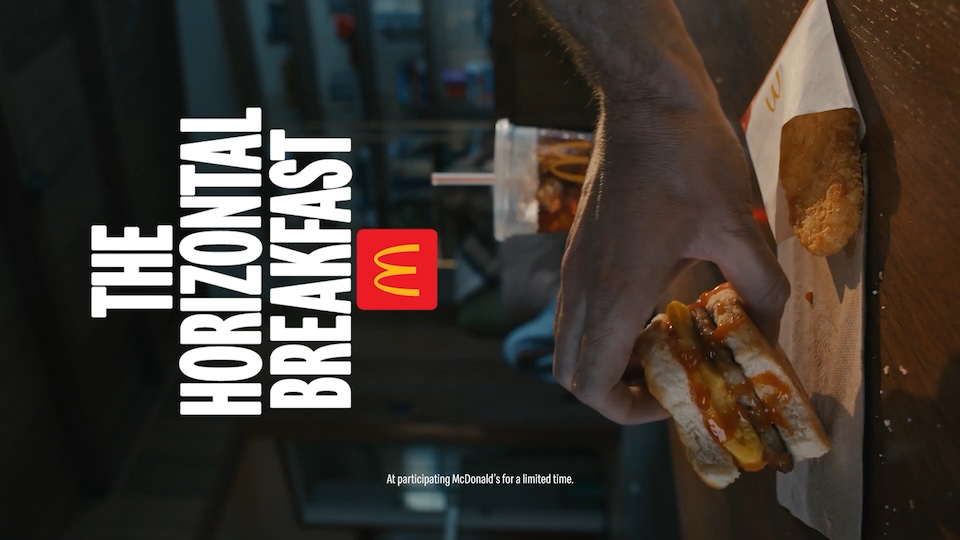
The campaign worked because the idea could travel across formats without translation. Ads of the World documented the sideways system across out-of-home and social, including lines such as “The breakfast to get you vertical” and “If you're horizontal, a little breakfast won't hurt.”[5] DesignRush also credited Wieden+Kennedy New York, Even/Odd, and Joint Editorial in the post-Super Bowl push.[6]
Sideways billboards are not strategically profound on their own. The sharper point is that the product, the daypart, the media behavior, and the creative treatment all pointed in the same direction. People were presumed to be horizontal after the Super Bowl. The breakfast would help get them vertical. The ad itself turned horizontal. The biscuit was physically simple enough to remain recognizable even when the world around it rotated.
That is the kind of campaign a brand team can explain in one meeting. It has a cultural trigger, a product hero, a visual rule, a media rule, and a short shelf life. It is also bounded. No one needs to pretend Horizontal Breakfast is a new masterbrand. It is a fast response attached to a product platform that already existed from the Hot Honey launch.
The one-week turnaround is the part worth taking seriously. Many brands talk about moment marketing as if the blocker is inspiration. At McDonald's scale, the harder test is approvals, production, legal review, media coordination, restaurant readiness, and the willingness to let an intentionally odd idea go live before the moment expires. LBB Online also described the campaign as a post-Super Bowl recovery play built around flipping the script, reinforcing that the creative system was tied to a specific cultural window rather than a generic breakfast message.[7]
That does not mean every brand should rotate its ads after every major event. The transferable lesson is narrower and more useful: if a product platform is already in market, a brand can respond to culture by changing the angle of attention, not the whole operating base. The biscuit did not have to become new again in February. The situation around it became new.
Honey Brown Butter Moved the Same Format Toward Indulgence
By July, McDonald's had a different flavor job for the biscuit. Quartz reported Honey Brown Butter Biscuits as a new breakfast addition scheduled for July 21, and AllRecipes described two first-of-their-kind sandwiches with honey brown butter sauce at about $5.19 each.[3][4] The product language moves away from heat and toward richness: honey, butter, browned flavor, breakfast comfort.
That shift matters because it keeps the platform from feeling like a single sauce campaign stretched too thin. Hot honey borrowed energy from sweet-heat momentum. Honey brown butter borrows from a different set of cues: bakery cases, restaurant desserts, home cooking, and premiumized comfort. Quartz connected the launch to a broader brown butter trend, including mainstream signals from Pillsbury and McCormick.[3]
The app-first discovery path also changes the marketing mechanics. AllRecipes reported that the sandwiches appeared through the McDonald's app, making the launch less dependent on a single mass-media reveal and more compatible with test-and-learn behavior.[4] For a breakfast item that is not the company's most iconic product, that channel choice is practical. It creates a discovery layer without demanding that every consumer understand the move at once.
The July launch should not be treated as the same campaign with a different drizzle. The product format repeats; the strategic signal changes. That is the whole value of the canvas. The biscuit can carry a trend-led flavor in January, a cultural recovery joke in February, and a premium comfort cue in July without asking consumers to learn a new breakfast architecture each time.
Why Breakfast Pressure Made the Biscuit More Rational
The biscuit sequence sits inside a less playful business context. Quartz, citing UBS Evidence Labs survey data, reported that McDonald's value perception declined from about 55% in 2020 to about 40% by 2024.[3] That figure should be read carefully because it is second-hand through Quartz rather than directly sourced here from UBS. Still, it points to a problem McDonald's leadership could not solve with charming creative alone: consumers needed clearer reasons to believe the menu was worth the trip.
Breakfast added another pressure point. Available estimates place breakfast at roughly 15% to 25% of McDonald's revenue, and Nation's Restaurant News reported that McDonald's had seen market share slip at breakfast.[8] In that context, a repeatable breakfast platform is more than a content idea. It is a way to put new news into a daypart where the company has both brand permission and competitive need.
The Q1 2026 numbers are useful context, with limits. McDonald's reported U.S. comparable sales growth of 3.9% and global Systemwide sales of more than $34 billion in the first quarter of 2026. CEO Chris Kempczinski said the results reflected “the power of our value platforms, menu innovation and breakthrough marketing.”[9] That statement supports the idea that marketing and menu innovation were part of management's growth narrative. It does not isolate the biscuit campaigns, and it does not provide campaign-level attribution.
McDonald's formal strategy language points in the same direction. On June 1, 2026, the company introduced McDonald's > NEXT, explicitly prioritizing stronger menu offerings and deeper consumer connections as part of its next era of growth and productivity.[10] The biscuit work fits that language neatly because it is menu-led and connection-seeking at the same time. It gives the consumer something to buy, not just something to watch.
This is also where restraint matters. A weaker case study would take Q1 comparable sales, attach three biscuit headlines, and imply causality. The stronger read is more defensible: McDonald's was operating in a market where value perception, breakfast share, and menu relevance all mattered, and it used a familiar breakfast format to create repeated reasons to talk about the daypart.
What Marketers Can Actually Reuse
The reusable idea is not “make a biscuit campaign.” Most brands do not have McDonald's footprint, breakfast permission, franchise system, or agency infrastructure. The reusable idea is to choose a low-risk product canvas that can carry different strategic jobs over time.
- Pick a format the organization already knows how to execute, so marketing novelty does not create unnecessary operational drag.
- Separate the product platform from the campaign idea; Hot Honey, Horizontal Breakfast, and Honey Brown Butter did not ask the biscuit to mean the same thing each time.
- Use flavor or feature changes when they create real consumer-facing news, not just internal SKU variation.
- Build fast-response campaigns around an existing product base, because cultural timing expires faster than most approval processes.
- Keep attribution language honest; adoption, attention, executive commentary, and sales lift are different evidence types.
There is a useful comparison to broader year-long campaign design in How Disney Built a Yearlong Super Bowl Marketing Engine. Both cases show that a platform does not have to be one giant campaign. It can be a sequence of smaller, timed moves that become more valuable because they share an underlying logic.
For internal planning, the McDonald's example is especially useful because it is explainable to both creative and commercial stakeholders. A strategist can show the January launch as trend capture, the February work as organizational speed, and the July product as premiumization. The same base format reduces the burden of persuasion. Leadership does not have to approve three unrelated bets; it can evaluate a platform with three applications.
The operator's view should stay in the room, too. Product-led marketing at this scale only works if the restaurant system can absorb it. A sauce, a sandwich build, an app-first discovery path, and a time-bound creative push each create different operational demands. The biscuit looks strategically elegant partly because it keeps many variables stable while changing the visible layer consumers notice.
The Defensible Read
McDonald's did not prove, publicly, that biscuits drove its Q1 performance or solved breakfast share pressure. What it did demonstrate is more specific and more useful: a familiar, operationally manageable product format can support faster cultural response, flavor-trend testing, and premiumization signals across a year-long campaign platform.
The planning lesson is to stop looking only for the next big campaign wrapper. Sometimes the stronger move is to find the small product canvas that can do several jobs without needing to be reinvented each time.
References
- McDonald's bets big on hot honey and protein to bring in customers, Fox Business
- McDonald's Flips Its Ads Sideways for Couch-Bound Fans After the Super Bowl, Adweek
- McDonald's adds honey brown butter breakfast biscuits, Quartz
- McDonald's Just Quietly Released 2 New, First-Of-Their-Kind Sandwiches, AllRecipes
- McDonald's: The Horizontal Breakfast, Ads of the World
- McDonald's Goes Sideways in Post-Super Bowl Push by W+K, DesignRush
- McDonald's Flips the Script on Super Bowl Recovery with 'Horizontal Breakfast', LBB Online
- McDonald's sees market share slip at breakfast, Nation's Restaurant News
- McDonald's Reports First Quarter 2026 Results, McDonald's
- Our Next Era of Growth & Productivity: Introducing McDonald's > NEXT, McDonald's, June 1, 2026


Comments
Join the discussion with an anonymous comment.