
AI Stock Selloffs Drive Aggressive Platform Defaults in 2026
The 2026 AI-stock selloffs create direct institutional pressure on ad platforms to accelerate aggressive AI defaults, reduce advertiser control, and obscure performance data – this article explains the incentive chain and how media buyers can anticipate platform moves before they break campaign targets.
- Platform
- Meta Ads
- Campaign type
- Advantage+ Creative
- Spend range
- >$0k/month
- Timeframe
- Feb-Jul 2026
- Click Volume
- -15% to -20% YoY
- Verdict
- mixed
- Last reviewed
- 0-07-25
Did AI spending concerns and the 2026 stock-market drops change anything a buyer can actually see inside an ad account? Not as a clean one-day chain. No platform changes your PMax asset reporting at 9 a.m. because the Nasdaq sold off at 4 p.m. the prior day. The useful signal is narrower: when AI capex gets punished by investors, the platforms with the most to prove have stronger reasons to push AI surfaces, defaults, and bundled reporting faster than advertisers can instrument them.
That makes this a tracker problem, not a benchmark result. The question is not whether every CPA swing in 2026 traces back to an earnings call. It is whether the dated sequence of selloffs, capex guidance, and product behavior gives media teams an earlier warning system for Advantage+, PMax, AI Max, AI Overviews, and the reporting gaps around them.

The Timeline Buyers Should Keep Open
| Window | Market or Platform Event | Why It Matters in an Ad Account |
|---|---|---|
| February 2026 | A broad AI-related software market wipeout erased about $2 trillion in software market value. | It established that investors were no longer treating every AI story as automatically accretive. |
| April 2026 | Meta raised 2026 capex guidance to $125-145 billion and its stock fell 7%. | Meta has less room than cloud peers to monetize AI outside advertising, so ad automation becomes the obvious ROI path. |
| April-May 2026 | Google’s AI capex burden sat in the $180-190 billion range while AI Overviews expanded across commercial search. | Search behavior changed before advertisers received clean channel-split reporting. |
| June 2026 | A global tech selloff hit AI-linked stocks; the Nasdaq fell 2.2% in the Fortune-reported selloff window. | The pressure was not isolated to one company or one earnings reaction. |
| June-July 2026 | REI’s AI-generated ad backlash and later reporting from eight advertisers exposed Meta AI creative failures tied to auto-enabled Advantage+ features. | The abstract AI monetization story arrived as a brand-safety cleanup job. |
The February market move matters mostly as context. Fortune reported that roughly $2 trillion had been wiped from software market caps after investors had priced AI as if almost every tech company would be a winner.[1] By June, another AI-led global selloff moved from Wall Street into Asian markets, with Fortune reporting a 2.2% Nasdaq decline in that selloff and the Guardian describing a wider market shakeout tied to US AI stocks.[2][3]
Those numbers do not prove a platform motive. They do prove the operating environment. When investors stop rewarding AI spending on faith, platforms have to show where that spending becomes revenue, retention, or margin protection. In ad platforms, that usually does not show up as a memo called “monetize AI faster.” It shows up as a default that turns on, a campaign type that becomes harder to separate, or a report that stops answering the question buyers are asking.
Meta Is the Cleaner Control-Loss Case
Meta is the easier case to map from market pressure to account risk because the monetization path is so direct. CNBC reported in April 2026 that Meta raised its 2026 capital expenditure guidance to as much as $145 billion and that the stock fell 7% after the update; the same coverage contrasted investor trust in Google’s AI spending with greater skepticism toward Meta’s.[4] Quartz also covered Meta’s Q1 2026 capex raise to $145 billion.[5]
The important distinction is not that investors dislike capex. It is that Meta does not have the same cloud business escape valve as Google or Amazon. If Meta needs to justify larger AI infrastructure spending, ads are the most obvious place to turn that infrastructure into visible commercial output. More automated creative generation, more automated placements, more automated audience expansion, and more default-on “enhancements” are not side projects in that structure. They are the route.
Business Insider’s July 2026 reporting is why this stops being theoretical. The outlet documented eight advertisers describing routine AI ad failures on Meta, including changed products, garbled text, and wrong audiences being added, with the failures tied to Advantage+ Creative Enhancement features that advertisers said were auto-toggling on through a bug Meta had not fixed at the time of reporting.[6]

The REI incident in June 2026 made the risk visible outside Ads Manager: an AI-generated bicycle ad with distorted product imagery drew consumer backlash, and Meta’s response, as reported in the same Business Insider account, placed responsibility back on the advertiser while acknowledging that AI can make mistakes.[6] That is the operating problem in one sentence. The platform expands the automated surface; the advertiser handles the screenshot, the comments, the client call, and the postmortem.
This does not require claiming that Meta flipped more toggles because the stock fell 7%. The stronger, defensible read is structural: after a capex raise that sharpened investor pressure, Meta had every incentive to make AI ad products more pervasive, and within the same 2026 window advertisers were reporting auto-enabled AI creative failures with real brand consequences.
For operators, the action is boring and necessary. Audit the Advantage+ creative layer as its own risk surface, not as a sub-menu under “creative optimization.” The existing brand-safety workflow in Meta Is Auto-Enrolling Your Ads in AI: A Brand Safety Audit for 2026 is the right companion when you need a toggle-by-toggle check, and the Meta Advantage+ Creative Controls framework is where to pressure-test whether a campaign should absorb automation or wall it off.
Google Is Not a Simple Bad-Default Story
Google’s 2026 problem is different. The spend is larger, but the monetization surface is broader. CNBC reported Google’s 2026 AI capex commitment in the $180-190 billion range.[4] Unlike Meta, Google can point to cloud demand, infrastructure services, search, YouTube, and ad products when investors ask where the AI spending pays back.
That broader business does not make paid search cleaner for advertisers. AI Overviews now appear on more than 60% of US commercial queries, according to eMarketer/Elliott data, and Adthena data discussed in an Optmyzr webinar showed roughly 25% of paid search ads being displaced in affected search results.[7]
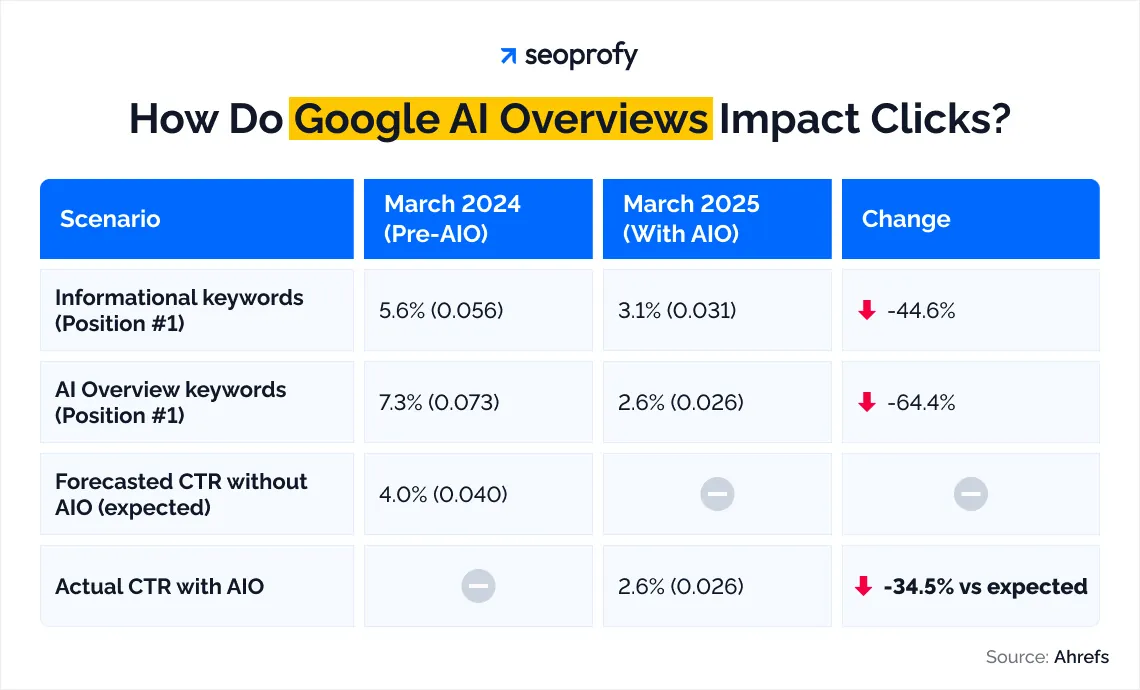
The first instinct is to treat that as lost traffic. Sometimes it will be. But the Optmyzr discussion, including commentary from Aaron Levy, made the more interesting point: click volume was down 15-20% year over year in the observed context, while conversion rates and revenue improved, suggesting AI Overviews may be pre-qualifying some users before they click rather than only siphoning demand away.[7]
That is why Google deserves a more careful read than “AI bad, ads displaced.” If lower click volume arrives with stronger conversion quality, the performance surface has changed. The campaign may be reaching fewer users, but the users who remain may be closer to action. A buyer who only watches clicks will overreact. A buyer who only watches blended CPA may miss that the query environment has been rewritten around them.
The reporting issue is the part that should irritate serious operators. Optmyzr reported, based on sourcing from Google insiders, that Google intentionally withholds channel-split reporting data so advertisers do not treat AI Overviews as a separate silo.[7] That may make product sense from Google’s side. It is still a loss of diagnostic power for the person trying to explain why desktop search, mobile search, brand queries, nonbrand queries, and PMax-assisted paths stopped behaving like last quarter.
AI Overview exposure also varies by industry and geography, with healthcare and finance more affected than many other categories. Appearance rates also differ on desktop and mobile. That makes device-level segmentation a measurement tactic, not just a bidding preference. When the platform will not provide a clean AI Overview split, device behavior becomes one of the few remaining shadows on the wall.
What the Stock Market Can and Cannot Tell You
There is a bad version of this argument where every platform change becomes proof of executive panic. That is too neat. Meta and Google do not publicly say they are reducing advertiser control because their stocks moved. The evidence here is timing, incentives, and documented behavior, not an internal strategy document.
The better version is practical causality. If investors question AI spending, platforms need clearer AI monetization. If the ad business is the most immediate monetization outlet, the platform has an incentive to move more campaign behavior into AI-managed systems. If those systems are bundled, default-on, or under-reported, the buyer gets less ability to separate what changed.
That is the mechanism worth tracking. Not “the market dropped, so your CPA rose.” More like: “the market punished AI spending; the platform had to show AI usage and revenue; the next product updates made AI harder to opt out of or harder to measure separately; your CPA swing happened inside that window.”
The macro pressure is not only coming from traders. Fortune cited Apollo’s Torsten Slok warning that if hyperscaler AI revenues disappoint, reduced data center spending could help tip the economy into recession.[8] CBS News has also framed the investor demand plainly: Big Tech is spending trillions on AI, and investors now want proof it will pay off.[9] For media buyers, the relevant translation is simpler: platforms under proof-of-ROI pressure rarely become more generous with manual controls.
How to Monitor the Next Default Before It Hits Targets
The practical move is to put market dates and account dates in the same review. Earnings reactions do not replace campaign diagnostics, but they should change where you look first when performance starts moving without a clean creative, bid, feed, or landing-page explanation.
- Track capex guidance and earnings reactions for Meta and Google alongside platform changelogs, especially around February, April, and June 2026.
- Audit Meta Advantage+ Creative Enhancement toggles after major platform updates, not only during campaign launches.
- Use the Advantage+ Creative Enhancement decision matrix when a campaign has strict product, regulatory, or brand-voice constraints.
- Treat Google AI Overview exposure as a measurement problem: watch device splits, query mix, click volume, conversion rate, and revenue together.
- Use the site’s tracker entries for AI Max migration, Advantage+ Creative changes, and Symphony updates as dated evidence before assuming a performance move is account-specific.
- Cross-check CPA or ROAS swings during the February, April, and June 2026 windows against available Benchmarks before attributing the move to creative fatigue or bid strategy alone.
The audit does not need to become a macro ritual. It needs to catch the quiet account-level changes that macro pressure makes more likely: creative enhancement toggles reappearing, campaign migrations framed as simplification, asset-level visibility declining, search surfaces changing without a clean split, and platform recommendations becoming harder to ignore.
For Meta-heavy accounts, that means creative review and brand-safety checks should sit closer to media operations than they used to. For Google-heavy accounts, it means fewer arguments about whether AI Overviews are “good” or “bad” in the abstract, and more work isolating where fewer clicks are being offset by better conversion quality—or where they are simply disappearing.
Selloffs do not mechanically rewrite campaign settings the next morning. They do intensify the institutional need for platforms to prove AI monetization, and that pressure tends to arrive in accounts as faster defaults, more automation, and less separable reporting. The buyer’s edge is not predicting the market. It is noticing when the same pressure that moved the stock also moved the checkbox.
References
- Trillion-dollar AI market wipeout happened because investors banked that almost every tech company would come out a winner, Fortune, February 2026.
- Tech stocks lead steep global selloff as investors lose faith in AI chip trade, Fortune, July 2026.
- US AI stock sell-off shakes markets from Wall Street to Asia, Guardian, June 2026.
- Investors trust Google more than Meta when it comes to spending on AI, CNBC, April 2026.
- Meta Q1 2026 earnings: AI capex raised to $145B, Quartz, April 2026.
- Meta's AI advertising dreams have become a nightmare for brands, Business Insider, July 2026.
- Paid Search in 2026: 10 Essential Lessons From Our Latest Webinar, Optmyzr, April 2026.
- Tech stocks lead steep global selloff as investors lose faith in AI chip trade, Fortune, July 2026.
- Big Tech is spending trillions on AI. Investors now want proof it will pay off., CBS News.
Built on this evidence
No Bidding tactic or Creative record currently cites this case file. Compare it against other results in Benchmarks.
Related benchmark reading
Report a corroborating or contradicting result
Seeing something different in your own account? Feed the data-integrity loop instead of leaving an open comment.