
Why $100 AOV Is the AI Image Ad Performance Threshold
AI-generated images in social ads deliver ROAS parity with human creative for products below $100 AOV but underperform above it—based on a 50,000+ creative dataset across Meta, Google, and TikTok, with the threshold rising from $25 in early 2025.
- Platform
- Meta Ads
- Campaign type
- Advantage+
- Spend range
- Varies
- Timeframe
- 2025-2026
- ROAS
- 4.0x
- Verdict
- mixed
- Industry vertical
- ecommerce
- Last reviewed
- 2026-07-29
For Q3 2026 media planning, the cleanest working rule is this: AI-generated images can default into production for products under $100 average order value, but human-led creative still protects ROAS above that line. In DigitalApplied’s dataset of more than 50,000 creative variations across Meta, Google, and TikTok, AI image ads beat human creative below $25 AOV, reached near parity from $25 to $100, then fell behind once products crossed $100.[1]
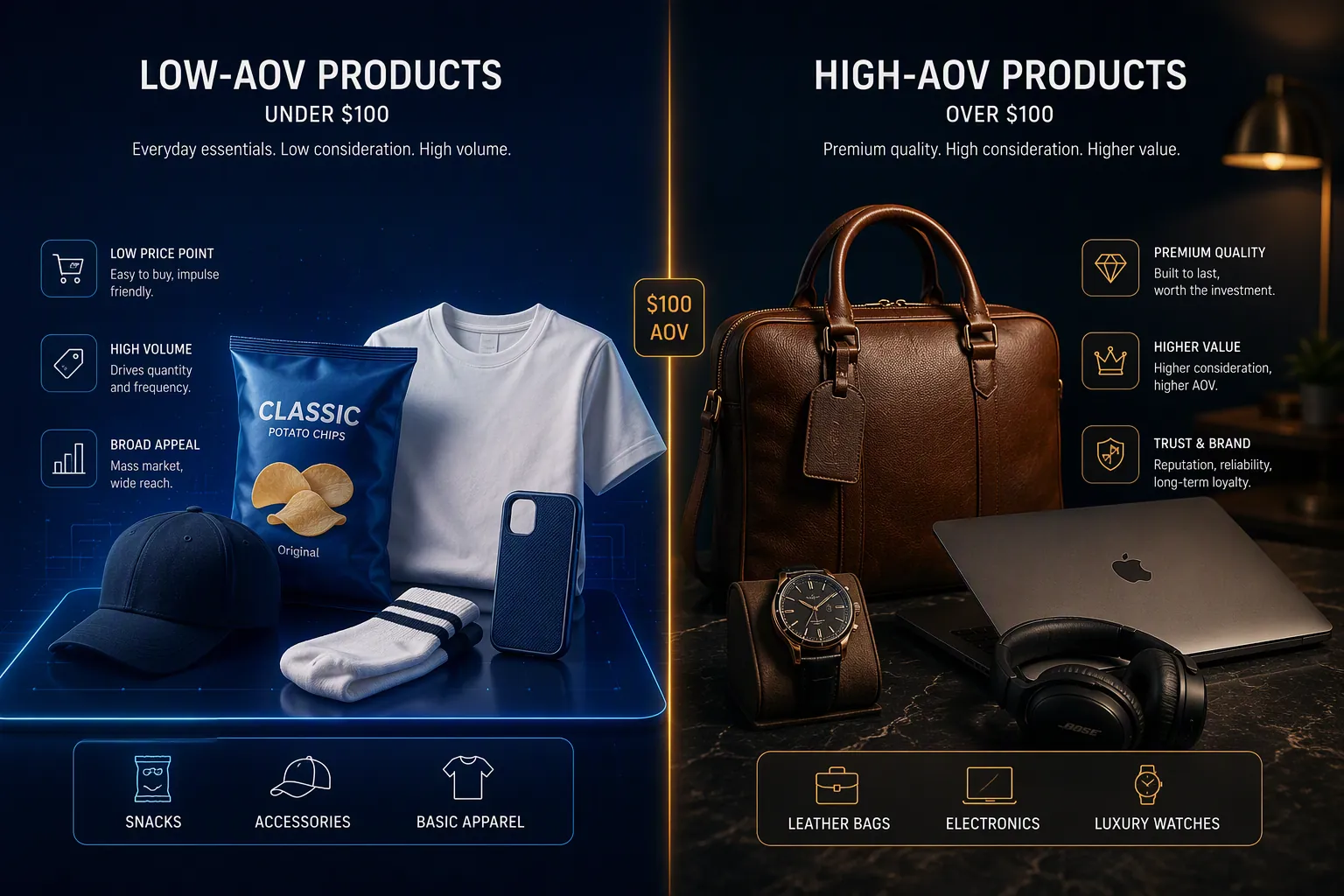
That does not make $100 a law of nature. The dataset comes from a paid-media agency with an obvious interest in AI adoption, and campaigns will still move around by category, seasonality, offer, landing page, account history, and audience quality. But it is a useful threshold because it answers the question buyers actually have to act on: where can the account accept cheap creative volume without creating a ROAS problem later?
The AOV Split Is the Useful Part
The average claim that AI creative is “improving” is too broad to be operational. The AOV bands are more useful because they turn a creative preference debate into an allocation rule.
| AOV band | AI image creative | Human image creative | Operating read |
|---|---|---|---|
| Under $25 | 4.8x ROAS | 4.5x ROAS | AI leads; default AI production is defensible |
| $25-$100 | 4.0x ROAS | 4.1x ROAS | Near parity; AI can carry production volume |
| $100-$500 | AI trails by about 0.6x ROAS | Human creative leads | Human direction still matters |
| Above $500 | AI trails by more than 1.0x ROAS, with a 14% conversion gap | Human creative leads more clearly | Do not let variant volume hide purchase-quality loss |
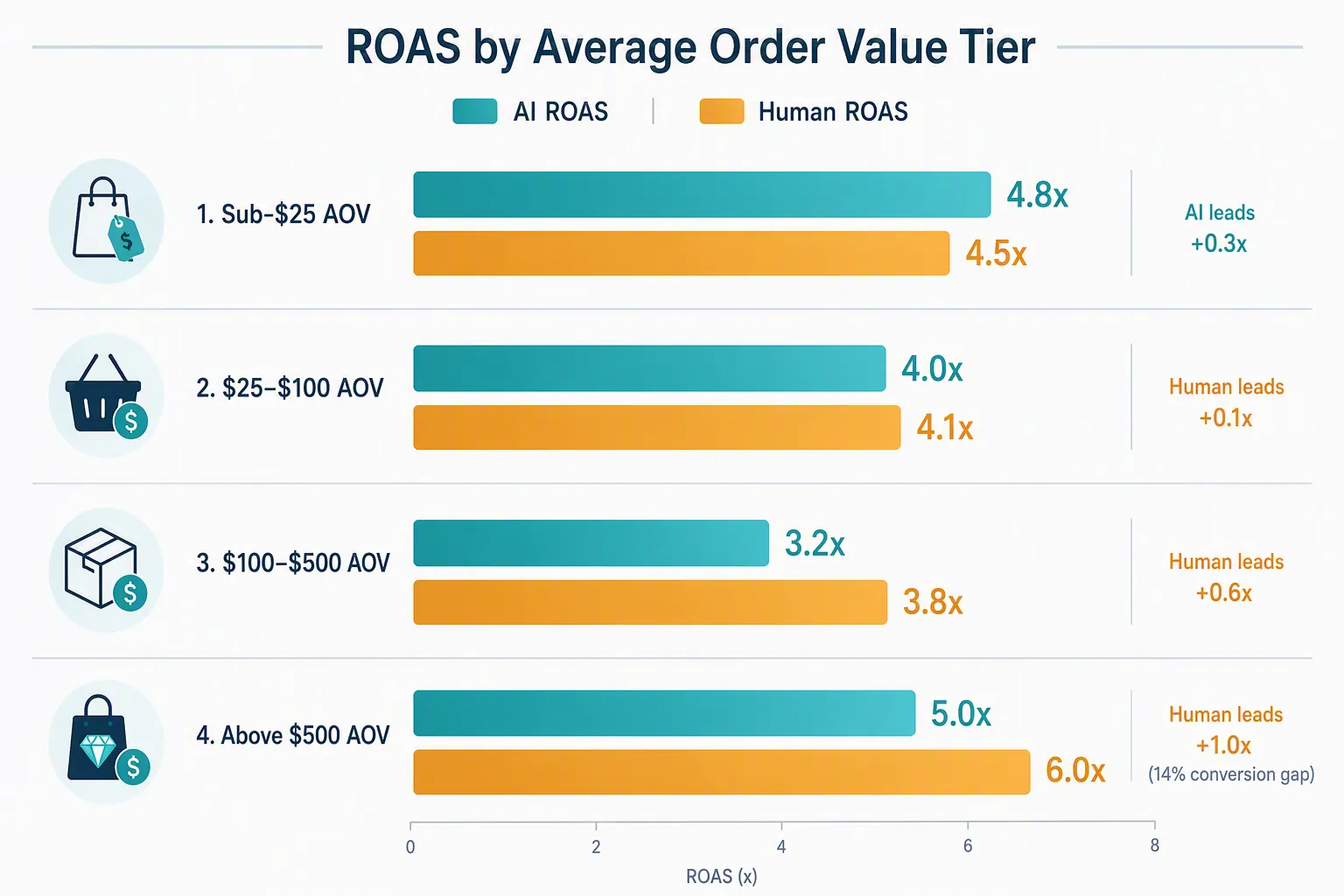
Below $25 AOV, the result is not subtle. AI image ads posted 4.8x ROAS against 4.5x for human creative, which is exactly where machine-made volume should be expected to do well: low-consideration products, fast visual comprehension, fewer brand-trust hurdles, and enough creative testing surface area for platforms to find a winner.[1]
The $25-$100 band is the more important finding. AI did not beat human creative there; it reached parity close enough to change the production default. A 4.0x AI ROAS versus 4.1x human ROAS is not a reason to fire the photographer. It is a reason to stop bottlenecking every new product angle, seasonal variant, colorway, bundle, or promo concept behind a human-only production queue.[1]
The decision changes at $100. In the $100-$500 band, AI creative lagged by roughly 0.6x ROAS, which is no longer a harmless testing tax. That gap can erase the savings from cheaper image production quickly, especially in accounts where the media team is already fighting rising CPMs, thinner contribution margin, or a founder who wants to scale as soon as click-through rate moves.[1]
Above $500 AOV, the gap widens into a different kind of problem. DigitalApplied reports that AI creative trails by more than 1.0x ROAS and carries a 14% conversion gap in that tier.[1] At that point, the issue is not whether the image looks “good enough” in a creative review. The issue is whether the ad is attracting the wrong kind of attention, weakening confidence, or failing to carry the proof burden that higher-consideration products need.
This is also where the language around AI needs to stay precise. Some datasets treat fully AI-generated images as the test condition; others include AI-assisted assets that a human refined. Those are not the same production model. If an account team uses AI for backgrounds, cropping, props, or resizing while a human still owns the product shot and art direction, the result may behave differently from a fully synthetic image.
CTR Is the Trap Metric
The impact of AI generated images on social media advertising looks better if the account stops reading at CTR. That is why the $100 line matters: it forces the conversation past attention and into conversion quality.
The HBS working paper “AI in Disguise” is useful here because it separates attention from perceived artificiality. The preprint analyzed more than 16 billion impressions, 116 million clicks, and 4,633 sibling ads, and found that AI images could outperform on CTR, including a 12% lift on Meta, when they did not look artificially generated.[2]
The penalty appears when people identify the image as AI. In the HBS findings, intense color saturation and unnatural aesthetics were more likely to signal AI, while clearer images and larger faces read more human.[2] That tracks with the account-level pattern: AI can win the scroll, but if the image triggers doubt before purchase, the extra traffic is not automatically valuable.
The trust side is not just a creative-theory issue. Edelman’s 2026 trust data and the HBS findings converge around a 14-22% purchase-intent drop and a 22-point trust-score decline when consumers identify images as AI-generated.[2][3] That penalty can be survivable for impulse products. It is much harder to ignore for luxury, B2B, health-adjacent, financial, and other categories where the buyer is looking for proof before they give up money or contact information.
This is the same reason a buyer’s intuition can be unreliable. A creative can look clean in a Slack review, earn a higher CTR, and still pull in lower-intent traffic. The stronger test is not “would I click this?” but “does this image preserve purchase confidence at this price point?” The site’s AI ad perception-gap benchmark is useful background for that mismatch between marketer perception and buyer response.
For teams trying to diagnose the CTR-versus-conversion split, the companion AI creative advertising threshold framework is the better place to go deeper. The short version here is enough for budget allocation: do not let cheap variant production or a prettier CTR chart overrule ROAS by AOV tier.
Platform Behavior Changes the Size of the Bet
The AOV threshold is the first cut. Platform behavior decides how aggressively to scale the test once a product is on the right side of that threshold.
Meta is the friendliest environment for AI image volume in the available data. DigitalApplied reports that Advantage+ can compound the AI advantage by letting campaigns work through 50-100 creative variants instead of the 5-10 variants more typical of human-only production, and the HBS paper reports a 12% CTR lift for AI images on Meta when the images did not look artificial.[1][2]
That matters because Meta’s system rewards breadth. If the product is under $100 AOV and the account already has clean conversion tracking, AI image production can feed the machine enough angles to find pockets of performance: product close-ups, offer-led variants, lifestyle composites, seasonal treatments, and audience-specific hooks. The buyer still has to watch ROAS, but the production bottleneck is less defensible.
TikTok is less forgiving when AI tries to imitate creator content and fails. The platform split in the available data shows only a 4% CTR gain overall, with creator-style AI ads underperforming by 15-20% while product-showcase AI ads perform 10% better.[1][4] That is a useful distinction. AI product imagery can help a TikTok shop-style product demo or showcase unit; fake-looking creator scenes can create the exact authenticity problem the platform’s ad format is supposed to solve.
Google sits closer to the middle case. Performance Max campaigns using AI assets show reported ROAS lifts of 15-25%, but that does not erase the AOV split.[1] Google’s asset mixing can make AI useful for coverage and variation, especially across shopping-style placements, but high-consideration products still need the signals that make a buyer comfortable: credible product depiction, recognizable proof, and landing-page continuity.
The Threshold Has Already Moved
The reason this decision is worth revisiting in 2026 is that the threshold did not stay at $25. DigitalApplied’s trajectory shows AI image parity moving from roughly $25 AOV in early 2025 to $100 by Q1 2026.[1] That is a real planning change. A production rule that was too aggressive last year may now be conservative for a large part of a DTC catalog.
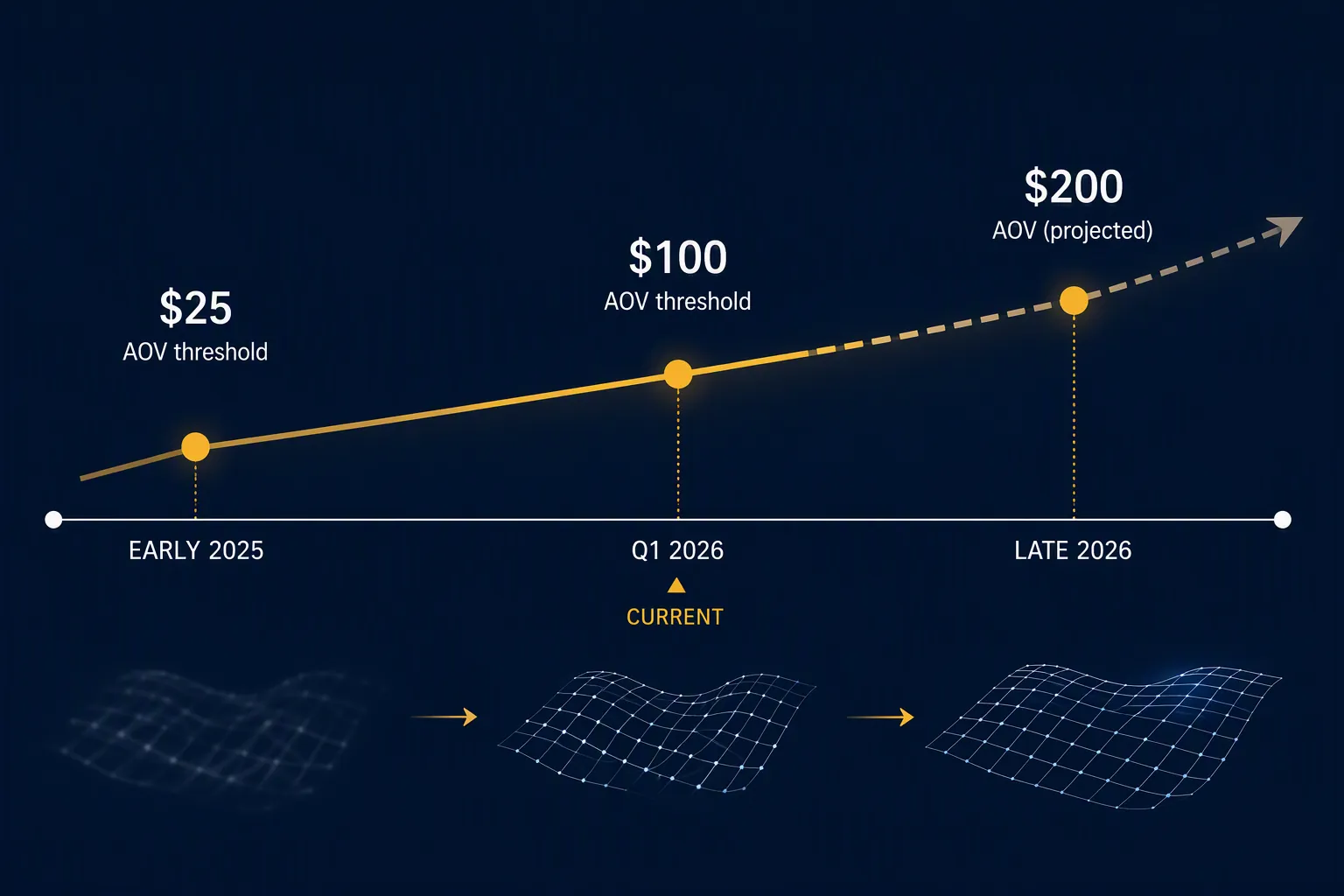
The late-2026 projection is more fragile. DigitalApplied and an AMRA & Elma compilation point to 30-40% year-over-year improvement in AI image quality tools and suggest a possible $200 parity threshold by late 2026.[1][5] That is a watch item, not a promise. It assumes tool quality keeps improving at a similar pace, platform systems continue rewarding AI-fed variation, and consumers do not become faster at detecting synthetic creative.
Creative’s share of campaign outcomes is another reason the production decision now belongs in media planning, not just in the design queue. The AMRA & Elma compilation attributes roughly 70% of campaign performance outcomes to creative, aggregating references from Deloitte Digital and Nielsen/Google DeepMind.[5] Even if that number is directional rather than account-specific, the implication is hard to dodge: creative allocation is now a budget lever.
There is also a scaling risk in treating every upward threshold as permission to flood accounts with synthetic assets. The more aggressive the volume, the more important cleanup becomes: fatigued winners, off-brand variants, mismatched product details, weak landing-page continuity, and campaign learning distorted by low-intent clicks. The site’s AI ad bubble-signals benchmark is relevant here because the danger is not AI testing; it is letting production velocity outrun performance discipline.
The Q3 2026 Allocation Rule
For products under $100 AOV, AI-generated image production should be the default starting point, especially on Meta and for product-showcase formats. That does not mean every asset should ship untouched. It means the account should not wait for human-only production before testing fresh angles.
For products from $100 to $500 AOV, AI belongs in support, not control. Use it for iteration, background exploration, resizing, localization, or concept boards, while a human still owns the core product depiction and trust-building choices. The reported 0.6x ROAS lag is large enough that production savings need to prove themselves against conversion quality, not against output volume.[1]
For products above $500 AOV, keep human-led creative as the default. AI can still help with drafts and variations, but the ad has to carry too much trust, specificity, and proof to let synthetic polish become the main selling surface. If AI is tested in that tier, judge it by ROAS, assisted conversion quality, lead quality, refund behavior, or downstream sales acceptance—not CTR alone.
The broader 2026 AI digital advertising benchmark playbook is useful if the account needs a full testing system across channels. For this specific decision, the threshold is enough: default AI below $100, keep human-led creative above $100, and treat $200 parity as a late-2026 hypothesis to verify rather than a budget assumption.
References
- AI Ad Creative Benchmarks 2026: CTR and ROAS Data — DigitalApplied.
- AI in Disguise — HBS Working Paper, SSRN No. 5096969.
- Edelman Trust Barometer 2026 Special Report — Edelman.
- TikTok Symphony documentation — TikTok.
- AI Marketing Benchmark Compilation — AMRA & Elma.
Built on this evidence
No Bidding tactic or Creative record currently cites this case file. Compare it against other results in Benchmarks.
Related benchmark reading
Report a corroborating or contradicting result
Seeing something different in your own account? Feed the data-integrity loop instead of leaving an open comment.