
Wan 3.0 for ad creative? The claims don't match the record
Circulating headlines claim Alibaba's Wan 3.0 shipped as open-weight, 4K, and free. The dated record shows an invite-gated API beta capped at 1080p with per-second pricing, and this audit turns that gap into a practical read on whether the model justifies ad-creative pipeline time.
- Platform
- Alibaba Cloud Model Studio
- Creative type
- AI video ads
- Last reviewed
- 0-08-27
For a media buyer evaluating the Alibaba Wan 3.0 AI video model as an ad-creative tool, the first issue is basic product identity. The circulating description—open-weight, free, and capable of 4K video—does not match the dated release record. The product documented in August 2026 is wan3.0-video: an invite-gated API beta with paid, per-second generation and a 1080p output ceiling.[1][2]
| Circulating claim | Dated record through August 27, 2026 | Decision consequence |
|---|---|---|
| Wan 3.0 is open-weight | Access was documented as an invited-account beta through Alibaba Cloud Model Studio and Qwen Cloud. No Wan 3.0 weights or inference code were published with the release.[1][2] | A team cannot treat it like a self-hosted model or budget it as open-weight infrastructure. |
| Wan 3.0 generates 4K video | The documented video ceiling is 1080p. The 4096×4096 specification belongs to wan2.7-image-pro, a still-image model.[1] | Any delivery requiring native 4K video needs another source or an added upscaling stage. |
| Wan 3.0 is free | Recorded international API rates are $0.05 per second at 480p, $0.10 at 720p, and $0.20 at 1080p. fal.ai separately lists a $0.05-per-second Wan 3.0 offering.[1][4] | The relevant budget is total generated duration, including rejected and superseded outputs. |

Those corrections do not make Wan 3.0 uninteresting. Its native ingestion of documents and webpages, 30-second single-pass output, default audio, and multi-format reference controls could remove several handoffs from a narrow creative-production lane. They do change the approval question. This is a paid service to test under constrained access, not a free model a team can download now and integrate later.
How the open-weight assumption became outdated
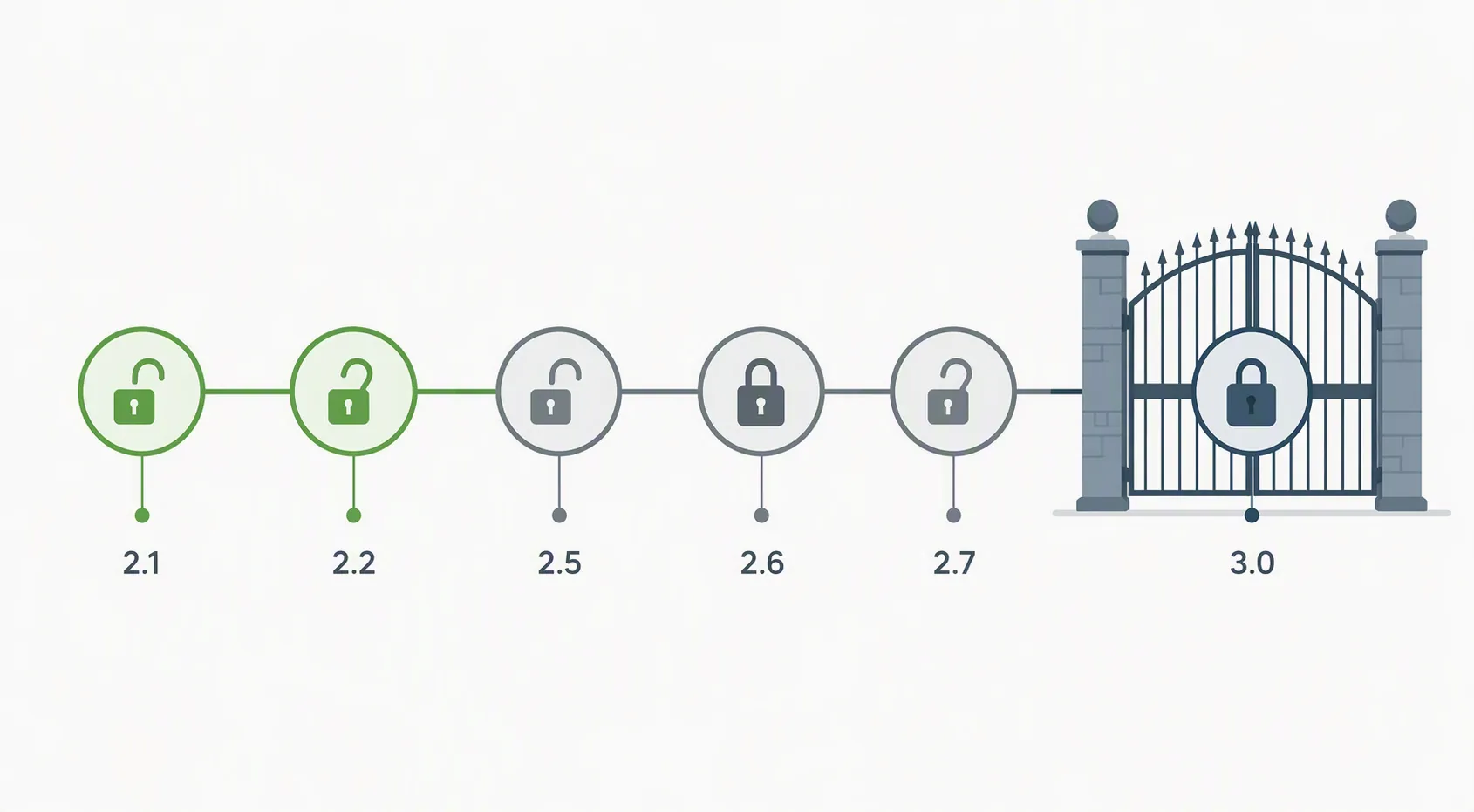
The confusion makes more sense when Wan 3.0 is placed in its release sequence. Alibaba established an open-weight expectation with Wan 2.1 and 2.2. Later versions progressively broke that pattern, but headlines and model summaries continued carrying the earlier status forward.
| Version | Release point | Access record |
|---|---|---|
| Wan 2.1 | February 2025 | Released under Apache 2.0 with open weights.[1][2] |
| Wan 2.2 | July 2025 | Released under Apache 2.0 and remained the last fully open-weight flagship in the documented sequence.[1][2] |
| Wan 2.5 | September 2025 | Opening was promised, but the corresponding public release did not ship.[1] |
| Wan 2.6 | December 2025 | Closed release.[1] |
| Wan 2.7 | March 2026 | Partially opened rather than released as a complete continuation of the earlier Apache 2.0 pattern.[1] |
| Wan 3.0 | August 6, 2026 | wan3.0-video entered an invite-gated public beta rather than shipping with downloadable weights and inference code.[1][2] |
The official Wan-Video repository reinforces that sequence. In the documented August 11 review, the organization still presented Wan 2.1 and Wan 2.2 rather than a Wan 3.0 repository containing weights or runnable inference artifacts.[1][3] A prior project using Apache 2.0 does not automatically confer that license on a later API product.
“Public beta” also should not be mistaken for unrestricted public access. The August 6 entry covered Alibaba Cloud Model Studio endpoints in Beijing and Singapore’s ap-southeast-1 region, along with Qwen Cloud, but use was limited to invited accounts.[1][2] A creative team without access cannot validate output quality, measure latency, inspect rejection behavior, or build a dependable integration merely because a product page exists.
A Reuters headline dated August 24 described Alibaba as formally launching Wan 3.0 after a $10 billion share sale.[5] Because the article body was unavailable for verification, that headline is useful only as a dated record of the launch framing. It does not establish that the invite gate disappeared, that weights were released, or that the pricing changed.
The 4K claim belongs to a different model
The resolution discrepancy is simpler. Wan 3.0’s documented video outputs top out at 1080p. The nearby 4096×4096 specification applies to wan2.7-image-pro, which produces still images.[1] Repeating that dimension as “4K video” merges two products and two media types.
For paid creative, this is more than a specification correction. A team promising native 4K delivery would have to introduce upscaling, substitute another generator, or revise the delivery requirement. Each option affects review time and may alter text, product detail, or visual consistency. None is represented in the advertised per-second generation price.
What the ad-creative test lane actually contains
Wan 3.0’s strongest reason to enter a creative test is its input layer. The documented service accepts office documents, text files, Markdown, Apple productivity files, and webpages—including DOC, XLS, PPT, PDF, TXT, KEY, PAGES, MD, and URLs—as native inputs.[1][2] A team can therefore begin with material that already contains approved product positioning instead of manually converting every brief into a sequence of visual prompts.

| Test stage | What the record supports | What the buyer must verify |
|---|---|---|
| Access | Invite-gated use through documented Alibaba Cloud Model Studio or Qwen Cloud surfaces.[1][2] | The account is enabled in the required region, current terms permit the intended commercial use, and the needed interface or API is available. |
| Source ingestion | Native document and URL inputs across the listed file formats.[1][2] | The model extracts the correct claims, product details, hierarchy, and calls to action from the team’s actual source material. |
| Generation | Single-pass clips up to 30 seconds, with audio generated by default.[1][2] | The full duration remains coherent and the audio is usable rather than merely present. |
| Reference control | Omni-reference support across as many as 10 images, five videos, and five audio inputs.[1][2] | Products, people, packaging, visual identity, and voice remain stable enough for a series. |
| Delivery | 480p, 720p, or 1080p output, with 1080p as the documented ceiling.[1] | The selected resolution survives placement formatting, captions, overlays, compression, and client review. |
| Cost | Per-second charges varying by output resolution.[1][4] | The cap covers every generated second, not only the final exported advertisement. |
Deck-to-video
A deck-to-video test is the cleanest match for the unusual input capability. Give the model an approved sales deck or product brief, identify one audience and placement, and inspect how it turns the existing hierarchy into a 30-second narrative. The meaningful comparison is against the team’s current handoff: extracting claims, drafting a script, planning scenes, locating references, and assembling a first cut.
Success should be defined before generation. Reviewers need to know whether they are scoring factual fidelity, opening-hook clarity, product visibility, brand consistency, audio quality, editability, or some combination of those criteria. A polished clip that invents an offer or drops a required qualifier has failed the paid-media task even if its motion quality is impressive.
A single-take 30-second spot
The 30-second single-pass window is useful when continuity itself is under evaluation. It can test whether one generated scene holds together long enough for a conventional spot without requiring the team to generate several short clips, reconcile their look, and rebuild timing in an editor. That is a narrower claim than saying Wan 3.0 replaces editing: captions, legal copy, placement variants, timing changes, and final audio treatment can still create downstream work.
A reference-locked product series
The multi-reference controls justify a separate test for a product series. Approved package shots, visual references, demonstration footage, and audio can be supplied together rather than summarized into one text prompt. The evaluation should concentrate on the details that create rejection risk: logos, package geometry, colors, product proportions, recurring characters, and continuity from one variant to the next.
Support for a stated number of references measures input capacity, not consistency effectiveness. The model still has to prove that it uses those references correctly on the buyer’s material. A capped product-series test can establish that; a feature list cannot.
Price the iteration lane, not the selected clip
The pricing record turns a 30-second generation into a straightforward base cost. Ngram documented international rates from Alibaba’s Model Studio information, although the original Alibaba help page returned a 404 during later review. fal.ai provides a separate cross-check for the $0.05-per-second entry point, not independent confirmation of every Alibaba tier.[1][4]
| Output resolution | Recorded rate | One 30-second generation |
|---|---|---|
| 480p | $0.05 per second | $1.50 |
| 720p | $0.10 per second | $3.00 |
| 1080p | $0.20 per second | $6.00 |
A $6 1080p clip is not a $6 finished ad unless the first output is accepted without revision and requires no additional work. The test budget should count generated seconds across abandoned concepts, factual corrections, consistency failures, audio replacements, aspect-ratio versions, and final-resolution reruns. It should also record the human time spent preparing inputs, reviewing outputs, cleaning integrations, and finishing the accepted assets.
One practical test design is to explore concepts at a lower resolution and reserve 1080p for finalists, provided the team separately checks that changing resolution does not alter material features of the output. The budget can be capped in generated seconds rather than an assumed number of revisions. That avoids pretending the acceptance rate is known before the account has produced anything.
There is no Wan 3.0 benchmark result to borrow
As of the documented August 11 check, Wan 3.0 had no placement in the Artificial Analysis video arena. Wan 2.7 was the nearest measured relative, with an Elo score of 1,161 and a fourth-place position, compared with MiniMax H3 at 1,238.[1] That result describes Wan 2.7 under the benchmark’s conditions. It does not establish Wan 3.0’s quality, ad effectiveness, document fidelity, or production reliability.
The evidence gap is why a creative test should produce its own operational record instead of importing a predecessor’s leaderboard position. The site’s AI-video ad creative benchmark record separates named campaign evidence from broad AI-video claims; Wan 3.0 currently offers too little independent outcome evidence to add a performance conclusion of its own.
The decision: a capped test, not a production commitment
Wan 3.0 earns consideration where its distinctive inputs can remove real preparation work: converting a deck or webpage into a first video narrative, generating a coherent 30-second spot in one pass, or building a product series from image, video, and audio references. A generic text-to-video trial would reveal less about why this particular model deserves pipeline time.
- Confirm that the test account is invited, the required regional endpoint is available, and the current commercial terms fit the intended campaign.
- Choose one of the narrow workflows—deck-to-video, a single-pass 30-second spot, or a reference-locked series—rather than testing every advertised capability.
- Set a fixed cap on generated seconds and track charges for accepted, rejected, and superseded outputs.
- Use a written acceptance rubric covering source fidelity, product consistency, audio, visual defects, required disclosures, and the amount of finishing work.
- Stop if native document ingestion and longer single-pass generation do not reduce enough handoff work to justify access friction, API spend, and integration cleanup.
That standard is consistent with the site’s audit of Alibaba AI ad-creative claims, its open-weight cost contrast, and the capped-test approach used for Qwen 3.8 Max. Closed access does not disqualify Wan 3.0, but it removes the licensing and infrastructure assumptions that made earlier Wan releases attractive.
The record was last reviewed on August 27, 2026. Because access and pricing are still evolving, the invite state, official repository, regional endpoints, usage terms, resolution limits, and current per-second charges should be checked again immediately before publication or test approval. Unless that check produces published Wan 3.0 weights or materially different access terms, the defensible decision remains a priced, bounded test centered on document input and 30-second output—not a commitment to rebuild the ad-production pipeline around the model.
References
- Wan 3.0: Alibaba's AI Video Model Now Turns Slide Decks and Spreadsheets Into Video. ngram, August 11, 2026.
- Wan 3.0. Morphic.
- Wan-Video/Wan2.1. GitHub.
- Alibaba. fal.ai.
- Alibaba launches Wan3.0 AI video model after $10 billion share sale. Reuters, August 24, 2026.
This is a record of what happened and what was tested, not legal advice. Compliance determinations require qualified counsel.