
Why GIVA pulled its Kriti Sanon Rakhi ad days before Rakhi
A dated, sourced case record of how GIVA's Kriti Sanon Rakhi campaign went from its July 21 launch to an Aug 26 withdrawal after political amplification escalated a creative backlash days before the gifting peak. It separates what is documented — a creative-execution failure — from what no source quantifies, such as wasted spend and sales impact.
- Platform
- Cross-platform
- Creative type
- video ad
- Failure type
- creative-execution failure
- Last reviewed
- 0-08-27
Case record
Record date: August 27, 2026. Last reviewed: August 27, 2026.
| Event | Documented record |
|---|---|
| Campaign launch | July 21, 2026 — GIVA launched “Furever Sibling – The Pawfect Bond,” a Raksha Bandhan Pet Collection campaign featuring Kriti Sanon.[1] |
| First visible backlash located in reporting | August 23, 2026 — afaqs cited a user post criticizing Sanon’s outfit. This is the earliest criticism identified in the supplied coverage, not proof that it was the first objection anywhere online.[2] |
| Political amplification | August 25, 2026 — Kangana Ranaut criticized the creative in an Instagram Story; Kriti Sanon responded, and Rahul Gandhi and Nupur Sanon publicly supported her.[3][4][5] |
| Withdrawal | August 26, 2026 — GIVA said it had withdrawn the advertisement from all media. The withdrawal and statement were reported consistently by the BBC, The Hindu, The Economic Times, Storyboard18, and Adgully.[3][6][7][8][9] |
| Documented outcome | The hero creative was removed during the Rakhi gifting period, after approximately three days of visible escalation and one day after political amplification. |
| Business impact | Unknown. No cited source quantifies wasted media or production spend, lost sales, app-rating damage, or any other commercial effect. None reports an ASCI complaint. |
What GIVA put on screen
The pulled film used a culturally playful premise: Sanon treated a pet as a sibling and marked that relationship for Raksha Bandhan. The disputed element was not the jewelry or the act of including a dog in the celebration. Criticism centered on the visual execution, particularly Sanon’s festive Indo-Western outfit combining a bralette-style top, cape, and skirt.[1][2][3]
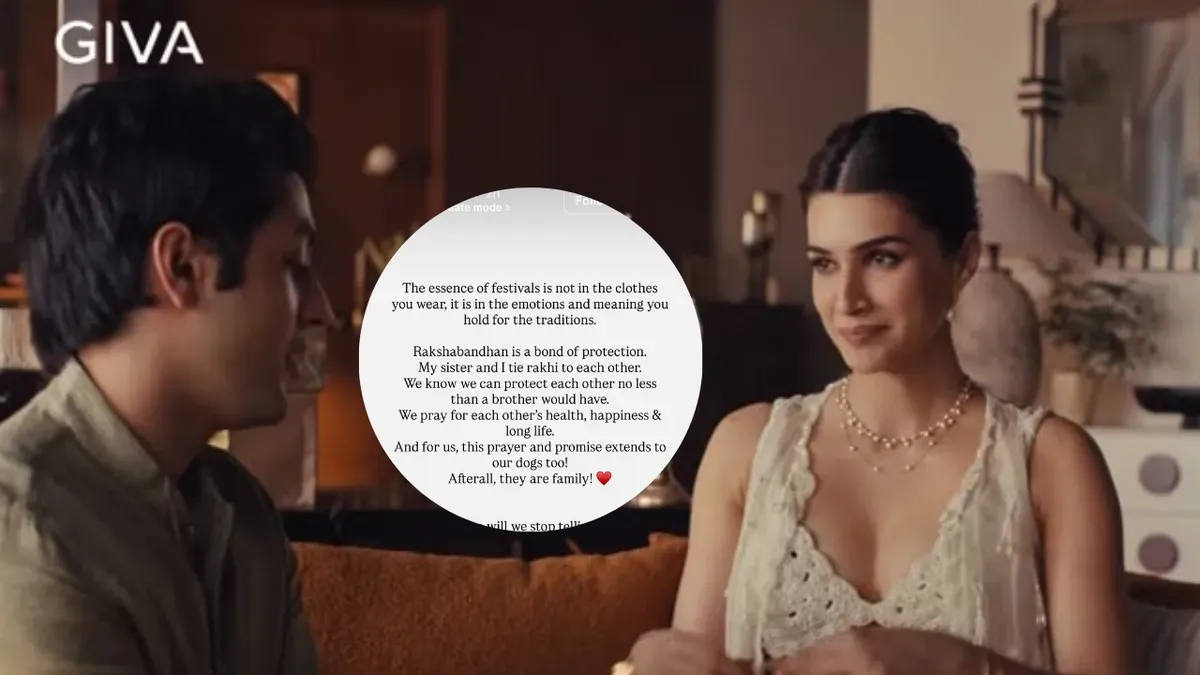
That distinction matters to the diagnosis. “Pet as sibling” was the creative premise. The clothing, casting, framing, distribution, and release context formed the execution that audiences actually encountered. Approval of the premise did not settle the risk of the finished asset.
For readers outside India, Raksha Bandhan centers on sibling relationships, traditionally marked by tying a rakhi, or ceremonial thread, and exchanging gifts. Contemporary campaigns extend the occasion to cousins, friends, chosen family, and pets. For jewelry and gifting brands, the commercial opportunity is time-bound: creative, creator activity, retail displays, and conversion campaigns converge as the festival approaches.
The campaign had been live for more than a month
GIVA launched “Furever Sibling – The Pawfect Bond” on July 21, with chief brand officer Resha Jain describing the collection and campaign as a celebration of the bond between people and their pets. The launch plan included digital platforms, creator collaborations, and online and offline festive gifting activity, but the reporting does not identify a creative agency, media agency, or specific paid channels.[1]
Sanon was also a newly appointed ambassador rather than a one-film casting choice. GIVA announced her appointment on May 22, 2026, with founder Ishendra Agarwal placing it in the context of the company’s expansion from one store to more than 300.[10] By July, the Rakhi film was carrying both a seasonal collection and a larger ambassador relationship.
Nothing in the available record indicates that GIVA launched the film into an immediate, campaign-ending controversy. The first visible objection located by afaqs appeared on August 23, more than a month after launch. The user criticized the decision to show a rakhi ritual with Sanon dressed in what the post characterized as a bralette.[2] This does not establish how widely the criticism had spread at that moment; it establishes a checkable starting point for the escalation recorded by the press.
August 23–26: criticism became a distribution decision
The operating risk changed on August 25. Kangana Ranaut, an actor and BJP parliamentarian, amplified the criticism through an Instagram Story. She called the advertisement “intentionally creepy” and objected to performing a religious ritual “in your bikini/under garments.”[3][4][5] The wording is useful here as timestamped evidence of what was being alleged: not simply that the styling was unattractive, but that the brand had juxtaposed intimate-looking clothing with a ritual in a way critics considered disrespectful.
Sanon answered that “Culture & Traditions are in her heart, not in her neckline!”[3][4] Her sister Nupur Sanon and Congress leader Rahul Gandhi also supported her.[3] At that point, the asset was no longer being discussed only as festive advertising. It had become material in a public argument involving political identities, celebrity reach, clothing, and cultural authority.
Political amplification did not prove that most customers opposed the film, nor did social posts measure purchase behavior. It changed the cost of leaving the asset live. Every additional impression could now attract replies, screenshots, demands for a response, and questions directed at retailers or customer-service teams. Media buyers might need to pause or replace creative while brand, legal, communications, and leadership teams decided whether the controversy would remain contained.
On August 26, GIVA ended that decision process publicly. Its statement said the company held Indian culture and traditions in the “highest regard,” had “no intent” to hurt sentiments, and had withdrawn the advertisement from all media.[3][6][7][8][9] The five reports align on the essential outcome. None supplies an internal approval trail or attributes the decision to a named agency, platform, retailer, or media partner.
Calling this a paid-media event therefore requires precision. The sources confirm a withdrawal from all media and a broader digital, creator, online, and offline campaign plan; they do not disclose which placements were active when the film was removed. The operational consequence is clear—a live flagship asset had to stop—but the channel mix and amount at risk remain unknown.
Why the timing mattered
| Context | What the figure shows | What it does not show |
|---|---|---|
| Rakhi category timing | CaratLane allocated 30% of its August media investment to Rakhi, illustrating how heavily a jewelry advertiser can concentrate spending around the occasion.[11] | It is not evidence of GIVA’s budget, allocation, or channels. |
| GIVA company context | RoC-derived FY25 reporting put GIVA’s revenue at ₹523.3 crore, advertising expense at ₹135.5 crore, and loss at ₹72.4 crore. Advertising expense was reported as 55% higher year over year.[12] | These are company-level FY25 figures that predate the 2026 campaign. The ₹135.5 crore figure is not the Kriti Sanon campaign budget. |
A withdrawal during a concentrated gifting window is harder to absorb than a pull during an always-on period. Approved replacements must fit existing placements, product pages may need new video or imagery, creators may require revised instructions, and store screens can remain out of sync with digital decisions. Those are foreseeable operational consequences, not documented evidence that each occurred at GIVA.
The record does not support a loss estimate. There is no disclosed production cost, media commitment, cancellation fee, conversion impact, sales result, app-rating movement, or retailer response. Even GIVA’s substantial company-level advertising expense cannot be converted into a plausible campaign number without inventing an allocation.
The 2025 comparison changes the diagnosis
GIVA had already used the broad pet-as-sibling idea. Its 2025 “Ties of Love” Raksha Bandhan film showed Anushka Sharma tying a rakhi on a dog.[13] The available campaign record does not identify a comparable withdrawal around that film.
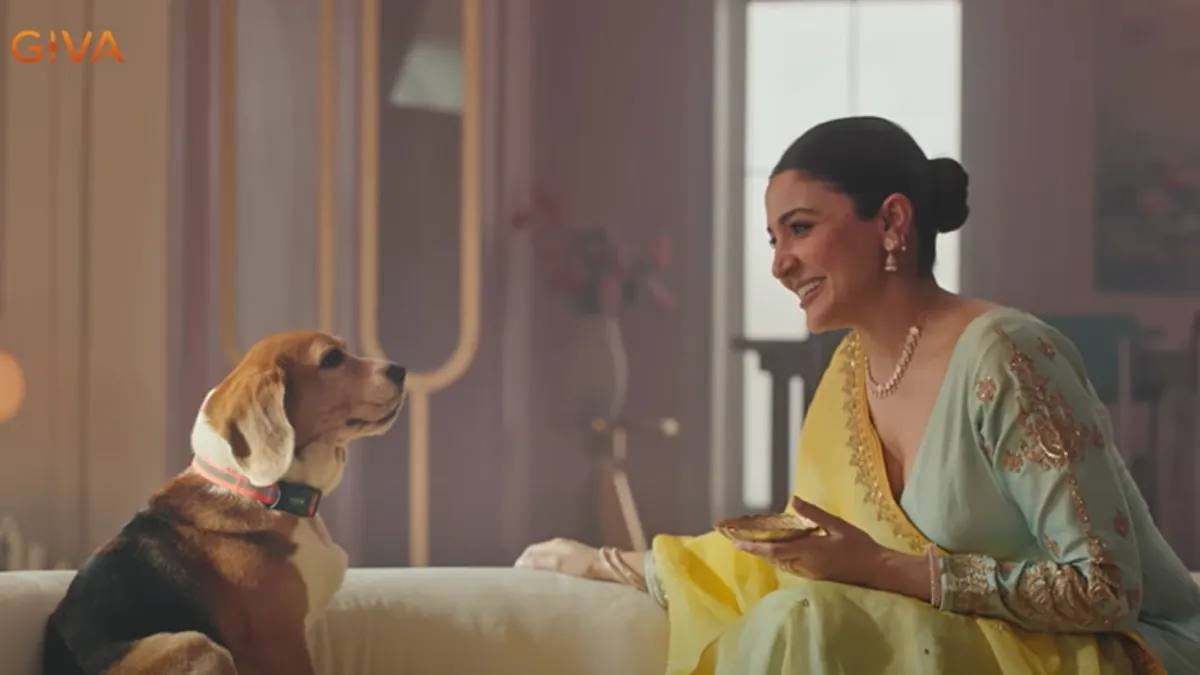
That comparison does not establish that one outfit caused the 2026 withdrawal. It does rule out the simplest explanation—that portraying a pet as a sibling was automatically unacceptable. The common premise survived across both executions; the spokesperson, styling, framing, reach, timing, and public context did not remain constant.
| Creative variable | 2025 execution | 2026 execution | Review implication |
|---|---|---|---|
| Core premise | A pet participates in Raksha Bandhan as family. | A pet participates in Raksha Bandhan as a sibling. | Prior approval supports the premise only, not every later treatment. |
| Spokesperson | Anushka Sharma. | Kriti Sanon, appointed GIVA ambassador in May 2026. | Casting changes the audience, associations, and likely amplification paths. |
| Visual treatment | The available 2025 frame presents a conventional domestic rakhi scene. | The disputed 2026 frame uses an Indo-Western bralette, cape, and skirt look. | Wardrobe must be reviewed in relation to the depicted ritual, not only against a fashion brief. |
| Escalation | No comparable withdrawal is identified in the available campaign record. | Criticism visible by August 23 was politically amplified on August 25; the film was withdrawn August 26. | A concept’s history cannot substitute for a current-context escalation assessment. |
The approval failure sits in the gap between those columns. A team can correctly remember that the pet-rakhi idea worked before and still fail to ask whether the complete new execution creates a different reading. Reusing a conceptual territory is not the same as rerunning an identical asset under identical conditions.
Withdrawal contains exposure—and creates an incentive
Removing the film limited GIVA’s immediate exposure and gave the company an unambiguous response for customers, partners, and internal teams. It also illustrates a wider tension in Indian advertising. Open Magazine summarized the mechanism as: “the celebrity supplies conviction. The brand supplies the delete button.” The same analysis cited SP Jain professor Ashita Aggarwal’s warning that repeated withdrawals teach pressure groups that outrage can control advertising.[14]
That concern should not be used to pretend an advertiser can ignore escalation days before a gifting peak. It does mean the withdrawal itself has consequences beyond one media plan. If every disputed interpretation triggers deletion, organized critics learn where the leverage sits. If a brand refuses to act without having rehearsed the decision, marketers and customer-facing teams bear the resulting confusion.
This is the same control problem visible in the Tim Hortons brand-safety case: placement filters cannot solve a risk embedded in the campaign’s own creative. The site’s broader creative-backlash record is also useful when backlash needs to be treated as a performance and operations variable rather than a binary verdict on whether the internet liked an advertisement.
The approval standard this case supports
Festive creative should be approved as a complete execution in its expected launch context. That review needs the final wardrobe, ritual action, edit, captioning, spokesperson, creator adaptations, store version, planned distribution scale, release date, and a current map of plausible political amplification. A deck-level concept approved in a previous year cannot answer those questions.
The media plan also needs a removal path before launch: who can pause an asset, which replacement is already cleared, how creators will be notified, which retail and owned surfaces must change, and who determines whether criticism represents limited commentary or an escalation requiring action. That preparation does not assume every complaint deserves a withdrawal. It prevents the first serious review of the finished campaign from happening while it is already live.
Nothing in the documented record makes pet-rakhi creative inherently unsafe. The narrower lesson is that safety does not transfer automatically from one execution to another. When styling, spokesperson, distribution, timing, or political context changes, the approval must be run again—and the replacement route should be ready before the gifting peak.
References
- GIVA’s Raksha Bandhan campaign celebrates pets as ‘furever siblings’ — afaqs
- Kriti Sanon responds to backlash over GIVA’s Raksha Bandhan ad — afaqs
- Kriti Sanon Rakhi ad: Giva jewellery drops Bollywood actor's Indian festival ad over outfit — BBC
- Kriti Sanon-Kangana Ranaut row explained: What happened over Cocktail 2 actress’ Raksha Bandhan ad — The Economic Times
- Kangana Ranaut questions GIVA’s Raksha Bandhan creative featuring Kriti Sanon — Storyboard18
- Kriti Sanon’s Rakhi ad pulled by jewellery brand after controversy — The Hindu
- Kriti Sanon’s Rakhi ad pulled by jewellery brand after controversy — The Economic Times
- GIVA withdraws Kriti Sanon’s Rakhi ad after backlash — Storyboard18
- GIVA withdraws Raksha Bandhan ad featuring Kriti Sanon following online backlash — Adgully
- GIVA names Kriti Sanon as brand ambassador — afaqs
- CaratLane puts 30% of August media behind Rakhi — Social Samosa
- Bengaluru-based D2C fine jewellery brand GIVA surges 87% to Rs 523 Cr revenue in FY25 while losses widen to Rs 72 Cr — Startuppedia
- Anushka Sharma ties rakhi on dog in GIVA’s new Raksha Bandhan film — afaqs
- GIVA Hired Kriti Sanon. Kangana Ranaut Got Final Cut. Welcome to Outrage-Era Advertising — Open Magazine
This is a record of what happened and what was tested, not legal advice. Compliance determinations require qualified counsel.