
What ANA's Chiikawa Jet Announcement Actually Says
ANA's Chiikawa Jet announcement (Aug 3, 2026) came with zero published performance data. This fact file separates what's verified from what isn't, explains why scarce licensed creative is unmeasurable in platform terms, and lists what would count as proof once the jet enters domestic service in late October.
- Platform
- Offline/owned media
- Creative type
- Physical licensed livery
- Last reviewed
- 0-08-03
ANA’s Chiikawa Jet announcement landed on Aug. 3, 2026 with the parts that make a creative launch easy to share: a named aircraft, a character universe, domestic service from late October, cabin touches, and merchandise still to come. What it did not include, as of Aug. 3, was the part performance marketers usually need before calling anything a success: published results.
That absence is not a footnote. It is the current status of the campaign. The ANA Chiikawa Jet story is, today, an announcement-time evidence file: what has been announced, what is source-dependent, what is merely adjacent demand context, and what would have to be measured once the aircraft enters domestic service in late October 2026.
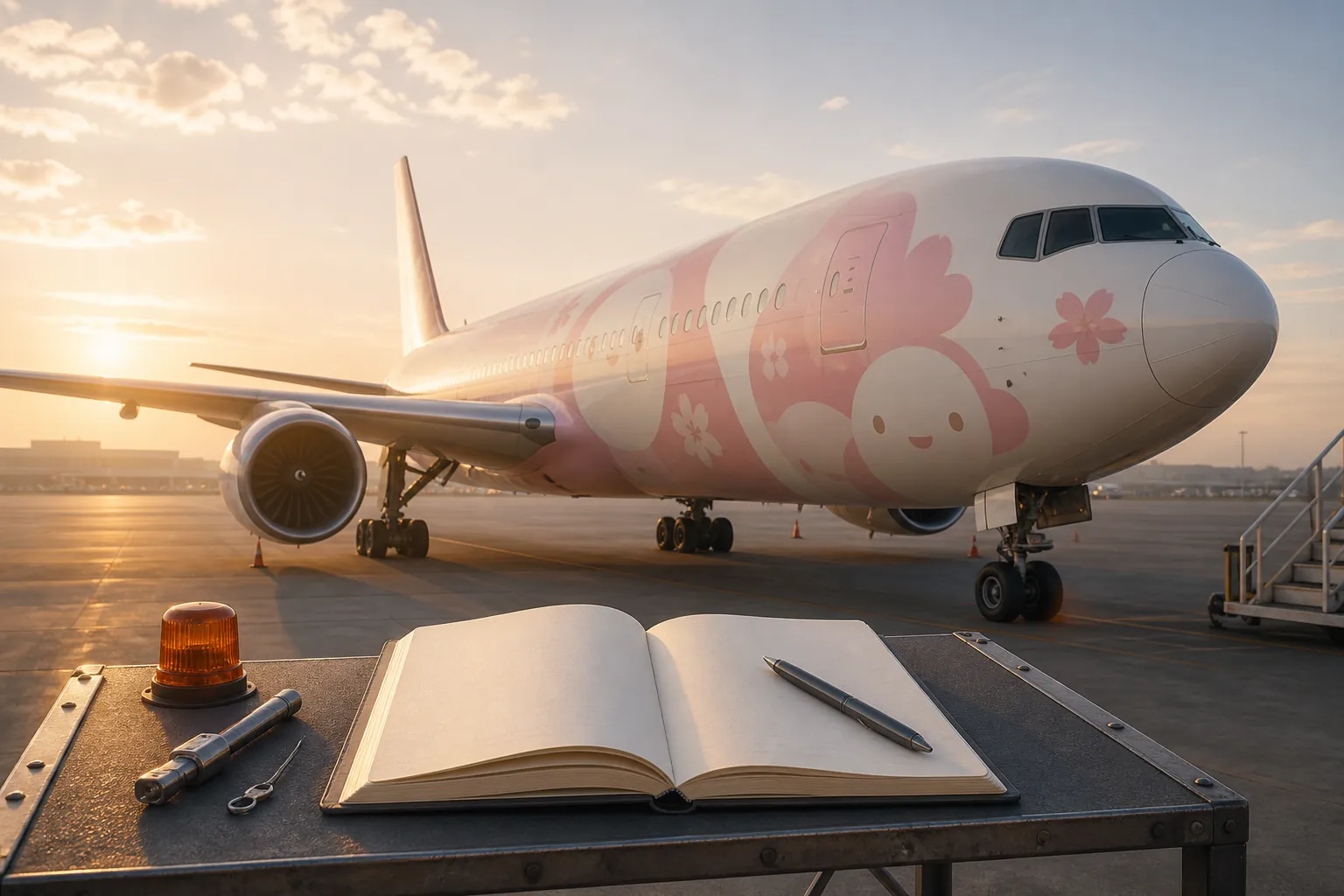
The Aug. 3 fact file
The reported aircraft is a Boeing 767-300ER, registration JA609A, scheduled for domestic Japanese routes from late October 2026. The exterior design features eight Chiikawa characters, including Chiikawa, Hachiware, and Usagi, along with seasonal Japan motifs. TRAICY Global and TravelWires both reported those core details on Aug. 3, 2026; TRAICY Global also disclosed that its English article was automatically translated by GPT-4 from its Japanese-language original, which matters for source confidence rather than for spectacle value.[1][2]
| Item | Announcement-time status as of Aug. 3, 2026 |
|---|---|
| Aircraft | Boeing 767-300ER |
| Registration | JA609A |
| Planned service | Domestic routes from late October 2026 |
| Exterior design | Eight Chiikawa characters, including Chiikawa, Hachiware, and Usagi, with seasonal Japan motifs |
| Cabin item | Economy Class headrest covers, not for take-home |
| Service item | Limited-edition hot and cold cups |
| Merchandise | Chiikawa characters in ANA uniforms; details still to be announced |
| Published performance results | None found or reported at announcement |
The cabin details are not decorative trivia. Headrest covers that stay on board create exposure during the flight but do not become portable media. Limited cups may extend the interaction into service moments, but only while supply lasts. Merchandise featuring Chiikawa characters in ANA uniforms could become the more trackable commercial layer, but it is still a placeholder until ANA publishes availability, pricing, distribution, or sell-through.

There is also a useful airframe detail, though it should be handled with lower confidence: Airfleets’ snippet for JA609A lists MSN 32978, model 767-381ER, with first flight dated May 11, 2002, which would make it roughly a 24-year-old airframe at launch. The page itself is auth-walled in the available source set, so that data belongs in the “check again before using in a pitch deck” column, not the “confirmed by ANA” column.[3]
The source chain is thin, and that changes the confidence level
The English-language coverage available at announcement is mostly a relay layer. TRAICY Global and TravelWires report the same practical launch facts: aircraft type, registration, design elements, late-October domestic service, cabin items, and merchandise to be announced.[1][2] The primary source behind the announcement is ANA’s Japanese-language release. As of Aug. 3, 2026, no official English-language ANA press release for the Chiikawa Jet was indexed in the available source set.
That does not make the announcement doubtful. It does mean the English record is not as clean as it would be if ANA had published a dedicated English release with the same fields. TRAICY’s auto-translation disclosure is especially relevant for exact wording, naming, and nuance. For basic facts repeated by both English sources, confidence is reasonable. For any interpretation of ANA’s intended objective, expected demand, or commercial impact, the evidence is not there yet.
| Claim type | Current confidence |
|---|---|
| ANA announced a Chiikawa-themed Boeing 767-300ER, JA609A | High, based on repeated English reporting tied to ANA’s Japanese release |
| The aircraft will feature eight characters and seasonal Japan motifs | High for the general design description; exact visual interpretation should be checked against ANA’s Japanese materials |
| Economy headrest covers are not take-home items; limited hot/cold cups are planned | High, based on repeated launch reporting |
| ANA-uniform Chiikawa merchandise will be sold | Medium until ANA publishes the actual merchandise details |
| JA609A is a 2002 first-flight airframe | Lower, because the available Airfleets support is an auth-walled snippet |
| The campaign has increased bookings, fares, load factor, social reach, or merchandise revenue | Unsupported as of Aug. 3, 2026 |
This is where ordinary launch coverage gets mushy. A character jet is visible, charming, and easy to describe. It is also easy to smuggle in words like “engagement,” “demand,” and “halo” before anyone has shown whether a booking changed, a route filled faster, a fare moved, a product sold through, or earned media sustained beyond announcement day.
This is not an AI creative test with wings
A fair read of the Chiikawa Jet has to start with the medium. This is a scarce, licensed, physical media object attached to a finite aircraft schedule. It is not a batch of generated image or video variants pushed into Performance Max or Advantage+ until a platform finds the least-bad option at scale.
That difference should make marketers more careful, not more forgiving. In AI creative accounts, the measurement promise is volume: lower production cost, more variants, faster iteration, and cleaner platform-level comparison if the account has enough spend and conversion density. Signal & Convert’s earlier audits of Dr Pepper’s Fansville AI creative claims and measurable AI ad creative backlash sit on that side of the ledger: cheap-to-produce assets, broad distribution, and claims that should be tested against actual platform and audience behavior.
The Chiikawa Jet is the opposite risk profile. It concentrates cost, licensing, operations, and attention into one visible object. The exposure is constrained by routes and aircraft utilization. The “creative” is not just a file; it includes a fuselage, cabin surfaces, service ware, passenger dwell time, airport spotting, social posts, press pickup, and possibly merchandise. A weak AI image can be killed after a test. A themed aircraft has to keep flying.
That does not make it unmeasurable. It makes it measurable on different terms. The mistake would be using the existence of this aircraft later as proof that licensed IP beats AI creative, or that physical immersion beats platform testing, without matching the claim to the evidence. A livery program can be a PR asset, a loyalty touchpoint, a fan-service object, a route-demand nudge, a merchandise platform, or a brand-halo play. Each one needs different proof.
Adjacent IP demand is context, not proof
There is a reason this announcement travels quickly. Chiikawa has demonstrated commercial force in Japan, and ANA has a long history of character and entertainment liveries. But those facts are context for why ANA might make the bet. They are not evidence that this specific jet has performed.
SimpliFlying’s airline-livery analysis says ANA’s 1998 Pokémon livery, which included themed headrests, uniforms, and souvenir bags, “led to actual increase in ticket sales.” The same piece frames aircraft as unusually long engagement environments compared with short-lived consumer-packaging interactions, citing airline engagement windows of 2 to 20 hours versus under 10 minutes for a beverage can, and notes the cost implications of special paint beyond a basic three-color scheme plus fuel-burn effects from paint weight.[4]
Useful? Yes. Transferable as a performance baseline for Chiikawa Jet? No. Pokémon in 1998 is not Chiikawa in 2026, and “ticket sales increased” is not the same as a route-level causal model. It tells us ANA has precedent for treating aircraft as character media. It does not tell us what JA609A will do after late October.
ANA’s special-livery history also includes major entertainment programs. The R2-D2 787, JA873A, was retired on Aug. 6, 2025, with the broader Star Wars program ending by March 2026, according to 100knots.[5] That matters as brand-operating context: ANA knows how to run long-lived themed aircraft. It still does not supply results for this launch.
The Chiikawa commerce numbers floating around the research trail need even stricter labeling. MAY Planning aggregates several eye-catching claims from other outlets and institutions: a March 2024 Kura Sushi collaboration with same-store sales up 23% year over year, traffic up 9.5%, average spend up 12.3%, and repeat visits up 19 points; Lawson onigiri at 3.7 times standard sales; EPOS card applications tripling; and McDonald’s Japan 2025 Happy Meal supply and resale issues.[6] Those figures may be useful demand context after chasing their original sources. They should not be laundered into ANA Chiikawa Jet attribution.
The movie side is similar. Cartoon Brew reported that the Chiikawa film opened with ¥2.24 billion over three days and the seventh-best opening day in Japan.[7] That supports the broad idea that Chiikawa is not a niche mascot with no audience. It does not tell us whether a traveler will choose an ANA domestic flight because JA609A might be assigned to the route.
The design details are still part of the evidence
A verification file should not become visually dead. The design specificity matters because it shows what kind of attention ANA is buying. Eight characters on the fuselage are not the same as a small tail decal. Seasonal Japan motifs are not generic “cute branding.” Economy headrest covers put the collaboration into the passenger’s field of view for the flight. Cups shift it into service. Merchandise, if released, could turn the aircraft from a sighting into a purchasable memory.
That is the brand magic worth preserving in the analysis. A 24-year-old widebody becoming a moving pastel character surface is stranger, more memorable, and more operationally committed than another grid of synthetic ad variants. But the more spectacular the object, the more tempting it becomes to skip the measurement question. The spectacle explains why people notice. It does not prove what the notice is worth.
There is also a practical creative boundary: official Chiikawa artwork is copyrighted by Nagano and the Chiikawa Committee. An analysis can describe the announcement and cite reporting without reproducing official character art. For publishers and advertisers, that distinction is operational, not academic; licensed IP is powerful partly because it is controlled.
What would count as proof after late October
Once JA609A enters domestic service, the question changes from “what did ANA announce?” to “what did the program move?” The cleanest evidence would come from ANA itself, especially if ANA states the campaign objective. A livery built for earned media should be judged differently from one built to lift bookings, sell merchandise, or deepen loyalty among family and fan segments.
| Evidence to watch | Why it matters |
|---|---|
| Route allocation and schedule dates | Shows where the scarce asset actually appears and which travelers can encounter it |
| Aircraft utilization after late October | Separates a symbolic launch from meaningful in-market exposure |
| Passenger load factor or fare effects, if ANA publishes them | Would support commercial impact, though causality would still need care |
| Booking behavior tied to announced Chiikawa Jet routes | Could indicate demand response if measured against comparable routes and timing |
| Earned media and social pickup with dates | Would support PR reach and fan amplification claims |
| Merchandise availability, pricing, and sell-through | Would show whether the collaboration converts attention into direct commerce |
| Cabin-item supply and passenger behavior | Would clarify whether cups and headrest covers function as experience design, scarcity triggers, or both |
| ANA-reported campaign objective | Prevents retrofitting the easiest available metric into a success claim |
Even then, the standard should not be impossible purity. A themed aircraft will rarely produce the kind of clean incrementality read a buyer wants from a controlled media test. Route selection, seasonality, fan travel, announcement timing, aircraft swaps, and press cycles will all interfere. The job is not to pretend those problems vanish. The job is to keep the claim narrow enough for the evidence.
If ANA later reports merchandise sell-through, that is merchandise evidence. If social pickup spikes around first service, that is earned-media evidence. If specific domestic routes show higher demand after aircraft assignment is public, that is a booking-behavior clue, not automatic causal proof. If no numbers are published, then the campaign remains a high-attention brand asset with visible execution and unpublished performance.
The dated read
As of Aug. 3, 2026, ANA has announced a visually specific, operationally real Chiikawa Jet program: Boeing 767-300ER JA609A, eight-character exterior treatment, seasonal Japan motifs, Economy Class headrest covers that stay on board, limited hot and cold cups, and ANA-uniform character merchandise still to be detailed. It is scheduled for domestic service from late October 2026.
As of the same date, there are no published performance results for the jet. No reported booking lift. No disclosed fare effect. No route-level demand read. No earned-media tally. No merchandise sales. No ANA-stated KPI in the English source trail available at announcement.
That makes the honest article a verification file, not a success story. The Chiikawa Jet may become a useful case in licensed physical creative, airline dwell time, and character-collab brand design. It is not, on Aug. 3, 2026, proof that the strategy worked.
References
- ANA to Launch “Chiikawa Jet” on Domestic Routes from Late October, TRAICY Global, Aug. 3, 2026
- ANA to Launch Special Chiikawa-themed Boeing 767 on Domestic Flights, TravelWires
- Boeing 767 MSN 32978, Airfleets
- Marketing Importance Of Airline Liveries, SimpliFlying
- The Ultimate ANA Special Livery Guide For AvGeeks, 100knots
- Chiikawa Economic Effect: Why Collaborations with Kura Sushi, Lawson, and EPOS Card Were Successful, MAY Planning
- ‘Chiikawa’ Movie Opens To ¥2.24 Billion In Japan, Scoring Seventh-Best Opening Day Ever, Cartoon Brew
This is a record of what happened and what was tested, not legal advice. Compliance determinations require qualified counsel.