
Why the Nvidia stock warning is really about AI ad platforms
NVIDIA's 2026 stock warnings are about circular financing more than chips, and the loop runs straight through the ad platforms media buyers spend on. A break in that chain could hit AI ad budgets and platform revenue at the same time, so "AI ad spend is exploding" claims need the same source-checking as platform lift numbers.
- Platform
- Google Ads, Meta, TikTok
- Change category
- bidding
- Effective date
- 2026-07-30
- Change type
- default-on change
- Impact level
- moderate
The practical issue for media buyers is not whether NVIDIA’s chart looks expensive. It is whether the same capital paying for AI infrastructure is also paying for the acquisition budgets showing up inside Google, Meta, TikTok, Performance Max, Advantage+, and the rest of the automated buying stack. If that money is being treated as proof that “AI ad demand is exploding,” the buyer has to ask a more annoying question: which budget line is actually growing?
The 2026 NVIDIA stock warning matters because the loudest alarms are about circular financing. Michael Burry’s signal was credit-market rather than campaign-level: NVIDIA’s 5-year credit default swaps were described as “going parabolic,” with the cost of insuring against default roughly doubling in two months, and he disclosed a bolstered short through put options on July 24, 2026. Mark Cuban put the concern more bluntly: “Nvidia is the IPO funding everyone and anyone… It’s truly scary.” The same TheStreet report, citing Bloomberg, said NVIDIA had announced more than $540 billion in circular financing deals in 2026 alone, excluding a potential new OpenAI arrangement, and noted that the IMF and Bank for International Settlements had flagged AI circular financing as a systemic downside risk.[1]
A separate July 30, 2026 Investing.com risk note, disclosed as AI-assisted, reported that NVIDIA was in discussions to provide roughly $250 billion in financial guarantees to backstop OpenAI’s data-center lease obligations. I would not use that piece as the only source for a hard conclusion, but the number is worth tracking because it describes a different instrument from the $540 billion-plus circular-deal total: guarantees rather than announced financing deals.[2]

The stock warning becomes an ad-platform warning when the loop reaches distribution
A normal stock-warning article can stay with valuation, insider selling, GPU share, and the next earnings call. Those items exist here too. Investing.com’s July 30 risk note cited a 4% GPU-share decrease, more than 30x multiples, and $410.6 million in insider selling. Separately, the stock-data cutoff used here is the July 31, 2026 close at $200.75, and NVIDIA’s pending Q2 FY27 earnings event is scheduled for August 26, 2026.[2] Those details matter for investors. They are not the reason a growth lead should care.
The buyer-facing concern is the wiring. NVIDIA finances or backstops large AI customers. Those customers buy NVIDIA chips and reserve compute. They also need distribution, paid acquisition, and usage growth, which pushes money into Google and Meta. Google and Meta are not just ad platforms collecting those dollars; they are also major AI infrastructure buyers themselves. No single source proves that full transmission chain as a campaign outcome. The sourced facts establish the pieces. The ad-spend risk is the synthesis.
OpenAI is the cleanest case because the financing leg is visible. NVIDIA pledged up to $100 billion in investment in OpenAI in a deal announced in September 2025, a structure that raised concern because the customer receiving capital also buys the supplier’s chips.[3] The later reported guarantee discussions would add another layer if finalized, which is why the platform implication deserves its own treatment in our NVIDIA/OpenAI guarantee analysis.
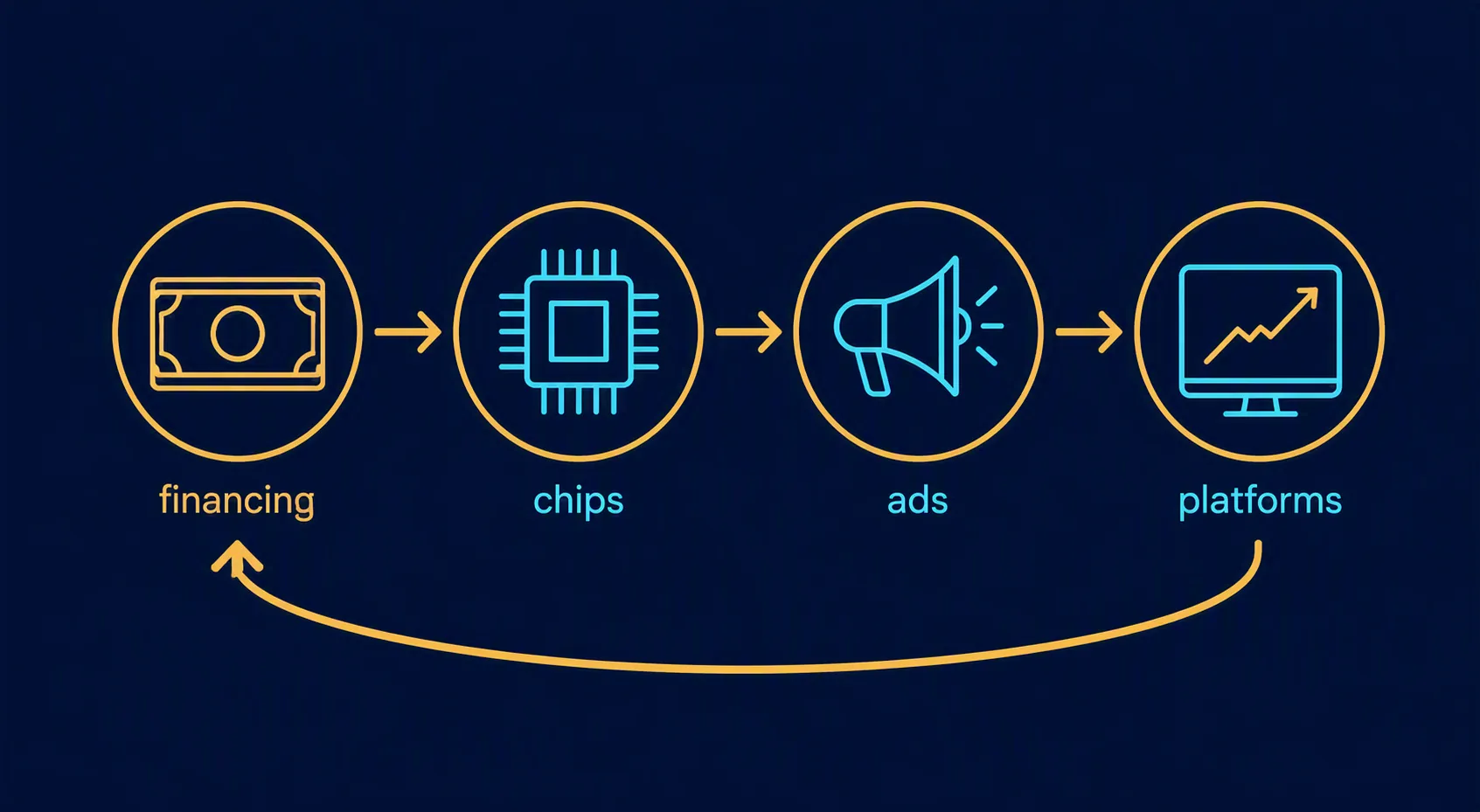
That does not mean every AI advertiser is spending NVIDIA-funded money, or that Google and Meta ad revenue is already impaired. It means the headline “AI ad spend is up” is not independent evidence until the source of that spend is separated from the machinery that produced it.
Three claims get blurred into one AI-demand headline
The sloppy version of the story says AI demand is booming, therefore chip demand is booming, therefore AI ad spend is booming, therefore ad platforms have durable growth. A buyer cannot plan from that sentence. It collapses three different ledgers.
| Claim | What it can actually measure | What it does not prove by itself |
|---|---|---|
| Chip demand | GPU orders, data-center buildout, cloud commitments, leases, guarantees, and infrastructure capex | That end users are creating enough durable revenue to support the buildout without continued capital support |
| AI-startup customer acquisition budgets | Money flowing into Google, Meta, TikTok, influencers, affiliates, and other distribution channels | That the advertiser’s demand is self-funded, profitable, or repeatable after financing conditions tighten |
| AI-powered ad-platform revenue | Spend routed through products such as Performance Max, Advantage+, and Smart+; platform run rates; projected AI-assisted buying revenue | That the spend is net-new to the ad market rather than reallocated from manual campaigns or existing platform budgets |
This distinction is where the NVIDIA warning stops being market commentary and starts being media planning. If a venture-backed AI app raises capital, spends aggressively on Meta, buys search demand on Google, and reports usage growth, the platforms see revenue. If the same app’s infrastructure economics depend on cheap financing, supplier support, cloud guarantees, or a future IPO window, that ad spend is not the same quality as a profitable advertiser expanding because payback is improving.
The ad-platform numbers are big; the source of growth is the unresolved part
The platform side of the story is not small. eMarketer projected Meta and Google would generate about $243 billion and $239 billion in 2026 ad revenue, respectively.[4] Meta’s Advantage+ has been described as running at more than $60 billion annualized, while a separate Q2 2026 figure put the run rate closer to $75 billion, so the exact number depends on the dated source and definition being used.[5]
Madison and Wall estimated that AI-powered ad revenue would grow 63% to $57 billion in 2026, as brands moved more budget into automated systems such as Performance Max, Advantage+, and TikTok Smart+.[6] That is the number that tends to travel well in executive decks because it sounds like an independent demand wave.
The counterweight in the same research ecosystem is more useful for buyers: “AI isn’t creating growth, it’s capturing it.” Madison and Wall’s original report, commissioned by Adobe, argued that AI-powered buying is mostly growing through reallocation of existing dollars rather than the creation of net-new ad spend.[7]
That is not a bearish call on Performance Max or Advantage+. Automated buying can still win budget because it reduces manual control, absorbs campaign structure, and gives platforms more room to allocate impressions. Buyers who need the mechanics can use our Advantage+ profile as a reference. The point is narrower: platform AI revenue can rise even when the total advertiser wallet is not expanding.

What breaks first if the loop tightens
The first pressure point would not necessarily be a sudden collapse in Google or Meta revenue. Large platforms have many advertiser categories, and the broader 2026 AI-market rout has, through the July 31 cutoff, looked more like a valuation and capex story than a measured digital-ad-demand story. That broader Q1–Q3 context is tracked in our AI rout and ad-spend timeline.
The more plausible buyer-facing sequence is less dramatic and more operational. AI startups facing tighter financing would shorten payback windows, cut experimental geographies, reduce broad-match and Advantage+ scale targets, pause creator and affiliate tests, and push agencies to defend every marginal dollar. At the same time, the platforms selling AI automation would still be funding their own AI infrastructure plans. CNBC framed that investor concern in February 2026 as NVIDIA earnings colliding with Wall Street skepticism over AI spending and hyperscaler capex.[8]
That is the double exposure. The advertiser cohort most eager to buy distribution can become more capital-constrained, while the platforms routing that spend can also face scrutiny over the cost of building and running AI systems. A platform can still have excellent auction liquidity and strong near-term revenue under those conditions. The question is whether the incremental AI-ad-growth claim is being financed by durable customers or by the same capital cycle supporting the infrastructure buildout.
NVIDIA’s defense deserves to be in the file
The circular-financing critique is not the only read. NVIDIA has defended its strategic investments as transparent and has said its portfolio companies are “growing their own revenues rapidly.” Jensen Huang has called circular-financing criticism “ridiculous.”[9] That matters because a supplier investment is not automatically a fake sale, and infrastructure can create real distribution advantages when the downstream product has users, retention, and pricing power.
The buyer does not need to adjudicate NVIDIA’s intrinsic value to use the warning properly. The useful test is provenance. Is a number a commitment, a guarantee, a reported discussion, a projected ad-revenue figure, a platform run rate, or actual spend flowing through accounts? The answer changes how much weight it should carry in a media plan.
A verification standard for AI ad-spend claims
When a vendor, platform rep, or executive memo says AI ad spend is exploding, the first response should not be agreement or dismissal. It should be source-checking.
- Separate projected platform revenue from actual advertiser spend. A forecast for Google, Meta, or AI-powered buying tools is not the same as observed incremental demand in your category.
- Ask whether the growth is net-new or reallocated. If AI buying is capturing budgets that used to sit in manual search, prospecting, retargeting, or app campaigns, the automation product may be growing while the advertiser wallet is flat.
- Identify the payer behind the spend. Public-company operating cash, profitable subscription revenue, venture financing, supplier-backed guarantees, and IPO-window spending are not interchangeable.
- Treat run rates as dated snapshots. Advantage+ at more than $60 billion annualized and a later $75 billion-style run-rate claim are not wrong just because they differ; they may be using different dates, scopes, or definitions.
- Stress-test payback windows. If financing tightens, the accounts most likely to change behavior are the ones scaling on long-dated lifetime-value assumptions, loose CAC thresholds, or investor-funded land grabs.
- Watch the next hard update. NVIDIA’s Q2 FY27 earnings event on August 26, 2026 is the next scheduled point that can update the market’s view of AI infrastructure demand, customer concentration, and capex durability.[2]
The NVIDIA stock warning is useful to ad buyers only if it is translated out of stock-market shorthand. The relevant risk is not “NVIDIA down, ads down.” It is that the same financing loop can support chip purchases, AI-startup acquisition budgets, and platform AI-revenue narratives at the same time. If that loop tightens, those budgets can be pressured together, so AI ad-spend growth claims deserve the same source-checking buyers already apply to platform lift claims.
References
- Mark Cuban, Michael Burry send strong warning on Nvidia, AI stocks — TheStreet, July 30, 2026
- Six key risks facing NVIDIA stock ahead of August earnings — Investing.com, July 30, 2026
- Big AI's reliance on circular deals is raising fears of a bubble — NBC News, September 2025
- 2026 ad revenue projections — eMarketer
- Meta Advantage+ run-rate reporting — TNW / Meta / eMarketer / Magnet Media, Q2 2026
- AI-powered ad spend is set to soar 63% this year as brands ditch manual controls — Business Insider, March 2026
- AI-powered advertising report commissioned by Adobe — Madison and Wall
- Nvidia earnings collide with Wall Street skepticism over AI spending — CNBC, February 24, 2026
- Q4 FY26 and Q1 FY27 financial results — NVIDIA Newsroom
Primary source: https://www.thestreet.com/investing/mark-cuban-michael-burry-nvidia-ai-stocks