
Why the AI market rout hasn't hit digital ad spend
A dated tracker of Q1–Q3 2026 AI market rout events and what each one actually changed in digital ad spending — auction behavior, budgets, or nothing measurable. The evidence as of July 31, 2026 reads as a valuation and capex story so far, not a demand story.
- Platform
- Cross-platform
- Change category
- bidding
- Change type
- market event
- Impact level
- low
As of July 31, 2026, the AI market rout has done far more visible damage to equity valuations and capex confidence than to measurable digital ad demand. The useful question for a media buyer is narrower than the market headline: did CPMs move, did CPCs move, did auction liquidity change, or did advertisers actually pull budgets? In the dated record available through July 31, the answer is still: not clearly.

The sharpest equity-market entry is exactly the kind of number that turns into a Monday budget-freeze question. On Feb. 3–4, the Anthropic-triggered software rout pushed the S&P software and services index down about 13% over six sessions, with roughly $830 billion in market value wiped out since Jan. 28, Reuters reported on Feb. 4.[1] That is a real market shock. It is not, by itself, an ad-spend signal.
The Q1–Q3 tracker: market event first, ad-spend signal second
The tracker below treats the AI market rout as something that has to pass through the ad account before it becomes a media-budget fact. A valuation drop counts as the market event. It only becomes relevant to Performance Max, Advantage+, AI Max, Symphony, or other live buying systems if there is a dated spend or auction signal attached to it.
| Date | AI-market event | Observable ad-spend signal | Source | What to watch next |
|---|---|---|---|---|
| Jan. 28–Feb. 4, 2026 | Anthropic-triggered software rout. The S&P software and services index fell about 13% over six sessions, and roughly $830 billion in market value had been wiped out since Jan. 28.[1] | No dated evidence in the available record ties this selloff to a measurable pullback in digital ad budgets, CPMs, CPCs, auction liquidity, or active campaign spend. | Reuters for the equity-market move; no matching dated ad-spend signal supplied. | Daily CPM and CPC movement by platform; impression volume; pacing changes; platform revenue commentary; dated client budget-cut disclosures. |
| Q1–Q3 2026 through July 31 | Continuing AI valuation and capex anxiety remains a plausible budget-meeting topic, but no additional dated AI-rout event with a verified ad-spend effect is present in the available record. | Nothing in the supplied dated evidence shows a broad digital ad-demand break. The current read is absence of a sourced demand signal, not proof that second-order effects cannot appear later. | Available dated research record through July 31, 2026. | Any sourced report showing advertisers reducing digital budgets because of AI-market losses; platform disclosures showing demand weakness; account-level auction-cost moves that persist beyond normal volatility. |
That second row is intentionally plain. If a source does not give a date, a spend behavior, and a link to actual auction or budget movement, it stays out of the demand column. “AI stocks sold off” may explain why a finance lead is nervous. It does not explain why a campaign should be cut this week.
What counts as an ad-spend signal
The filter is simple because the failure mode is common: a market story gets translated into a media-buying story without passing through any media-buying evidence. For this tracker, a headline has to clear three gates before it changes the budget read.
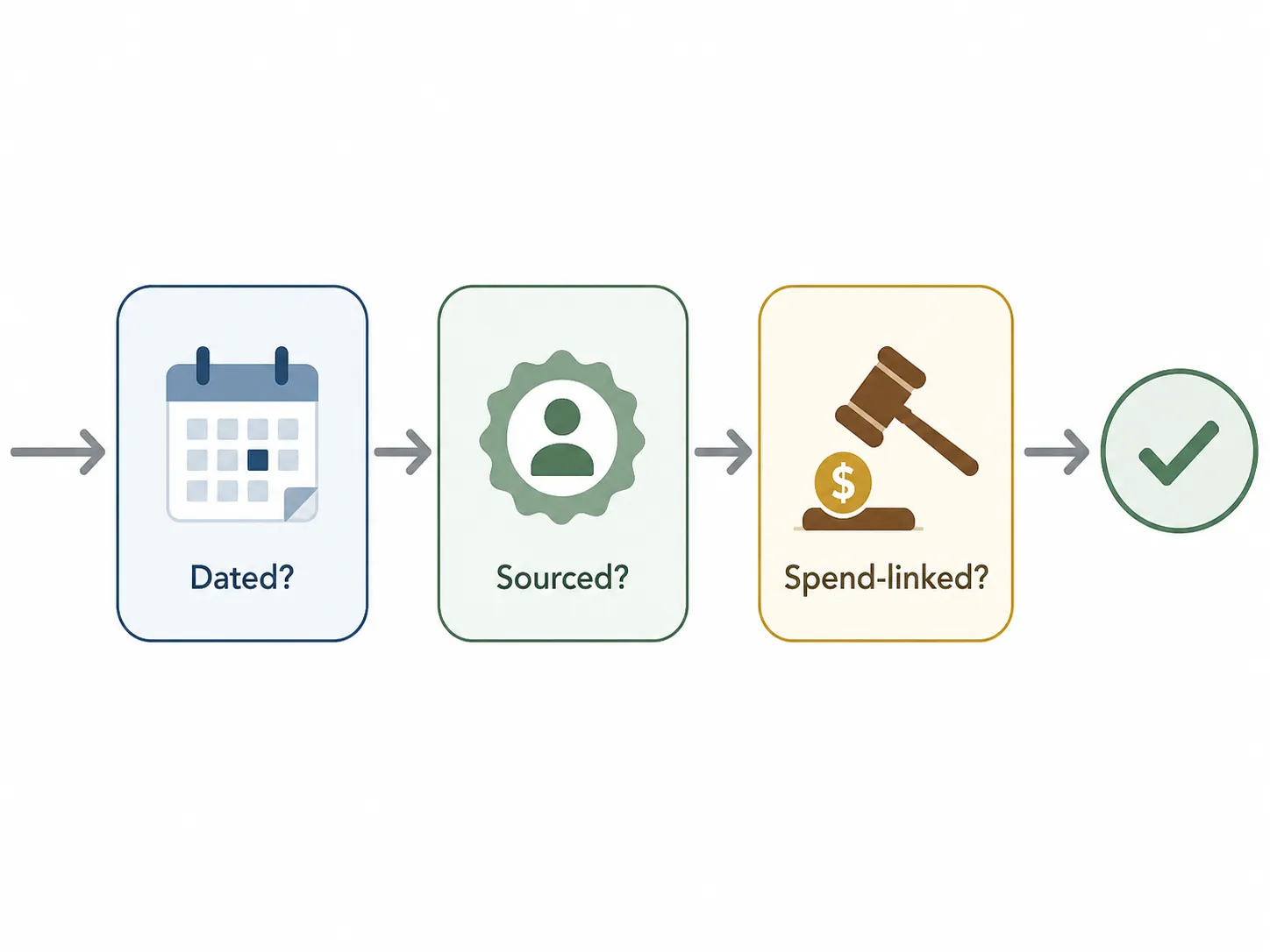
- Dated: the claim has to land in a specific time window, not a vague “advertisers are pulling back” formulation.
- Sourced: the claim has to come from a report, disclosure, survey, platform statement, or account-level record that can be checked.
- Spend-linked: the claim has to touch actual budgets, auction prices, pacing, conversion volume, advertiser withdrawals, platform ad revenue, or liquidity in the buying system.
A software index falling 13% clears the first two gates when it is dated and sourced. It fails the third unless someone shows the media consequence. That distinction matters because ad accounts are full of expensive false positives: scary macro headlines that never show up in CPMs, and platform-friendly reassurance that says automation is efficient without proving demand is intact.
Examples of claims that do not change the budget read yet
- A stock selloff in AI-linked software companies, unless it is paired with advertiser budget cuts or measurable auction changes.
- A capex anxiety story, unless it changes platform capacity, product delivery, pricing, or ad demand in a documented way.
- A vendor statement that AI buying tools are still improving efficiency, unless the claim includes dated performance or spend evidence that can be separated from sales messaging.
- A founder or finance lead saying the company should “pause until the market settles,” unless that becomes an actual budget change.
How to defend a live budget while the market headline is moving
The cleanest answer in a budget meeting is not “the rout doesn’t matter.” It is: “The rout matters to valuation and possibly to capex planning, but we do not yet have a dated signal that it has hit our auctions or spend efficiency.” That keeps the argument anchored to the account instead of forcing the media team to litigate whether AI stocks were overvalued.
For a live PMax or Advantage+ budget, the immediate defense should use account evidence: recent CPM direction, CPC direction, conversion volume, conversion rate, cost per acquisition, return on ad spend, impression share where available, pacing against plan, and any budget edits actually made by stakeholders. If those metrics are stable enough for the business target, an equity-market rout is not a sufficient reason to freeze spend.
There are still reasons to reduce spend, but they should be ordinary media reasons. If acquisition cost has moved outside the allowed range, if conversion quality has deteriorated, if cash constraints have changed, or if leadership has issued a real budget reduction, then spend changes are on the table. The AI market rout can be part of the explanation for why executives are more cautious. It should not be substituted for auction evidence.
The second-order risk is real, just not proven in the ad data here
The cautious reading should not become complacent. Valuation shocks can work through budgets later: hiring freezes, vendor cuts, lower startup confidence, tighter finance approval, delayed launches, and reduced appetite for experimental spend. Those are plausible paths from market stress to ad demand. The current tracker does not rule them out; it says they have not yet appeared in the dated, spend-linked evidence available through July 31.
That “for now” is doing real work. If AI-linked companies start cutting paid acquisition budgets publicly, if platforms report weaker ad demand from software or startup advertisers, or if account-level auction costs move in a way that cannot be explained by seasonality, product changes, or normal volatility, the tracker should change. Until then, the supported conclusion is narrower: equity losses and capex anxiety are visible; a digital ad-demand collapse is not.
Signals that would change the July 31 read
| Signal | Why it would matter | How to treat it |
|---|---|---|
| Platform ad revenue commentary points to demand weakness | This would connect the market environment to monetization, not just investor sentiment. | Check whether the weakness is broad, sector-specific, or limited to one advertiser category. |
| Dated advertiser budget cuts tied to the AI rout | This would turn executive caution into actual spend behavior. | Separate announced cuts from implemented campaign changes. |
| Sustained CPM or CPC movement inside active accounts | Auction prices are closer to the buyer’s actual problem than stock prices are. | Compare against normal seasonality, bid strategy changes, creative rotation, and conversion tracking changes. |
| Auction liquidity changes | Lower competition or reduced spend by a major advertiser set could alter delivery and pricing. | Look for changes in impression volume, win rate proxies, and pacing constraints. |
| Capex cuts that affect platform product delivery | This would be a platform-operating issue rather than an advertiser-demand issue. | Do not classify it as ad-demand weakness unless budgets or auctions also move. |
As of July 31, 2026, the evidence reads as valuation correction and capex anxiety, not digital ad-demand collapse. Keep watching auction costs, platform revenue commentary, budget-cut disclosures, and dated account-level spend changes. Until those move, the AI market rout is something media buyers need to explain, not something that has clearly hit their auctions.
References
- Anthropic-triggered software rout report, Reuters, Feb. 4, 2026, https://www.reuters.com/
Primary source: https://www.reuters.com/