
How NVIDIA's AI chip earnings change what AI ad buyers track
NVIDIA's Q2 FY27 print is a cost-and-demand signal for the AI ad stack, not a ROAS predictor. For PMax, AI Max, and Advantage+ buyers, the dated figures worth tracking are the >15% server price-hike timing, hyperscaler capex, and their own CPC/CPM drift.
- Platform
- Cross-platform
- Change category
- bidding
- Effective date
- 0-08-26
- Change type
- market signal
- Impact level
- low
Record status — August 26, 2026: incomplete pending primary-source verification. The supplied source record does not contain NVIDIA’s official Q2 FY27 results or a reconciled investor-relations calendar entry for the earnings call. The pre-earnings Google Finance snapshot put consensus at approximately $92.16 billion in revenue and $2.09 in EPS, but those estimates must not be treated as the reported print.
| Q2 FY27 measure | Pre-earnings consensus | Official actual |
|---|---|---|
| Revenue | Approximately $92.16 billion | Not verified in the available primary-source record |
| EPS | Approximately $2.09 | Not verified in the available primary-source record |
| Earnings-call timing | Conflicting secondary-source listings | Official IR calendar confirmation required |
Signal or noise: the eventual revenue and EPS comparison will confirm the scale and pace of infrastructure demand, but it will not predict ROAS. The more actionable signal for AI-ad buyers is the August 22 notice that many Vera Rubin and Grace Blackwell server systems shipping early next year would carry price increases above 15%.[1] That creates a monitoring window. A headline beat, by itself, does not.
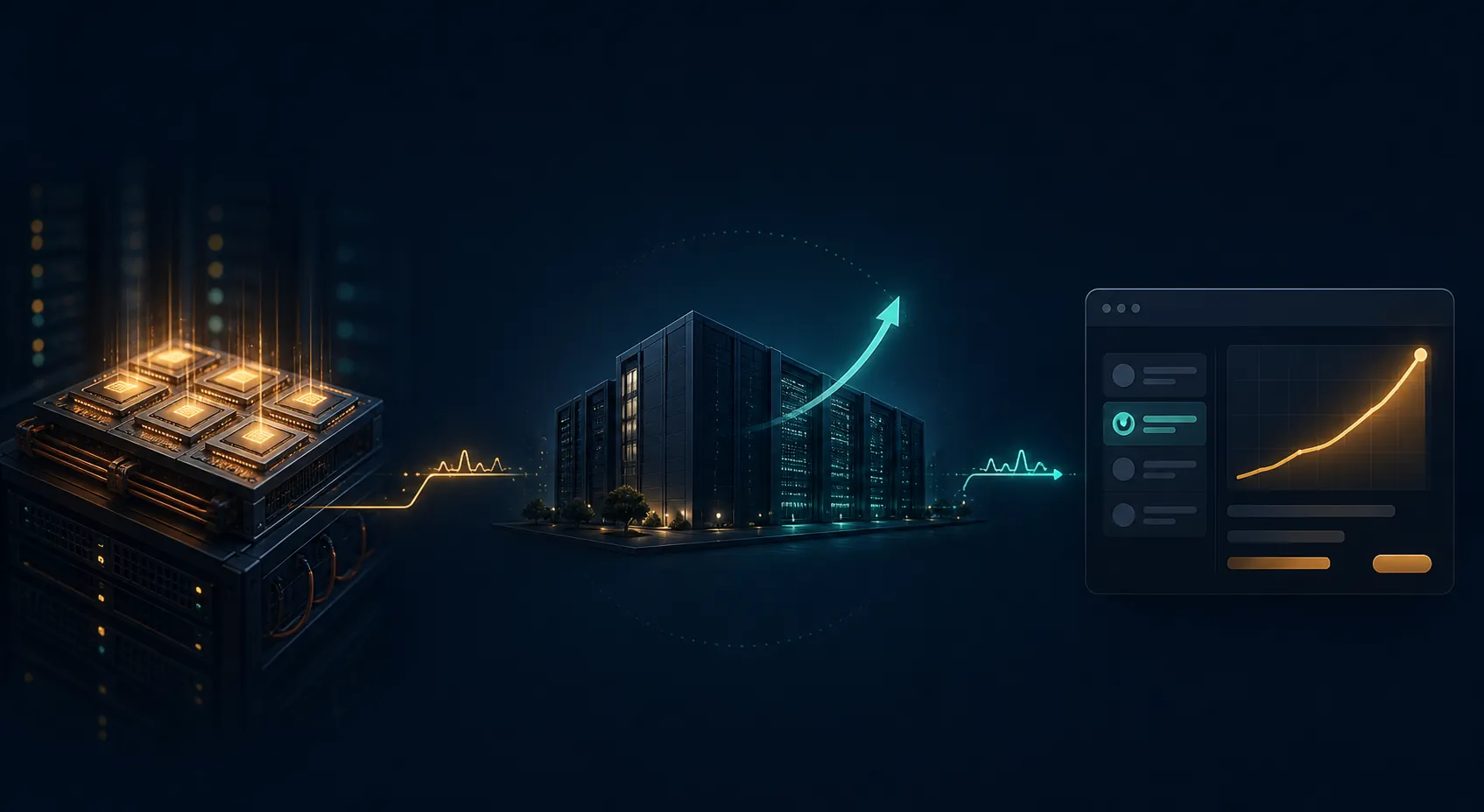
The dated chain behind the earnings event
The useful sequence began before earnings. On August 10, third-party AI-infrastructure financing activity involving Apollo, BlackRock, Blackstone, Brookfield, Goldman Sachs, and KKR drew attention to how capacity is being funded. That activity belongs alongside the existing record of the NVIDIA–OpenAI financing loop; it is not proof that any particular advertising product will become cheaper or more effective.
On August 22, Bloomberg reported that NVIDIA had notified large customers of price increases above 15% in many cases. The increases applied to Vera Rubin and Grace Blackwell server systems expected to ship early in 2027, with memory-chip costs identified as the driver.[1] This is a customer price notice tied to a shipment period, not an engineering benchmark or a forecast about ad auctions.
On August 25, OpenAI disclosed Jalapeño, its custom inference chip. A secondary report said it delivered 1.5 to 1.9 times as much work per watt as NVIDIA GB200 and GB300 systems on OpenAI’s inference benchmarks. The same report quoted OpenAI saying it “will continue to widely deploy accelerators from NVIDIA.”[2] Both parts matter: the benchmark supports a diversification case, while the purchasing statement argues against treating one workload result as evidence of a clean NVIDIA replacement.
The August 26 earnings event then supplied the scheduled checkpoint, although its actual Q2 figures remain unverified in this record. The demand backdrop was already steep: the cited Q1 FY27 data-center revenue was $75.25 billion, up 92% year over year, while supply-related commitments totaled $119.0 billion.[2] Those figures establish scale and commitments; they do not reveal how much of the infrastructure will serve advertising inference, which platforms will absorb higher costs, or whether auction outcomes will change.
How chip pricing could reach an ad account
Signal & Convert synthesis: the plausible path runs from infrastructure cost to platform budgeting, then through product rollout behavior and auction dynamics. No cited source establishes a direct NVIDIA-to-ROAS relationship, and a media buyer cannot observe server acquisition prices inside Performance Max, AI Max, or Advantage+.
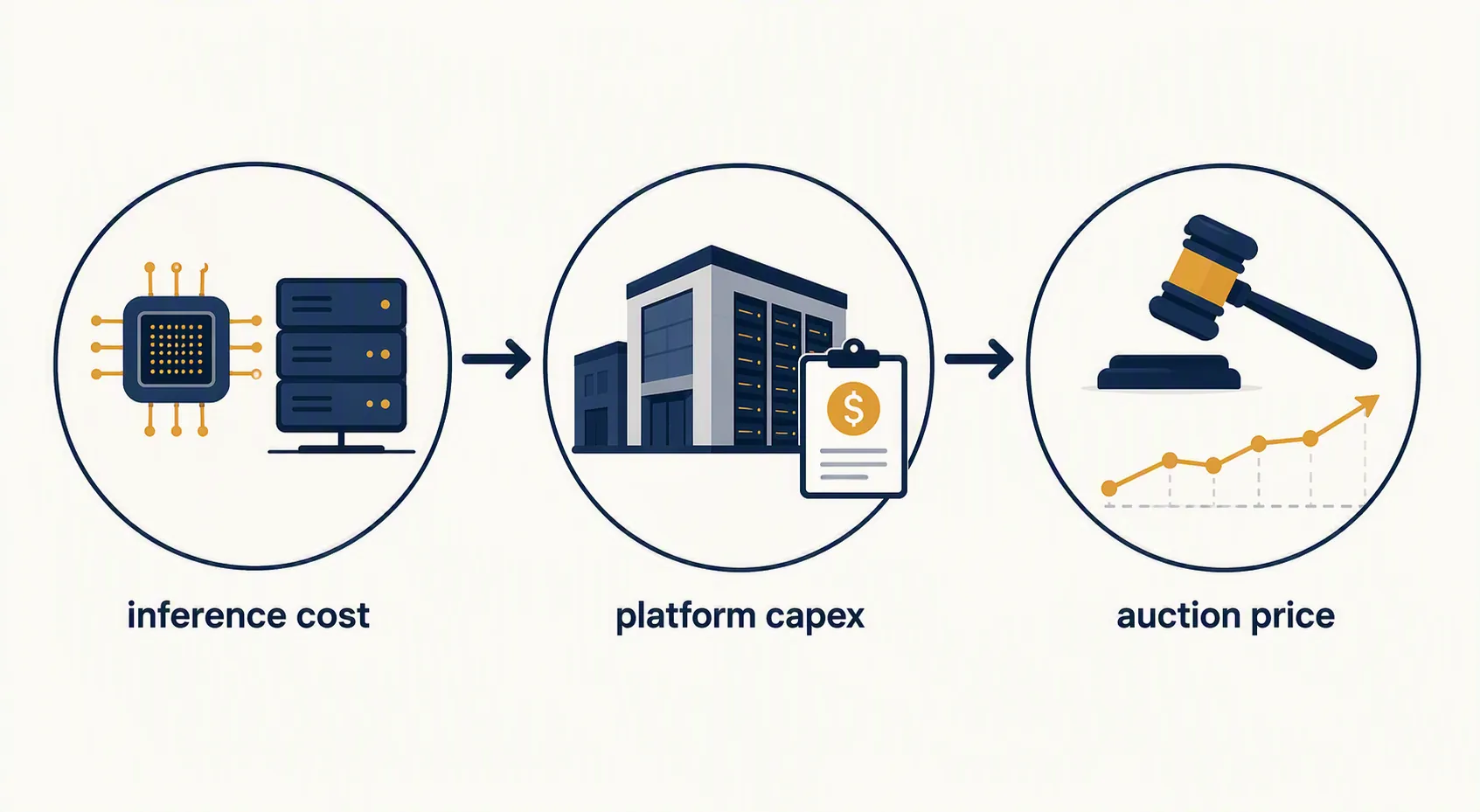
Inference-cost pressure
A server price increase can raise the cost of adding or replacing capacity, but it does not automatically produce a matching increase in the cost of each ad decision. Platforms can negotiate supply, extend hardware life, improve utilization, route workloads to internal accelerators, change model size, or accept lower margins. The August 22 notice therefore starts a test period; it does not settle the result.
NVIDIA has claimed that Vera Rubin can reduce inference-token cost by as much as 10 times compared with Blackwell.[3] That is a vendor projection for its platform, not an independently established cost reduction and not a promise that savings will be passed to advertisers. A higher server purchase price and a lower claimed per-token cost can coexist if throughput and utilization improve enough.
Platform-owned silicon complicates the pass-through further. Google’s TPU 8i and inference-cost record is the relevant counterweight: an ad platform with internal accelerators is not exposed to NVIDIA pricing in the same way as a customer relying entirely on merchant GPUs. OpenAI’s Jalapeño result points in the same strategic direction, but its continued NVIDIA purchasing shows why custom silicon should currently be tracked as workload diversification.
Capex funds deployment, but does not validate performance claims
Meta reported $31.08 billion in Q2 2026 capital expenditures including finance leases and narrowed its full-year capex guidance to $130 billion–$145 billion. Free cash flow fell to $784 million from $8.55 billion a year earlier. At the same time, ad revenue reached $59.36 billion, average price per ad increased 12% year over year, and ad impressions increased 14%.[4] These are observable company financial and delivery measures. They show that infrastructure spending and ad monetization are occurring together, but they do not isolate AI infrastructure as the cause of higher ad prices.
A secondary analysis estimated that Meta’s quarterly capex consumed roughly 98% of its $31.86 billion in operating cash flow. It also reported Alphabet Q2 capex of about $44.9 billion and a raised full-year 2026 guide of $195 billion–$205 billion.[5] That spending supports continued model, data-center, and product deployment. It does not disclose the cost allocated to an individual automated campaign or whether additional inference generates incremental conversions.
Meta has separately stated that Advantage+ passed a $75 billion annual ad-revenue run rate and that its Generative Recommender and GEM models produced 8.3% more Facebook ad clicks and 15.7% more conversions in early deployment.[5] Those are Meta-stated results, not independent benchmarks. They belong in the same evidence class as Google’s product-lift claims, which should be checked against the distinction between AI-advertising results and vendor marketing claims. Buyers deciding how much control to hand over can use the corresponding Advantage+ automation guide without converting company-wide lift statements into an account forecast.
Auction drift is where the buyer can finally observe something
If infrastructure pressure reaches advertisers, it is more likely to appear as a sequence of platform-side changes than as a separately labeled GPU surcharge. A platform might alter feature availability, rollout speed, model routing, campaign eligibility, budget recommendations, or auction participation. Some of those changes could affect CPC or CPM; competitive demand, seasonality, inventory mix, creative quality, conversion tracking, and bidding changes can affect the same measures.

That makes account annotation more useful than reacting to the stock tape. For each material PMax, AI Max, or Advantage+ change, record the rollout date, campaign eligibility, bid-strategy change, budget change, conversion-definition change, CPC, CPM, impression volume, conversion rate, and acquisition cost. Compare like-for-like periods where possible. A movement beginning after a platform rollout is a lead for investigation, not proof that NVIDIA pricing caused it.
The monitoring window
- Now: verify NVIDIA’s official Q2 FY27 revenue and EPS against the approximately $92.16 billion and $2.09 pre-earnings consensus. Until the primary release is captured, do not classify the event as a beat or miss.
- Official calendar check: reconcile the earnings-call date and time against NVIDIA Investor Relations before attaching call commentary to the August 26 event.
- Q1 2027: watch for evidence that the above-15% Vera Rubin and Grace Blackwell server increases took effect on shipped systems, were renegotiated, or were offset by lower per-unit inference costs.
- Subsequent Meta and Alphabet disclosures: track capex guidance, deployment commentary, ad-price movement, impressions, and any dated changes to AI campaign products. Keep financial results separate from vendor-stated product uplift.
- Custom-silicon disclosures: follow which workloads move to TPUs or Jalapeño-class accelerators and whether external NVIDIA purchasing declines, stays additive, or grows alongside internal capacity.
- Each buyer’s account: measure CPC and CPM from a dated baseline, then inspect delivery, auction competition, conversion rate, campaign settings, and rollout eligibility before proposing an infrastructure explanation.
- Next NVIDIA print: compare realized demand, supply commitments, pricing commentary, and the Vera Rubin shipment schedule with this August record.
A possible 2027 IPO could make more of OpenAI’s infrastructure economics checkable, as the August 25 record on a possible 2027 IPO explains. For this earnings event, the nearer test is less dramatic: confirm the official print, wait for early-2027 server pricing to become observable, and keep a dated account log capable of showing whether CPC or CPM actually moved.
References
- Nvidia Customers Notified About AI-Related Price Hikes Above 15%, Bloomberg, August 22, 2026
- OpenAI's Custom Chip Embarrasses Nvidia, While Company Vows to Keep Buying From It, 24/7 Wall St., August 26, 2026
- NVIDIA Announces Financial Results for Fourth Quarter and Fiscal 2026, NVIDIA Newsroom, February 2026
- Meta Reports Second Quarter 2026 Results, Meta Investor Relations, July 29, 2026
- Meta Q2 2026: Ad Machine Strong, Capex Spooks the Street, Digital Applied
Primary source: https://nvidianews.nvidia.com/