
How Google News AI recommendations shrink ad visibility
Four dated changes to Google's news surfaces — For You personalization, AI article overviews, AI audio briefings, and Discover AI summaries — now answer readers inside Google instead of sending them to publisher pages. This tracker record shows how that click-to-citation shift erodes pageviews and viewable ad inventory, and labels Google's 'more engaged audiences' claim as first-party positioning rather than evidence.
- Platform
- Google News
- Change category
- targeting
- Change type
- default-on change
- Impact level
- High
Last reviewed: August 27, 2026
The effect of Google News AI recommendations on publisher ad visibility is ultimately a routing question. Google can send a reader to a publisher page, where an ad has an opportunity to load, or satisfy more of that reader’s need inside Google while leaving the publisher as a citation. The dated record shows a steady expansion of the second route.
| Date | Change | Where consumption occurs | What remains for the publisher | Source |
|---|---|---|---|---|
| 2018 | Google relaunched Discover as an AI-ranked, interest-based feed. | The reader selects from stories ranked inside Google rather than beginning with a publisher or a conventional query. | A linked story card that can produce a publisher visit. | Chartbeat data reported by Press Gazette [1] |
| Ongoing; launch date not established in this record | Google News For You personalizes the story selection shown to each user. | Discovery and prioritization occur in the Google News interface. | The publisher link, subject to being selected by the recommendation layer. | Google News product behavior; launch date not established by cited sources |
| May 2024 | Google rolled out AI Overviews in US Search, extending in-surface answers across a major route to news and information. | A synthesized response appears before a user decides whether source pages are still needed. | Citations and links embedded in or placed around the overview. | Google retrospective and first-party product account [2] |
| December 17, 2025 | Google News began piloting AI article overviews on participating publishers’ News pages and added a fourth Listen tab with AI-generated audio briefings. | Context can be read before a click, while a newsroom-derived briefing can be consumed through in-app playback. | Publisher attribution and links to participating sources. | 9to5Google report on the pilot [3] |
| By June 2026 | AI summaries in Discover had become subject to UK Competition and Markets Authority conduct requirements, including a publisher opt-out. | A summary can address the immediate information need directly in the Discover feed. | Citations to source stories, plus an opt-out whose traffic effect publishers must assess with incomplete click reporting. | Digiday report on the CMA requirements and measurement gap [4] |
The recommendation layer now controls more than story selection
For You is the routing layer. It determines which stories enter a reader’s field of view according to inferred interests and prior behavior. Personalization may be useful: a reader sees relevant reporting without repeatedly searching for it. On its own, however, personalized ranking does not prove that a click has been lost. A conventional story card can still send the reader directly to the publisher.
The commercial mechanism changes when recommendation is combined with summarization or playback. Ranking first selects the reporting; an overview, Discover card, or audio briefing then extracts enough utility from it to delay or remove the need for a visit. The publisher remains visible as a source, but source visibility is not the same transaction as a pageview.
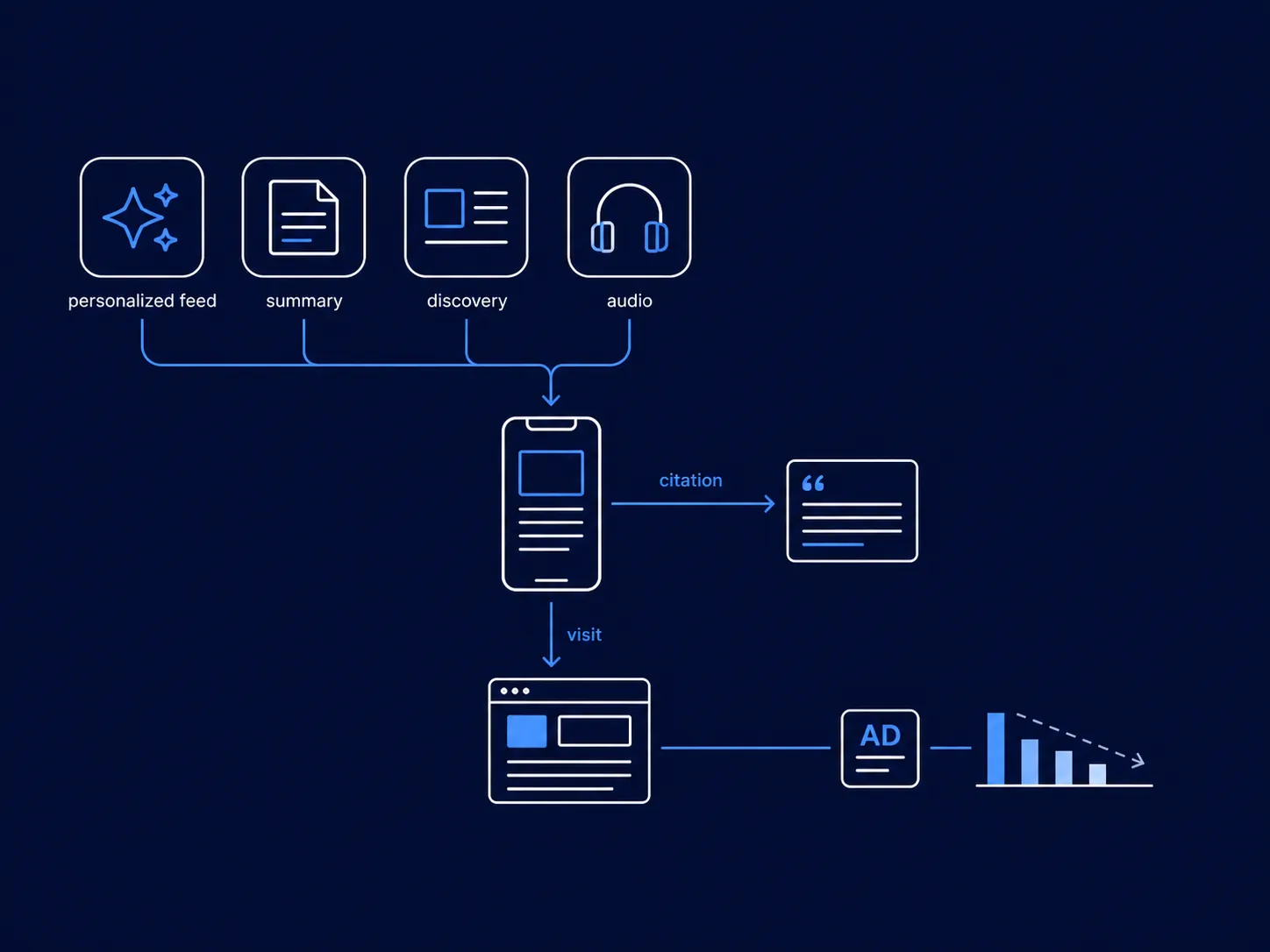
That distinction matters to an ad-operations team. A citation can preserve brand recognition, authority, and a route to deeper reading. It does not open the publisher page containing the ad slots that were included in an inventory forecast. Reader convenience, publisher traffic, and advertiser value therefore cannot be assumed to rise together.
Article overviews move context ahead of the visit
The December 2025 Google News pilot made the substitution mechanism unusually clear. Participating publisher pages received AI article overviews intended to give readers context before they clicked through. This placement changes the order of consumption: the reader obtains a synthesized orientation first and reaches the original article only if the overview leaves a reason to continue.[3]
Some visits may become more intentional as a result. Someone who proceeds after reading an overview could spend longer with the full story or arrive with a better understanding of its relevance. But that possibility concerns the quality of the clicks that survive. It does not establish that the publisher receives enough additional value from those visits to offset the readers whose needs were satisfied before clicking.
The Listen tab turns sourced reporting into an in-app session
Google News’ fourth tab, Listen, carries the process further. Its pilot offered AI-generated audio briefings sourced from participating newsrooms including Der Spiegel, El País, The Guardian, and The Washington Post.[3] Instead of deciding whether to open one of several articles, a user can press play and consume a briefing assembled from that reporting.
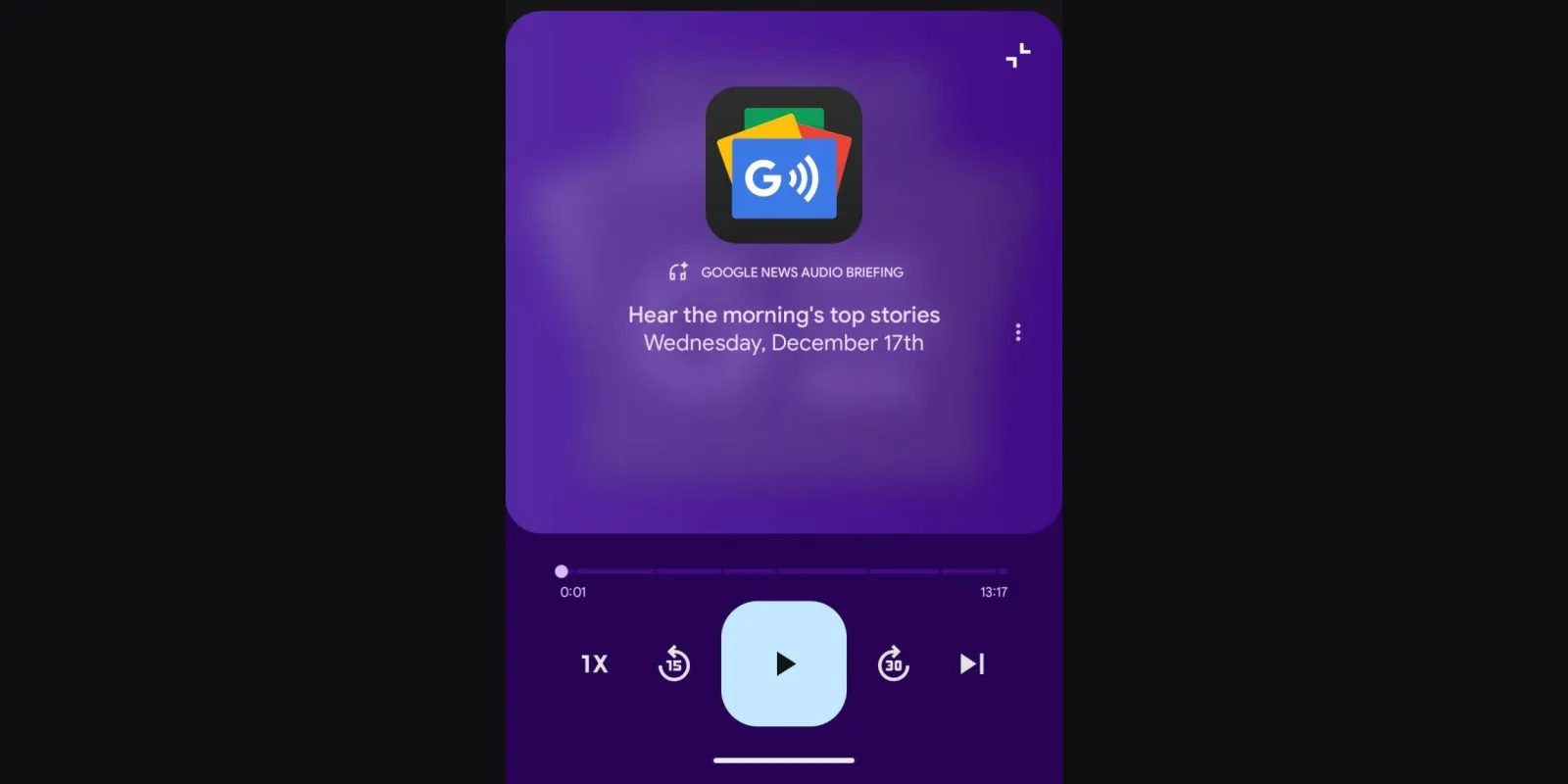
Audio may serve readers who would not have opened a text article at that moment, so not every play should be counted as a stolen visit. The narrower and defensible point is that playback creates a complete consumption option inside Google. When it substitutes for a visit that otherwise would have occurred, publisher attribution survives while the pageview and its ad opportunities do not.
Discover summaries combine scale with limited verification
Discover is the more consequential surface for many news publishers because it is already a major referral source. Chartbeat data covering almost 2,000 news sites found that Discover supplied 68% of their Google traffic, compared with 32% from search, and accounted for about 17% of all publisher traffic.[1] Those figures describe the sites and measurement window in that analysis; they are not Google News app market-share numbers.
Discover sessions are also shallow by design. A reader commonly follows one recommended story and rarely opens a second publisher page, producing fewer pageviews per session than a search visit.[1] Even before summaries are considered, a Discover referral tends to provide a thinner inventory event than a session that continues through related coverage or another section of the site.
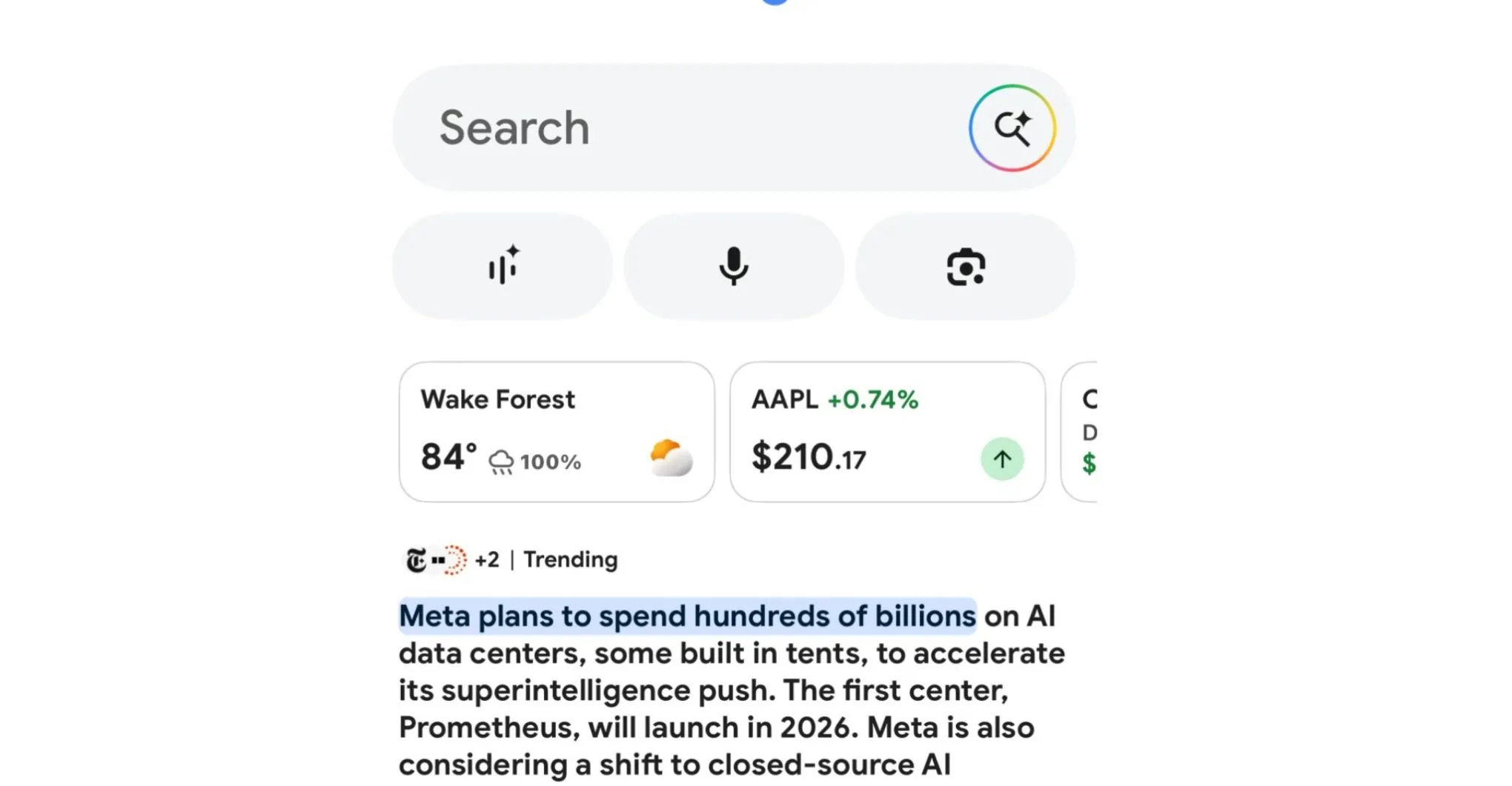
An AI summary adds another decision point ahead of that already-fragile visit. The user can read the synthesized account, inspect the cited outlets, and keep scrolling. A link is still present, but its role has changed from carrying the main answer to supporting an answer already delivered by Google.
The UK CMA requirements reported in June 2026 are significant because they formally cover AI summaries in Discover and require a publisher opt-out. Yet publishers reportedly receive AI impression information without corresponding AI click data, limiting their ability to compare inclusion, citations, visits, and downstream revenue.[4] An opt-out is difficult to price when the operator cannot see how often the summarized exposure converted into a click or replaced one.
The independent traffic record
In a separate, later Chartbeat measurement covering more than 2,500 news sites, Discover referrals were down 21% year over year through November 2025 and 18% compared with May 2023. The same Reuters Institute report said organic search referrals had fallen 33% globally and 38% in the United States.[5] The Discover result should not be blended with the earlier almost-2,000-site traffic-share analysis: one establishes the surface’s importance, while the other records deterioration across a different population and period.
Nor can those declines be assigned entirely to one AI feature. Ranking changes, audience behavior, news demand, publisher mix, and other product changes can move referrals. The data nevertheless show that the Google-controlled surfaces on which publishers depend were sending fewer visits, while Google was adding more ways to consume newsroom-derived information before reaching a publisher page.
Digital Content Next provides supporting but differently scoped evidence. Its member survey found a median 10% year-over-year decline in Google Search referrals during an eight-week period in May and June 2025; participating members derived 78% of digital revenue from advertising.[6] This is a trade-association member aggregate focused on Search, not an independent estimate of Google News or Discover referrals. It helps explain publishers’ commercial exposure, but it does not supply the missing ad-impression measurement.
From a missing click to missing viewable supply
The ad-visibility chain has several distinct stages:
- Google displays or recommends publisher-derived content.
- The exposure becomes either an in-app citation or a visit to the publisher.
- A publisher visit generates at least one pageview and may generate more if the reader continues.
- Each pageview creates opportunities for eligible ad slots to request and serve ads.
- Only a portion of served impressions qualify as viewable.
The final two movements are programmatic-logic synthesis, not measured outcomes in the cited traffic studies. If fewer Google exposures become publisher visits, and all other conditions remain equal, publishers receive fewer pageviews. Fewer pageviews provide fewer opportunities to serve ads, which in turn reduces the pool from which viewable impressions can be counted.
All other conditions do not always remain equal. A publisher could change ad density, refresh rules, lazy-loading behavior, consent rates, page speed, demand partners, or viewability performance. A smaller number of better-qualified visitors might also read more deeply, partially offsetting lost entrances. That is why traffic contraction supports a risk to viewable supply but cannot, by itself, quantify the loss.
Operationally, the first symptom may appear in forecasting rather than a public traffic chart. With fewer eligible pageviews than expected, ad ops revises available inventory, reallocates delivery, or explains why an already-sold campaign is pacing behind plan. Buyers then face a supply change that may be described as an audience-quality improvement even though no comparable publisher-level viewable-impression result has been produced.
Google’s engagement case does not close the measurement gap
Google said in May 2025 that AI Overviews was driving an “over 10% increase in usage.” In August, Google’s Liz Reid described aggregate organic click volume as “relatively stable” and said the clicks sent through AI experiences were of “higher quality.”[2] The December Google News pilot was similarly presented as a way to drive “more engaged audiences.”[3]
These are first-party product and performance claims. Increased Google usage measures activity on Google, not publisher pageviews. “Higher quality” may describe users who remain after summaries filter out casual clicks, but it does not show that resulting publisher revenue, served impressions, or viewable impressions offset the traffic that disappeared. “Relatively stable” aggregate clicks can also coexist with sharp losses for particular publisher categories or referral surfaces.
Validation would require comparable reporting that joins Google-surface exposure to publisher clicks and then to publisher outcomes: landing-page sessions, pages per session, served impressions, viewable impressions, and revenue. The same discipline used to separate claims from measurable ad-market outcomes in the YouTube TV price tracker applies here.
This record is deliberately publisher- and inventory-centered. It does not measure the consumer welfare created by faster summaries, better personalization, or accessible audio briefings. It measures whether newsroom-derived consumption still reaches the pages where publishers can serve ads. The product design and independent referral declines establish a structural risk to that supply. A quantified loss of viewable ad impressions remains unproven until publishers disclose comparable served- and viewable-impression changes tied to these referral surfaces.
References
- Google Discover now drives more traffic to publishers than search — Press Gazette, August 2025
- AI in Search is driving more queries and higher quality clicks — Google, August 6, 2025
- Google News tests AI article summaries and audio briefings — 9to5Google, December 17, 2025
- Google’s AI opt-out leaves publishers with a choice they can’t safely use — Digiday, June 8, 2026
- Journalism, media, and technology trends and predictions 2026 — Reuters Institute for the Study of Journalism, January 12, 2026
- The facts: Google’s push to AI hurts publisher traffic — Digital Content Next, August 14, 2025
Primary source: https://blog.google/products/search/ai-overviews-more-queries-and-higher-quality-clicks/