
Does google.com/goto break paid search tracking?
Google confirmed the google.com/goto passthrough redirect on August 26, 2026. This dated Tracker record explains why the paid-search exposure sits between the SERP and the landing page rather than in Ads' own counting, and why gclid and UTM survival through the hop still needs an account-level verification test.
- Platform
- Google Ads
- Change category
- policy
- Effective date
- 0-08-26
- Change type
- default-on change
- Impact level
- Medium
Tracker record: google.com/goto and paid search tracking
Status as of August 28, 2026: Google confirmed on August 26 that it is using a Google-controlled passthrough redirect to protect Search from abuse. The confirmed behavior applies to organic-result links. Reports of the same mechanism appearing on some paid ads remain unconfirmed. Google has not documented whether gclid, UTM, or other click parameters survive the new hop.
| Question | Current answer |
|---|---|
| What is google.com/goto? | A Google-controlled redirect that can rewrite a result URL as google.com/goto?url=[hash] before sending the user to the destination. |
| Is paid-search exposure confirmed? | No. Practitioners have reported seeing it around some ads, but Google’s confirmation describes organic results. |
| Does it break Google Ads click counting? | There is no evidence here that Google Ads’ own counting is the leading failure point. |
| Do gclid and UTM parameters survive? | Undocumented. Treat survival as an account-level verification question. |
| Does it change rankings or final landing URLs? | No change is currently reported; Search Engine Land assesses Google Search Console data as unaffected. |
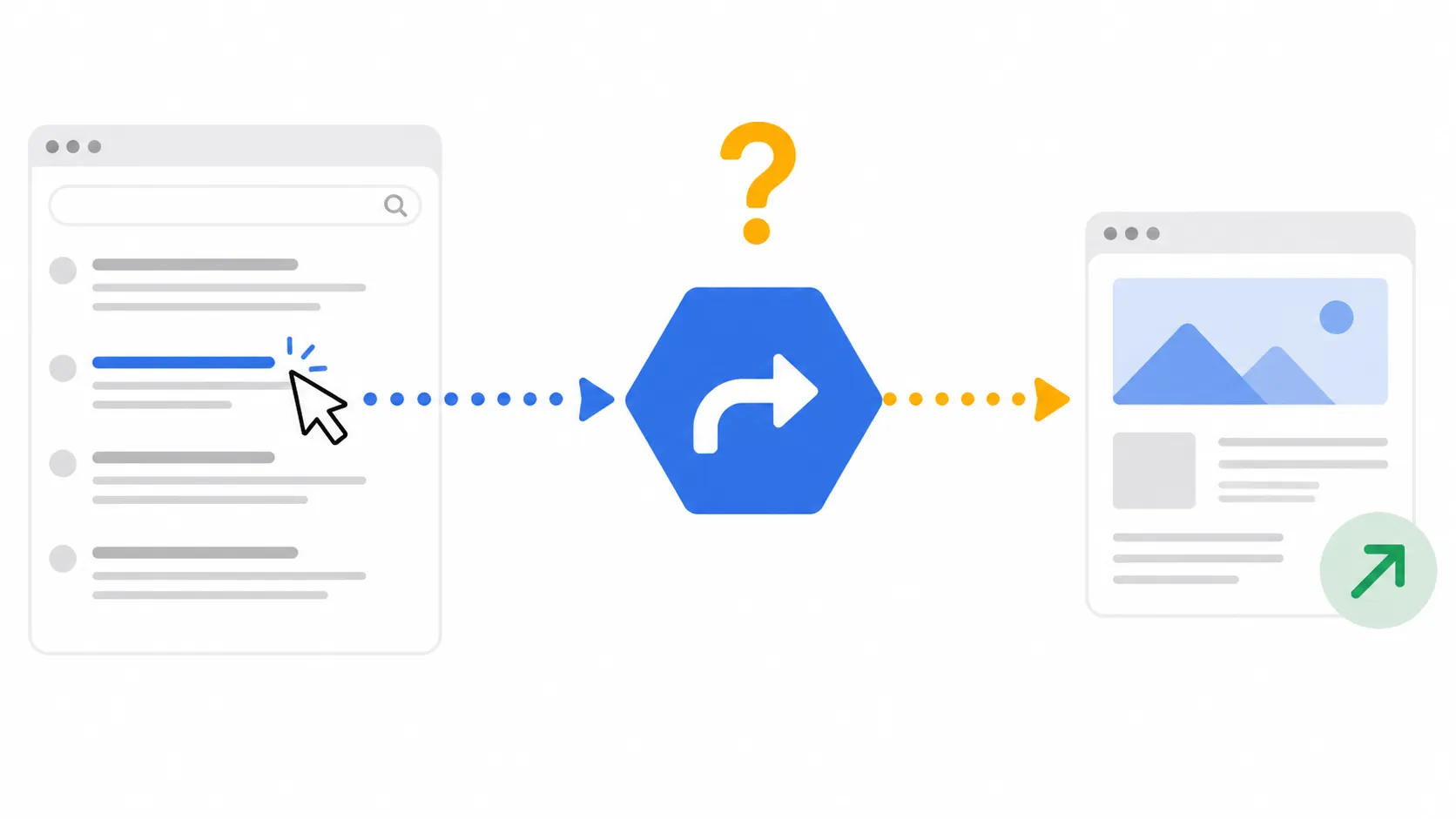
The practical answer is narrower than “Google broke tracking.” If a paid click is exposed to the redirect, the risk sits in the handoff between the search result and the landing page: a third-party click tracker, a tool that parses the destination URL, a referrer-based attribution layer, or server-side logic that expects to see the original URL. Google Ads reporting can remain populated while one of those neighboring systems loses the information it uses to classify or attribute the visit.
The click path has more than one measurement boundary
The reported path is straightforward: a user selects a result, Google serves a URL in the form google.com/goto?url=[hash], and Google’s server then redirects the request to the real destination. That is the supported description of the new hop, not a technical specification of what happens to every query parameter.
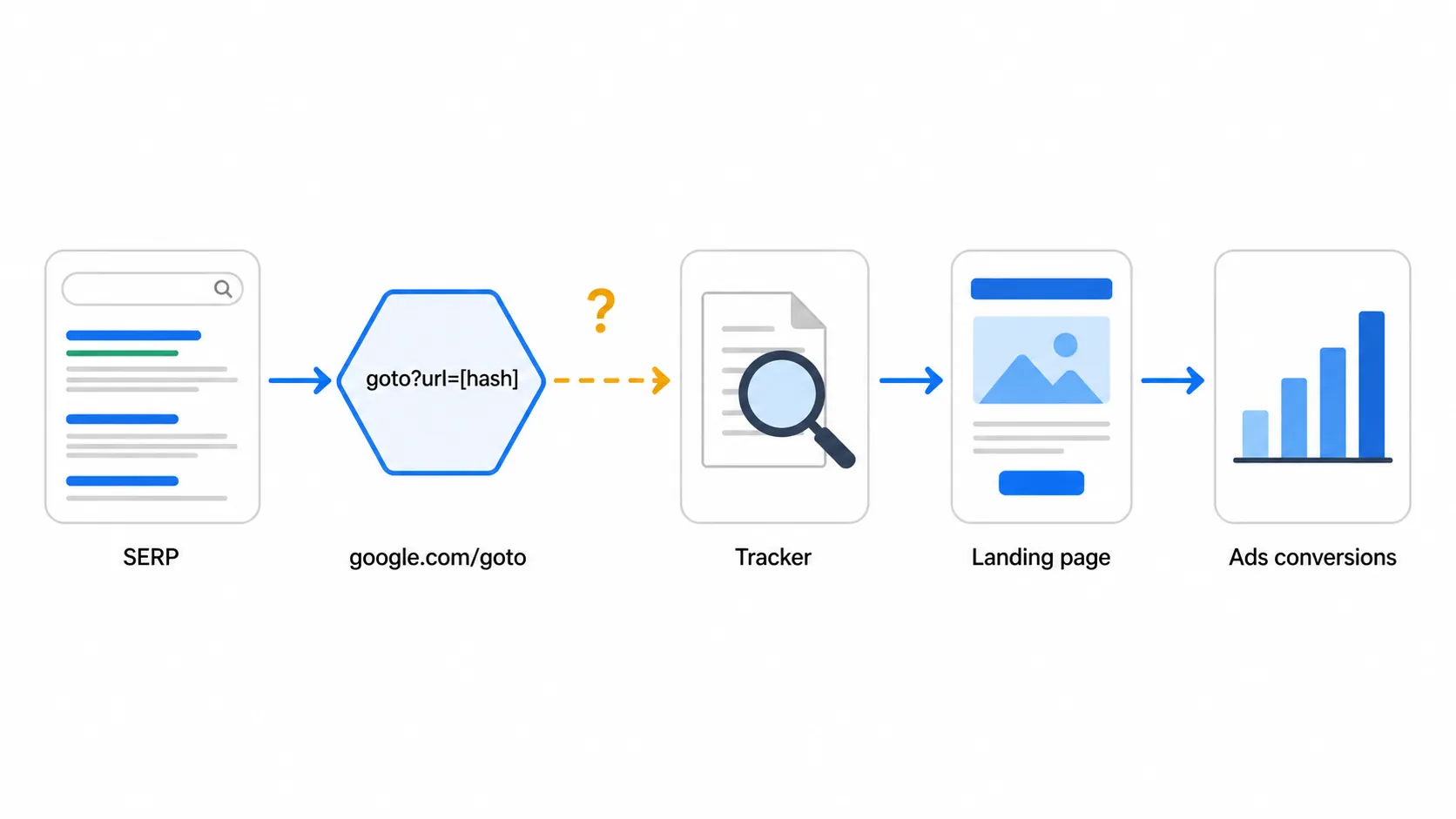
For an account operator, the useful model is:
- Search result or ad click
- Google-controlled goto redirect
- Third-party tracker, destination parser, or intermediary attribution layer
- Final landing page and its server logs
- Google Ads, GA4, CRM, and conversion-reporting systems
The question is therefore not simply whether the user reaches the page. The user may arrive normally while the intermediary fails to recognize the click, the landing page receives a different query string, or an attribution system records direct or referral traffic instead of paid search.
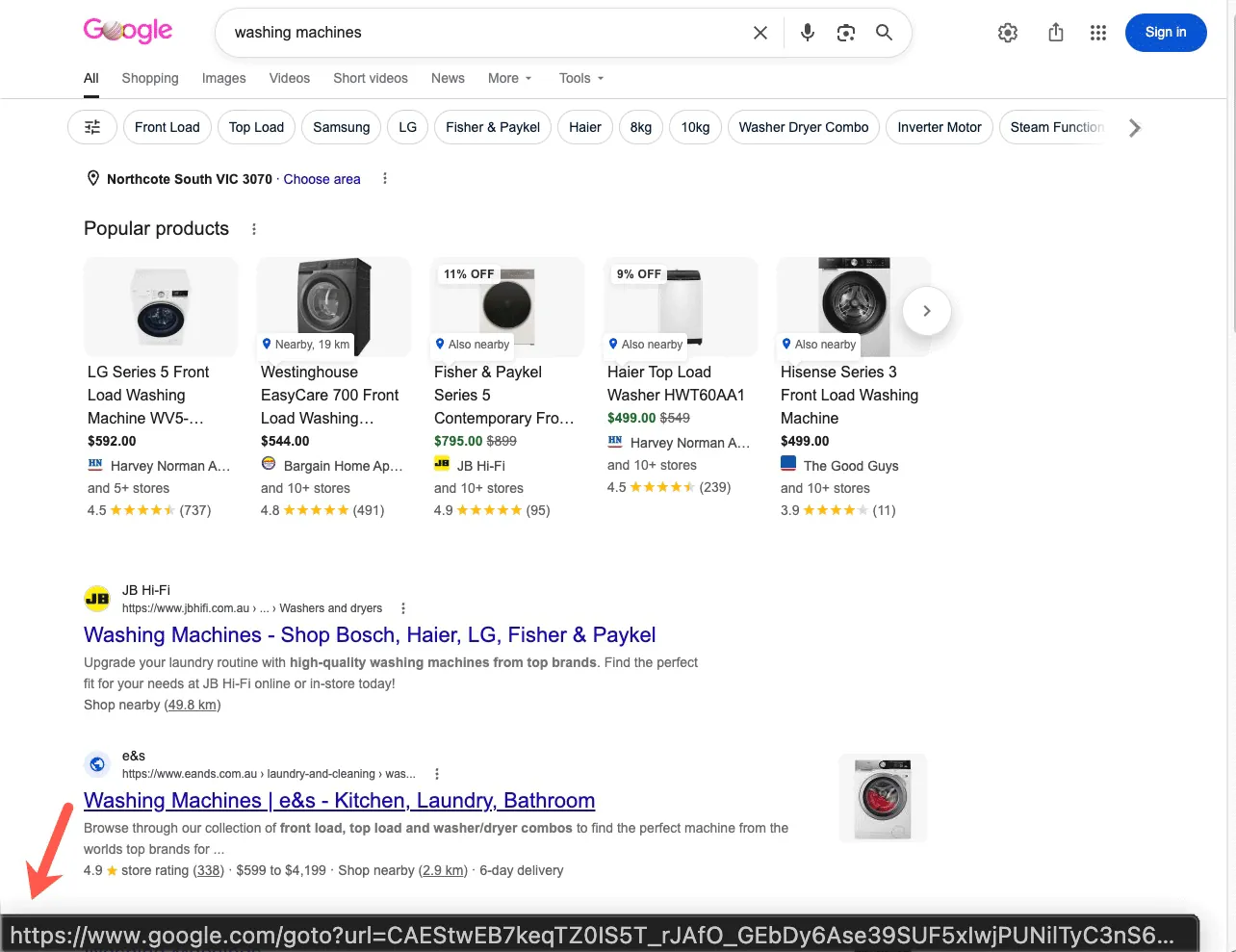
Search Engine Roundtable documented the rewritten links in a July 8 test report, after Alex Greenland’s June 23 public sighting.[1] The visible URL is useful evidence that the hop exists, but it does not by itself show whether the original destination query string is preserved after the server-side redirect.
What Google Ads already documents—and what it does not
Google Ads’ existing measurement rules provide the baseline. With auto-tagging enabled, Google Ads appends a gclid to the clicked URL. For conversion measurement to work, the site’s own redirects must pass that identifier through to the final page. GA4 prioritizes auto-tagging over manual campaign tagging, so a UTM configuration does not automatically override the gclid path.
Those rules describe the pre-goto click pipeline and the advertiser’s redirect handling. They do not document the new Google-controlled hop. Extending them to conclude that goto definitely preserves—or definitely strips—gclid and UTM parameters would go beyond the available evidence.
The same distinction matters for parallel tracking and certified third-party click trackers. Parallel tracking remains the Google Ads click-measurement method, while certified trackers are expected to expose a visible next-hop parameter and treat UTM and affiliate parameters as foreign parameters. An intermediary that works correctly under the existing Ads flow may still need testing when an additional Google redirect appears before it.
Operators inspecting ValueTrack data should also keep the familiar fields in view: {lpurl}, {gclid}, {matchtype}, {network}, {device}, {targetid}, {campaignid}, and {adgroupid}. In AI Max traffic, {matchtype}=a and a kwl- value in {targetid} identify keywordless matching. That helps explain what Ads generated for the click; it does not prove that a later goto hop delivered every value to the destination.
A small but relevant control: tracking-template changes can take 24–48 hours to propagate. A test run immediately after changing a template can therefore confuse propagation delay with parameter loss at goto.
The account-level test that can answer the paid-search question
The right response is a controlled comparison, not a platform-wide assumption. Use a test destination and record the complete URL at each boundary. The test should compare a click that follows the ordinary path with one observed through google.com/goto, while keeping the ad, tracking template, device, and destination conditions as consistent as possible.
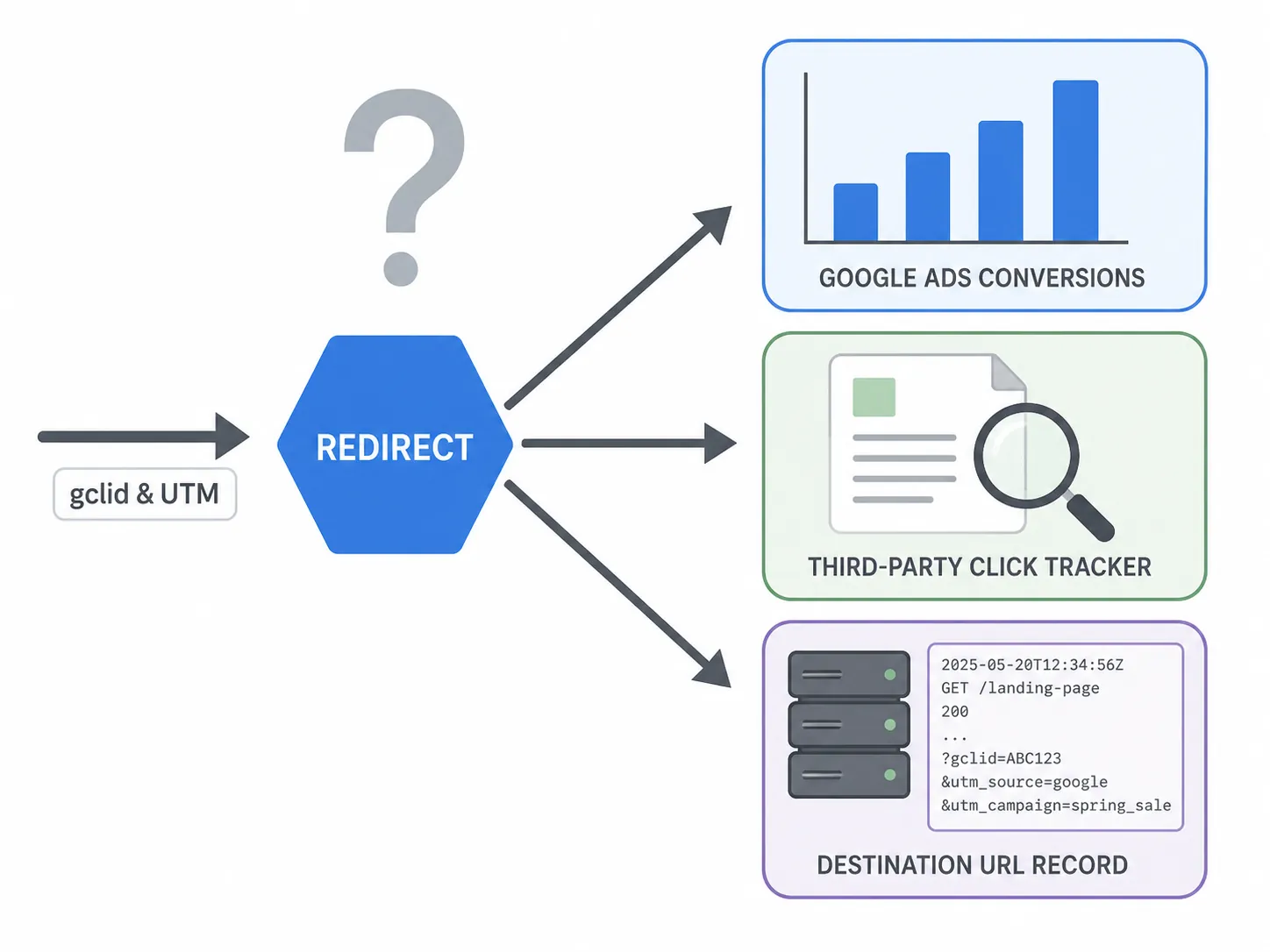
- Capture the ad-side values, including the final tracking-template expansion and any gclid or ValueTrack fields used by the account.
- Inspect the first request visible to the intermediary tracker. Record whether the request reaches that tracker and which query parameters it can read.
- Inspect the final landing-page request and server logs. Compare the received gclid, UTM, affiliate, and other campaign parameters with the values recorded at the ad side.
- Compare the resulting records in Google Ads, GA4, the click tracker, and the CRM or conversion store. Look for disagreement in click identity, source classification, session attribution, or conversion association.
Evidence of parameter survival would be the same identifier appearing at the relevant handoffs and being available to the system that needs it. Evidence of a tracking problem would be a reproducible disappearance, rewrite, or misclassification at a specific boundary. A missing value in one report alone is not enough to identify goto as the cause.
If a tracking-template change is part of the test, wait for the documented propagation window before drawing a conclusion. Also preserve the raw request and redirect records; screenshots of the browser address bar cannot establish what the server sent between hops.
What is confirmed, and what remains a report
Google confirmed the redirect on August 26 using broad anti-abuse wording: “We have a long history of deploying technical measures against evolving forms of abuse, and we regularly take steps to protect our services and users.”[1][2] Google did not publish a parameter-by-parameter explanation, rollout schedule, or statement confirming paid-ad coverage.
Nozzle’s Derek Perkins reported nearly a 100% rollout across several residential IP providers and said goto links could not be decoded client-side. Search Engine Roundtable’s earlier inability to reproduce the behavior sits alongside that report rather than canceling it out: the available evidence points to an uneven rollout across environments, not a universal experience.[1]
The Reddit discussion describing Google as wrapping organic results and “some ads,” and Alex Li’s LinkedIn warning that a Google Ads passthrough could affect branded paid traffic and search attribution, are useful explanations for why operators are asking about paid search. Neither establishes the behavior across Google Ads accounts, so neither should be used as proof that paid ads are being rewritten.
The change is not described as a ranking update. Search Engine Land’s assessment is that Google Search Console data is not impacted, although third-party Google Search tracking tools may be.[2] Crawl Vision similarly characterizes the measure as abuse protection rather than an algorithm change and says most sites do not need a technical SEO response.[3] Those conclusions answer adjacent SEO concerns; they do not settle parameter survival in a paid-search measurement stack.
For the broader measurement context, see the site’s GA4 measurement setup and the Tracker record on Search Console limits for paid measurement. Accounts using AI Max can cross-check the related campaign setup notes when reviewing ValueTrack output.
As of August 28, Google Ads’ own counting is not the leading suspected failure point. The sensible scrutiny belongs on intermediary trackers, destination parsing, referrer handling, and the final URL record. Until Google publishes technical documentation or reproducible tests establish the behavior, gclid and UTM survival through google.com/goto remains an explicitly dated, account-level verification task—not a confirmed break and not a confirmed non-issue.
References
- Google Search Testing New Google.com/goto As Tracking URLs — Search Engine Roundtable; July 8, 2026.
- Google Confirms Deploying Goto URL Redirects To Search Results Links — Search Engine Land; August 26, 2026.
- Google Search Goto Tracking URLs — Crawl Vision; 2026.
Primary source: https://searchengineland.com/google-confirms-deploying-goto-url-redirects-to-search-results-links