
HubSpot Breeze
Struggling to tell if an AI email tool is genuinely improving with your data or just spitting out generic copy? This article provides a decision framework to distinguish account-learning AI from generative-only tools, backed by real testing evidence.
Marketing Categories
⚠ Notable Limitations
Account-learning features require higher-priced tiers
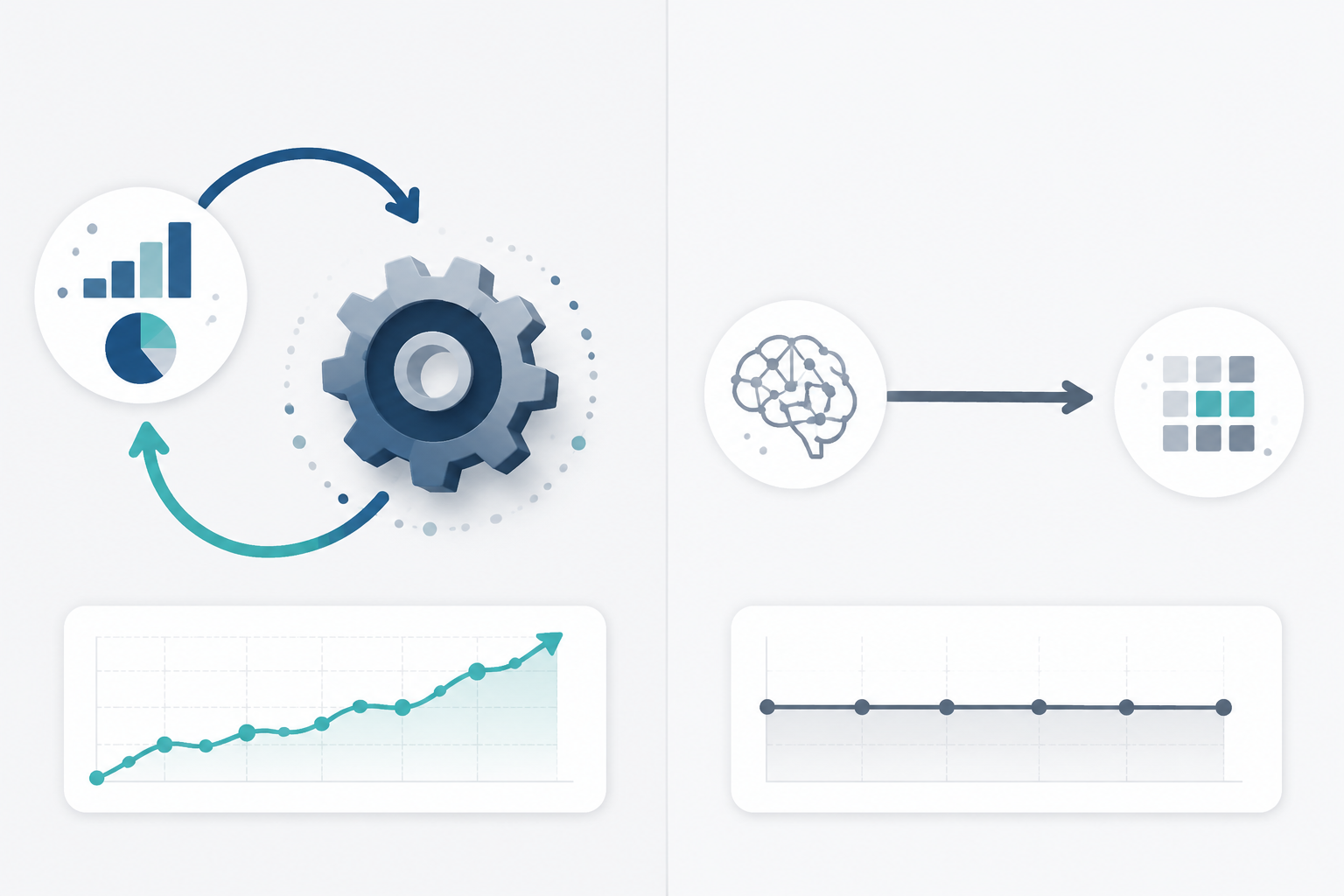
Two ai email marketing tools can both promise smarter campaigns and mean very different things. One may remember which audiences responded, adjust send-time recommendations by contact, suggest segments from prior behavior, and get more useful as campaigns accumulate. The other may write a cleaner subject line from a generic model, then start from roughly the same place next week.
That distinction matters more than the demo output. A good first draft saves time; an account-learning system changes the amount of remedial work the team has to do after every send. If six months of campaigns have not made the recommendations sharper, the platform may be convenient, but it has not become much smarter for your business.
The Useful Split: AI That Learns vs. AI That Generates
The fastest way to evaluate an AI email platform is to ask what changes after your own campaigns run. Does the tool retain account context? Does it use engagement history to adjust future recommendations? Does it build segments, send-time predictions, or audience guidance from behavior inside your account? Or does it mainly generate copy, subject lines, product blurbs, and variants from a prompt?
Venture Harbour’s 2026 testing framework makes this split explicit: it separates platforms that learn from campaigns, tone, and audience behavior from tools that mostly accelerate production through generic generation. Its strongest example is ActiveCampaign’s Active Intelligence, which Venture Harbour describes as learning campaigns, tone, and audience patterns over repeated use rather than merely producing one-off assets.[1]
| Buyer Question | Account-Learning AI | Generative-Only AI |
|---|---|---|
| What data does it use after launch? | Campaign history, engagement behavior, CRM or commerce context, and prior audience response | The current prompt, selected fields, brand instructions, or a generic model context |
| What improves over time? | Recommendations, predictive segments, send-time choices, and sometimes tone or audience fit | The team’s prompt quality and production speed |
| What should the demo prove? | How recommendations change after campaigns run | How fast the tool creates drafts or variants |
| Main risk | The useful learning features may be locked behind higher plans | The team mistakes faster drafting for compounding intelligence |
This is not a purity test. Generative tools are useful. They can remove blank-page friction, speed up lifecycle copy, draft promotional angles, and help a small team ship more consistently. The problem starts when the same AI label is used for autocomplete, predictive sending, segmentation, and account-aware recommendations as if they were the same class of capability.
The Buyer Test Before You Watch Another Demo
Before comparing vendor pages, put four questions in front of the sales call:
- What campaign, audience, CRM, ecommerce, or engagement data does the model retain at the account level?
- Which recommendations change after campaigns run, and can the vendor show that change inside the product?
- Which AI features depend on historical engagement rather than a prompt?
- Which plan unlocks those features, and is that the plan actually being budgeted?
The fourth question is where many evaluations become real. A platform can honestly say it “has AI” while the capability that learns from your account sits above the tier being quoted. That is not a semantic issue; it changes the business case. If the budget only covers drafting assistance, do not defend the purchase internally as though it will produce account-level optimization.
ActiveCampaign Is the Strongest Case for Compounding Learning
The most useful evidence in the current market is not a polished AI-written email. It is Venture Harbour’s long-running practitioner account of testing ActiveCampaign over 14 years, because it pays attention to the thing buyers usually cannot see in a demo: what happens after repeated campaign history accumulates.[1]
In that testing narrative, ActiveCampaign’s Active Intelligence is treated as a true AI assistant that learns from campaigns, tone, and audience behavior. The reported advantage is not that it can write copy. It is that per-contact predictive sending and segment recommendations improve as the system observes more campaigns and more engagement patterns.[1]
Per-contact predictive sending is a good place to separate platform intelligence from writing assistance. A copy generator can suggest “Last chance” or “Your offer ends soon.” A learning email platform can use prior engagement signals to decide when a specific contact is more likely to open or click. That means the operational burden shifts: instead of the team manually guessing send windows for broad segments, the system applies contact-level timing decisions based on behavior it has seen.
Segment recommendations matter for the same reason. Most teams already know they should segment more carefully; the work falls apart in the details. Someone has to decide which behaviors indicate buying intent, which contacts are cooling off, and which audience cuts are worth sending to. Venture Harbour’s account of ActiveCampaign emphasizes predictive segments that become more useful with repeated campaign data, which is the kind of compounding behavior a buyer should look for when a vendor claims the platform “learns.”[1]
Tone and audience learning are more subtle. They are also easier to oversell. A system that can reference previous campaigns may help keep emails closer to the brand’s established style, but the stronger buying case is not “the AI sounds like us.” It is that the platform connects that account context to engagement outcomes: which messages different groups received, how they behaved, and what the system recommends next.
There is a caveat. Venture Harbour’s ActiveCampaign evidence is practitioner testing, not an independent benchmark proving a universal lift for every account. It is still valuable because it follows use over time and focuses on behavioral features, but it should be read as a strong field signal rather than a guaranteed result.[1]
HubSpot Breeze Shows Why “Has AI” Is Too Weak
HubSpot is the example that should slow down a budget conversation. Venture Harbour’s review describes a practical gap between Breeze at the Starter level, around $450 per month, and the more differentiated account-learning AI available at Pro+ tiers starting around $890 per month.[1]

That gap is the tier trap. At the lower tier, AI can feel present because the product can help generate content and use CRM fields. For many teams, that is genuinely helpful. It can make email production faster, especially when the team already lives in HubSpot and wants fewer disconnected tools. But the more important question is whether the system is making richer recommendations from account data, not whether it can fill in a merge-field-aware draft.
The budget consequence is simple. If the business case assumes learning intelligence, but the approved plan mostly provides generation, the marketing manager inherits the gap. The executive sponsor remembers the AI promise. The team still has to manually diagnose weak segments, adjust nurture timing, and explain why the platform did not appear to get smarter after a dozen sends.
This is also where buyers comparing larger suites should keep total cost in view. A related platform comparison such as HubSpot vs Marketo vs Salesforce AI is useful only if it separates the AI features included in the quoted tier from the features shown in the most impressive demo.
Pricing and product packaging also move quickly. The Starter-versus-Pro+ distinction should be verified against current HubSpot pricing at purchase time, especially because Breeze is evolving through 2026. The durable lesson is not one static price point; it is that meaningful learning features tend to appear higher in the package ladder.[1]
Omnisend’s Learning Is Narrower, and That Is Not a Flaw
Omnisend is easier to understand if it is judged as an ecommerce system rather than a universal email intelligence layer. Venture Harbour highlights Brand Assets AI and a natural-language segment builder as useful account-learning features for ecommerce teams.[1]
That specificity is a strength when the buyer’s workflow matches it. Ecommerce email teams care about product context, promotion cadence, customer behavior, abandoned carts, repeat purchases, and recognizable brand assets. A tool that learns inside that world can be more useful than a broader platform that treats every campaign as interchangeable marketing copy.
The boundary is just as important. Omnisend’s ecommerce-oriented learning does not automatically solve the same problem for a B2B demand generation team with long sales cycles, complex account hierarchies, and CRM-stage dependencies. It belongs in the account-learning group, but the right question is still whether its learning surfaces map to the buyer’s actual email decisions.
Where Mailchimp, Brevo, Campaigner, and Jasper Fit
Mailchimp, Brevo, Campaigner, and Jasper are useful in a different way. Venture Harbour classifies these as generative-only or primarily velocity-oriented tools in this context: they help produce copy, subject lines, variants, or campaign assets faster, but they do not provide the same evidence of persistent account-level learning that it attributes to ActiveCampaign, HubSpot’s higher tiers, or Omnisend.[1]
For a lean team, that can still be enough. If the bottleneck is that campaigns sit in draft for too long, a generative assistant may create immediate value. If the lifecycle program is already segmented and the team mainly needs more subject-line options or promotional angles, faster production is a real operational win.
It becomes the wrong purchase when the team expects the tool to learn which accounts are warming, which customers need a different offer, or which segments should be suppressed. Jasper, in particular, should be evaluated as a content generation system, not an email platform that owns campaign behavior. Teams weighing that distinction may find a focused comparison such as HubSpot AI Content Assistant vs. Jasper more relevant than a generic AI tools roundup.
Other Reviewers Are Also Separating Platform Intelligence From Velocity
Venture Harbour is carrying most of the specific learning-versus-generating argument here, so it is worth checking whether that distinction shows up elsewhere. ZoomInfo’s 2026 B2B evaluation uses a revenue-engine framing that favors tools connected to pipeline, CRM, and go-to-market workflows rather than treating all AI email features as copy assistance.[2]
Simular’s hands-on 2026 review draws a related boundary with categories such as Platform AI, Velocity AI, and Agent AI. That framework is not identical, and its Agent AI category is still emerging, but it reinforces the same buyer instinct: a tool that helps you move faster is not the same as a platform that uses embedded workflow data to make decisions.[3]
These secondary frameworks should not turn the buying process into taxonomy homework. Their value is narrower: they corroborate that the market is no longer usefully described by a single “AI email” bucket.
Why This Distinction Affects ROI Claims
The reason teams care about AI in email is not mysterious. Digital Applied’s 2026 statistics report cites a 26% open rate lift and a 41% revenue lift in the context of AI-driven email marketing benchmarks.[4] Those are the kinds of figures that make AI upgrades feel urgent in a planning meeting.
But ROI statistics do not tell you which mechanism produced the lift. Better subject lines, cleaner personalization, send-time optimization, segment selection, and lifecycle timing can all affect performance. If a vendor points to broad AI email gains, the buyer still has to ask whether the quoted tool and tier include the features most likely to create those gains.
Adoption data has the same limitation. Forbes Advisor reports that 47% of email marketers use AI, and that 49% of those users use it for content generation.[5] That tells us AI is already part of email work, but it also suggests a lot of usage may be concentrated in drafting and production rather than deeper campaign learning.
That is not bad news. It just means adoption is not the same as effectiveness, and content generation is not the same as account intelligence. If the internal goal is to reduce production drag, usage of generative AI may be enough. If the internal goal is to improve targeting, timing, and recommendations over time, the platform needs behavioral data and features that can act on it.
What to Ask Vendors for Proof
A serious vendor should be able to show more than a prompt box. Ask for a walkthrough that starts with historical campaigns, not a blank draft. The useful proof is visible change: recommendations before and after engagement data, segment suggestions tied to actual behavior, and send-time or audience guidance that depends on more than a static rule.
- Ask which features use your historical engagement data and which features only use the current prompt.
- Ask whether predictive sending works at the contact level, segment level, or only as a general recommendation.
- Ask to see how segment recommendations are generated and whether the system explains the behavioral signal behind them.
- Ask whether brand tone learning is connected to performance data or only to stored writing guidelines.
- Ask for the exact plan name and price required for every AI feature shown in the demo.
The plan question should come last in the demo and first in the buying memo. Many teams do not lose money because they picked a bad AI feature; they lose money because they bought the cheaper tier while defending the decision with the higher-tier story.
A Practical Read on the Current Field
| Tool | Best Read From the Available Evidence | Main Buyer Caution |
|---|---|---|
| ActiveCampaign | Strongest available account-learning case, with practitioner-observed improvement across predictive sending and segment recommendations | Evidence is longitudinal practitioner testing, not an independent universal benchmark |
| HubSpot Breeze | Potentially powerful when deeper account-aware features are available in higher tiers | Starter-level AI may feel included while the more differentiated learning sits behind Pro+ pricing |
| Omnisend | Meaningful ecommerce-specific account learning through features such as Brand Assets AI and natural-language segment building | Best fit depends on whether ecommerce behavior is the core email workflow |
| Mailchimp, Brevo, Campaigner | Useful for faster subject lines, copy, and campaign production | Do not treat drafting convenience as evidence of persistent account-level learning |
| Jasper | Strongest as a content generation layer rather than an email platform intelligence layer | Needs another system to own behavioral campaign data |
The cleanest buying judgment is not to ask which AI email marketing tool writes the best first draft. Ask whether the platform learns from your campaigns, whether that learning is available on the plan you can afford, and whether the evidence you are shown proves compounding improvement rather than generic generation.
References
- 7 Top AI Email Marketing Automation Tools in 2026 (Tested), Venture Harbour
- 10 Best AI Email Marketing Tools for B2B in 2026, ZoomInfo
- Best AI Email Marketing Tools in 2026: A Hands-On Review of 10 Platforms, Simular
- Email Marketing Statistics 2026: 200+ Essential Data, Digital Applied
- 49 Top Email Marketing Statistics – Forbes Advisor, Forbes Advisor

Comments
Join the discussion with an anonymous comment.