
HubSpot vs Marketo vs Salesforce AI: Which Platform Fits Your B2B Team in 2026?
A head-to-head comparison of HubSpot Breeze, Marketo Engage AI, and Salesforce Agentforce for mid-market B2B marketing and RevOps leaders, with concrete cost data, production-readiness assessments, and a decision framework by team size and organizational model.
Executive Summary: Three Platforms, Three Organizational Models
By mid-2026, every major marketing automation platform has bolted on AI features. But the surface-level parity hides a deeper structural difference: HubSpot Breeze, Marketo Engage AI, and Salesforce Agentforce each serve a fundamentally different organizational model. The choice isn‘t about which platform has the longest AI feature list — it’s about how your team operates, how much data integration complexity you can absorb, and how quickly you need to see results.
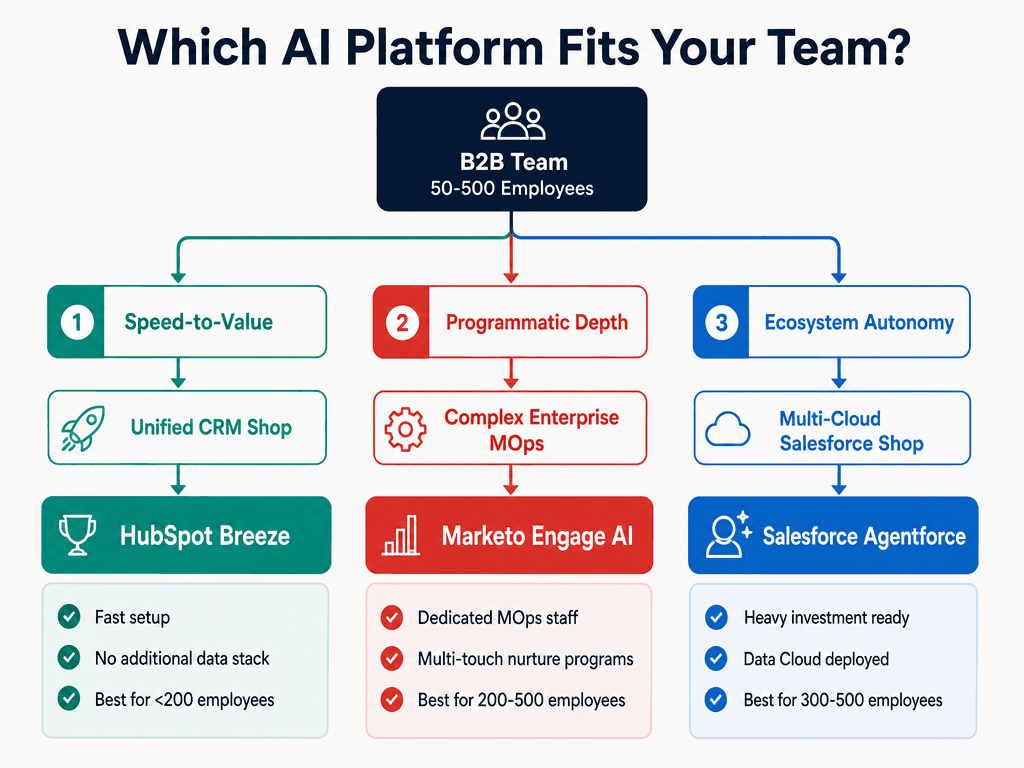
For mid-market B2B teams (50–500 employees), three distinct buying personas emerge:
- Speed-to-value teams — unified CRM shops that want embedded AI with zero additional setup. HubSpot Breeze fits here.
- Programmatic depth teams — enterprise MOps organizations with dedicated staff that need complex journey orchestration. Marketo Engage is the play.
- Ecosystem autonomy teams — multi-cloud shops that already invest in Salesforce and want AI agents that span sales, service, and marketing. Agentforce is the bet.
This comparison goes beyond a feature matrix. We assess each platform’s AI architecture, production-readiness, real-world costs (including the often-overlooked implementation and credit fees), and which team profile gets the best return. The goal is not to declare a single winner but to match the platform to your operating model.
AI Architecture Comparison: Embedded vs. Layered vs. Ecosystem
How each platform integrates AI into its existing stack determines deployment speed, data consistency, and total cost. The differences are not cosmetic — they dictate whether your marketing team can use AI on day one or needs months of configuration.
| Dimension | HubSpot Breeze | Marketo Engage AI | Salesforce Agentforce/Einstein |
|---|---|---|---|
| Integration model | Native, embedded across unified CRM | Layered on top of marketing automation engine | Separate ecosystem (Data Cloud + Einstein + Agentforce) |
| Data foundation | Single data layer — CRM and marketing share schema | Requires separate CRM; syncs up to 200,000 records/hour | Multiple clouds must be integrated via Data Cloud |
| AI activation | Available immediately with existing Pro/Enterprise tier | Requires Prime/Ultimate tiers, additional setup | Requires separate license + Data Cloud + consumption units |
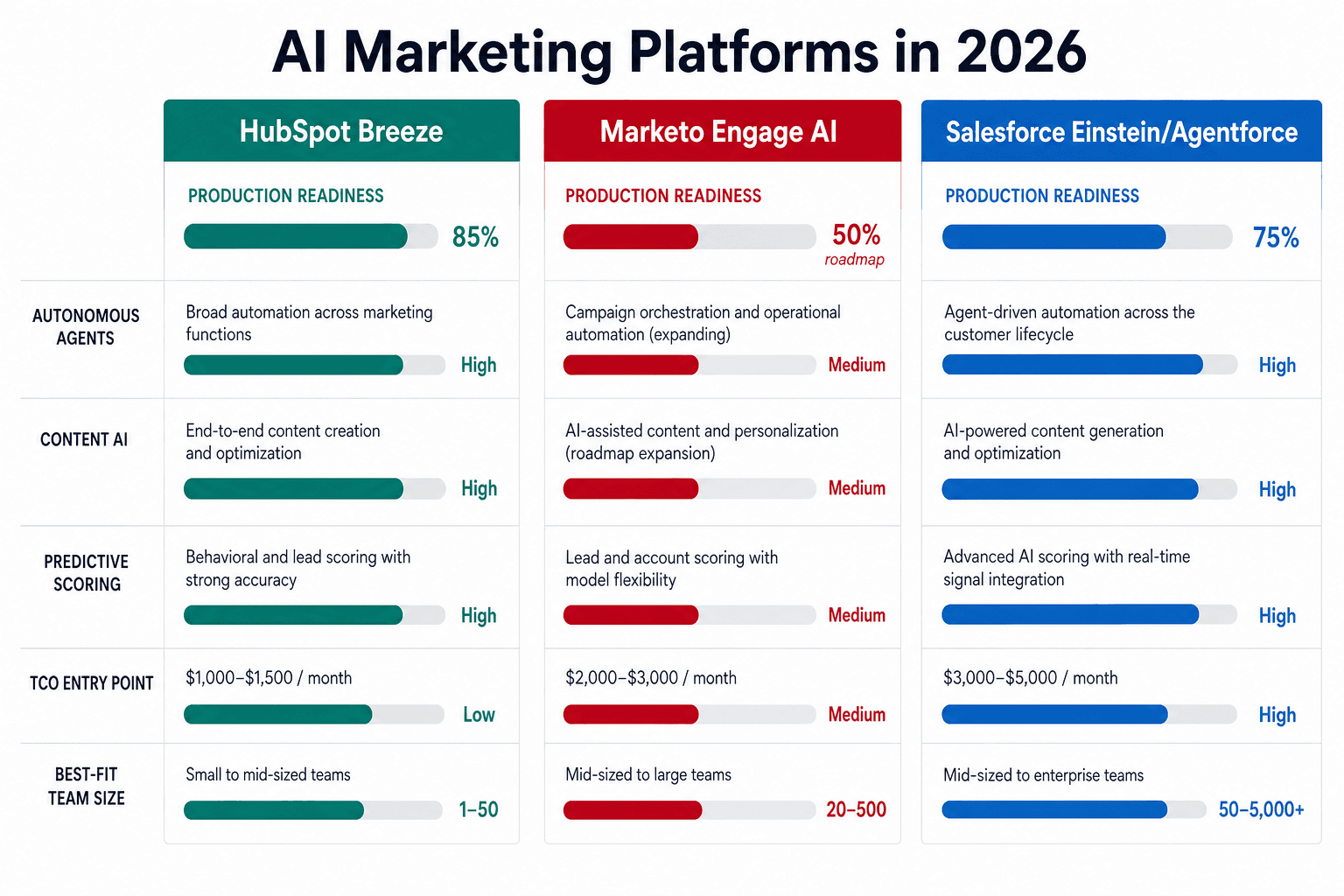
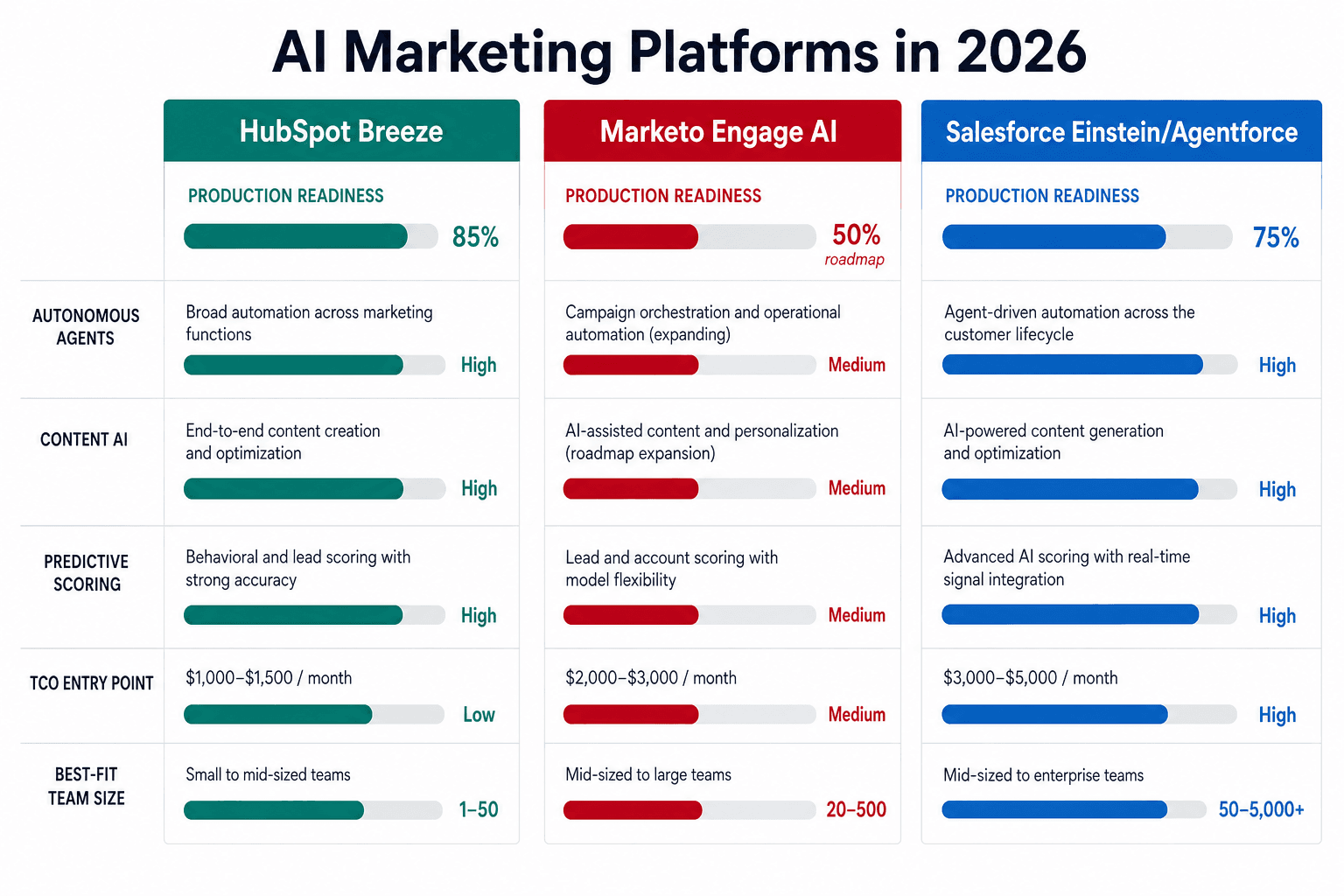
| Production readiness | ~85% of announced features shipping (verified via release notes) | Many features marked ‘coming soon’ as of Q1 2026 | ~75% of agent features in production (2.4B units delivered) |
| Deployment time for AI features | Weeks | 60–90 days for full setup | 3–6 months for multi-cloud deployment |
HubSpot’s unified architecture means AI features like Breeze Intelligence enrichment work on the same contact record your sales team updates — no sync jobs, no field mapping. Marketo’s layered approach adds AI on top of a dedicated marketing automation engine that must be connected to a CRM (usually Salesforce) with a separate sync process. Salesforce offers the widest AI surface area (predictions, agents, conversational AI) but requires stitching together Sales Cloud, Marketing Cloud, Data Cloud, and often a third-party data partner for top-of-funnel enrichment.
HubSpot Breeze AI: Fast-to-Value for Unified CRM Teams
HubSpot’s 2026 AI suite — branded Breeze — includes a Copilot, specialized Agents (Customer, Prospecting, Data), and a Breeze Intelligence layer for data enrichment. The key advantage is that all these capabilities run natively inside HubSpot's unified CRM. There is no separate platform to buy, no additional data pipeline to build, and no sync job to monitor.
The Customer Agent, for example, can autonomously resolve over 62% of conversations without human escalation, according to HubSpot’s own documentation. The Prospecting Agent identifies and enriches leads at a cost of 100 credits ($1) per contact per month. The Data Agent runs research prompts at 10 credits ($0.10) each. These features do not require a separate subscription — they are available to any Professional or Enterprise tier customer.
The February 2026 release cycle added connectors for Claude and ChatGPT that can directly create and update CRM records, a refreshed Breeze Assistant with @Mentions and saved prompts, and expanded Buyer Intent signals including Industry Recognition and Regulatory Approval. These are shipping features, not roadmap promises.
For a detailed record of what Breeze has shipped since its 2024 launch, see our HubSpot Breeze AI: Marketing Features Released in 2024 — Platform Changelog. The contrast with Marketo and Salesforce: HubSpot’s AI is immediately usable by any team that already has HubSpot. You do not need a dedicated MOps specialist to turn it on.
Marketo Engage AI: Powerful Roadmap, Production Gaps
Adobe’s Marketo Engage has announced a compelling set of agentic AI capabilities: an Agentic Orchestrator for autonomous journey creation, Smart List generation from natural language, program validation, and data normalization. On paper, these features promise to reduce the manual overhead that has long been Marketo’s biggest criticism — the need for dedicated MOps staff to build and maintain complex programs.
However, as of Q1 2026, the majority of these features are explicitly labeled “COMING SOON” on Adobe’s own Marketo agentic AI page. The list of unshipped capabilities includes Smart List creation from natural language, program and smart campaign creation, journey creation, data normalization and deduplication, and an AI Assistant for product knowledge. Only Predictive Audiences and send-time optimization are generally available today.
Marketo’s existing AI — Predictive Audiences, Content AI, and send-time optimization — requires Prime or Ultimate tier access (starting around $3,000–$5,000+ per month), plus dedicated MOps staff to configure and maintain. Unlike HubSpot, these AI features are layered on top of a separate marketing automation engine that must be synchronized with a CRM (usually Salesforce). That sync can process up to 200,000 records per hour, according to public documentation, but it remains a separate integration layer that adds latency and failure points.
For teams that already have deep Marketo expertise and a mature MOps function, the 2026 roadmap is genuinely exciting — especially the Agentic Orchestrator’s promise of autonomous journey creation. But for mid-market teams evaluating AI today, the gap between announced and shipping features is a material risk. If you need agentic AI now, HubSpot and Salesforce have more production capability today.
Salesforce Agentforce and Einstein: Broadest Scope, Highest Investment
Salesforce’s AI bet is Agentforce — a family of autonomous agents that span sales, service, and marketing. The scale is impressive: Agentforce has reached $800 million in ARR and delivered 2.4 billion Agentic Work Units, according to ZoomInfo‘s analysis. These are real, in-production workloads — not pilot projects.
But deploying Agentforce for marketing requires assembling multiple pieces: Sales Cloud (or Marketing Cloud Account Engagement, starting at $1,250/org/month), Data Cloud (for unified customer profiles), and Agentforce licenses (typically $550/user/month for the full agent tier). Most mid-market teams also need a third-party data partner for top-of-funnel enrichment, since Salesforce relies on partners rather than native B2B data.
For teams already running multiple Salesforce clouds, the integration depth is unmatched. Einstein can predict lead conversion scores, recommend next-best actions, and personalize email content with claimed lift rates. But the year-one total cost of ownership for a full AI deployment across Sales Cloud + Marketing Cloud + Data Cloud often exceeds $200,000 — a number that can vary 30–50% depending on negotiated contract terms.
For a practical mid-market deployment approach, see our Salesforce Data 360 and Marketing Cloud AI: A Mid-Market Setup Guide for 2026. And for a real-world example of Einstein’s email personalization in B2B SaaS, read the Salesforce Einstein Email Personalization in B2B SaaS deployment case study.
Side-by-Side AI Feature Table
The table below distills the key AI capabilities of each platform into a scannable, attribute-by-attribute comparison. Production-readiness status is based on public documentation, shipping release notes, and independent audits as of Q1–Q2 2026.
| AI Capability | HubSpot Breeze | Marketo Engage AI | Salesforce Agentforce / Einstein |
|---|---|---|---|
| Autonomous agents (agentic AI) | Customer Agent (live chat, 62% auto-resolve), Prospecting Agent, Data Agent — all shipping | Agentic Orchestrator, journey creation — both ‘coming soon’ | Agentforce agents across sales, service, marketing — shipping ($800M ARR, 2.4B units) |
| Content generation (email, landing pages, ads) | Breeze Copilot with @Mentions, saved prompts — shipping | Content AI (subject lines, body copy) — shipping | Einstein Copy Insights and personalization — shipping |
| Predictive lead scoring | Built into Breeze Intelligence — shipping | Predictive Audiences — shipping | Einstein Lead Scoring — shipping |
| Send-time optimization | Included in Breeze — shipping | Available as add-on — shipping | Einstein Send-Time Optimization — shipping |
| Data enrichment | Breeze Intelligence (free with Core Seats Starter+) — shipping | Lead list import enrichment — ‘coming soon’ | Requires Data Cloud or third-party partner — shipping |
| CRM integration depth | Native — unified CRM and marketing in one data layer | Separate CRM sync (up to 200K records/hour) | Multiple clouds; requires Data Cloud for unified profile |
| Production-readiness score (est.) | ~85% | ~50% (major features in roadmap) | ~75% |
Total Cost of AI Ownership: Subscription, Credits, and Implementation
Subscription fees are only the starting point. AI features come with per-use credits, add-on tiers, and implementation costs that can double or triple year-one spend. The figures below represent typical mid-market deployments (100–300 contacts, marketing + sales use cases) and include data from independent analysts and partner benchmarks.
| Cost Component | HubSpot Breeze | Marketo Engage AI | Salesforce Agentforce |
|---|---|---|---|
| Monthly base (core seats) | Professional ~$890/mo (3 seats) | Select ~$895–$1,000 (quote-based) | Marketing Cloud ~$1,250/org + Sales Cloud ~$25–$150/user |
| AI add-on / credit cost | Credit-based: $0.01/credit. Pro ~3K credits/mo, Enterprise ~5–10K | Included in Prime/Ultimate tiers ($3K–$5K+/mo) | Agentforce $550/user/mo plus Data Cloud $15K+/yr |
| Typical monthly AI usage | $30–$100 (credits for agents + enrichment) | N/A (bundled in tier) | $500–$2,000+ (agentic units + Data Cloud storage) |
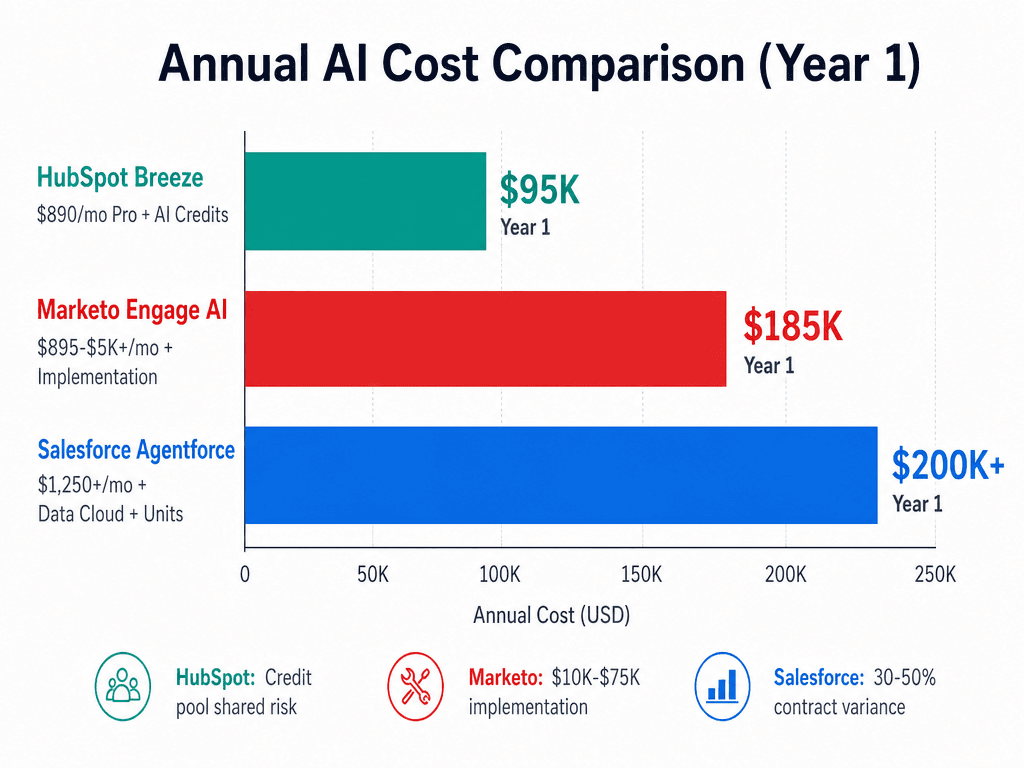
| Implementation cost (year one) | $5K–$15K (self-service or partner) | $10K–$75K (partner-led, 60–90 days) | $30K–$80K (partner-led, 3–6 months) |
| Year-one total TCO (estimated) | ~$95,000 | ~$185,000 | >$200,000 (varies 30–50% by contract) |
| Three-year TCO trajectory | Y1 $95K → Y2 $110K → Y3 $125K | Y1 $185K → Y2 $160K → Y3 $175K | Higher — escalates with data volume and users |
Decision Framework: Which Platform for Your Team?
The right platform depends on your team size, operational maturity, and tolerance for integration complexity. Use the pathways below to match your profile to the best fit.
- Speed-to-value (HubSpot Breeze) — Choose if you have fewer than 200 marketing employees, use a unified CRM (or can migrate to one), and need AI capabilities working within weeks. HubSpot’s embedded AI requires no separate setup and its credit-based pricing is predictable. Teams migrating from Marketo to HubSpot typically see a 30–50% reduction in time spent reconciling data between platforms, per IntegrateIQ’s analysis.
- Programmatic depth (Marketo Engage) — Choose if you have 200–500 employees, a dedicated MOps team of 2+ people, and complex multi-step nurture programs that justify the higher TCO. Marketo’s roadmap is powerful, but you must be comfortable with features that are still in “coming soon” status. Budget at least $185K year one and plan for a 60–90 day implementation.
- Ecosystem autonomy (Salesforce Agentforce) — Choose if you already run multiple Salesforce clouds (Sales, Service, Marketing), have 300–500 employees, and want AI agents that can operate autonomously across those systems. Be prepared for year-one costs above $200K and a 3–6 month deployment. The payoff is broadest AI scope and the most production-proven agent ecosystem.
If your team falls between categories — say, 250 employees with a unified CRM but growing program complexity — consider a hybrid approach: HubSpot as the primary marketing automation layer, with a targeted Salesforce integration for sales-side AI if needed. The worst decision is to pick a platform solely because of its AI feature list without accounting for the organizational model it demands.

Comments
Join the discussion with an anonymous comment.