
The Content Reallocation Playbook: What B2B Content Survives AI Overviews
AI Overviews cannibalize clicks unequally across B2B content types. This playbook uses 2026 CTR data to show which content to reduce investment in and which to expand.
The budget question for an AI Overviews content strategy for B2B is not whether organic search still matters. It is which pages are still earning their keep. In Q3 2026 planning, the uncomfortable split is already visible: some B2B content is being turned into answer-box raw material, while other content still attracts clicks because the searcher needs a sequence, a decision framework, implementation detail, or a vendor comparison that cannot be completed in a short summary.
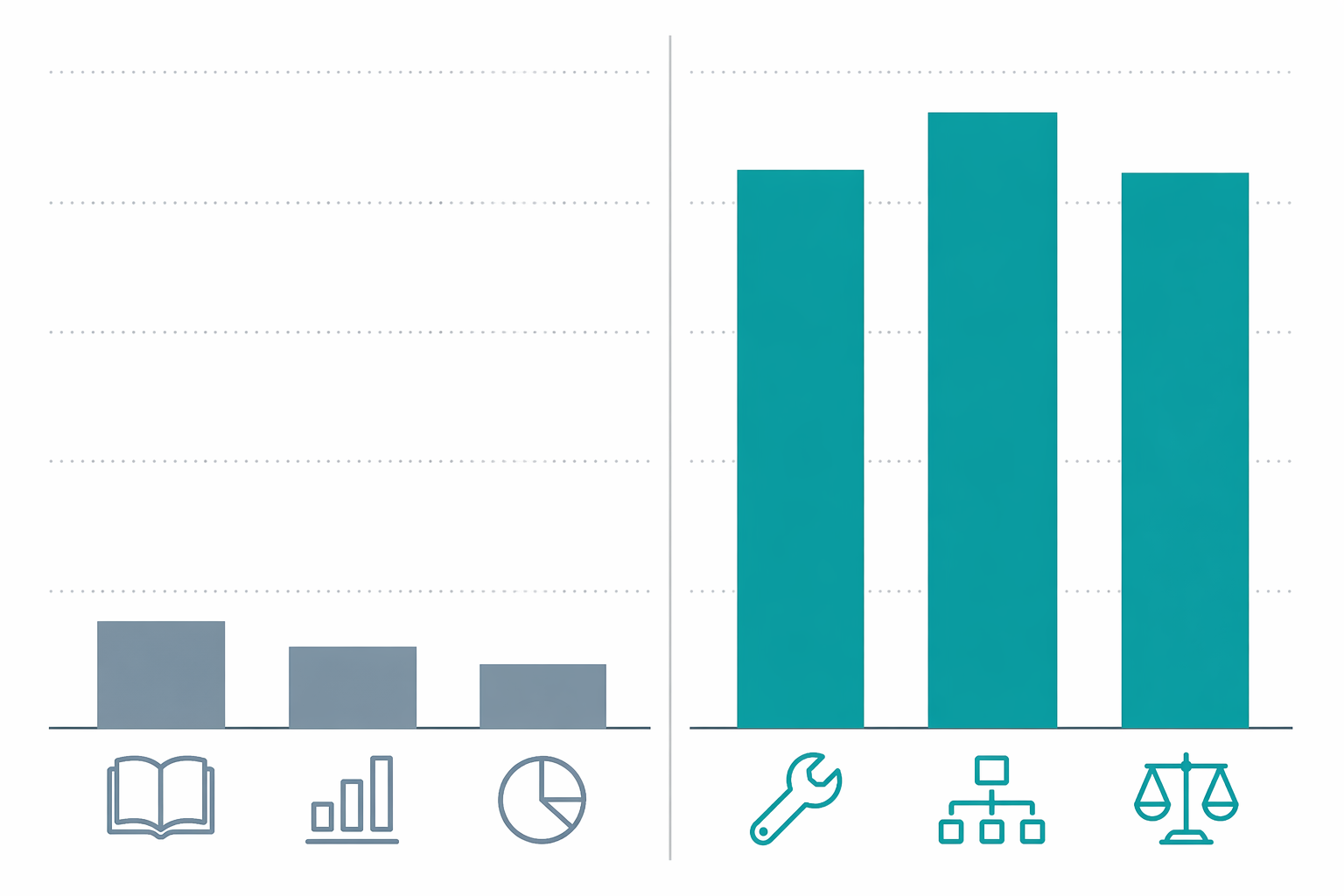
The cleanest starting point is not an overall traffic-loss number. It is a content-category view. Indexed’s 2026 study of 50 B2B keywords found much lower CTR on definitional and metrics-oriented queries than on how-to and process queries when AI Overviews appeared: churn rate at 31%, ARR at 35%, CAC at 42%, compared with SEO best practices at 70%, off-page SEO at 69%, and keyword research guides at 65%.[1]
| Query or content type | CTR in the Indexed B2B sample | Planning implication |
|---|---|---|
| Churn rate | 31% | Reduce new investment in standalone definition pages |
| ARR | 35% | Keep only if it supports product, calculator, or comparison journeys |
| CAC | 42% | Consolidate thin metric explainers into stronger financial-planning assets |
| SEO best practices | 70% | Maintain or expand when the page helps users make implementation choices |
| Off-page SEO | 69% | Invest where the article explains tradeoffs, workflows, and execution |
| Keyword research guides | 65% | Expand when the page gives a usable process, not just a definition |
That study should not be treated as a universal benchmark for every B2B vertical. A 50-keyword sample is useful because it separates query types, not because it settles the entire market. Its value is operational: it gives a content team enough evidence to stop debating “AI search” as one giant budget line.
Why Definition Pages Are the Easiest Budget to Cut
A page answering “what is churn rate” has a narrow job. If the AI Overview gives the definition, the formula, and a short example, many searchers have enough to move on. The same vulnerability applies to “what is ARR” and “how to calculate CAC.” The page may still rank, but the user’s reason to click has been weakened.
That does not mean every metric page should be deleted. It means the old production habit is no longer defensible: one page per acronym, one paragraph of definition, one formula, one generic SaaS example, one CTA. In the Indexed sample, the lowest CTR examples are exactly the kinds of pages many B2B teams have been briefing because they are easy to assign and easy to approve.[1]
The practical move is to sort the inventory by role, not by past traffic. Some definitional pages still matter as supporting infrastructure. They help internal links, product education, sales enablement, or glossary completeness. But they should not absorb the same editorial, design, and subject-matter-expert time as content that helps a buyer complete a task.
- Reduce: standalone definitions that answer a single term and do not lead into a workflow, tool, comparison, template, or implementation decision.
- Consolidate: overlapping acronym and metric pages that compete with each other or repeat the same formula-level explanation.
- Maintain lightly: glossary pages that support product education, but do not justify heavy quarterly refresh cycles.
- Upgrade selectively: metrics content that can become a planning guide, benchmark interpretation page, calculator, or decision-support asset.
This is where many teams will feel the pain. Glossary programs are predictable. They create visible publishing velocity. They are also the easiest content type for an AI-generated summary to satisfy. If the page’s main value is that it says what a term means, the page is now competing with a feature designed to say what things mean.
Overall Click-Loss Studies Explain the Pressure, Not the Allocation
The broader research supports the pressure on organic clicks. Ahrefs analyzed 300,000 keywords and reported that AI Overviews reduced clicks by 34.5% overall.[2] That number is useful for setting expectations with executives: yes, click cannibalization is real enough to affect forecasts.
It is less useful for deciding whether to cut a glossary refresh, rewrite a comparison hub, or fund a workflow series. Studies produce different loss estimates because they use different keyword sets, baselines, and time windows. Seer Interactive has reported a larger 61% drop, while Indexed reported a smaller 10 percentage-point drop in its B2B sample.[1][3] Those figures should not be forced into a winner-takes-all argument. They are measuring different slices of a moving search environment.
For budget planning, the more useful question is where the loss concentrates. A sitewide traffic decline can hide pages that still deserve more investment. It can also protect weak assets because the team treats every category as equally threatened.
The Content That Still Gives Searchers a Reason to Click
Process content survives better because it asks more of the reader and more of the page. A good keyword research guide does not merely define keyword research. It helps someone choose seed sources, segment intent, prioritize opportunities, handle stakeholders, and decide what not to publish. A good off-page SEO explainer does not stop at “what is off-page SEO.” It helps the reader judge link quality, digital PR fit, risk, internal ownership, and measurement.
That distinction shows up in the Indexed data. SEO best-practice, off-page SEO, and keyword research guide queries retained 65% to 70% CTR in the sample, far above the definitional and metric examples.[1] The likely reason is not that AI Overviews fail to summarize process pages. It is that a summary often creates the next question instead of completing the job.

A process page earns its place when it contains the parts AI summaries tend to compress: sequencing, exceptions, decision criteria, examples of tradeoffs, and implementation consequences. The page should make the reader more capable after the click, not merely more informed.
What to Expand
- Workflow guides that show the order of operations, ownership, inputs, review points, and handoffs.
- How-to frameworks that help readers choose between methods, not just execute one generic method.
- Best-practice pages that include constraints, maturity levels, and tradeoffs instead of recycled checklists.
- Implementation explainers that connect strategy to the actual work of setup, governance, measurement, and maintenance.
- Templates and calculators when they are embedded in a broader decision process rather than attached to a thin definition.
This is also where existing teams should look before commissioning net-new articles. Many B2B sites already have pages with the right topic but the wrong depth. A “keyword research” page may need fewer definition paragraphs and more segmentation logic. An “off-page SEO” page may need less channel description and more judgment about what a team can safely outsource, what must stay internal, and how results should be reviewed.
Comparison Content Is Not Dead, but It Has a Different Job
Comparison queries are easy to misread. If AI Overviews appear often, it is tempting to cut comparison content along with definitions. The evidence points in a more complicated direction. The Starr Conspiracy reported that 95% of comparison queries triggered AI Overviews, and that cited brands earned more clicks.[4] Seer Interactive, cited by ScaledOn, found that cited pages earned 35% more organic clicks and 91% more paid clicks than non-cited pages.[3]
That changes the assignment. The goal of comparison content is no longer only to rank for “[competitor] vs [competitor]” or “best [category] software.” It also has to be the kind of source an AI Overview can cite and the kind of page a serious buyer still wants after reading the summary.
The content bar is higher because comparison searchers are not all doing the same thing. Some want a quick shortlist. Some want to validate a vendor they already heard about. Some want implementation differences, pricing-model implications, migration risk, security review burden, or fit by company size. A generic “top 10 tools” page gives the AI Overview plenty to summarize and gives the buyer little reason to trust the click.
For comparison hubs that still deserve funding, the tactical layer should move toward citation readiness: clearer entity relationships, stronger source structure, evidence-backed claims, and pages that make the brand easy to cite accurately. That is where a citation-first SEO strategy for Google AI Overviews belongs. It is not a substitute for reallocation; it is the execution layer for the comparison and decision-support content you choose to keep.
A Practical Reallocation Model for Q3 2026
The reallocation model is simple enough to put into a planning spreadsheet, but it requires discipline. Do not start with pageviews. Start with the job the query asks the page to do.
| Content group | Q3 2026 funding posture | What changes |
|---|---|---|
| Commodity definitions | Cut or consolidate | Stop producing one-off glossary pages unless they support a larger buyer journey |
| Metrics and formula explainers | Maintain selectively | Merge thin pages; expand only when the page helps with interpretation, planning, or benchmarking |
| Foundational reference content | Maintain as infrastructure | Refresh for accuracy and internal linking, not for aggressive growth expectations |
| How-to and process guides | Expand | Add sequencing, decision criteria, examples, and implementation detail |
| Comparison and alternatives content | Expand selectively | Prioritize pages with citation potential and real buyer decision support |
| Workflow and operational content | Expand | Build assets around handoffs, governance, tools, review cycles, and measurement |
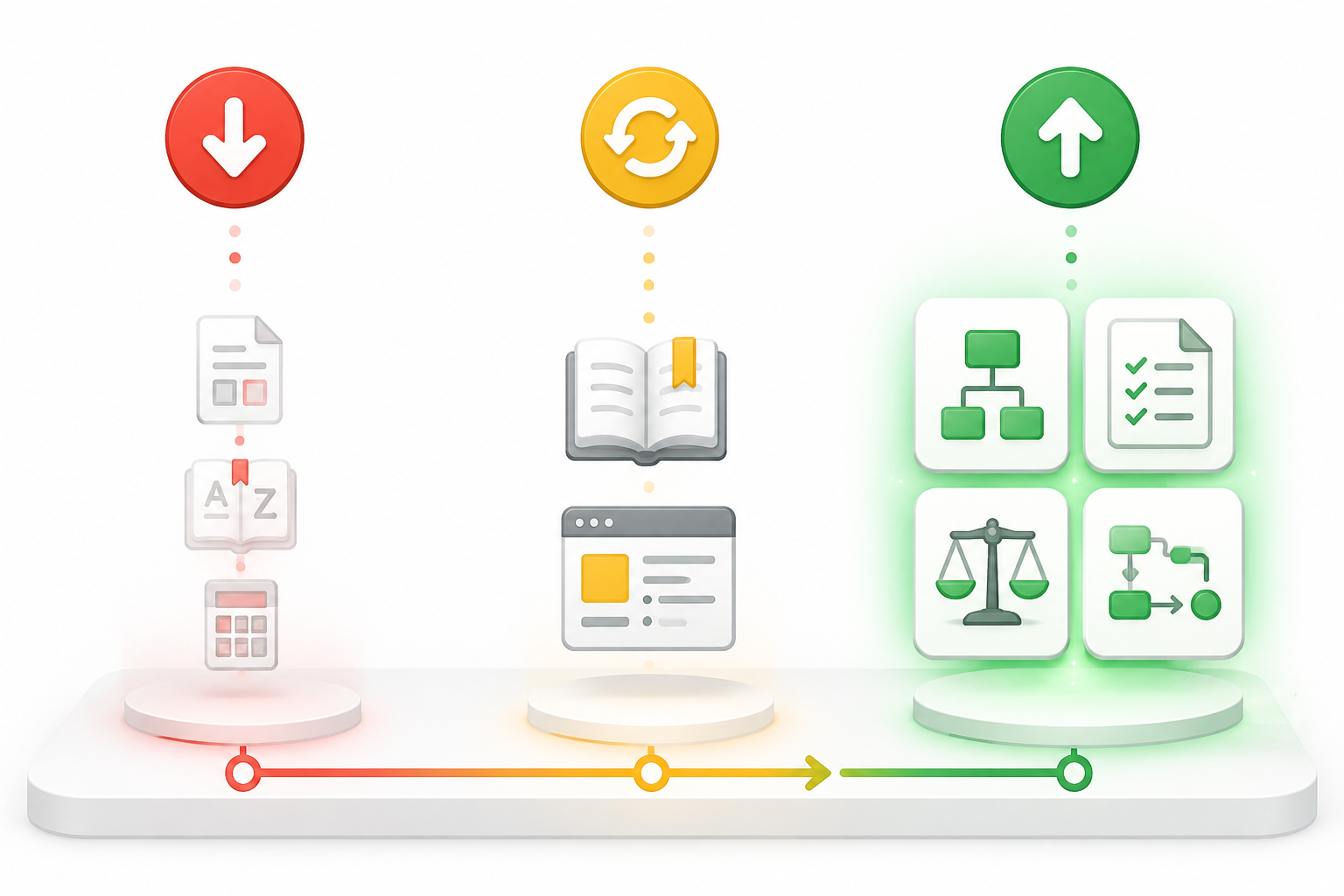
This model also fits the broader B2B SaaS pattern. Entail AI identifies top-of-funnel informational content as the area hardest hit by AI Overviews in B2B SaaS.[5] That finding should not be flattened into “top-of-funnel is dead.” It should push teams to separate commodity TOFU from useful TOFU. A workflow guide can still be early-stage content. So can a category comparison or implementation primer. The weak category is not “early.” It is “complete after one summary.”
How to Audit the Existing Inventory
A useful audit does not need to become a six-month taxonomy project. Pull the pages that lost organic clicks, group them by query job, and assign one of four actions: cut, consolidate, maintain, or expand. The label should come from what the searcher still needs after an AI summary.
- Mark pages where the AI Overview can satisfy the whole query: definitions, formulas, acronyms, basic category descriptions.
- Find pages where the query implies execution: setup, process, best practices, workflow, troubleshooting, implementation, governance.
- Separate comparison pages by buyer usefulness: shortlist filler, feature matrix, migration guidance, pricing tradeoff, use-case fit, or category education.
- Map internal links from reduced pages into the pages you are expanding so old glossary equity supports better assets.
- Put refresh capacity behind pages where added expertise changes the reader’s next action.
The fourth step matters because cutting investment does not always mean deleting URLs. A thin “ARR” page may remain useful if it routes readers into revenue forecasting, SaaS metrics interpretation, or investor-reporting content. The mistake is continuing to treat that page as a growth asset on its own.
Do Not Replace Glossary Production With AEO Busywork
There is an easy way to waste the same budget twice: stop mass-producing definitions, then spend the savings on mechanical AEO or GEO rewrites that do not improve the content. Google’s May 2026 AI Optimization Guide points back to foundational SEO and advises creating non-commodity content rather than chasing special tricks for AI answers.[6]
That guidance is not glamorous, but it is clarifying. If a page has no original judgment, no useful structure, no demonstrated expertise, and no reason for a buyer to continue beyond the summary, adding more schema or rewriting headings into question format will not turn it into a durable asset.
The better use of budget is editorially harder: interview subject-matter experts, add implementation examples, show decision criteria, explain tradeoffs, improve internal linking, update stale claims, and make comparison pages more precise. Those tasks take longer than glossary production, which is exactly why they are harder for AI summaries to flatten into a complete substitute.
The Q3 Decision Rule
For Q3 2026, the decision rule is this: fund the content that helps the buyer finish work the AI Overview can only introduce. Cut or consolidate pages whose main value is a definition, formula, or generic category explanation. Maintain foundational references only where they support stronger journeys. Expand process guides, how-to frameworks, workflow assets, and comparison content that can earn citation visibility and still reward the click.
No format is immune. Process pages can become generic. Comparison pages can become affiliate-style filler. Glossaries can still support a site when they are handled as infrastructure. The point is to stop treating AI-driven content decline as an equal, sitewide event. The work now is reallocation: away from commodity explanations and toward pages that help buyers make decisions, complete tasks, and carry consequences back into their teams.
References
- CTR Study 2026, Indexed, 2026
- AI Overviews Reduce Clicks, Ahrefs
- How Google AI Overviews Are Changing SEO in 2026 and What to Do About It, ScaledOn
- Google AI Overviews CTR Shows Early Signs, The Starr Conspiracy
- AI Overviews: B2B vs B2C, Entail AI
- AI Optimization Guide, Google Search Central, May 2026

Comments
Join the discussion with an anonymous comment.