
What Xbox Game Pass Pricing Changes Mean for Retention Strategy
When Xbox raised Game Pass prices by 50% in October 2025, millions of subscribers left. This case study examines how the subsequent price cut and internal reset are restoring retention, and what subscription businesses can learn about price elasticity and corrective action.
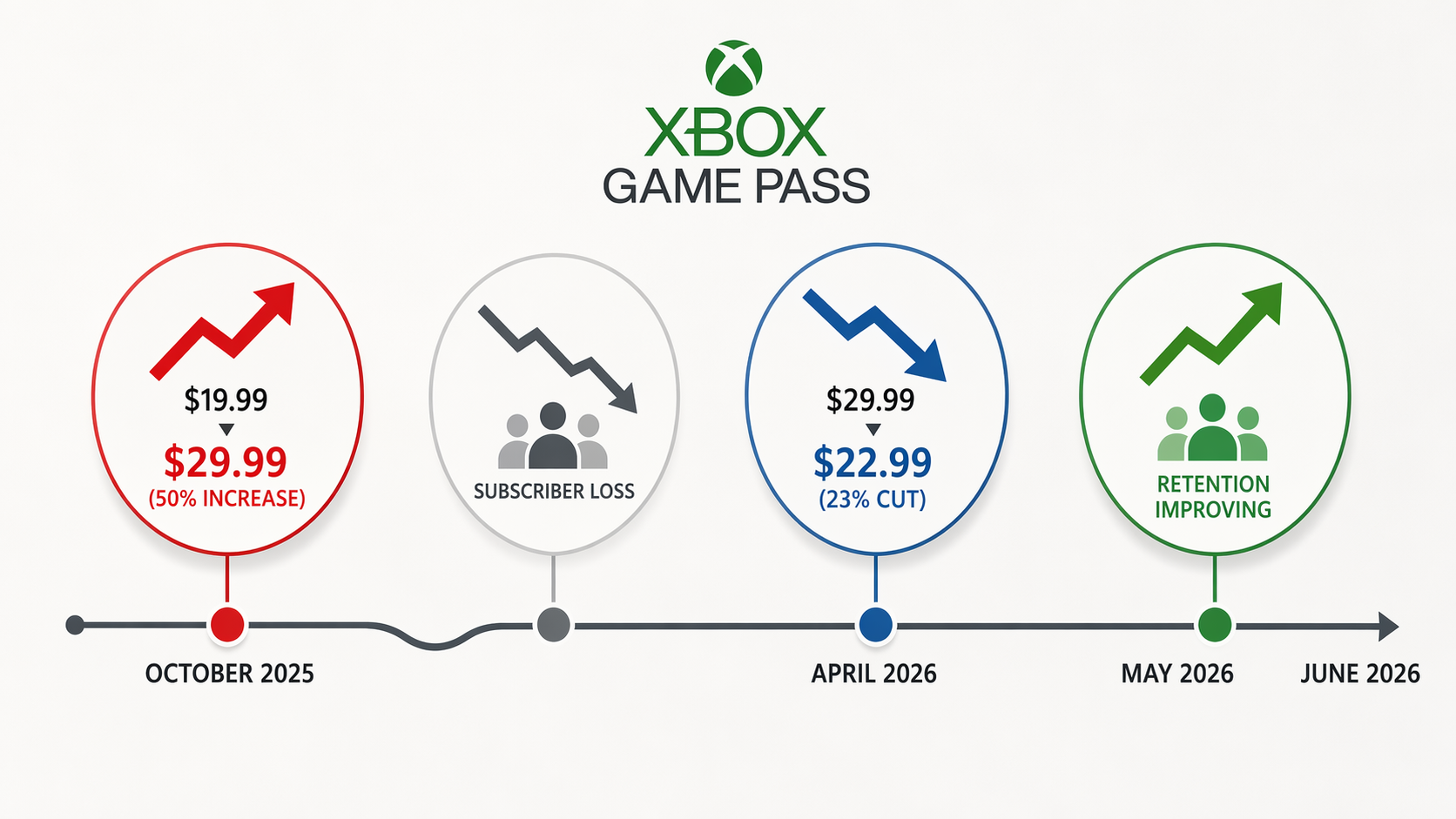
Xbox Game Pass did not run into a retention problem because its catalog suddenly became irrelevant. The more useful lesson is sharper than that: in October 2025, Microsoft raised Game Pass Ultimate from $19.99 to $29.99, a one-step 50% increase, and Xbox chief strategy officer Matthew Ball later acknowledged that the move “shed millions of subscribers.”[1] For anyone studying Xbox Game Pass marketing strategy and subscriber retention, that sequence matters more than any generic claim about content value.
The correction came later. On April 21, 2026, Microsoft cut Game Pass Ultimate to $22.99 and lowered PC Game Pass from $14.99 to $11.99.[2] In May, an internal memo from Xbox CEO Asha Sharma said acquisition was up and retention had improved after the cuts, while also warning that the larger business challenge would take time.[3] That is the case in miniature: a price shock, a subscriber exit, a delayed reversal, and early signs that the service could regain some momentum once price moved closer to customer tolerance.
The timeline is the strategy lesson
Subscription pricing decisions often get discussed as if the company only has to prove that the product is worth more. That framing is incomplete. Customers do not experience a price increase as a finance model, a content investment thesis, or a platform strategy. They experience it as a new charge on the next renewal date, with a cancellation button nearby.
| When | What happened | Why it matters for retention |
|---|---|---|
| October 2025 | Game Pass Ultimate increased from $19.99 to $29.99, a 50% jump.[1] | The change asked existing subscribers to re-evaluate the product immediately, not gradually. |
| Following months | Matthew Ball later said the increase shed “millions of subscribers.”[1] | The catalog did not eliminate price elasticity. |
| April 21, 2026 | Microsoft cut Ultimate to $22.99 and PC Game Pass to $11.99.[2] | The company moved back toward a lower-friction renewal price. |
| May 2026 | Asha Sharma’s internal memo said acquisition was up and retention had improved after the cuts.[3] | The reversal appears to have helped, though Microsoft has not disclosed audited retention rates. |
| June 2026 | Xbox leadership described the business as needing a reset, with reporting also pointing to an eight-month decline.[3][4] | The correction was part of a broader repair job, not a clean win. |
That sequence is uncomfortable because none of the individual ideas behind a higher price are irrational. Premium content costs money. Day-one access has value. A subscription that trains customers to expect a large catalog at a low monthly fee can eventually trap itself. The problem was the size and speed of the change. A 50% overnight increase makes the renewal moment feel less like optimization and more like a forced re-contracting of the customer relationship.
Strong content did not remove elasticity
The central blind spot was treating content strength as if it lowered churn risk enough to absorb the entire increase. That can happen in smaller increments. It is much harder when the customer sees the top-tier price move from just under $20 to just under $30 in one step.
Ball’s later admission that the hike shed “millions” is important precisely because it is not a spreadsheet abstraction.[1] It says enough to establish direction and scale, but not enough to calculate a clean churn percentage. Microsoft has not published the exact number of subscribers lost, nor has it disclosed renewal rates by tier. The responsible conclusion is narrower: the hike produced a material subscriber loss, and the loss was large enough for leadership to acknowledge publicly.
Subscriber-count reporting adds context, but it should not be stretched beyond what it can support. Microsoft’s last official Game Pass figure was 34 million subscribers in February 2024. Later Wall Street Journal reporting, cited by GamesIndustry.biz, put the current count at around 30 million, but Microsoft has not confirmed that figure.[5] The gap suggests churn and stalled growth pressure, yet it does not allow a precise attribution of every lost subscriber to the October 2025 increase.
That distinction matters for operators. If the lesson becomes “Game Pass lost exactly X% because of price,” the case gets overfit. If the lesson becomes “a large, sudden price move can make even loyal subscribers reconsider the value equation,” the case becomes useful.
The revenue picture also pushed against any easy defense of the hike. Microsoft’s fiscal Q3 2026 content and services revenue declined 5% year over year, and reporting tied the pricing fallout to an estimated $300 million in lost Call of Duty revenue.[1] Those figures do not prove that the price increase alone caused the full decline. They do show that the broader monetization story was not insulated from the subscription decision.
Why the one-step increase hurt more than a normal price test
A subscription price increase is not automatically bad retention strategy. Many services underprice early, let heavy users anchor to an unsustainable deal, and then delay correction until the gap becomes too large. The cleaner path is usually staged: segment by usage, test willingness to pay, communicate added value, grandfather or step up sensitive cohorts, and watch cancellation behavior before imposing the new economics on the full base.
The October 2025 move compressed too much of that work into one customer-facing moment. A subscriber did not need to understand Microsoft’s content cost structure to decide that $29.99 felt like a different product category from $19.99. At that point, the marketer’s problem becomes more expensive: win back people who have already made an active cancellation decision.
That is a different task from preventing churn. Prevention can lean on habit, saved payment methods, usage reminders, annual plans, loyalty credits, and careful messaging before renewal. Win-back has to overcome a stronger signal: the customer has already decided the product is no longer worth the price. Even if the customer still likes the games, the company has trained them to inspect the subscription rather than let it renew quietly.
This is where “content is king” becomes a lazy answer. Content may justify higher ARPU for some cohorts. It may improve acquisition during major releases. It may reduce churn for high-engagement players. It still does not guarantee that a broad subscriber base will accept a 50% increase at the same time, especially if lower-usage customers were already close to cancellation.
The correction was meaningful because it changed the renewal conversation
The April 2026 cut did not restore the old price. Ultimate went to $22.99, not back to $19.99. PC Game Pass moved from $14.99 to $11.99.[2] That distinction is useful. Microsoft did not simply apologize with a full rollback; it searched for a new price point that could preserve some of the ARPU ambition while reducing cancellation pressure.
For a growth team, that is often the more realistic correction. A complete reversal can be politically difficult and economically unattractive. A partial reversal, if clearly communicated, can still change the customer’s next decision from “this got too expensive” to “this is closer to fair.”
The early internal signal was positive. Sharma’s May memo said acquisition was up and retention had improved after the price cuts.[3] The phrasing should be read carefully. It is not a public cohort-retention table. It does not reveal whether returning subscribers were high-value users, discounted reactivations, or customers who had intended to pause temporarily. But it does indicate that the company saw enough movement after the cut to describe acquisition and retention as improving internally.
Analysts were not surprised. Ampere Analysis and Circana analysts described the price cut as an inevitable shift and expected it to help drive subscription growth in 2026.[6] That outside interpretation fits the operating logic: when a price point causes broad subscriber resistance, lowering the friction can restart acquisition and reduce avoidable churn, even if it does not repair every relationship damaged by the original move.
The word “inevitable” is doing a lot of work here. It implies the earlier price was not merely aggressive; it had moved beyond what the market would bear at scale. That is the kind of signal pricing teams are supposed to detect in test cells before the entire subscriber base is exposed.
The eight-month gap is part of the cost
It is tempting to grade the April correction generously because many companies wait too long or refuse to reverse at all. Microsoft did move. The price cut was visible, concrete, and large enough to matter. But the timing still matters: reporting described Game Pass as suffering an eight-month decline before growth resumed.[4]
Eight months is a long time in subscription retention. During that span, cancellation decisions compound. Win-back audiences get colder. Support teams absorb frustration that pricing teams often do not have to hear directly. Lifecycle marketers have to decide whether to message value, offer discounts, suppress angry cohorts, or wait for leadership to approve a cleaner correction. The financial model that justified the increase rarely includes the full operational cost of that work.
The trust cost is harder to measure, but not imaginary. Once customers believe a subscription can jump sharply without much warning, they may become more alert to future renewals. That can lower the effectiveness of later campaigns because every value message is interpreted against the memory of the prior increase.
The business-reset language makes it harder to treat the cut as a neat redemption arc. Sharma reportedly said the business was “not in a healthy spot” and called for a reset within 100 days.[3] That is not the language of a company making a minor pricing tweak. It is the language of leadership acknowledging that the operating model needs repair.
Microsoft had more subtle tools available
The bluntness of the October increase stands out more because Microsoft had already been evaluating more nuanced subscription options. A 2025 Kellogg/Sage teaching case on Xbox Game Pass documented strategic evaluation of tiered pricing and loyalty programs.[7] That does not mean every option was easy to implement, or that a case study reveals internal decision rights. It does show that the company was not unfamiliar with the basic menu of subscription pricing tools.
Tiering and loyalty mechanisms matter because they let a company separate willingness to pay from willingness to stay. Heavy users may accept a premium tier with day-one releases, cloud features, or bundled benefits. Lighter users may need a lower-priced plan to remain in the ecosystem. Long-tenured customers may tolerate increases better if the change is phased or paired with recognition. None of those moves eliminates churn, but they reduce the odds that a single price decision forces every customer into the same yes-or-no choice.
The useful comparison is not between raising prices and never raising prices. It is between imposing one broad increase and designing a migration path. In the first version, customers decide whether the product is still worth it. In the second, customers decide which version of the product fits them now. That difference can be the gap between manageable downgrade behavior and outright cancellation.
What retention teams should take from the case
The Game Pass pricing cycle is useful because it does not produce a simplistic rule. It does not prove that subscription companies should avoid major price increases forever. It does not prove that a price cut automatically fixes churn. It shows how the sequence of testing, communication, timing, and correction changes the size of the damage.
- Test elasticity before exposing the full base. A strong catalog is not a substitute for cohort-level price sensitivity. Heavy users, casual users, annual subscribers, and recent acquisitions may react differently.
- Model cancellation behavior, not just ARPU lift. A 50% increase can look attractive until the forecast includes downgrade paths, support load, win-back cost, and lost cross-sell revenue.
- Give customers an alternative to cancellation. Tiering, temporary grandfathering, annual locks, and loyalty-based migration can preserve relationships even when the top-tier price rises.
- Watch the first renewal cycles closely. If churn spikes beyond the acceptable range, waiting for a full strategic review may turn a pricing miss into a brand and retention problem.
- When reversing, make the correction legible. A partial cut can work if customers understand the new value exchange and internal teams know whether the priority is acquisition, retention, reactivation, or ARPU recovery.
The correction sequence is especially relevant for teams that have already overshot. There is often a reluctance to cut price because it feels like admitting failure. In practice, delay can be more damaging than the admission. The April 2026 cut gave marketing and retention teams a concrete reason to re-open the conversation with churned and wavering subscribers: the product was still premium, but the company had moved away from the rejected price point.
That kind of correction also requires internal alignment. Finance needs to accept that the original ARPU target may have been too aggressive. Product needs to clarify which benefits justify each tier. CRM needs permission to message the change directly instead of hiding it behind vague value language. Customer support needs clean explanations, not defensive talking points. If those teams are not aligned, the price cut becomes just another promotion rather than a retention reset.
There is still a ceiling on subscription growth
The Game Pass story also needs a market-size guardrail. Circana’s Matt Piscatella has noted that subscription spending represents only 10% of total console and PC content spending.[8] That does not make subscriptions unimportant. It means a gaming subscription cannot assume that every player wants to move their spending into a monthly bundle, even at a better price.
This limits the upside of price maneuvering. A lower price can improve acquisition and retention among people already open to the model. It can reactivate customers who liked the service but rejected the new rate. It can reduce cancellation pressure at renewal. It cannot, by itself, turn the entire console and PC market into subscription-first buyers.
That is why the April cut should be read as a repair move, not a growth strategy in full. It created better conditions for retention. It did not erase the months of subscriber loss, the reported revenue pressure, or the broader question of how large Game Pass can become without overcharging the customers most likely to stay.
The retention judgment
Microsoft’s Game Pass pricing cycle shows both sides of subscription discipline. The October 2025 increase treated a loyal base as if strong content could absorb a sudden 50% jump. The subscriber loss showed otherwise. The April 2026 cut then demonstrated that a clear correction can begin to restore acquisition and retention, especially when the rejected price point is moved back toward customer tolerance.
The cost sits in the gap between those two decisions. Millions of subscribers did not need to leave for Microsoft to learn that the top-tier price had overshot. An eight-month decline did not need to become the evidence base for a correction. For subscription businesses, the practical lesson is not caution for its own sake. It is to test elasticity before imposing it, correct visibly when the market rejects the move, and count the lost months as part of the strategy’s real price.
References
- Xbox Game Pass Lost Millions of Subscribers After 2025 Price Hikes — IGN
- Microsoft lowers Game Pass Ultimate and PC subscription prices — CNBC
- Xbox CEO says Game Pass cuts helped 'retention improve' — Windows Central
- Xbox Boss Admits Game Pass Suffered An Eight-Month Decline — WGB
- Xbox Game Pass subscriber count is less than 50% of original target — GamesIndustry.biz
- 'Not surprising at all' – analysts see Game Pass price cut as inevitable shift — GamesIndustry.biz
- Xbox Game Pass: Business Model Optimization and Transformation — Kellogg/Sage
- Subscription Growth Has Flattened — Forbes
Comments
Join the discussion with an anonymous comment.