
What AI-Assisted Marketing Actually Looks Like in 2026: Workflows, Tools, and the Data Behind Both
A practitioner-focused guide to AI-assisted marketing in 2026, covering the five core workflows delivering measurable ROI, tool recommendations by channel, time savings by role, and the critical human-in-the-loop distinction that separates high-performing teams from the rest.
The State of AI-Assisted Marketing in 2026
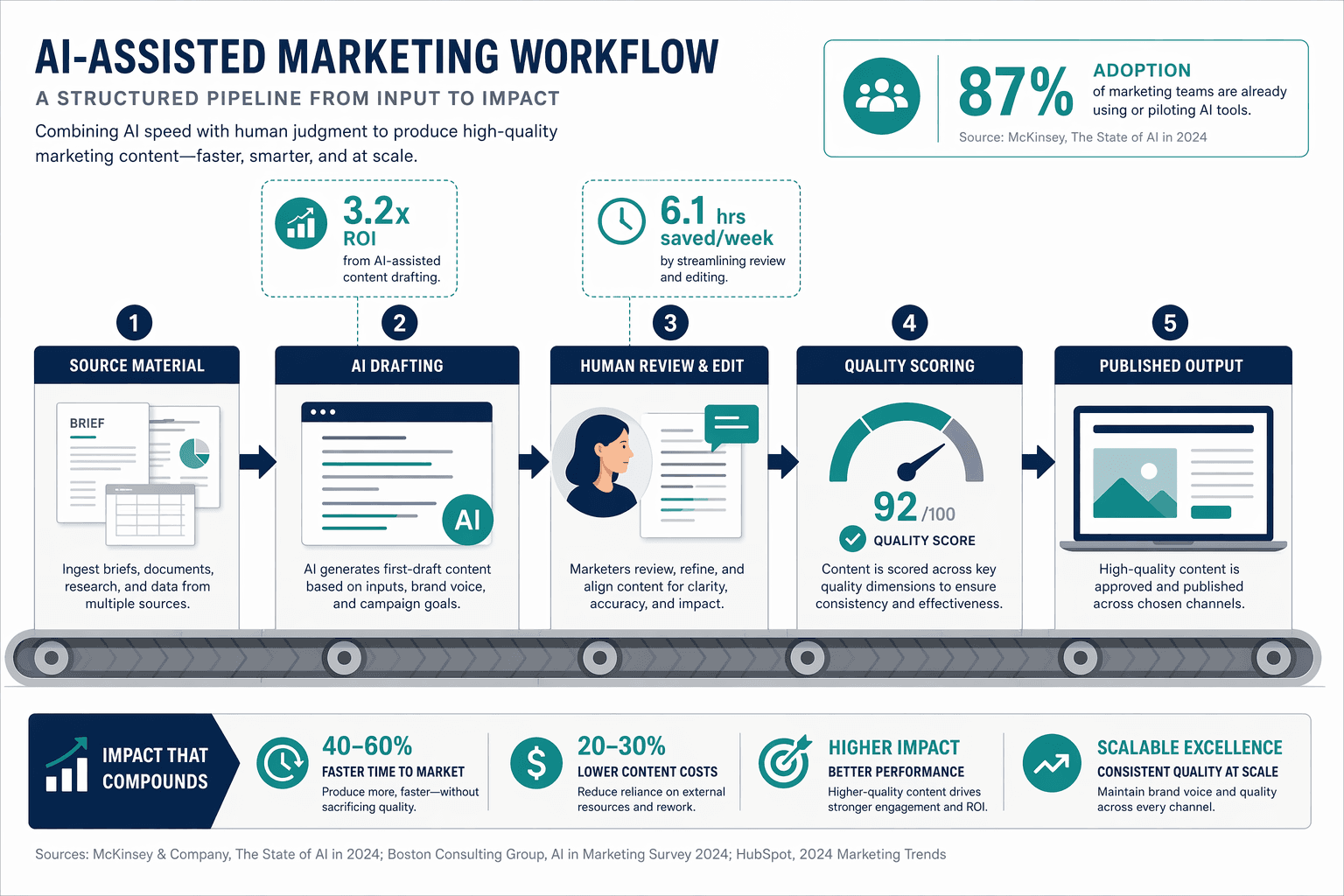
The experimental phase is over. By Q1 2026, 87% of marketers were using generative AI in at least one recurring workflow, according to the Salesforce State of Marketing report. That figure has climbed from 51% in Q1 2024 — a 36-point jump in two years. Among those users, 88% report daily use. The tooling has moved from novelty to infrastructure.
But adoption volume alone tells a misleading story. The same data set reveals a widening gap between teams that treat AI as a structured collaborator and those that treat it as a faster keyboard. The latter group is increasingly visible — and increasingly penalized. Google's March 2026 core update, for instance, hit sites publishing unedited AI content at scale: 18% of those sites lost 40% or more of their organic traffic. The market is no longer rewarding volume without governance.
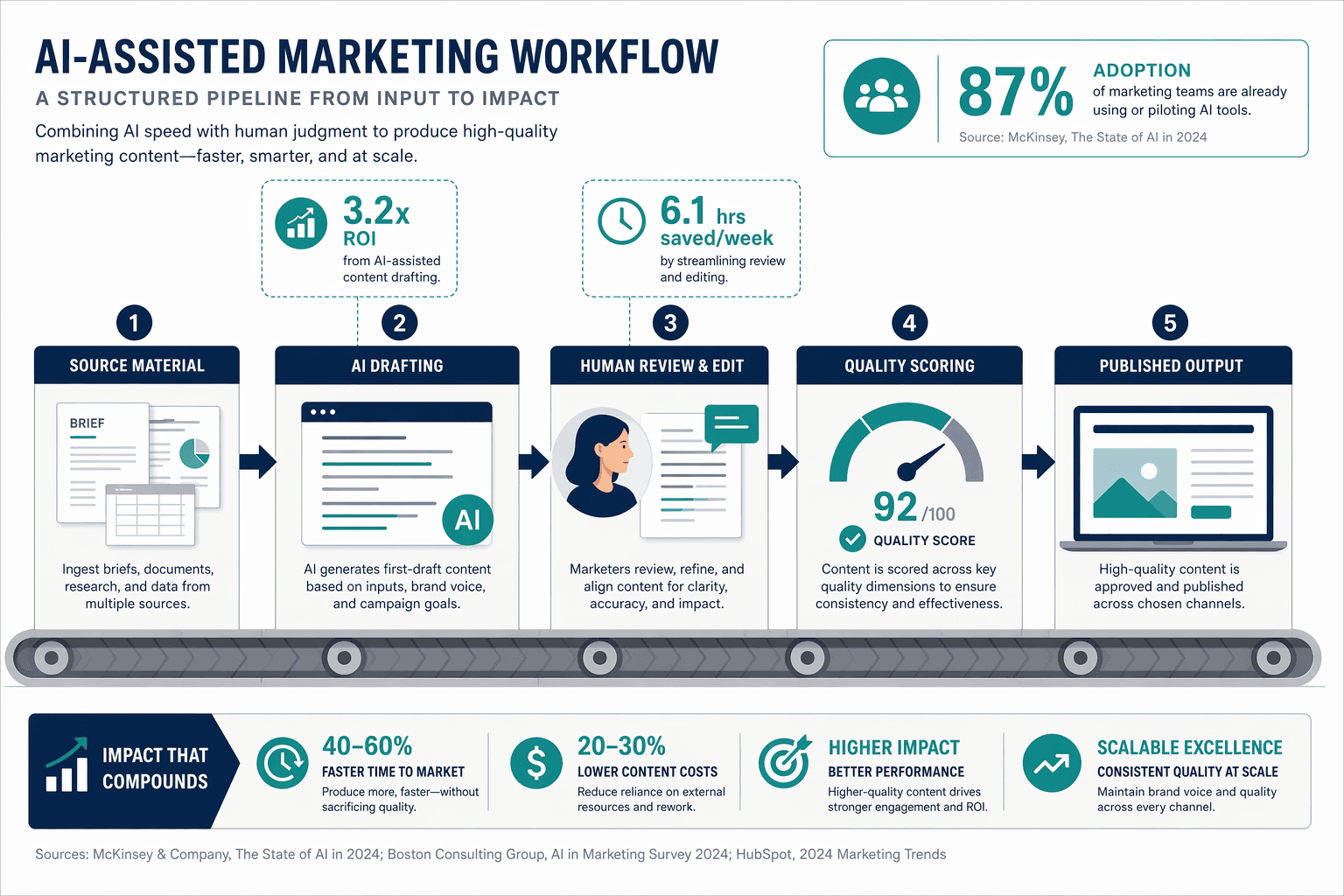
The teams seeing real returns have moved past the prompt-and-publish phase. They operate with defined source material, structured prompts, human review standards, and performance tracking. This article maps what that looks like in practice: the workflows delivering measurable ROI, the tools matched to specific channels, the time savings by role, and the data that separates high-performing hybrid teams from the rest.
The Five Core Workflows Where AI Delivers Measurable Results
Not all AI applications produce the same return. McKinsey's Global AI Survey 2026 provides a useful benchmark across five common marketing workflows, measured as blended ROI (revenue or cost savings attributable to AI divided by AI-related spend). The figures below represent median self-reported returns, with interquartile ranges showing the spread.
| Workflow | Median ROI | IQR Range | Typical Application |
|---|---|---|---|
| Content drafting & production | 3.2x | 2.4x – 4.1x | Blog posts, landing pages, email sequences, social copy |
| Personalization engines | 2.7x | 2.0x – 3.6x | Dynamic website content, email personalization, product recommendations |
| Audience research & segmentation | 2.4x | 1.8x – 3.2x | Persona development, intent data analysis, lookalike modeling |
| Ad copy & creative generation | 2.3x | 1.7x – 3.0x | Paid search headlines, social ad variants, display creative |
| Analytics & reporting automation | 2.1x | 1.5x – 2.8x | Campaign performance summaries, anomaly detection, dashboard generation |


Comments
Join the discussion with an anonymous comment.