
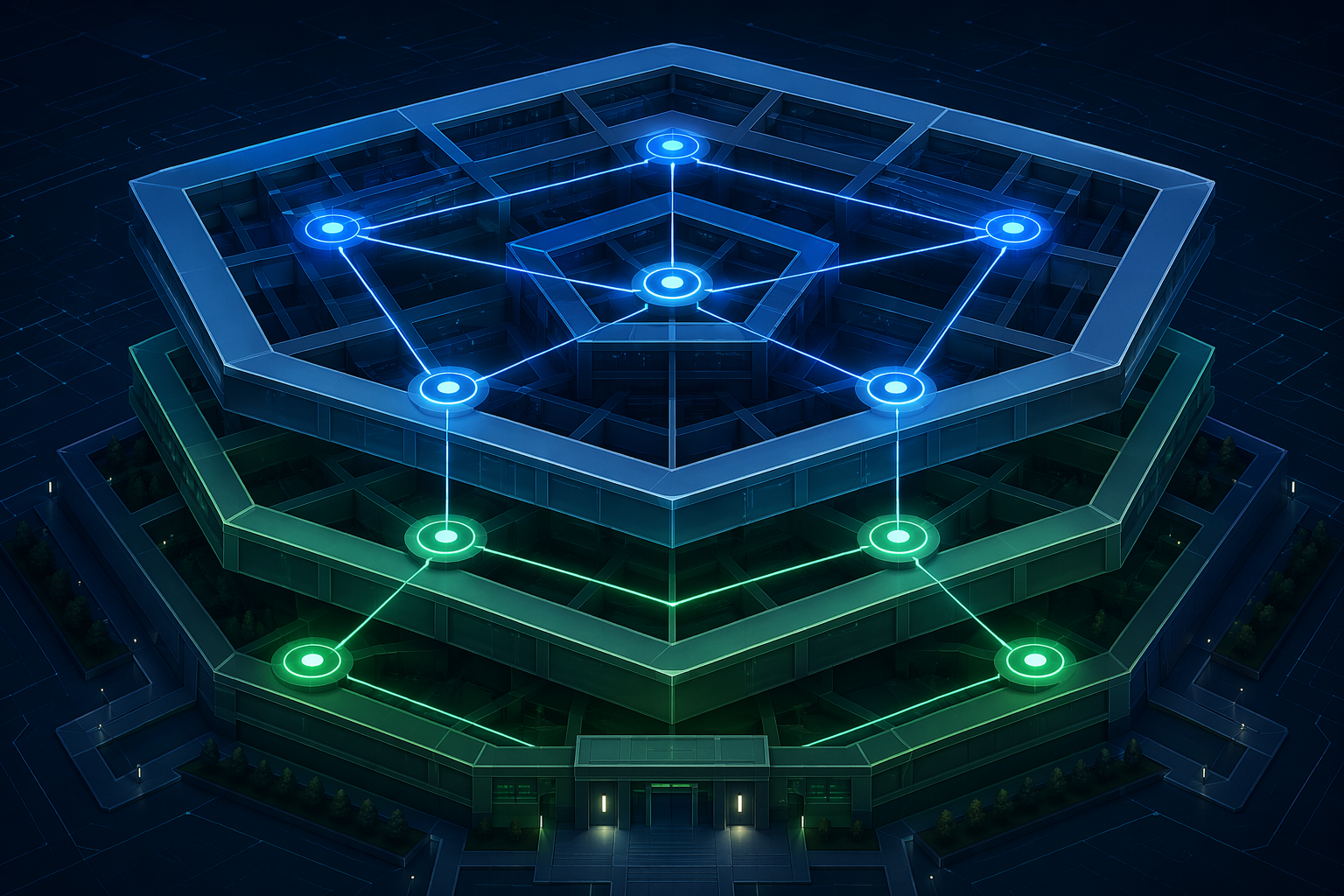
Why the Pentagon Requires 8 AI Vendors (and Your Team Should Too)
Marketing teams that standardize on one or two AI tools expose themselves to pricing hikes, feature deprecation, and contract disputes—the same risks that drove the Pentagon to require eight vendors for its GenAI.mil program. This article unpacks the Pentagon's multi-layer diversification framework and shows how marketing leaders can apply it to build resilient AI tool stacks.
The Pentagon Said the Quiet Part Out Loud
On May 1, 2026, the War Department made a procurement principle unusually explicit: it said GenAI.mil was being built to prevent AI vendor lock, and it paired that language with a final roster of eight companies on IL6 and IL7 networks: SpaceX, OpenAI, Google, NVIDIA, Microsoft, AWS, Oracle, and Reflection [1]. The release also said GenAI.mil had already reached more than 1.3 million personnel, with tens of millions of prompts and hundreds of thousands of agents deployed in five months, which makes the program look less like a pilot and more like infrastructure [1].
The number to notice is not just eight. It is the judgment behind it: the Pentagon is not treating a single AI partner as a safe default, even in a classified environment where continuity is unusually hard to preserve. That is the part marketing leaders should pay attention to. The organization with the most restrictive networking and supply-chain constraints is still designing against dependency, not around it [1].
How the Stack Is Actually Split
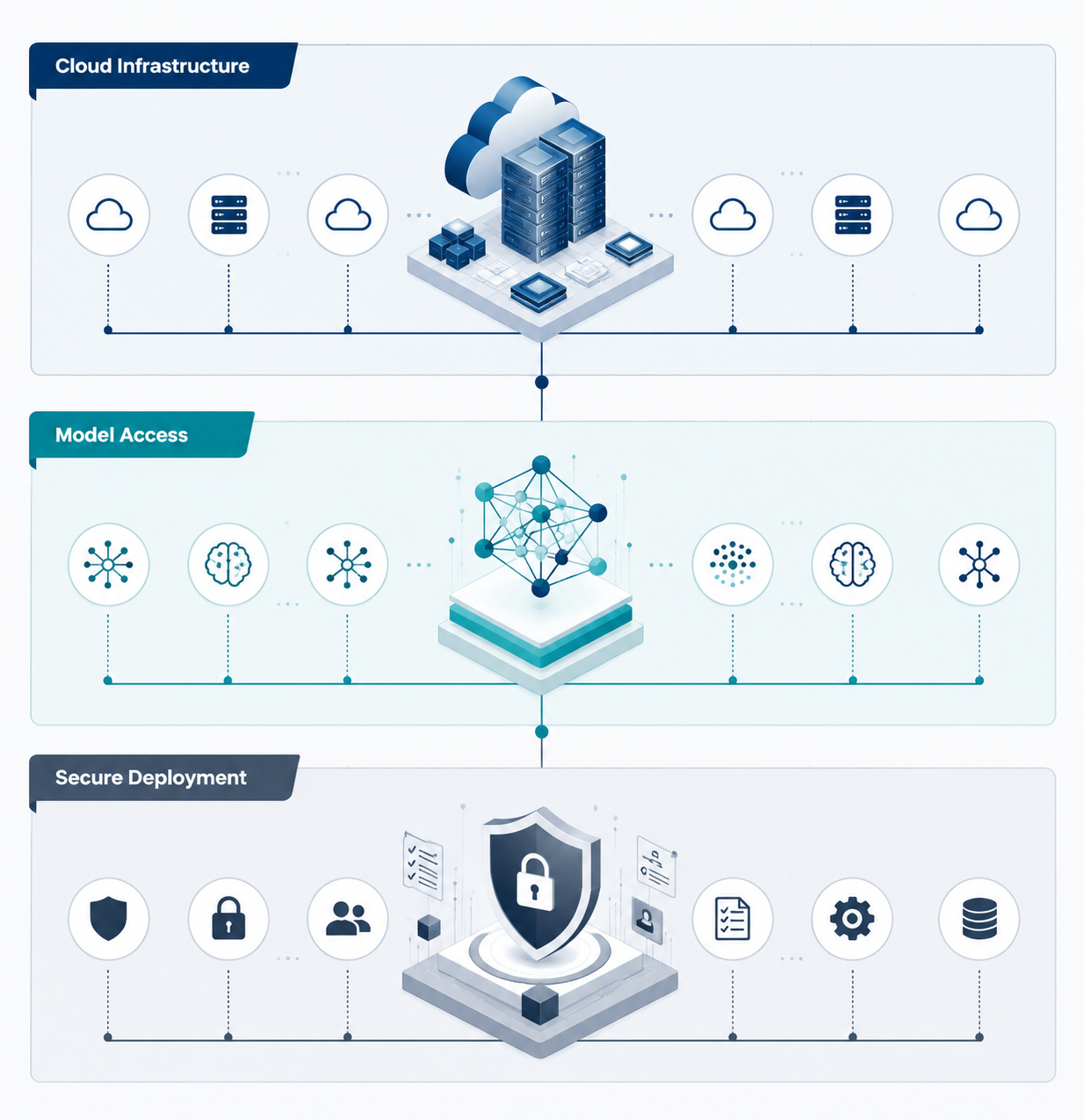
TECHi's read of the Pentagon stack is useful because it breaks the program into three layers: cloud infrastructure, model access, and secure deployment [2]. That is the right level of abstraction for a marketing team, because it turns a vague "which AI tool should we standardize on?" debate into separate procurement questions.
| Layer | Pentagon question | Marketing translation |
|---|---|---|
| Cloud infrastructure | Where does the compute run? | Which vendor actually hosts prompts, files, and automation jobs? |
| Model access | Which models can teams reach? | Can the team switch models without rebuilding the workflow? |
| Secure deployment | How are data, permissions, and outputs controlled? | Do identity, logging, approvals, and retention move with the tool? |
That split matters because a team can diversify one layer and still be trapped in another. A second chatbot does not help much if both products sit on the same cloud dependency, expose the same model family, or require the same brittle approval path. The useful question is not whether you have "more tools"; it is whether any one vendor owns too much of the stack.
Why Anthropic Is the Warning Teams Miss
The Anthropic episode shows why vendor risk is bigger than outages or price increases. Federal News Network and NextGov reported that Anthropic objected to an "all lawful purposes" clause because of concerns about autonomous weapons and mass surveillance, later received a supply-chain risk designation in March 2026, and was still excluded from the May 1 awards despite a preliminary injunction [3][4].
That is the kind of break teams often fail to model. A vendor does not have to fail technically for the relationship to become unusable. Terms-of-service disputes, policy boundaries, or supply-chain judgments can cut off access just as effectively as a service outage, and they are harder to plan around because they usually arrive as procurement problems, not IT alerts.
Why the SpaceX Talks Matter Even Without a Contract
The July 2026 reporting around SpaceX is useful only if it is handled carefully. The Wall Street Journal said the Pentagon was in talks with SpaceX about computing capacity, but also noted that the deal could fall apart and that no contract had been signed [5]. That means the story is not evidence of a finished award. It is evidence that AI compute itself has become a negotiable strategic asset.
For marketing, the transferable lesson is narrower. Compute, model access, and deployment controls are not just feature choices anymore; they are leverage points. If one vendor controls all three, a pricing change, feature removal, or policy shift can force the whole workflow to move at once.
What Marketing Leaders Can Take From It
Marketing teams do not need classified-network redundancy, and they do not need eight vendors for the sake of symmetry. What they do need is separation of failure modes. Keep compute from collapsing into one provider, keep model capability from living behind one API, and keep workflow control from depending on one UI or one contract.
That standard is practical rather than dramatic. A team can still prefer a primary vendor for day-to-day work, but it should document how to swap models, where the data lives, what happens if terms change, and which workflows would stop if a platform disappeared. If all of that knowledge is trapped in one tool owner or one renewal cycle, the stack is already more fragile than it looks.
The clearest decision rule is simple: diversify by layer, document dependencies, and treat AI vendors as strategic infrastructure rather than interchangeable subscriptions.
References
- War Department release on GenAI.mil agreements and AI vendor lock prevention, May 1, 2026 — war.gov — war.gov
- TECHi layered-stack analysis of the Pentagon AI architecture — techi.com — techi.com
- Federal News Network report on Anthropic's exclusion from Pentagon AI awards — Federal News Network — federalnewsnetwork.com
- NextGov report on the Anthropic procurement dispute and preliminary injunction — NextGov — nextgov.com
- Wall Street Journal report on Pentagon computing talks with SpaceX, July 17, 2026 — WSJ — wsj.com
Comments
Join the discussion with an anonymous comment.