

A Marketer's Decision Framework for Choosing the Right Machine Learning Model
Most marketing ML problems — lead scoring, segmentation, churn prediction — can be solved with simple, interpretable models like logistic regression or k-means. This guide presents a decision framework for eight common marketing tasks, so you can avoid overcomplicating your data and still get reliable, stakeholder-friendly results.
The useful question in machine learning and marketing is rarely “Which model is most advanced?” It is “Which model answers this business question clearly enough that the team can use it, defend it, and maintain it after the launch meeting ends?”
That question saves a lot of wasted work. A lead scoring project does not automatically need a neural network. A segmentation project does not become better because the clustering method sounds obscure. A sales forecast is not more trustworthy because the dashboard says “AI-powered.” For many marketing teams, the strongest starting point is still a simple, interpretable model: logistic regression for lead scoring, k-means for segmentation, linear regression or a time-series model for forecasting, and a decision tree when stakeholders need to see the path from input to recommendation.
The practical reason is not nostalgia for old methods. Simpler models usually require less data, fail in more understandable ways, and produce outputs that can survive budget review. Domaleski’s 2026 marketer-focused field guide makes the same point directly: most marketing problems do not need deep learning, and model choice should start with the marketing task rather than the algorithm menu.[1]
Large platforms have made machine learning feel like ordinary marketing infrastructure. Salesforce’s 2026 guide frames machine learning as part of how modern teams automate decisions, personalize experiences, and analyze customer behavior at enterprise scale.[2] That does not mean every team should buy or build the most complex version of those systems. It means marketers need a better filter before they approve the work.
Start With The Marketing Decision, Not The Model
A model is only useful if it matches the decision being made. “Improve performance” is not a model brief. “Rank inbound leads by probability of becoming sales-qualified within the next month” is closer. “Group customers by behavioral similarity so lifecycle campaigns can be planned around different needs” is also a model brief. The difference is that the second and third versions tell the team what kind of output is needed.
That output usually falls into one of three practical buckets:
- Prediction with known outcomes: You have historical examples with labels, such as converted or did not convert, churned or retained, high-value or low-value. This points toward supervised learning.
- Pattern discovery without known labels: You want to find groups or structures in customer behavior, but you do not already know the “right” answer. This points toward unsupervised learning.
- Continuous optimization through feedback: The system makes repeated choices, observes outcomes, and shifts future choices based on performance. This points toward reinforcement-style approaches, including bandit methods.
That is enough taxonomy for most marketing conversations. The team does not need a lecture on machine learning families before choosing a lead scoring model. It needs to know whether the problem has labeled historical outcomes, whether the output must be explainable, and what happens when the model is wrong.
A Starting Framework For Eight Common Marketing Problems
The following table is a starting point, not a law. Data quality, channel mix, sales cycle length, and team capability can change the final choice. But it gives a marketer a defensible first answer when someone asks which model belongs with which task. The mapping follows the problem-to-model logic in Domaleski’s field guide, with the simplest useful option placed first.[1]
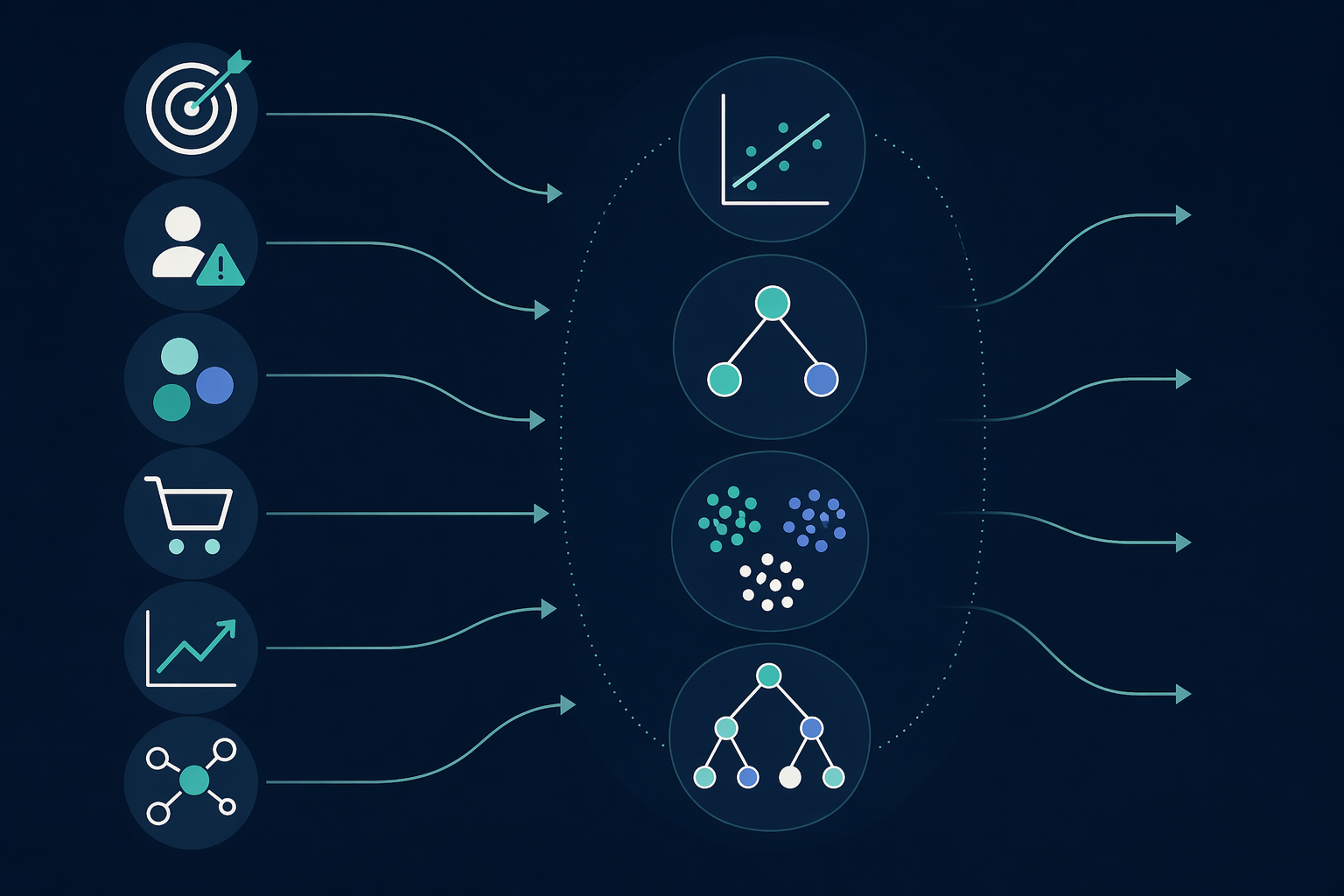
| Marketing problem | What the team needs | Recommended starting model | Why this is the sensible first choice |
|---|---|---|---|
| Lead scoring | Rank prospects by likelihood to convert or become qualified | Logistic regression | It predicts a binary outcome and can show which variables increase or decrease conversion probability. |
| Churn prediction | Identify customers at risk of leaving | Random forest or gradient boosting | Churn often involves nonlinear behavior patterns, but the model still needs feature importance and validation discipline. |
| Customer segmentation | Group customers by similarity when labels do not already exist | K-means clustering | It gives marketers usable segments based on behavioral or profile similarity without pretending the groups were known in advance. |
| Content or product personalization | Recommend the next best content, offer, or product | Collaborative filtering or recommendation systems | It uses patterns across users and items, which fits personalization better than a single static rule. |
| Sales or demand forecasting | Estimate future volume, revenue, or pipeline | Linear regression or time-series models | It provides a clear baseline before the team adds seasonal, channel, or external variables. |
| Sentiment analysis | Classify customer text as positive, negative, neutral, or topic-specific | NLP with bag-of-words or simple text classification | It can be enough for structured reporting when the goal is routing or trend detection rather than deep language understanding. |
| Ad bidding or offer testing | Shift spend toward better-performing options as results arrive | Multi-armed bandit | It balances exploration and exploitation in repeated decision environments. |
| Marketing attribution | Estimate how touchpoints contribute to conversion | Markov chains or Shapley values | They distribute credit across paths more thoughtfully than last-click rules, while still requiring careful interpretation. |
The table also shows why “use machine learning” is not a complete plan. Lead scoring, segmentation, bidding, and attribution are different jobs. They produce different outputs, use different data structures, and create different risks when they fail.
Lead Scoring: Start With Logistic Regression
Lead scoring is often the cleanest case for a simple model. The business question is usually binary: is this lead likely to convert, qualify, book a meeting, or become an opportunity? Logistic regression is built for that kind of outcome. It also gives the marketing and sales teams something they can inspect: which variables push the score up, which push it down, and whether the pattern makes business sense.
That last part matters. If a model says webinar attendance, company size, and recent pricing-page visits raise conversion probability, a sales leader can challenge or accept that logic. If a black-box system says “this account is hot” with no meaningful explanation, the burden shifts to the marketer to defend a recommendation they cannot fully explain.
Segmentation: Use Clustering Only When You Can Act On The Segments
Customer segmentation is a different problem because there may be no right answer in advance. The model is not predicting a known label. It is grouping customers by similarity. K-means is a reasonable starting point when the team has clean behavioral or profile variables and wants a manageable set of groups.
The trap is treating clusters as strategy. A cluster is only useful if the team can name it, understand it, and do something different for it. If the model produces five groups and nobody can explain how messaging, offers, cadence, or channel selection should change, the segmentation project has produced decoration, not leverage.
Churn Prediction: Complexity May Be Worth It, But Only With Discipline
Churn prediction is one of the places where moving beyond the simplest model can make sense. Customer attrition often depends on interaction patterns: product usage decline, support history, billing behavior, contract stage, engagement drop-off, and account characteristics. Random forests or gradient boosting can capture patterns that a linear model may miss.[1]
Even then, the operating question stays boring and important: what will the team do with the score? A churn model that triggers customer success outreach has a different error profile from one that triggers a discount. False positives can waste human time or give away margin. False negatives can allow preventable losses. The model choice should reflect those costs, not just a leaderboard accuracy number.
Forecasting: Build The Baseline Before The Showpiece
Forecasting is where teams are especially tempted to overbuild. A clean linear regression or time-series baseline can be more useful than a complex model if the real need is to explain expected pipeline, demand, or revenue movement to leadership. A forecast that clearly shows seasonality, campaign contribution, and historical trend is easier to challenge and improve.
More complex forecasting can be justified when the data is rich, the decision is frequent, and small improvements have meaningful financial value. But if the forecast will be reviewed in a monthly meeting by people asking why the number moved, a model that cannot explain its own drivers creates a second meeting before the first one is finished.
Why “Simplest That Works” Usually Wins
The case for simple models is not that they are always more accurate. They are not. The case is that marketing decisions usually require more than raw accuracy. Someone has to approve budget, change a workflow, defend a recommendation, or explain why a customer received one message instead of another.

An 80 percent accurate model that is fully explainable can be more useful than a higher-scoring black box when the decision affects spend, sales prioritization, customer treatment, or executive confidence.[1] The extra accuracy has to be worth the explanation tax. Sometimes it is. Often it is not.
Interpretability is not a soft concern. It changes adoption. A paid media manager can act on a model that says bids should rise for a segment because recent behavior, margin, and conversion probability support the move. A lifecycle marketer can use a churn risk score if the model shows that usage decline and support friction are driving the risk. A sales leader can accept a lead score when the top factors match experience or reveal a pattern worth discussing.
Opaque models make sense when the environment rewards speed, scale, and repeated optimization more than human explanation. Programmatic bidding is the obvious example. If a system makes high-volume decisions in real time and the performance lift is measurable, a more complex model can earn its keep. But that is a boundary case, not a universal argument for complexity.
Data Volume Is Usually The First Constraint
Many marketing teams do not have the data volume they imagine they have. They may have a large contact database, but only a smaller set of clean, recent, relevant examples for the exact outcome they want to model. A neural network does not become practical because the CRM has many rows. The question is whether the team has enough reliable examples of the specific behavior it wants to predict.
Deep learning methods generally require far more examples than linear methods, and the maintenance burden rises with that complexity.[1] Lumenalta’s discussion of machine learning challenges highlights related risks, including data requirements, bias, and overfitting.[4] Those are not abstract technical footnotes. They show up as models that perform well in testing, degrade in production, or quietly reproduce patterns the business would not defend if they were visible.
Prediction Is Not Proof
One of the most expensive mistakes in marketing analytics is confusing prediction with causation. A model can tell you that people who visit the pricing page are more likely to convert. It cannot automatically tell you that sending more people to the pricing page caused them to convert. It may be detecting intent that already existed.
This matters for budget. Prediction models are useful for ranking, routing, and prioritizing. Causal measurement requires lift testing, holdouts, experiments, or other designs that compare what happened against what would likely have happened without the intervention. If a team uses a predictive model as proof that a campaign caused revenue, it can shift money toward channels that merely touched customers who were already likely to buy.
Three Questions Before You Approve The Model
Before the team chooses an algorithm, it should answer three questions in plain language. If the answers are weak, the model will not be rescued by a better acronym.
- How much clean historical data do we have for this specific problem? Count the usable examples tied to the target outcome, not the total number of contacts, sessions, or events in storage.
- Does a stakeholder need to understand why the model made a recommendation? If the answer is yes, favor models that expose drivers, coefficients, feature importance, rules, or clear segment logic.
- What is the cost of being wrong? A false positive in a nurture campaign is not the same as a false positive that sends an expensive sales package, suppresses a customer, or changes bidding strategy.
The third question is where many model selection conversations finally become honest. Accuracy is an average. The business feels errors unevenly. A churn model that misses a high-value account may be worse than one that flags several low-risk accounts unnecessarily. A lead scoring model that buries a small number of excellent-fit accounts may damage pipeline even if its aggregate metrics look acceptable.
Where These Models Already Show Up In Marketing Work
The model families in this framework are not fringe methods. A bibliometric study indexed in PubMed Central found that machine learning applications in marketing research include methods such as regression, classification, clustering, neural networks, and related predictive approaches.[3] That matters because the practical recommendations here are not avoiding machine learning. They are choosing the parts of machine learning that fit ordinary marketing decisions.
Vendor examples can make the work easier to picture, as long as they are treated as examples rather than universal proof. Braze describes machine learning applications including send-time optimization, churn prediction, and personalization, with customer examples from brands such as OneRoof, Pizza Hut, and Walgreens.[5] Those are credible illustrations of how ML enters lifecycle and engagement work, but vendor-reported cases should not be read as a guarantee that the same implementation will produce the same outcome in a different data environment.
Send-time optimization, for example, can be thought of as a prediction problem wrapped inside a workflow decision: when is this person most likely to engage? Churn prediction asks which customers are at elevated risk before they leave. Personalization uses customer and item patterns to select the next message, product, or offer. None of those use cases requires marketers to worship the model. They require the team to define the decision, test the output, and monitor whether the system keeps helping.
How To Defend The Choice In A Stakeholder Review
A good model recommendation should be boringly defensible. It should connect the business problem, data reality, model output, and operating plan in a way that a non-specialist can inspect.
| Stakeholder question | Good answer |
|---|---|
| Why this model? | Because the business question matches its output: probability, segment, forecast, recommendation, bid allocation, or touchpoint credit. |
| Why not something more advanced? | Because the simpler model gives enough performance, needs less data, and can be explained and maintained by the team. |
| How will we know it works? | We will compare it against a baseline, monitor errors, and measure the business action it supports. |
| What happens when it is wrong? | We have identified the main error types and matched review, thresholds, or human approval to the cost of those errors. |
| Who owns it after launch? | A named team owns monitoring, retraining triggers, documentation, and workflow changes. |
The ownership question belongs in the model conversation from the start. A model that requires constant specialist support may still be the right choice for a high-value, high-volume system. It is a poor choice for a quarterly campaign workflow that the marketing operations team must maintain with limited technical help.
There is also no shame in starting with a baseline. A simple model gives the team something to beat. If logistic regression performs well enough for lead scoring and explains the drivers clearly, the case for complexity is weak. If it fails in known ways and a more complex model improves the decision enough to justify the extra support, then the team has a real reason to move up.
The Practical Rule
For most marketing teams, the right machine learning model is the simplest one that answers the business question. Start with the decision. Check the data. Decide whether the output must be explainable. Match the model’s error profile to the real cost of being wrong.
If the simple model works, use it. If it does not, move to something more complex for a specific reason: better handling of nonlinear patterns, real-time optimization, richer personalization, or measurable performance lift at scale. Complexity can be earned. It should not be assumed.
References
- A Marketer's Field Guide to Machine Learning, Domaleski, June 2026.
- Machine Learning in Marketing: A Guide (2026), Salesforce, 2026.
- Bibliometric study on machine learning in marketing, PMC, NIH.
- 13 benefits and challenges of machine learning, Lumenalta.
- Harnessing machine learning in marketing, Braze.
Comments
Join the discussion with an anonymous comment.