

Does a Limited Edition Sellout Damage Brand Loyalty?
Immediate limited edition sellouts can reduce repurchase intentions and hedonic brand value—contrary to popular belief. This article explains when scarcity backfires based on recent research and how to calibrate production for healthy brand loyalty.
The cleanest limited-edition dashboard is often the most dangerous one: inventory gone in minutes, social screenshots everywhere, leadership asking when the next drop can go live. In limited-edition product marketing, that moment is usually treated as proof that scarcity worked. The harder question is whether it worked for the next purchase, not just the launch-day recap.
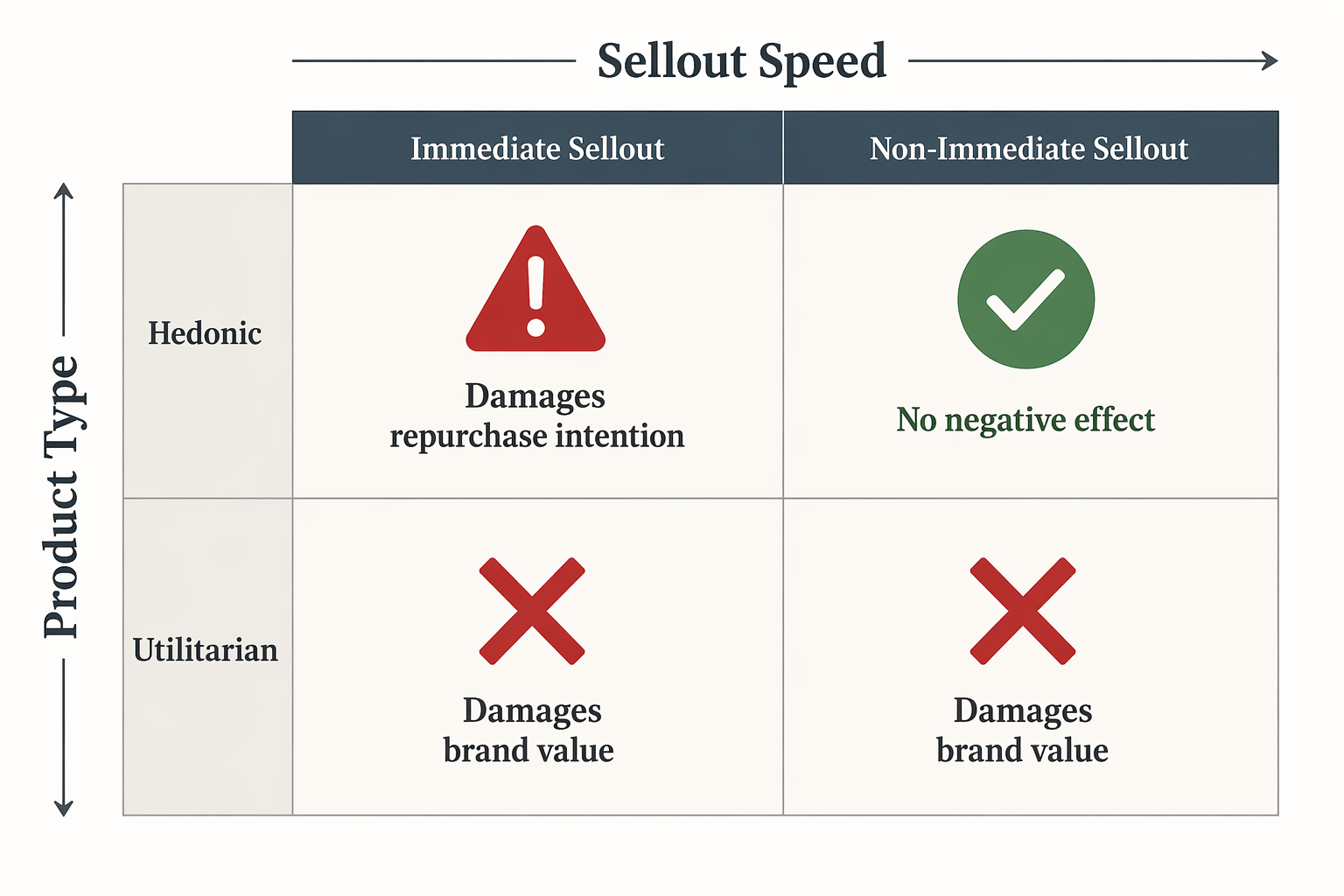
Recent research makes that question uncomfortable. A 2025 Journal of Retailing paper by Steiner, Hoyer, Krafft, and coauthors finds that immediate sellouts of hedonic limited editions reduce repurchase intentions and perceived hedonic brand value, while non-immediate sellouts of hedonic limited editions do not produce the same negative effect. For utilitarian limited editions, sellouts damage brand value regardless of whether the sellout is immediate or not.[1]
That does not mean scarcity is fake. It means “sold out” is too blunt a metric. A launch can create visible heat and still teach loyal customers that trying was pointless. A sellout can signal desirability to one group and exclusion to another. The same inventory outcome can mean very different things depending on what was sold, how quickly it disappeared, and whether customers felt they had a fair path to access.
A Sellout Is Not One Outcome
The important split starts with product type. Hedonic products are bought largely for pleasure, identity, taste, status, collecting, or emotional reward. Sneakers, fashion capsules, collectibles, beauty collaborations, and design-led accessories often sit here. Utilitarian products are bought primarily to solve a functional job: gear, tools, equipment, or everyday products where reliability and access matter more than the thrill of acquisition.
The distinction matters because customers do not interpret scarcity the same way across those categories. If a hedonic limited edition sells through after people have had a real window to participate, scarcity can preserve the feeling of specialness without turning the process into a punishment. If it vanishes instantly, the emotional signal changes. The customer who joined the waitlist, opened the app, refreshed at launch, and still got nothing may not read the event as proof of brand magic. They may read it as a brand wasting their effort.
For utilitarian limited editions, the tolerance is lower. When the product is primarily functional, a sellout is less likely to feel like a glamorous cultural moment and more likely to feel like failed availability. Steiner et al. find that utilitarian limited-edition sellouts hurt brand value regardless of speed.[1] That is the finding most likely to be ignored in a meeting where everyone is borrowing tactics from sneaker drops.
Why Immediate Hedonic Sellouts Can Backfire
A hedonic limited edition has room for scarcity because scarcity is part of the product experience. The product says something about taste, timing, belonging, or discovery. But that only helps if the customer still believes the brand offered a meaningful chance to buy.
An immediate sellout breaks that bargain. The customer did not simply decline to buy. They tried and failed. The campaign took their attention, created anticipation, and then converted that anticipation into frustration. The public story is “demand exceeded supply.” The private customer memory is “I was there and the brand still shut me out.”
That difference explains why the speed of sellout matters. In the Steiner et al. research, immediate sellouts of hedonic limited editions reduce repurchase intentions and the brand’s perceived hedonic value. Non-immediate sellouts do not cause that damage.[1] The lesson is not to make every limited edition widely available. It is to avoid designing scarcity so aggressively that the best customers experience the launch as unwinnable.
| Product and sellout pattern | What the evidence supports | Production implication |
|---|---|---|
| Hedonic limited edition, immediate sellout | Repurchase intentions and perceived hedonic brand value decline | Increase available supply, widen the purchase window, or use fair-access mechanics |
| Hedonic limited edition, non-immediate sellout | The same negative effect is not observed | Aim for controlled sell-through rather than instant disappearance |
| Utilitarian limited edition, any sellout | Brand value is harmed regardless of sellout speed | Avoid sellout-led scarcity as the core mechanic |
This is where the usual launch metric stack gets thin. Sellout time is easy to screenshot. Repurchase intention is harder to see immediately. Perceived brand value is even easier to miss because the customer may not complain; they may just skip the next release.
Scarcity Still Works, Just Not as a Blank Check
The broader scarcity literature still supports why marketers keep reaching for limited editions. A 2022 meta-analysis by Barton, Zlatevska, and Oppewal examined 416 effect sizes from 131 studies across 33 years of research and found that scarcity tactics increase purchase intentions overall. Supply-based scarcity had the largest effect on purchase intentions, followed by time-based scarcity and then demand-based scarcity; the reported effect sizes were g=0.58, g=0.43, and g=0.33 respectively.[2]
That finding is useful, but it answers a different question. It says scarcity can raise purchase intention. It does not say the most extreme version of scarcity is best for brand loyalty. It does not say every product should be engineered to sell out immediately. It does not erase the difference between getting someone to want an item and getting them to want to buy from the brand again.
The meta-analysis also found that supply-based scarcity has especially substantial effects for experiences compared with material goods.[2] That should make teams more precise, not more reckless. If scarcity is powerful, then the design of scarcity deserves the same discipline as pricing, merchandising, and retention.
The Production Target Is Controlled Scarcity
For a hedonic limited edition, the healthiest target is usually not “sell out as fast as possible.” It is “sell through after enough qualified demand has had a credible chance to convert.” That sounds less exciting in a launch room, but it is a better operating goal because it separates desirability from avoidable frustration.
A production plan for a hedonic drop should start with three demand pools: loyal customers who are likely to feel entitled to a fair shot, newer fans who are entering through the event, and casual spectators whose attention may never become purchase behavior. The mistake is to let the third group inflate the forecast while the first group absorbs the disappointment.
- If loyal-customer demand alone can exhaust supply instantly, the production quantity is probably too low for a hedonic brand-building drop.
- If the item remains available long enough for high-intent customers to complete the purchase journey, a later sellout can still preserve scarcity.
- If the campaign depends on customers losing repeatedly to create mystique, the brand is borrowing from future goodwill.
- If the product is utilitarian, production should be planned around service reliability rather than spectacle.
This does not require perfect forecasting. It requires deciding what kind of failure is acceptable. Overproducing a hedonic limited edition can dull exclusivity. Underproducing it so severely that serious customers never had a chance can damage the next cycle. The Steiner et al. finding points toward the middle: scarcity that is visible, but not instantly closed.[1]
Distribution Can Reduce Friction, Not Magically Remove It
When supply is genuinely constrained, distribution design becomes part of the product experience. Customers judge not only whether they got the item, but whether the process seemed fair.
Steiner et al. find that direct-to-consumer distribution using an app-plus-raffle approach reduces the negative effects of immediate sellouts, although it does not fully eliminate them.[1] That caveat matters. A raffle can shift the experience from “the site crashed and bots won” to “I entered a defined process.” It can also collect demand data and reduce checkout chaos. But a fairer disappointment is still disappointment, especially if the same loyal customer keeps losing.
A better access system usually has a few visible rules: eligibility is clear before launch, timing does not reward only the fastest click, bot resistance is credible, and customers know when they will receive an answer. For loyalty-sensitive audiences, brands can also separate access pools: one allocation for existing customers, one for public entrants, and one for retail or community partners. That is not a guarantee of happiness. It is a way to avoid making loyal customers compete blindly against the entire internet every time.
Utilitarian Limited Editions Need a Different Standard
The most common strategic error is importing hedonic drop logic into utilitarian categories. A limited colorway of a performance tool, a special version of a functional accessory, or a seasonal release of practical equipment may still attract attention. But if customers primarily evaluate the brand on usefulness and reliability, a sellout can weaken the very association the brand needs.
For utilitarian products, scarcity should be handled as a constraint, not a feature. If the item solves a practical problem, the brand should be cautious about making non-availability the center of the campaign. The safer move is often to limit customization, packaging, bundles, early access, or commemorative elements while keeping the core functional product available.
That preserves the signal a utilitarian brand usually wants to send: when customers need the product, the brand can deliver. A sellout may still happen, but it should not be the planned proof of success.
Brand Quality Is a Gate Before Scarcity
Limited editions do not automatically manufacture desire. Balachander and Stock find that limited editions generate purchase intention when offered by higher-quality brands. For lower-quality brands, consumers perceive the limited edition as the same product at a higher price, without a purchase-intention lift.[3]
That finding should sit early in any go/no-go discussion. If the base product is weak, if reviews are poor, if retention is already fragile, or if customers do not believe the brand has earned cultural permission to restrict access, a limited edition can look like price extraction wearing a nicer label.
For stronger brands, the question becomes calibration. For weaker brands, the question is whether scarcity is being used to avoid fixing the product. Customers are very good at noticing the difference.
New Fans Count, But So Does the Next Purchase
There is a real acquisition argument for limited drops. EQL, a commercial platform in the drop-management space, reports from more than 10,000 launches that 48% of entrants in limited-edition drops are new fans to the brand.[4] That is worth paying attention to, with the obvious caution that platform data reflects the company’s client base and commercial context.
The acquisition value changes the calculation, but it does not cancel the loyalty risk. A drop can bring new people into the funnel and still reduce repurchase intention among disappointed customers. The right question is not whether the campaign created new entrants. It is whether the value of those entrants exceeds the cost of frustration among people who already cared enough to show up.
That cost will not be evenly distributed. A casual entrant who loses a raffle may forget by dinner. A loyal customer who has bought from the brand for years may update their expectations permanently. The same failed attempt carries different emotional weight depending on the relationship that preceded it.
How to Calibrate a Limited Edition Without Chasing the Fastest Sellout
A practical launch decision should narrow in this order: product type, brand quality, desired customer mix, supply target, and access design. If the team starts with “How do we create FOMO?” it is already downstream of the more important questions.
| Decision point | Use this standard |
|---|---|
| Product type | Use sellout mechanics mainly for hedonic products; be far more cautious for utilitarian products. |
| Brand quality | Do not expect the limited-edition label to lift desire if customers do not already perceive the brand as high quality. |
| Sellout speed | For hedonic products, plan for controlled sell-through rather than immediate disappearance. |
| Customer access | Protect credible access for loyal customers before optimizing for public launch-day spectacle. |
| Distribution | Use app, raffle, or segmented allocation when they make the process feel fairer, while recognizing they cannot erase disappointment. |
| Measurement | Evaluate repeat purchase, sentiment, failed-checkout behavior, and future participation, not only sellout time. |
The measurement point is where many limited-edition postmortems go soft. A launch report that stops at sellout time, social reach, and revenue has not answered the loyalty question. It should also look at who failed to buy, whether they were existing customers, whether they returned for the next release, and whether customer service, social comments, app reviews, or email replies show a fairness problem.
For hedonic products, a healthy result may look less dramatic than an instant sellout: strong early demand, a purchase window that lets prepared customers complete checkout, visible scarcity by the end of the launch period, and no obvious evidence that loyal customers felt locked out by design. For utilitarian products, the healthier result may be no sellout at all, or a limited wrapper around a core product that remains easy to buy.
What the Evidence Does and Does Not Prove
The strongest sellout-backfire claim here rests on one recent multi-study paper. That is more serious than a single campaign anecdote, but it would still be stronger with independent replication across more categories, price points, and customer relationships. The finding should change how teams think; it should not be exaggerated into a universal law.
The narrower conclusion is strong enough for planning: do not treat the fastest possible sellout as the default goal. For hedonic limited editions, optimize for controlled scarcity that preserves perceived access. For utilitarian limited editions, avoid making sellout scarcity the central mechanic. For lower-quality brands, fix the quality problem before asking scarcity to create desire.
A limited edition should make customers feel that the product was special, not that the brand made participation futile.
References
- From rarity to desire: How introducing new limited editions, the immediacy of sellouts, and distribution strategies drive brand repurchase intentions — Journal of Retailing, 2025
- Scarcity tactics in marketing: A meta-analysis of product scarcity effects on consumer purchase intentions — Journal of Retailing, 2022
- Limited Edition Products: When and When Not to Offer Them
- How limited edition product drops can create lasting loyal communities — EQL, 2026
Comments
Join the discussion with an anonymous comment.