

Keep Your AI Marketing Content From Blending In
Learn why AI content tends to sound generic — and how to build brand voice rules into your AI workflow so your content stands out, not blends in. Backed by data showing 75% of marketers worry about brand uniformity from AI.
The most dangerous AI marketing draft is not the one with the obvious hallucination. It is the one that reads cleanly, hits the brief at a glance, and somehow sounds as if it could have been published by anyone.
The paragraphs are smooth. The benefits are plausible. The call to action is fine. No one in the approval chain can point to a single sentence that is wrong. But the piece has lost the fingerprints: the particular judgment, pacing, vocabulary, examples, boundaries, and product instincts that would make a reader recognize the brand behind it.
That is the practical problem with AI for marketing in 2026. The issue is not that AI cannot produce usable content. It clearly can. The issue is that, without stronger inputs, it tends to write toward the average. If a team scales that average fast enough, it does not get a stronger content engine. It gets a larger pile of competent sameness.
The Sameness Problem Is Showing Up in the Data
Smartly’s 2026 Digital Advertising Trends Report surveyed 450 marketing leaders and found that 75% were concerned about brand uniformity from AI-generated creative. The same report found that 86% had seen AI outputs resembling competitor content.[1]
Those figures should be handled with the right level of confidence. Smartly’s report is commissioned research, and the available methodology detail is limited beyond the stated sample size. It is not an academic finding about every marketing team in the market. Still, the numbers give shape to something many editors and brand managers already see in review queues: AI output can be fluent and off-brand at the same time.
The more operational warning is the measurement gap. Digital Applied reported that only 19% of content marketers track AI-specific KPIs, which means many teams are expanding AI-assisted production without measuring whether the work is getting more distinctive, more useful, or more recognizable.[2]
That is how brand voice becomes a casualty of productivity. The team celebrates faster drafts, shorter turnaround times, and more assets in the calendar. Meanwhile, the review criteria stay vague: “make it sound more like us,” “add personality,” “less generic,” “more premium,” “more human.” Those comments are familiar because they are often true. They are also hard to operationalize after the draft already exists.
Why AI Drafts Drift Toward the Middle
Generic AI content usually does not come from one bad prompt. It comes from a workflow that asks the model for polished output before it has been given enough brand-specific material to work with.
Large language models are useful because they can predict and assemble language patterns from broad training exposure. That same strength creates the default risk. If the prompt asks for a “friendly, professional, conversion-focused landing page” or a “thought leadership article for B2B buyers,” the model has an enormous supply of familiar patterns to draw from. Most of those patterns are not wrong. They are simply overrepresented.
The model reaches for the safest version of the category: the SaaS paragraph about unlocking efficiency, the ecommerce paragraph about elevating the experience, the travel paragraph about unforgettable moments, the agency paragraph about measurable growth. These lines survive because they are fluent. They fail because no one would miss them if a competitor published the same thing tomorrow.
Weak brand constraints make the problem worse. Many teams give AI a brand voice label rather than brand voice evidence. “Confident but approachable” is not much of an input. “Premium but not exclusive” is not much better. The model can imitate the average expression of those adjectives, but it cannot infer the specific tradeoffs your team has made unless those tradeoffs are documented.
Prompts also tend to reward the wrong thing. When the instruction is mostly about format, length, channel, and conversion goal, the model optimizes for completion and fluency. It gives the team a draft that looks finished. Distinctiveness requires different inputs: source examples, forbidden patterns, audience-specific assumptions, claims the brand will not make, metaphors the brand avoids, and standards for what “good” means in that channel.
This is where the AI conversation often becomes too vague. “Human review matters” is true, but incomplete. The more useful question is: review for what? Accuracy is one layer. Legal and compliance are another. Brand voice is not the decorative pass at the end. It is a set of production requirements that should shape the draft before the editor opens it.
Brand Voice Has to Become a System Input
A useful AI workflow does not ask a model to “sound like us” and hope the reviewer can clean up the residue. It gives the model structured material that narrows the possible output before generation starts.
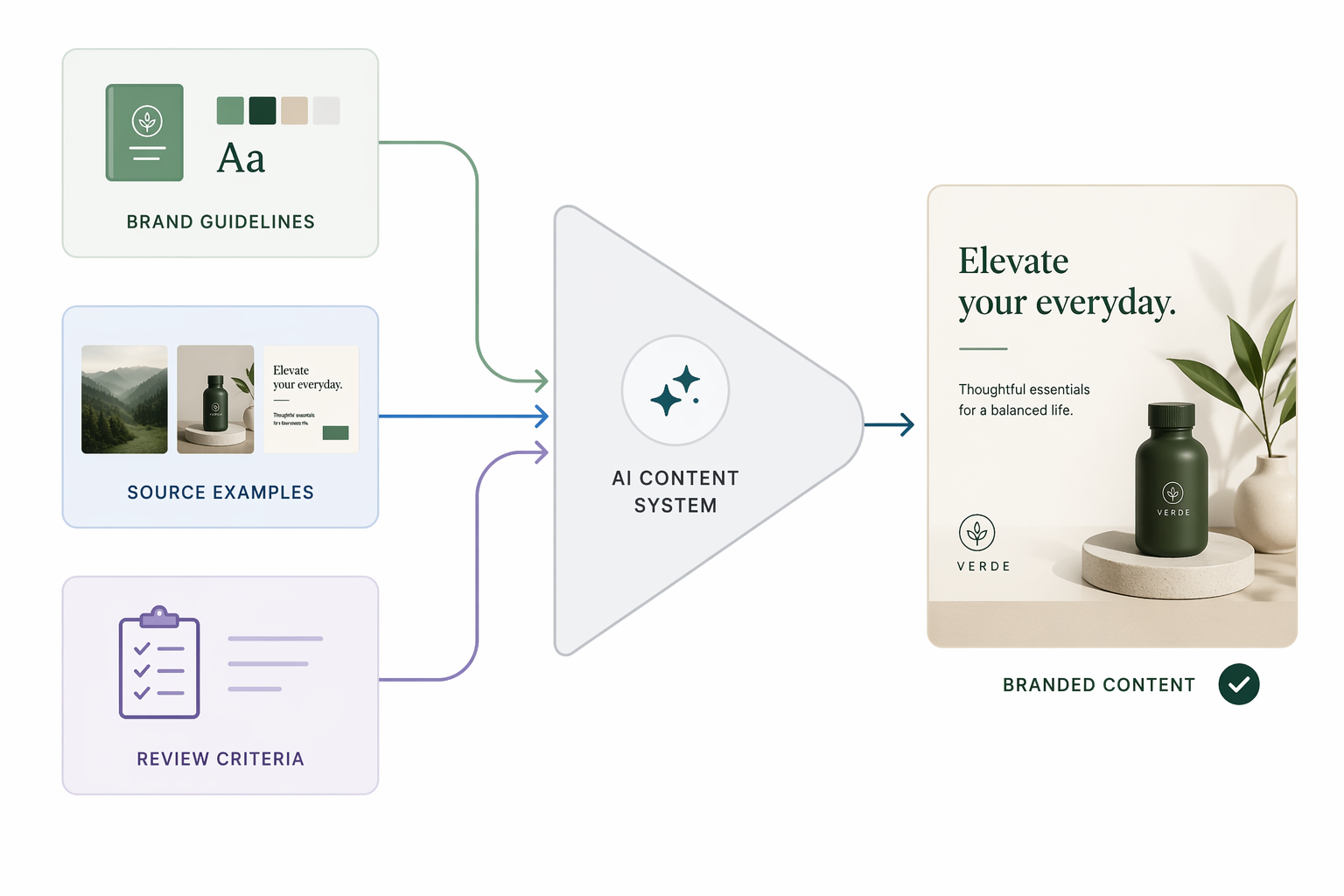
The most durable version of that workflow has three inputs: voice rules, source material, and review criteria. They sound basic until a team has to write them down. That exercise exposes whether the brand actually has an operating system for content or just a set of preferences held in the heads of senior reviewers.
| Workflow Input | What It Should Contain | What It Prevents |
|---|---|---|
| Voice rules | Specific patterns for tone, pacing, vocabulary, point of view, claim strength, and level of directness | Prompts that rely on vague adjectives like friendly, premium, bold, or human |
| Source material | Approved examples, product language, customer language, founder or executive phrasing, high-performing pages, and rejected examples | AI drafts built from category averages rather than brand evidence |
| Review criteria | Checks for recognizability, specificity, claim discipline, audience fit, channel fit, and competitive overlap | Editors making subjective comments that cannot be repeated or measured |
Voice rules need to be more concrete than a personality slide. If a brand is direct, what does that change in the sentence? Does it avoid setup paragraphs? Does it name the buyer’s tradeoff early? Does it reject inflated adjectives? Does it prefer operational language over emotional language? Those choices are small, but they are the texture of voice.
Source material matters because AI needs examples of what the brand has already decided. A good source set includes the obvious assets, such as positioning documents and approved website copy. It should also include less polished but more revealing material: customer interviews, sales-call language, product notes, executive edits, support tickets, and examples of drafts the brand rejected. The rejected examples are especially useful because they show the boundary between acceptable and almost-right.
Review criteria close the loop. If reviewers only mark factual errors, the team will gradually accept accurate but interchangeable content. If reviewers only mark tone, the team may produce lively copy that overclaims or drifts from positioning. A pre-publish review needs to ask whether the piece contains claims the brand can defend, examples the audience would recognize, and language a competitor would be unlikely to use in the same way. For a fuller review model, the pre-publish audit for AI content is a useful continuation.
Human Involvement Is Not a Percentage Problem
Shopify’s roundup of AI marketing statistics cites an informal industry guideline suggesting that at least 30% of the content workflow should remain human-led to protect authenticity.[3] As a heuristic, that is useful. It pushes against the fantasy of fully automated brand publishing.
But the number should not be treated as a proven threshold. Thirty percent human involvement can mean a strategist shapes the brief, an editor rewrites the argument, and a subject-matter expert sharpens the claims. It can also mean someone lightly scans the final draft before scheduling it. Those are not equivalent.
The better management question is where humans intervene. The highest-leverage points usually come before and after generation: defining the angle, selecting source material, setting voice constraints, checking claims, editing for specificity, and deciding whether the piece deserves to exist. Humans do not add value merely by touching the asset. They add value when they make judgments the model cannot responsibly make on behalf of the brand.
What Constrained AI Workflows Look Like in Practice
The more encouraging AI marketing examples are not the ones where a brand simply produces more assets. They are the ones where the AI system is constrained by brand standards early enough to affect the output.
Pragmatic Digital’s 2026 case studies describe Farfetch and Virgin Holidays using AI email optimization workflows that were constrained by explicit brand standards, rather than optimized only for open rates or generic performance targets.[4] These are vendor-published case studies, so they should not be read as independently verified proof that the same approach will produce the same outcome for every brand. Their value is more specific: they show the kind of workflow design that gives AI less room to flatten the brand.
For a premium fashion marketplace such as Farfetch, the risk is not only that AI copy could be inaccurate. It is that optimization pressure could slowly make luxury language sound like discount retail language. For a travel brand such as Virgin Holidays, the risk is that the copy could drift into the same dream-vacation phrases every competitor can generate. In both cases, the useful lesson is not “AI wrote emails.” It is that performance systems need brand boundaries.
That distinction matters. A model can test subject lines, restructure variants, and personalize copy while still staying inside a defined voice system. Or it can optimize toward whatever gets a short-term lift, even if the long-term effect is to train the audience to hear the brand as interchangeable. The workflow decides which version you get.
Teams looking for a more implementation-heavy version of this problem should continue into a brand voice governance framework for AI content, because the hard part is rarely agreeing that voice matters. The hard part is turning that agreement into prompts, source libraries, approval rules, and reusable checks.
Sameness Is No Longer Only a Copy Problem
The same pressure is moving into visual content. Forbes reported in 2025 that 71% of images shared on social media were AI-generated or AI-edited.[5] That figure combines fully generated and edited imagery, so it should not be read as a count of purely synthetic visuals. Still, it points to the larger issue: as AI enters more parts of the marketing system, brand sameness can compound across copy, layout, image style, and campaign concepts.
This does not require every content team to become a visual AI governance committee overnight. It does mean the copy team cannot treat voice as an isolated writing problem. If the headline sounds like the category average, the image looks like the platform average, and the landing page follows the same benefit stack as every competitor, the audience experiences the whole thing as generic even if each individual asset passes review.
What to Measure Before Scaling AI Content
AI detection is a poor proxy for brand quality. A piece can evade detection and still be empty. A heavily edited AI-assisted article can be useful, specific, and recognizably on-brand. The measurement question has to move away from whether AI was involved and toward what the work does in market.
Distinctiveness is harder to measure than output volume, but it is not impossible to inspect. Teams can track whether AI-assisted content uses approved source material, whether reviewers flag recurring generic phrases, whether claims are becoming more or less specific, whether subject-matter experts are making fewer late-stage corrections, and whether content from different product lines still sounds like it belongs to the same brand.
Competitive overlap deserves its own check. Before publishing an AI-assisted asset, compare the opening, promise, examples, and CTA against close competitors. If the brand name could be swapped without changing the substance, the draft is not finished. That is not a moral failure of AI. It is a sign that the workflow has not supplied enough proprietary material or editorial judgment.
For teams building a dashboard around AI-assisted content, the better signals often sit beyond detection scores: engagement quality, assisted conversions, branded search movement, sales-team usefulness, editorial rework rate, and expert correction rate. The measurement path in AI content detection is not a marketing strategy is the more relevant direction.
The Workflow Standard That Matters
A team is not ready to scale AI content confidently just because it has prompts, tools, and an approval process. It is ready when it can answer a few operational questions without improvising.
- Which voice rules are given to the AI before drafting, and are they specific enough to change the output?
- Which approved examples and source materials are used, and who maintains them?
- Which phrases, claims, structures, or tones are forbidden because they make the brand sound generic or misleading?
- Which review checks distinguish factual accuracy from brand distinctiveness?
- Which metrics show whether AI-assisted content is improving usefulness and recognition rather than only increasing volume?
If those answers live only in an editor’s head, the system will keep depending on rescue work. If they are embedded in briefs, prompts, source libraries, review rubrics, and measurement, AI can make distinctive content more repeatable instead of making average content easier to ship.
AI makes sameness easier when teams scale production without governance. It can also make brand standards easier to apply when those standards are treated as inputs, not afterthoughts. The difference shows up before the draft exists.
References
- Smartly 2026 Digital Advertising Trends Report, Smartly, https://www.smartly.io/digital-advertising-trends/2026
- AI Marketing Workflow Audit, Digital Applied
- 34 AI in Marketing Statistics, Shopify, https://www.shopify.com/blog/ai-marketing-statistics
- 7 AI Marketing Case Studies for 2026, Pragmatic Digital, https://www.pragmatic.digital/blog/ai-marketing-case-study-successful-campaigns
- Forbes 2025, Forbes
Comments
Join the discussion with an anonymous comment.